Pope Leo XIV's 'Magnifica Humanitas' encyclical on AI ethics
TECH

Pope Leo XIV's 'Magnifica Humanitas' encyclical on AI ethics

32+
Signals

Strategic Overview

  • 01.
    Pope Leo XIV released his first encyclical, 'Magnifica Humanitas,' on May 25, 2026 — a roughly 42,000-word, five-chapter document on safeguarding the human person in the age of artificial intelligence, signed on May 15, the 135th anniversary of Leo XIII's 'Rerum Novarum.'
  • 02.
    The text calls for AI to be 'disarmed' from logics of military and economic domination, declares classic 'just war' theory outdated in an age of algorithmic warfare, and denounces hidden labor exploitation behind AI systems as 'new forms of slavery.'
  • 03.
    In a historical first, Pope Leo personally presented the encyclical alongside Anthropic co-founder Christopher Olah — the first time an AI executive has helped unveil a papal encyclical — against the backdrop of Anthropic's ongoing legal fight with the Trump administration over military uses of its models.
  • 04.
    The document argues technology is never neutral, that AI tends to amplify the power of those who already hold data, capital and expertise, and that even a 'more moral AI' chosen by a small group remains illegitimate without shared, open ethical deliberation.

Deep Analysis

The Anthropic alliance: a safety-first lab adopted as Vatican co-presenter

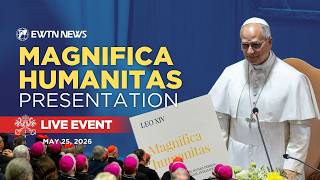
The most quietly extraordinary fact in the rollout is the stagecraft. For the first time in modern memory, a pontiff personally presented an encyclical rather than delegating to a cardinal, and the figure standing beside him was not a head of state or a moral philosopher — it was Anthropic co-founder Christopher Olah [1]. No AI executive has ever co-launched a papal encyclical before [2]. The Vatican chose this partner against a sharp political backdrop: in February 2026 the Trump administration ordered federal agencies to stop using Anthropic technology, and Anthropic is currently suing the administration over the dispute [1].

Reading the optics charitably, the Vatican is endorsing a posture — a frontier lab that publicly accepts that its 'incentives and constraints... can sometimes conflict with doing the right thing,' in Olah's words at the unveiling [3]. That sentence, delivered in front of the Pope, is a remarkable concession from a CEO-class figure, and it lines up almost paragraph-for-paragraph with the encyclical's claim that 'AI is not a morally neutral tool; it matters not only how it is used but how it is designed' [4]. The signal to the rest of the industry is uncomfortable: the Vatican is willing to confer moral legitimacy on labs that publicly accept the framing of constrained ethical agency, and to withhold it from those that don't. Whether that durably reshapes AI corporate behavior or simply gives Anthropic a one-off halo is the open question — but the choice of partner is itself a doctrine.
'Cultivated, not built': alignment-community vocabulary lands in papal teaching

Magnifica Humanitas is not the soft, hand-wavy ethics document many expected. The text describes modern AI systems as 'more cultivated than built' — language that reads like a frontier-lab research note, not curial Latin. It goes further still by naming the AI safety community's own term of art and then deliberately moving past it: alignment is necessary but not sufficient. A 'more moral AI is not enough if that morality is determined by a few,' the document argues, and it explicitly invokes 'the so-called alignment of AI with human values' before pivoting to insist on 'openly discussing the ethical frameworks involved and subjecting them to shared standards of social justice.'

This is one of the more technically literate statements on AI ever issued by a religious institution. It lands an argument the AI-safety community has been making internally for years: that whose values the model is aligned to is a political question, not just an engineering one. Anthropic's framing of AI unpredictability appears to have shaped parts of the text [5], and the encyclical's structure — chapters on AI's challenges, on truth, work and freedom (including 'new forms of slavery'), and on AI in warfare — treats the design layer as morally co-equal with the deployment layer [6].

Rerum Novarum, 135 years on: framing AI as the new labor question

The signing date is doing rhetorical work. Leo XIV signed Magnifica Humanitas on May 15, 2026 — exactly 135 years after Leo XIII signed Rerum Novarum on May 15, 1891 [7]. Rerum Novarum is the founding text of modern Catholic social teaching, written into a world where industrial machinery was reorganizing what work meant. The new Pope, choosing the same regnal name and the same date, is staking a claim that AI is the equivalent dislocation.

The document backs that framing up. A dedicated section on 'Breaking the chains of new forms of slavery' argues that 'every seemingly immediate and flawless response... relies on the silent work of millions of people' — the data labelers, content moderators, and mineral miners whose labor underwrites large language models [3]. The Pope places this against a market projection cited at the launch: AI value expected to reach $4.8 trillion by 2033, a 25-fold increase in a decade [3]. The Rerum Novarum echo is therefore not nostalgia. It is a deliberate move to push AI labor exploitation — currently a fringe topic in mainstream AI policy debate — into the same moral category as 19th-century factory conditions, addressed to roughly 1.4 billion Catholics worldwide [3].

Why secular tech communities are nodding along

The reception is the part nobody scripted. Discussions in mainstream tech and policy forums — not known for ecclesial deference — surfaced the most technically precise passages, the same lines about 'cultivated more than built' systems, alignment-by-the-few illegitimacy, and concentrated-power opacity that the AI-safety community has been circulating. The convergence is real: AI-safety researchers, secular tech readers, and Catholic social teaching are agreeing on the same diagnosis — concentration of AI power is a moral problem.

The encyclical phrases it as 'AI tends to amplify the power of those who already possess economic resources, expertise and data' [5], which is functionally the same critique that antitrust advocates and AI-safety researchers have been making in their own vocabularies. The contrarian voices are predictable but instructive: some readers argued that the Vatican itself is 'opaque,' and policy-focused skeptics cast the Pope as a tech-naive figure opining on the latest fads. That second critique is the more serious one — encyclicals do not bind governments, and the document calls for AI to be 'disarmed' from logics of military and economic domination [8], a near-impossible ask in the current geopolitical race. The Pope's bet is that moral framing precedes policy, not the other way around — and the cross-ideological reception is the first datum that the framing might travel further than the policy will.

Historical Context

1891-05-15
Issued 'Rerum Novarum' on labor and capital at the height of the industrial revolution — the founding document of modern Catholic social teaching. Leo XIV signed 'Magnifica Humanitas' on its 135th anniversary, deliberately framing AI as today's industrial-scale labor shock.
2015-05-24
Published 'Laudato Si' on care for the environment, broadening Catholic social teaching to planetary systems. Magnifica Humanitas is positioned as its AI-era continuation, applying the same integral-ecology logic to algorithmic systems.
2020-02-28
Launched the 'Rome Call for AI Ethics' with Microsoft and IBM (later joined by Cisco), laying the institutional groundwork the encyclical would build on.
2026-02
The Trump administration ordered federal agencies to stop using Anthropic technology; Anthropic sued. This live conflict is the political backdrop to the Vatican's choice of Anthropic's co-founder as launch partner.
2026-05-15
Signed 'Magnifica Humanitas' on the anniversary of Rerum Novarum; the document was unveiled publicly at the Vatican on May 25, with Anthropic co-founder Christopher Olah joining the Pope at the presentation.

Power Map

Key Players
Subject

Pope Leo XIV's 'Magnifica Humanitas' encyclical on AI ethics

PO

Pope Leo XIV

Author of 'Magnifica Humanitas'; positioning the Vatican as a leading moral authority on AI and framing AI as the defining moral test of the era.

CH

Christopher Olah, Anthropic co-founder

Joined Pope Leo at the Vatican unveiling — the first AI executive ever to help present a papal encyclical. His public framing of AI unpredictability and conflicting incentives appears to have shaped parts of the text.

AN

Anthropic (the company)

Vatican's chosen launch partner. Currently suing the Trump administration after federal agencies were ordered in February 2026 to stop using its AI; the choice is widely read as a moral endorsement of safety-first AI labs over rivals.

CA

Cardinal Víctor Manuel Fernández

Prefect of the Dicastery for the Doctrine of the Faith; named among the speakers at the encyclical's Vatican unveiling.

CA

Cardinal Michael Czerny

Prefect of the Dicastery for Promoting Integral Human Development; named as a co-presenter at the Vatican event.

BI

Big Tech / hyperscalers

Direct target of the encyclical, critiqued for concentrating economic, epistemic and political power and for asymmetric control of data — the document warns that AI 'amplifies the power of those who already possess economic resources, expertise and data.'

Fact Check

8 cited
  1. [1] Pope Leo XIV to launch his first encyclical, a document on artificial intelligence, with Anthropic's co-founder
  2. [2] Why Anthropic is helping unveil the Pope's new encyclical on AI
  3. [3] Pope urges 'disarming' of AI in major manifesto
  4. [4] Pope Leo XIV invokes justice to combat anti-human vision in AI
  5. [5] In his first encyclical, Pope Leo XIV says AI must serve humanity, not the powerful few
  6. [6] 13 things to know about Pope Leo's encyclical on AI
  7. [7] Pope Leo XIV's first encyclical Magnifica humanitas
  8. [8] Pope Leo XIV calls for AI to be 'disarmed', directed to the common good

Source Articles

Top 4

THE SIGNAL.

Analysts

"Likens AI to nuclear technology: it must be removed from logics of domination and oriented toward the common good. No algorithm, in his view, can morally justify war. Direct quote from the encyclical: 'Like nuclear energy, it must be at the service of all and of the common good.'"

Pope Leo XIV
Bishop of Rome

"Argues AI design itself, not just use, carries moral weight — a stance that puts model architecture, training data choices and corporate incentives inside the moral frame, not just deployment. The encyclical states: 'AI is not a morally neutral tool; it matters not only how it is used but how it is designed.'"

Pope Leo XIV
Bishop of Rome

"Identifies a 'technocratic paradigm' amplified by AI that risks normalizing an anti-human vision and reducing persons to optimization targets. The encyclical warns this 'threatens to normalize an antihuman vision.'"

Pope Leo XIV
Bishop of Rome

"Echoed the Pope's call for accountability and framed frontier AI labs as caught between commercial incentives and ethical duty, saying AI 'operates inside a set of incentives and constraints that can sometimes conflict with doing the right thing.'"

Christopher Olah
Co-founder, Anthropic
The Crowd

"JUST IN: Vatican announces that Pope Leo XIV's first encyclical — titled Magnifica Humanitas, on the safeguarding of the human person in the age of AI — will be presented at 11:30am on Monday, May 25, in the Vaticanʼs Synod Hall, in the presence of the Holy Father. Speakers at"

@@dianemontagna6681

"The questions posed by AI are bigger than the AI community. We urgently need the world – religions, civil society, academics, governments – to participate in creating a positive outcome. I'm glad the Catholic Church is engaging, and honored to speak at the presentation."

@@ch4021069

"A brief preview of Pope Leo XIV's first encyclical, "Magnifica Humanitas.""

@@JamesMartinSJ258

"Pope Leo Issues AI Encyclical Warning That 'Opaque Algorithms' Controlled by a 'Few' Companies Can Bring 'New Forms of Dehumanisation'"

@u/yourfavchoom4900
Broadcast
LIVE | Presentation of Pope Leo XIV's Encyclical Magnifica Humanitas from the Vatican | May 25, 2026

LIVE | Presentation of Pope Leo XIV's Encyclical Magnifica Humanitas from the Vatican | May 25, 2026

Pope's Leo XIV's Encyclical, Magnifica Humanitas | Interview with Lloyd Claycomb II

Pope's Leo XIV's Encyclical, Magnifica Humanitas | Interview with Lloyd Claycomb II

Pope Leo XIV's First Encyclical on AI "Magnifica Humanitas" — What to Expect

Pope Leo XIV's First Encyclical on AI "Magnifica Humanitas" — What to Expect