Memory chipmakers cross $1T on HBM scarcity
TECH

Memory chipmakers cross $1T on HBM scarcity

40+
Signals

Strategic Overview

  • 01.
    Micron Technology became the first U.S. pure-play memory firm to cross a $1 trillion market cap on May 26, 2026, after a 19% single-day jump triggered by a UBS upgrade that tripled its price target from $535 to $1,625.
  • 02.
    SK Hynix followed one day later on May 27, 2026, as shares jumped 12% to a record high and pushed the world's largest HBM supplier past $1 trillion in market value.
  • 03.
    Both companies have their entire 2026 HBM production sold out under multi-year contracts, and hyperscalers are now signing five-year supply agreements with 10-30% cash prepayments to lock in capacity.
  • 04.
    SK Hynix posted a Q1 2026 operating margin of 72% on $35.5B in revenue — higher than Nvidia's 65% — making the memory maker, on this metric, the most profitable name in the AI supply chain.

Deep Analysis

The valuation re-rating: memory is no longer pricing like a commodity

For thirty years, memory has been the textbook commodity semiconductor — three suppliers, deep boom-bust cycles, and equity multiples that compressed the moment prices peaked. In the past month that mental model has broken. Micron's market cap grew from roughly $108B in May 2025 to $1.01T in May 2026, a nearly 10x expansion in a single year [1]. SK Hynix shares are up around 250% year-to-date in 2026 after gaining 274% in 2025 [2]. The catalyst on May 26 was specifically a UBS note from Timothy Arcuri that tripled Micron's price target from $535 to $1,625, the highest on Wall Street, and explicitly argued the stock could more than double again [8]. Kang DaeKwun of Life Asset Management framed the move bluntly: memory chipmakers were 'irrationally undervalued' and a valuation gap recovery is now underway [5]. The community framing on r/stocks tracks the institutional read closely, treating HBM revenue as inference-infrastructure pricing power rather than the start of another DRAM cycle. The Q1 2026 margin profile — discussed below — is the specific anchor that lets analysts argue this is a structural re-rating instead of a peak-cycle blow-off.

The mechanism: take-or-pay contracts turn shortage into multi-year revenue visibility

The single most important structural change is contractual, not technical. Both SK Hynix and Micron have reported that their entire 2026 HBM production is already sold out, and shortages are projected to persist through 2027 [4][10]. SK Hynix's CFO first disclosed back in October 2025 that all 2026 HBM supply had been booked — the public confirmation that started the re-rating [3]. What changed in 2026 is that hyperscalers are now signing five-year supply agreements with 10-30% cash prepayments to lock in HBM capacity, a structure unprecedented in memory [2][9]. That converts what would normally look like a peak-cycle setup into something closer to a long-dated take-or-pay contract book. Micron is bringing new HBM capacity online via Singapore and Taiwan only in 2027, with a New York fab not arriving until 2030; SK Hynix is adding fabs in South Korea (2027) and the U.S. (2028) [9]. With ~90% of memory and effectively 100% of HBM controlled by three suppliers [2][12], the oligopoly is using lead times rather than spot pricing as the rationing mechanism — and getting paid up front for the privilege.

Margins are now the real story: a 72% operating margin in a commodity business

Margins are now the real story: a 72% operating margin in a commodity business
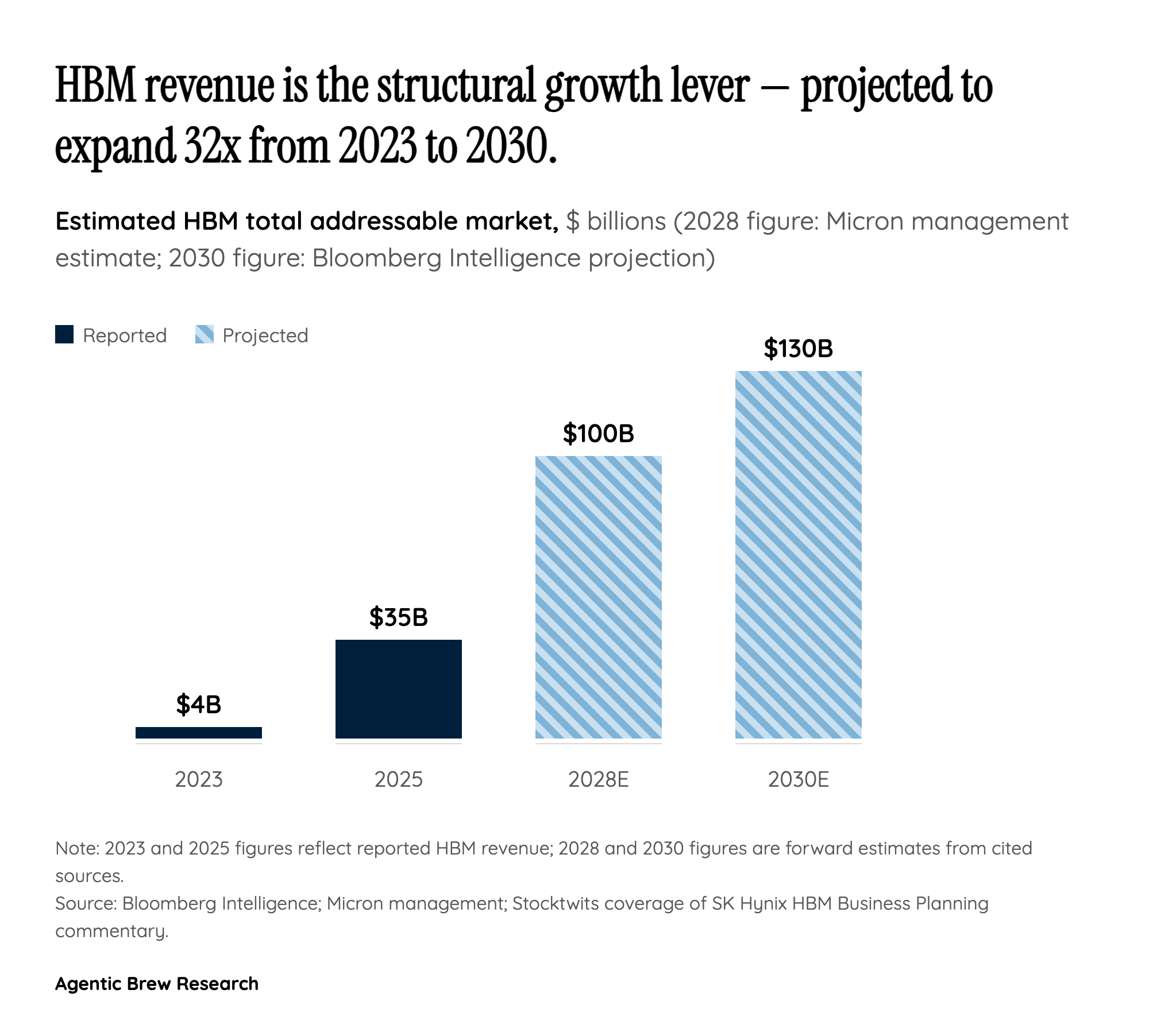
Estimated HBM total addressable market, $B. 2023 and 2025 reported; 2028E from Micron, 2030E from Bloomberg Intelligence.

The valuation re-rating ultimately rests on margins that look nothing like historical memory. SK Hynix posted Q1 2026 revenue of 52.58 trillion won (~$35.5B, +198% YoY) and operating profit of 37.61 trillion won (~$25.4B, +405% YoY), producing a 72% operating margin [6][7]. For comparison, Nvidia's most recent operating margin sat near 65% — meaning a memory company is, on this metric, the most profitable name in the AI supply chain. The underlying physics drives the gap: producing a bit of HBM requires roughly 3x the wafer capacity of DDR5, so every wafer mix shift toward HBM compounds tightness across the rest of the DRAM market [10][13]. HBM has gone from a ~$4B niche in 2023 to a projected $100B by 2028 per Micron management and ~$130B by 2030 per Bloomberg Intelligence [9][11]. Choi Joon-yong, who runs HBM Business Planning at SK Hynix, has gone out of his way to call the 30%-per-year HBM growth forecast through 2030 'conservative' rather than aggressive [11].

The non-AI cost: gaming GPUs, consumer DRAM, and a memory cartel narrative

The same dynamic that's minting trillion-dollar memory companies is now visibly squeezing the rest of the market. HBM consumes roughly 23% of total DRAM wafers, and the wafer reallocation is pushing standard DRAM pricing higher across PCs, smartphones, and consumer electronics [14]. The most striking signal: Nvidia has skipped a 2026 gaming GPU launch for the first time in roughly three decades, with available HBM and packaging capacity redirected entirely to data-center accelerators [10]. The Reddit reaction on r/pcmasterrace is openly hostile, with users describing the dynamic in cartel language as consumer DRAM prices spike. The market structure backs that framing up — three suppliers control ~90% of DRAM and effectively 100% of HBM [2][12], and Samsung's labor strike has only concentrated allocation further by pushing orders toward SK Hynix and Micron [3].

What would break the thesis: the cycle nobody wants to remember

Every previous memory super-cycle has ended the same way: capacity arrives, demand normalizes, prices crater. After roughly 50 fabs were announced in 1995-96, DRAM prices crashed 51% in 1996 and 65% in 1997 [15]. As recently as January 2023, the $160B memory-chip sector suffered one of its worst routs ever despite repeated industry vows to escape boom-and-bust [16]. A skeptical strand of the r/stocks discussion compresses that history into one line — memory remains a cyclical commodity, Chinese memory production is coming, and HBM offers no durable value-add beyond manufacturing scale. The structural-shortage thesis has to survive 2027-2028 capacity additions from both Micron and SK Hynix, plus Samsung's HBM3E qualification ramp — currently slowed by labor disruption — eventually re-entering the supply mix [3]. The bull counter is that long-dated take-or-pay contracts with hyperscaler prepayments have already absorbed the next-cycle capacity, which would smooth out the historical whipsaw. The next eighteen months — and specifically whether HBM4 yields and Samsung's qualification timing tighten or loosen the oligopoly — will decide which framing was right.

Historical Context

1995-1997
After ~50 fabs were announced in 1995-96, DRAM prices peaked in late 1995 and then crashed 51% in 1996 and another 65% in 1997 — the canonical memory bust that still anchors how investors price the sector.
2023-01
The $160B memory-chip sector suffered one of its worst routs ever despite years of industry vows to escape boom-and-bust, underscoring how cyclical the segment had been right up to the AI era.
2023-12
HBM was a roughly $4B market in 2023; Bloomberg Intelligence projects ~$130B by 2030, a ~32x expansion that reframes HBM from a niche DRAM variant into the primary growth vector for the entire memory industry.
2025-10
SK Hynix's CFO disclosed that all 2026 HBM supply was already sold — the first public confirmation of the multi-year shortage that triggered the subsequent re-rating.
2026-01-20
Unveiled 16-layer HBM4 at CES 2026, cementing its technical lead heading into the Nvidia Rubin platform cycle.
2026-05-26
Crossed $1T market cap after a 19% single-day surge triggered by a UBS upgrade that tripled its price target.
2026-05-27
Crossed $1T market cap one day after Micron, making South Korea the first non-U.S. country to host two trillion-dollar companies simultaneously.

Power Map

Key Players
Subject

Memory chipmakers cross $1T on HBM scarcity

SK

SK Hynix

World's largest HBM supplier with 57-62% global share; sold out of 2026 HBM capacity and expected to dominate HBM4 supply for Nvidia's Rubin platform.

MI

Micron Technology

First U.S. pure-play memory firm to reach $1T; 2026 HBM supply locked under binding contracts; committing roughly $200B to expand memory capacity through 2030.

SA

Samsung Electronics

Third HBM supplier (~22% share) working through an HBM3E qualification ramp, but a labor strike has redirected orders to SK Hynix and Micron.

NV

Nvidia

Single largest HBM buyer; B200 GPUs use 192GB of HBM3E (a DGX B300 needs 768 dies), and Nvidia is sourcing next-gen HBM4 for Rubin from all three memory makers.

HY

Hyperscalers (Microsoft, Google, Amazon, Meta)

Locking up future HBM capacity through unprecedented five-year supply agreements with 10-30% cash prepayments, converting today's shortage into multi-year visibility for memory vendors.

UB

UBS (Timothy Arcuri)

Tripled Micron's price target from $535 to $1,625 — the highest on Wall Street — providing the immediate catalyst that pushed MU past $1T.

Fact Check

16 cited
  1. [1] Micron Trillion Market Cap on AI Demand
  2. [2] Micron and SK Hynix Trillion-Dollar Chip Boom
  3. [3] SK Hynix HBM AI Nvidia Market Cap, Samsung Strike Memory Shortage, ADR Listing
  4. [4] SK Hynix Stock Jumps 12% as AI Chip Demand Pushes Market Cap to $1 Trillion
  5. [5] SK Hynix Joins $1 Trillion Club on AI Memory Chip Dominance
  6. [6] SK Hynix Q1 2026 Earnings
  7. [7] SK Hynix Q1 2026 Results
  8. [8] Micron Reaches $1 Trillion Market Cap Following Major UBS Upgrade
  9. [9] Micron 2026 HBM Supply Locked, Binding Contracts and Memory Cycle
  10. [10] HBM Supply Crisis 2026: The Bottleneck Redefining AI
  11. [11] Advantage Micron — SK Hynix Sees HBM Chip Sales Growing 30% Every Year Through 2030
  12. [12] Global DRAM and HBM Market Share
  13. [13] HBM Is Eating Your RAM
  14. [14] Memory Chip Shortage 2026: AI's Spillover Into Consumer Electronics
  15. [15] Every Memory Cycle Ends the Same
  16. [16] Memory Chip Sector Suffering Rout Despite Vows to Escape Boom-Bust Cycle

Source Articles

Top 5

THE SIGNAL.

Analysts

"Argues memory chipmakers were irrationally undervalued and that a valuation re-rating is now underway as the market reprices them alongside AI infrastructure peers."

Kang DaeKwun
Chief Investment Officer, Life Asset Management

"Says end-user AI demand is firm enough that HBM should grow at roughly 30% annually through 2030, and characterizes that forecast as conservative rather than aggressive."

Choi Joon-yong
Head of HBM Business Planning, SK Hynix

"Raised Micron's price target to $1,625 from $535, arguing shares could more than double again over the next year on HBM pricing power and locked-in supply."

Timothy Arcuri
Analyst, UBS

"Expects HBM supply tightness to continue and views a potential SK Hynix U.S. ADR listing as an additional catalyst that would broaden the investor base."

Barclays Research
Sell-side equity research, Barclays

"Projects the HBM market will grow to roughly $130B by the end of 2030, up from $4B in 2023 — a ~32x expansion driven entirely by AI accelerator demand."

Bloomberg Intelligence
Equity research desk, Bloomberg
The Crowd

"$MU - MICRON TECHNOLOGY HITS $1 TRILLION MARKET VALUE FOR THE FIRST TIME"

@@DeItaone819

"South Korea's SK Hynix became just the third Asian company to join the $1 trillion club as a breakneck surge in memory-chip stocks and an AI frenzy reshapes economies worldwide. @SheryAhnNews explains."

@@business103

"OK so memory just crossed the trillion-dollar line for the first time. HBM sold out through 2026 plus Q2 guidance at 68% gross margin reads as inference-infrastructure pricing power. The old commodity DRAM cycle would never have priced like this."

@@DoDataThings0

"Micron hits $1 trillion market cap for the first time"

@u/WickedSensitiveCrew979
Broadcast
If You Hold Nvidia SKHynix Micron Stock (NVDA) .. GET READY HBM GROWTH

If You Hold Nvidia SKHynix Micron Stock (NVDA) .. GET READY HBM GROWTH

Micron and Nvidia Investors Need to See This HBM Update!

Micron and Nvidia Investors Need to See This HBM Update!

Sign of the Times: Micron Hits $1 Trillion Market Cap

Sign of the Times: Micron Hits $1 Trillion Market Cap