Apple trains its own China-specific AI model with Alibaba's backing
TECH

Apple trains its own China-specific AI model with Alibaba's backing

25+
Signals

Strategic Overview

  • 01.
    Apple has trained its own proprietary large language model for the China market rather than relying solely on a third-party model, making it the first foreign company approved by Chinese regulators to deploy its own AI model in the country.
  • 02.
    China's Cyberspace Administration formally approved Apple Intelligence in mid-July 2026, about two years after its original launch elsewhere, under a dual-track structure that pairs Apple's own model with Alibaba's Qwen and Baidu's technology.
  • 03.
    The initial license reportedly covers iPhone only, leaving open whether iPad and Mac in China get the same AI features on the same timeline.
  • 04.
    Of seven AI services approved in this regulatory batch, only Apple and Samsung were foreign companies; the other five approvals went to domestic vendors including Huawei, Oppo, Vivo, Xiaomi and ZTE.

Deep Analysis

The Dual-Track Compromise: How Apple Split Its China AI Stack

Apple has trained its own large language model for the China market rather than relying on a third-party model as it does in the rest of the world [1], a move that makes it the first foreign company the Chinese government has approved to offer a proprietary AI model inside the country [1]. China's Cyberspace Administration formally registered the service in mid-July 2026, closing out a roughly two-year gap since Apple Intelligence's original launch elsewhere [2]. What regulators actually approved is not a single model but a three-way arrangement - commentators have called this dual-track approach highly unusual for a foreign company operating in China [3].

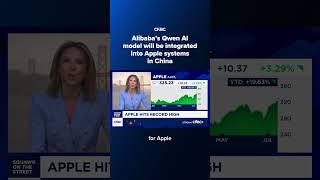
In practice, the stack layers three pieces on top of each other. Alibaba's Qwen model is integrated into Apple Intelligence across iOS, iPadOS, macOS and visionOS for Chinese users, covering text and image understanding and generation [4]. Baidu, meanwhile, is separately working with Apple on complementary features that reportedly handle search-related functions [2]. Sitting alongside both is Apple's own proprietary model, which by outside reporting has involved compressing Alibaba's open-source Qwen technology down to roughly 4GB so it can run on-device on an iPhone. Notably, the CAC's initial license appears to apply only to iPhone, leaving open whether iPad and Mac get the same treatment on the same timeline [2]. Apple even briefly published, then pulled, a support document describing how to connect Siri to Qwen as an extension - similar to its existing ChatGPT hookup - shortly before the fuller story of its own in-house model broke [1].
Is It Really Apple's Own Model? The Distillation Question Hanging Over Cupertino

The most pointed reaction to this story hasn't been celebration - it's skepticism about what 'Apple's own model' actually means. Community discussion has zeroed in on whether the China model is genuinely Apple-built or effectively a version of Qwen refined through post-training and distillation, drawing a direct parallel to how Apple's globally-shipped Apple Foundation Model is widely believed to be distilled from Google's Gemini, with critics pointing to Apple's own ambiguous newsroom phrase describing that model as 'custom-built in collaboration with Google and its Gemini models.' The China situation reopens the same unresolved question under a different regulator.

That skepticism has a documented backstory. Apple didn't start with Alibaba - Baidu was originally its primary China AI partner, but Baidu's model progress reportedly fell short of Apple's requirements, which is what pushed Apple to bring in Alibaba's Qwen as the leading model and to train a proprietary system of its own for greater control [5]. Alibaba Chairman Joe Tsai publicly confirmed the partnership as early as February 2025, noting Apple had evaluated multiple Chinese firms - including Baidu, ByteDance and Tencent - before settling on Alibaba [3][10]. Whether the eventual China-only model is closer to an Apple original or a heavily Alibaba-assisted derivative remains, by outside accounts, an open question rather than a settled fact - and it's the same open question that has followed Apple's AI strategy globally.

Washington's Unease: Apple Caught in a Trump-Era Tech Realignment

The Alibaba tie-up hasn't only drawn scrutiny from Beijing - it has drawn it from Washington too. US officials have reportedly examined the arrangement out of concern that it could help a Chinese company advance its own AI capabilities, extend the reach of Chinese chatbots subject to local censorship rules, and deepen Apple's legal exposure to Beijing's regulatory regime [6]. That scrutiny has been framed by some commentary as part of a broader political moment in which defense-aligned US tech companies are gaining favor in Washington while a China-entangled Apple draws pointed questions.

Markets, for their part, reacted differently than politicians did. Alibaba's US-listed shares rose roughly 4% following the July 2026 CAC approval, and both Apple and Alibaba shares were reported to have risen on news of the wider AI partnership [7][8]. The gap between Washington's wariness and Wall Street's short-term enthusiasm is itself a signal: investors are pricing the deal as a near-term unlock for a stalled China business, while policymakers are weighing a longer-run precedent about how much access a Chinese partner should have to Apple's AI stack.

Why Now: Huawei's Resurgence and the Cost of a Two-Year Wait

None of this compromise makes sense without the competitive backdrop. Apple has slipped in China's smartphone market as domestic rivals, led by a resurgent Huawei, ship devices with built-in AI assistants that Chinese iPhones couldn't match while Apple Intelligence sat in regulatory limbo. That absence has had a real commercial cost: Apple's Greater China sales reached $20.5 billion in Q2 2026, up 28% year-over-year, and the company had only recently regained the No. 2 position in China's smartphone market [4]- gains it has needed to defend as the AI gap narrowed the appeal of new iPhone models. The wait itself was long by any standard: roughly 22 months passed between Apple Intelligence's original launch elsewhere and its China approval [4].

The upgrade-cycle data makes the stakes concrete. Morgan Stanley analyst Erik Woodring found that over half of Chinese iPhone owners cited the staggered rollout of Apple Intelligence as having a moderate-to-significant impact on their decision not to upgrade this cycle [9]. Reporting on Apple's own public comments has also linked markets where Apple Intelligence did roll out to comparatively stronger iPhone 16 year-over-year performance. Read together, the dual-track Alibaba arrangement looks less like a strategic flex and more like the compromise Apple judged necessary to stop ceding further ground to Huawei in a market it can't afford to lose.

Historical Context

2025-02-13
Alibaba Chairman Joe Tsai publicly confirmed that Apple's iPhones would use Alibaba's AI in China, first surfacing the partnership.
2026-07-15
CAC approved Apple Intelligence for launch in China via partnerships with Alibaba's Qwen and Baidu, roughly 22 months after Apple Intelligence's original launch elsewhere.
2026-07-16
A Baidu spokesperson confirmed it is also working with Apple on Apple Intelligence features for Chinese users.
2026-08-10
Apple briefly published then removed a support guide for connecting Siri to Alibaba's Qwen model as an extension, similar to its ChatGPT integration.
2026-08-14
Reports revealed Apple had separately trained its own proprietary China-specific LLM with Alibaba's support, making it the first foreign firm Beijing approved to run its own AI model.

Power Map

Key Players
Subject

Apple trains its own China-specific AI model with Alibaba's backing

AP

Apple

Trained its own China-specific LLM and secured Beijing's first-ever approval of a foreign company's proprietary AI model, trading some control for regulatory access in its largest overseas market.

AL

Alibaba Group (Qwen)

Supplies the Qwen model folded into Apple Intelligence across iOS, iPadOS, macOS and visionOS in China, having been chosen over Baidu, ByteDance and Tencent after Apple evaluated multiple domestic partners.

BA

Baidu

Secondary partner now handling reportedly search-related AI features after its earlier role as Apple's primary China partner fell short of Apple's standards.

CY

Cyberspace Administration of China (CAC)

The regulator whose approval is the gating step for any public AI rollout in China; its July 2026 registration ended a roughly two-year wait and set the dual-track terms Apple had to accept.

HU

Huawei

Domestic rival whose AI-enabled devices and market-share gains in China are the competitive pressure widely cited as pushing Apple toward this arrangement.

Fact Check

10 cited
  1. [1] Apple Trained Own AI Model for China, Sources Say
  2. [2] China Approves Apple Intelligence for Phones, With Alibaba, Baidu as Emerging Partners
  3. [3] Apple Trains Proprietary AI Model for China Alongside Alibaba
  4. [4] Apple Intelligence Approved for Launch in China With Alibaba's Qwen AI
  5. [5] Alibaba Snags Deal to Power AI on Apple's iPhones in China
  6. [6] Trump Administration Is Concerned by Deal to Put Alibaba's AI on iPhones, NYT Reports
  7. [7] Apple's China AI Model Is a Concession Dressed Up as Strategy
  8. [8] Apple (AAPL) and Alibaba (BABA) Shares Rise on Reports of Chinese AI iPhone Partnership
  9. [9] Apple Cracks China With Alibaba for iPhone AI
  10. [10] Apple's iPhone Will Use Alibaba AI in China, Joe Tsai Says

Source Articles

Top 4

THE SIGNAL.

Analysts

Found that over half of Chinese iPhone owners cited the staggered rollout of Apple Intelligence as a moderate-to-significant factor in deciding not to upgrade this cycle, underscoring the commercial stakes behind the China AI push.

Erik Woodring
Analyst, Morgan Stanley

Frames the arrangement as a concession dressed up as strategy - Apple built a China-only model to Beijing's rules and leaned on Alibaba and Baidu for the parts it couldn't build alone, illustrating the terms under which Western tech is permitted to operate in China.

TheNextWeb tech commentary
Tech commentary/analysis
The Crowd

🇺🇸🇨🇳 Apple has trained its own AI model specifically for China, with help from Chinese tech giant Alibaba. It's a remarkable workaround to China's AI restrictions: ChatGPT and Claude aren't available there, so Apple is building a separate AI ecosystem for Chinese iPhones while [...]

@@MarioNawfal217

🇺🇸🇨🇳 Apple built its own LLM for China with Alibaba's technical backing, ditching its earlier plan to simply license Baidu's existing model. This gives Apple direct control over its AI stack in its second-largest market, where regulatory approval from Beijing is non-negotiable

@@MarioNawfal78

EXCLUSIVE: Apple trains its own AI model for China market with Alibaba's support, sources say

@@Reuters71

Apple Intelligence Finally Cleared to Launch in China

@u/pdfu303
Broadcast
Alibaba's Qwen AI model will be integrated into Apple systems in China

Alibaba's Qwen AI model will be integrated into Apple systems in China

Apple just embraced Chinese AI

Apple just embraced Chinese AI

Apple faces U.S. backlash over Alibaba China AI deal

Apple faces U.S. backlash over Alibaba China AI deal