Meituan releases LongCat-2.0 open-source 1.6T MoE model
TECH

Meituan releases LongCat-2.0 open-source 1.6T MoE model

22+
Signals

Strategic Overview

  • 01.
    On June 30, 2026, Meituan open-sourced LongCat-2.0, a 1.6-trillion-parameter Mixture-of-Experts model that activates roughly 48 billion parameters per token and reads up to a million tokens of context natively via LongCat Sparse Attention.
  • 02.
    The weights are released under the permissive MIT license on Hugging Face, GitHub, and ModelScope, with INT8 and FP8 variants plus OpenAI- and Anthropic-compatible endpoints for agentic harnesses like Claude Code, OpenClaw, and Hermes.
  • 03.
    LongCat-2.0 is the same engine that had been quietly topping OpenRouter's developer charts for about two months under the stealth codename Owl Alpha.
  • 04.
    Meituan says the full pretraining run and large-scale deployment happened on a roughly 50,000-card cluster of domestic Chinese chips, making it the first trillion-parameter model trained end-to-end without top-end Nvidia hardware.

A delivery company just broke the Nvidia-or-nothing assumption

The most disruptive fact about LongCat-2.0 is not its size but its supply chain. Meituan says the full pretraining run and large-scale deployment were completed on a roughly 50,000-card cluster of domestic Chinese chips, making it the first trillion-parameter model trained end-to-end on local hardware [5]. The company processed more than 30 trillion tokens through that stack - upward of 35T across training and deployment validation - without top-end Nvidia GPUs [6]. For an industry that has treated access to restricted American silicon as the gating factor for frontier work, that is a direct counterexample. The Geopolitechs analysis frames the shift bluntly: the binding constraint has moved to whether domestic hardware plus systems engineering can carry a serious model, and 'frontier-scale AI work can emerge from places that American policy and foreign investors were not watching closely enough' [6]. It is worth holding one caveat firmly, though. Meituan has claimed full domestic-chip training but has not disclosed which chips, so the headline cannot be independently verified [6]. The community filled that vacuum with guesses - Huawei's Ascend line is the popular bet - but skeptics on r/LocalLLaMA pushed back that this looks like 'good enough' mature-process silicon rather than cutting-edge parity, pointing to interconnect speeds well below the InfiniBand fabrics Western labs run. The signal is real; the exact hardware story is still partly a black box.
The pricing trick that rewrites agent cost math

Agents are expensive for a boring reason: they read the same codebase, system prompt, and tool definitions over and over, and every iteration round re-bills that context. LongCat-2.0 attacks this directly with a cache-hit-free mechanism - cached input-prefix reads are simply not charged [7]. Layer that on top of already-aggressive per-token pricing (standard rates around $0.75 per million input and $2.95 per million output tokens, with a promotional tier near $0.30 and $1.20, roughly 6-7x cheaper input and 10x cheaper output than GPT-5.5) and the economics of deep iterative exploration change shape [7]. Cost no longer compounds linearly with the number of interaction rounds, which is exactly the failure mode that makes long agent sessions painful today. Developers quoted via PANews called it a move that 'changes the economics of Agent costs' [7]. For teams running agents that grind through a large repository across dozens of turns, free cached reads plus a sub-frontier price tag is a more consequential lever than a point or two on a benchmark.

How LongCat Sparse Attention buys a native million-token window

A 1-million-token context is the headline feature, and LongCat Sparse Attention (LSA) is the mechanism that makes it affordable. Standard attention scales quadratically with context length; LSA selects only the most relevant tokens, dropping that cost closer to linear [3]. The design stacks three orthogonal improvements - Streaming-aware Indexing, Cross-Layer Indexing, and Hierarchical Indexing - to decide which tokens actually matter at each layer [2]. On r/LocalLLaMA, practitioners read LSA as an evolution of DeepSeek Sparse Attention paired with a 3-step multi-token-prediction path for speculative decoding and roughly 97% MoE sparsity per token, which fits the picture of a giant model that only ever lights up about 48 billion of its 1.6 trillion parameters at a time [1]. The practical payoff is coherence over very long inputs - the same property that let it hold up as a coding agent chewing through entire repositories.

By the numbers: topping GPT-5.5 on SWE-bench Pro while running as a stealth model

By the numbers: topping GPT-5.5 on SWE-bench Pro while running as a stealth model
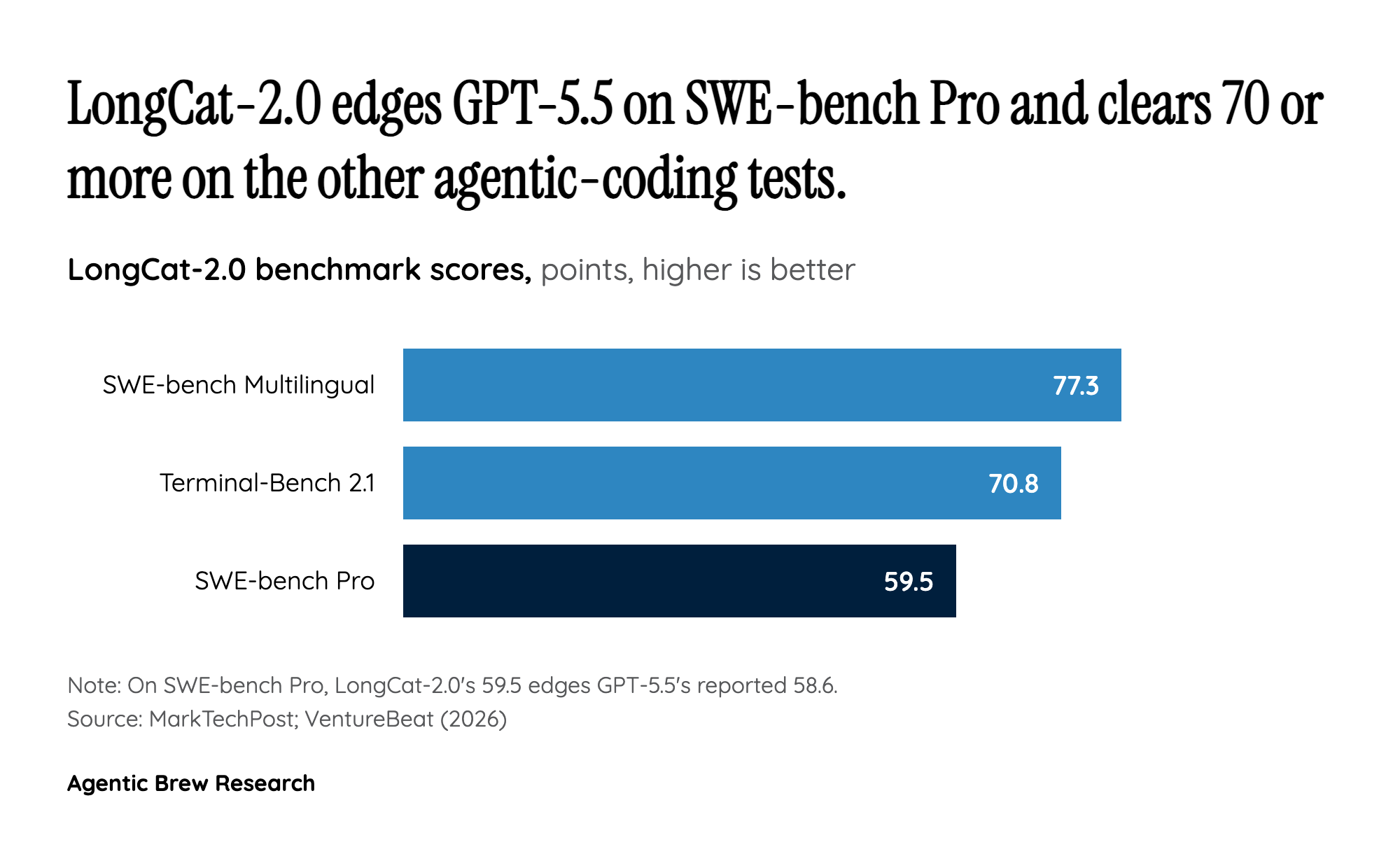
LongCat-2.0 agentic-coding benchmark scores: SWE-bench Multilingual 77.3, Terminal-Bench 2.1 70.8, SWE-bench Pro 59.5 (edging GPT-5.5's 58.6).

The benchmark sheet is where LongCat-2.0's ambition is easiest to read. It posts 59.5 on SWE-bench Pro, edging past GPT-5.5's 58.6, alongside 70.8 on Terminal-Bench 2.1 and 77.3 on SWE-bench Multilingual [3]. Those are agentic-coding scores, not trivia, and they line up with how the model behaved in the wild. Before the reveal, running as Owl Alpha on OpenRouter, it was moving roughly 10.1 trillion tokens a month - about 559 billion tokens a day - and growing 242% month over month, enough to top the platform's agent-usage charts [4]. The scale story underneath is equally stark: 1.6 trillion total parameters with roughly 48 billion active per token (a dynamic 33B-56B range) [1], trained on more than 30 trillion tokens [6]. Read together, the numbers describe a model that earned real production demand anonymously before anyone knew whose it was.

The community verdict: a superb agent, not a reasoner

The most useful thing about an open release is that people run it immediately, and the r/LocalLLaMA reception was sharp and specific. The consensus was not 'best model ever' but something more calibrated: one commenter who had already pushed 3.6 billion tokens through it as Owl Alpha via the Hermes agent called it explicitly NOT a reasoning model, but strong at instruction-following, planning, and long-context coherence - the exact profile you want in a coding harness rather than a math olympiad. YouTube hands-on coverage echoed the 'three brains fused' framing, noting only a sliver of the network activates per token. The other loud thread was skepticism about the hardware claim: contrarians argued the domestic chips look like mature-process 'good enough' silicon rather than leading-edge parity, and that a 200Gbps RDMA fabric is slow next to the 800Gb InfiniBand interconnects frontier labs use. Practically, downloading the weights is a commitment - 3.55TB in BF16, 2.05TB in FP8 - so most of the excitement is flowing through the hosted OpenAI- and Anthropic-compatible endpoints rather than local runs [3].

Historical Context

2025-09
Meituan releases LongCat-Flash, a 560-billion-parameter MoE model with Zero-computation Experts activating 18.6B-31.3B parameters, followed by the reasoning-tuned LongCat-Flash-Thinking.
2026-03
LongCat-Next arrives, a native discrete multimodal variant unifying image, audio, and text in one model.
2026-06-30
LongCat-2.0 (1.6T) launches, nearly tripling its predecessor's parameter count in under a year and revealing itself as OpenRouter's stealth model Owl Alpha.

Power Map

Key Players
Subject

Meituan releases LongCat-2.0 open-source 1.6T MoE model

ME

Meituan (LongCat team)

Developer and open-source publisher. A Chinese local-services and delivery giant, now demonstrating that frontier-scale training can run entirely on domestic hardware and shipping the weights under MIT.

OP

OpenRouter

The model marketplace where LongCat-2.0, disguised as Owl Alpha, quietly climbed to the top of agent-usage charts, offering real-world proof of demand before the public reveal.

AN

Anthropic (Claude Code)

Its Claude Code harness is a primary integration target. LongCat-2.0's Anthropic-compatible endpoints position it as a drop-in, low-cost backend for existing agent setups.

DO

Domestic Chinese chip vendors

Supplied the roughly 50,000-card ASIC cluster behind training and inference. Meituan has not named them, leaving the specific vendor a matter of community speculation.

Fact Check

7 cited
  1. [1] meituan-longcat/LongCat-2.0
  2. [2] meituan-longcat/LongCat-2.0 · Hugging Face
  3. [3] Meituan Releases LongCat-2.0: A 1.6T-Parameter Open MoE Model with Native 1M Context and LongCat Sparse Attention
  4. [4] Meituan open-sources LongCat-2.0, the 1.6T near-frontier agentic coding model that's been leading OpenRouter, trained entirely on Chinese chips
  5. [5] China debuts biggest AI model trained on local chips as Meituan releases LongCat-2.0
  6. [6] LongCat-2.0: China's Most Unexpected Frontier Lab
  7. [7] LongCat-2.0 and the new economics of agent costs

Source Articles

Top 3

THE SIGNAL.

Analysts

"Argues the binding constraint for frontier AI has shifted to whether domestic hardware plus systems engineering can support serious models, and that frontier work can now emerge from places Western policy was not watching closely."

Geopolitechs
Geopolitics and AI analysis publication

"Cautions that Meituan's hardware claim cannot be independently verified, because the company has not disclosed which domestic chips it actually used."

Geopolitechs
Geopolitics and AI analysis publication

"See the cache-hit-free pricing as a pioneering move that fundamentally changes the cost math of agent workflows."

Developer community (via PANews)
Agent developers
The Crowd

"Introducing LongCat-2.0 🐱 1.6T parameters · MoE with ~48B active · 1M context The full model behind Owl Alpha on @OpenRouter — now available. Built for agentic coding from the ground up: ◆ LongCat Sparse Attention (LSA) — scales efficiently for 1M-context tokens"

@@Meituan_LongCat3739

"🐱 LongCat-2.0 is now fully open-source — MIT licensed, no restrictions. Since our launch a few days ago, the response from the community has been incredible. Thank you for all the feedback, discussions, and interest. Today, we're releasing the model weights and inference code"

@@Meituan_LongCat1956

"LongCat-2.0 is now open source, and this one is big: a 1.6T total / ~48B active MoE built for agentic coding, with native 1M context. 🚀 🏆 Coding: 59.5 on SWE-bench Pro, ahead of Gemini 3.1 Pro, GPT-5.5, and Claude Opus 4.6; plus 70.8 on Terminal-Bench"

@@ModelScope2022594

"Introducing LongCat-2.0 - a large-scale MoE language model with 1.6 trillion total parameters and ~48 billion activated per token. This was the stealth model that was on Openrouter under the name 'owl-alpha'."

@u/AnticitizenPrime465
Broadcast
LongCat 2.0 - Open-Source Alternative to Fable 5?

LongCat 2.0 - Open-Source Alternative to Fable 5?

LongCat 2.0: N-Grams Beat More Experts

LongCat 2.0: N-Grams Beat More Experts

Meituan LongCat 2.0 (Tested): China's 1.6T OPEN MODEL looks CRAZY!

Meituan LongCat 2.0 (Tested): China's 1.6T OPEN MODEL looks CRAZY!