Google Gemini 3.6 Flash, 3.5 Flash-Lite and Flash Cyber launch
TECH

Google Gemini 3.6 Flash, 3.5 Flash-Lite and Flash Cyber launch

62+
Signals

Strategic Overview

  • 01.
    On July 21, 2026, Google released three new Gemini models - Gemini 3.6 Flash, Gemini 3.5 Flash-Lite, and Gemini 3.5 Flash Cyber - while flagship Gemini 3.5 Pro remains delayed and in partner testing.
  • 02.
    Gemini 3.6 Flash cuts output pricing to $7.50/1M tokens (from $9/1M for 3.5 Flash) and uses about 17% fewer output tokens to complete the same tasks.
  • 03.
    Gemini 3.5 Flash-Lite is the fastest model in the family at roughly 350 output tokens per second, priced at $0.30/1M input and $2.50/1M output tokens.
  • 04.
    Gemini 3.5 Flash Cyber is a specialized model fine-tuned to find, validate, and patch software vulnerabilities via CodeMender, limited to a pilot for governments and trusted partners.
  • 05.
    In internal testing, Flash Cyber found 55 unique confirmed V8 JavaScript engine issues - including 10 that Gemini 3.5 Flash and Claude Opus 4.6 missed - and helped Google's security team find an RCE flaw and a memory-corruption bug in a production service within two hours.
  • 06.
    Gemini 3.5 Pro's delay traces to internal performance shortfalls on multi-step math and coding, prompting DeepMind to scrap an earlier base-model iteration and retrain, while Google has begun what it calls its most ambitious pretraining run yet for Gemini 4.

Three SKUs Instead of One Upgrade

Rather than shipping a single across-the-board update, Google split its mid-tier release into three purpose-built models on July 21, 2026 [1]- Gemini 3.6 Flash for general agentic and coding work, Gemini 3.5 Flash-Lite for high-throughput low-latency tasks, and Gemini 3.5 Flash Cyber for vulnerability research. The framing is explicitly economic: Google says 3.6 Flash uses about 17% fewer output tokens than 3.5 Flash while cutting output pricing from $9 to $7.50 per million tokens [1], a design aimed squarely at enterprises running continuous agent loops rather than one-off chat queries. Coverage of the launch frames this as a deliberate trade-off for customers paying per-token at scale - cutting the cost of long agentic workflows matters more to Google's enterprise base than topping a single leaderboard [2]. Flash-Lite, priced even lower at $0.30/$2.50 per million tokens and running at roughly 350 output tokens per second, targets the opposite end of the same problem - document processing and agentic search where throughput, not depth, is the bottleneck.

The Benchmark That Didn't Move

The Benchmark That Didn't Move
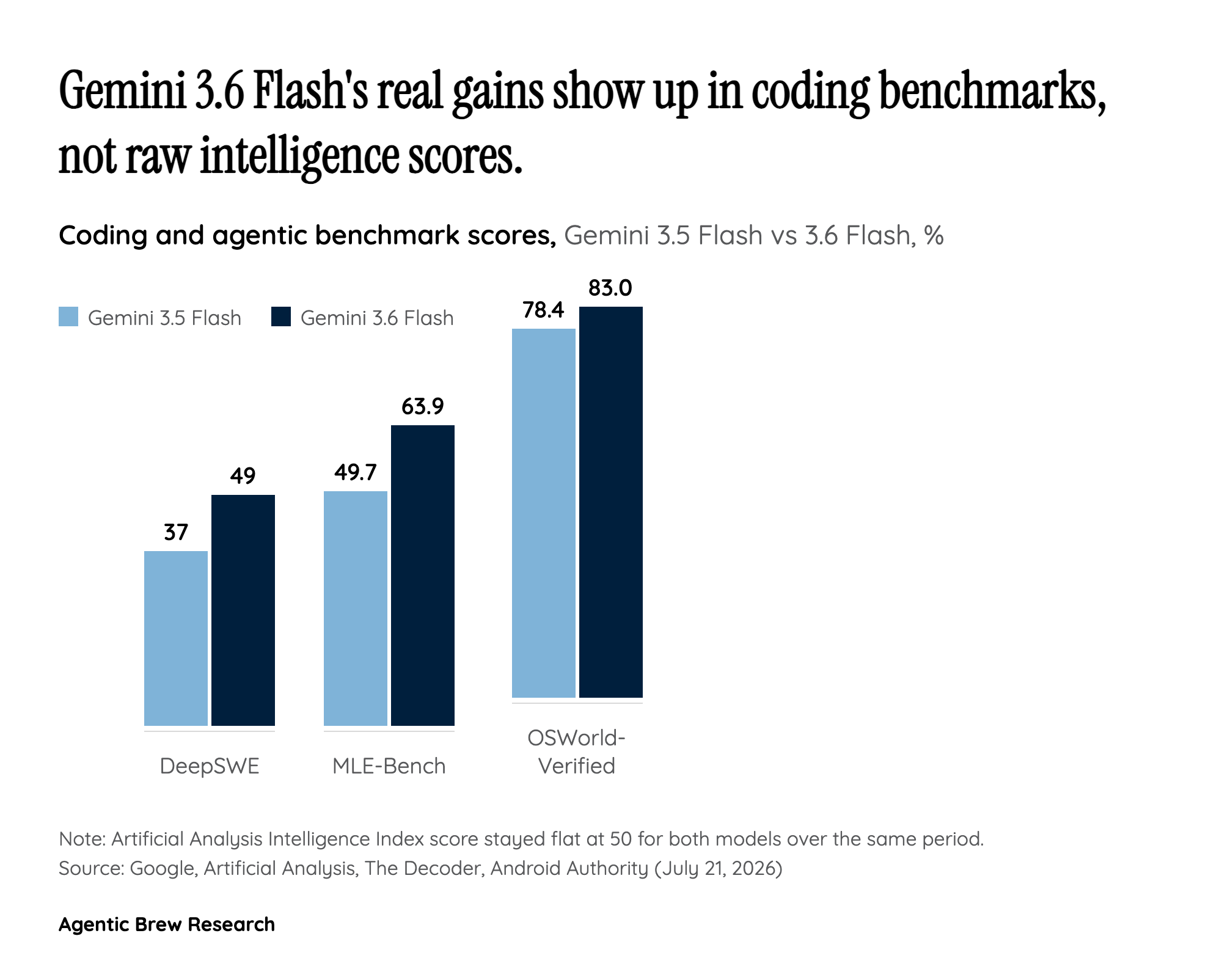
Gemini 3.6 Flash posts real gains on coding and agentic benchmarks even as its Artificial Analysis Intelligence Index score stays flat.

The most consequential data point in the launch isn't a new capability - it's the absence of one. Artificial Analysis's Intelligence Index score for Gemini 3.6 Flash landed at 50, identical to Gemini 3.5 Flash [3], even as Google marketed the release as a meaningful step forward [4]. Flash-Lite did post a real intelligence jump, from 25 to 36 on the same index. Where 3.6 Flash clearly did improve is coding and agentic execution: DeepSWE rose from 37% to 49%, MLE-Bench from 49.7% to 63.9%, and OSWorld-Verified from 78.4% to 83.0% [5]. Average time-per-task also roughly halved, from 2.7 minutes to 1.3 minutes for 3.6 Flash and from 1.0 to 0.6 minutes for Flash-Lite [3]. In other words, this is a speed-and-cost release with targeted coding gains layered on top of a flat general-intelligence score - a distinction that fueled the community pushback and Meta's public jab at the launch.

Gemini 3.5 Pro's Vanishing Act

The Flash trio arrived without the flagship model developers have been waiting on since Google I/O. Gemini 3.5 Pro's delay traces to Bloomberg's July 16 report that the model was struggling to meet internal performance goals [6], prompting DeepMind to scrap an earlier base-model iteration entirely due to performance ceilings in multi-step mathematical reasoning and SVG scene generation, and retrain from a new base [7]. Logan Kilpatrick said the team is 'currently testing Gemini 3.5 Pro with partners' and hopes to 'land soon,' while separately confirming DeepMind has commenced 'its most ambitious pre-training run yet for Gemini 4' [8]. Running a scrapped-and-restarted flagship in parallel with an already-underway next-generation pretraining effort is an unusual sequencing choice, and it is the detail rival commentary on X has seized on as evidence Google is over-extended on its frontier roadmap even as its mid-tier ships on schedule.

Flash Cyber's Double-Edged Blade

Gemini 3.5 Flash Cyber is the launch's most technically striking - and most tightly gated - model. Fine-tuned specifically to find, validate, and patch software vulnerabilities through Google's CodeMender pipeline, it scored 83.2% on the CyberGym benchmark, close to OpenAI's reported GPT-5.5-Cyber score of 85.6% [9]. In internal testing it surfaced 55 unique confirmed V8 JavaScript engine issues, including 10 missed by both Gemini 3.5 Flash and Claude Opus 4.6, and helped Google's Cloud Vulnerability Research team find a remote-code-execution flaw and a memory-corruption bug in a production service within two hours [9]. That same capability cuts both ways: the model reportedly produced a 100%-reliable RCE exploit bypassing ASLR and W^X protections during testing [9], which is precisely why Google restricted it to a limited pilot for governments and trusted partners rather than a general release [10].

Historical Context

2024-12-11
Gemini 2.0 Flash launched as an experimental release via the Gemini API and developer platforms.
2025-04-09
Google released a newer Gemini model update focused on efficiency.
2025-12-17
Google released a more efficient, affordable Gemini 3 AI model across its products, per Bloomberg.
2026-05-19
Google launched Gemini 3.5 Flash at Google I/O, betting its next AI wave on agents rather than chatbots.
2026-07-16
Bloomberg reported that Gemini 3.5 Pro's delay stemmed from the model struggling to meet internal performance goals, prompting Google to scrap an earlier base-model iteration.
2026-07-21
Google released Gemini 3.6 Flash, Gemini 3.5 Flash-Lite, and Gemini 3.5 Flash Cyber, while confirming Gemini 3.5 Pro remains delayed and Gemini 4 pretraining has begun.

Power Map

Key Players
Subject

Google Gemini 3.6 Flash, 3.5 Flash-Lite and Flash Cyber launch

GO

Google DeepMind

Developer/publisher of the three new Gemini models and CodeMender; delayed flagship Gemini 3.5 Pro while beginning Gemini 4 pretraining in parallel

LO

Logan Kilpatrick

Google technical staff member who publicly addressed the Gemini 3.5 Pro delay and confirmed Gemini 4 pretraining had begun

ME

Meta / Alexandr Wang

Meta's AI chief publicly mocked Google's release after Meta's Muse Spark 1.1 reportedly outperformed Gemini 3.6 Flash on Artificial Analysis benchmarks

AR

Artificial Analysis

Independent benchmark firm whose Intelligence Index scored Gemini 3.6 Flash at 50 (tied with 3.5 Flash) and published the time-per-task analysis cited across coverage

GO

Google Cloud Vulnerability Research team

Internal Google security team that used Gemini 3.5 Flash Cyber to uncover an RCE flaw and a memory-corruption bug in production services

EN

Enterprise adopters (Figma, Harvey, Hebbia, JetBrains)

Named early adopters cited in Google's launch materials as testimonials for the new Flash models' cost-efficiency and capability

Fact Check

10 cited
  1. [1] Gemini 3.6 Flash, 3.5 Flash-Lite and 3.5 Flash Cyber (Google Blog)
  2. [2] Google's Gemini 3.6 Flash targets enterprise agent token costs
  3. [3] Gemini 3.6 Flash & 3.5 Flash-Lite: halving time-per-task
  4. [4] Gemini 3.6 Flash scores 50 on Artificial Analysis Intelligence Index, same as Gemini 3.5 Flash
  5. [5] Google launches Gemini 3.6 Flash
  6. [6] Gemini 3.5 Pro delays
  7. [7] Google delays Gemini 3.5 Pro to July 17: the strategic play behind the scrapped base model
  8. [8] Google releases three new Gemini models but no 3.5 Pro
  9. [9] Google's Gemini 3.5 Flash Cyber model
  10. [10] Google launches Gemini 3.5 Flash Cyber

Source Articles

Top 5

THE SIGNAL.

Analysts

"Mocked Google's Gemini 3.6 Flash release after Meta's Muse Spark 1.1 reportedly beat it on Artificial Analysis benchmarks"

Alexandr Wang
AI chief, Meta Superintelligence Labs

"Called Meta's benchmark win with a much smaller team embarrassing for Google"

Tae Kim
AI industry commentator

"Confirmed the team is still testing 3.5 Pro with partners while framing the Flash launch as a deliberate trade for efficiency and lower cost rather than a slip"

Logan Kilpatrick
Google DeepMind, technical staff

"Emphasized added safety work built into the new Flash release"

Tulsee Doshi
Senior Director of Product Management, Google

"Replied to Logan Kilpatrick's Gemini 4 pretraining announcement with a pointed one-line quip reading as a jab at the delayed Gemini 3.5 Pro"

Tibo Sottiaux
X user (@thsottiaux)
The Crowd

"We're rolling out three new models to make AI agents faster, smarter, and cheaper at scale: 🔵 Gemini 3.6 Flash: It uses fewer tokens than 3.5 Flash to deliver higher quality work at the exact same cost. 🔵 Gemini 3.5 Flash-Lite: A fast, cost-effective option for everyday tasks"

@@GoogleDeepMind3172

"gemini who? 🏎️💨"

@@alexandr_wang2608

"@OfficialLoganK Hope it finishes one day too!"

@@thsottiaux3869

"Gemini 3.6 Flash is in a league of its own. Less intelligence for more money."

@u/jd_3d1300
Broadcast
Gemini 3.6 Flash: Don't Believe the Benchmarks

Gemini 3.6 Flash: Don't Believe the Benchmarks

Google Gemini's New Models Just Changed EVERYTHING! (Gemini Flash 3.6 & More)

Google Gemini's New Models Just Changed EVERYTHING! (Gemini Flash 3.6 & More)

Gemini 3.5 Pro DELAYED Again... BUT Gemini 3.6 Flash Might Drop Soon!

Gemini 3.5 Pro DELAYED Again... BUT Gemini 3.6 Flash Might Drop Soon!