)
The Self-Play Arms Race That Machines Can Run Forever
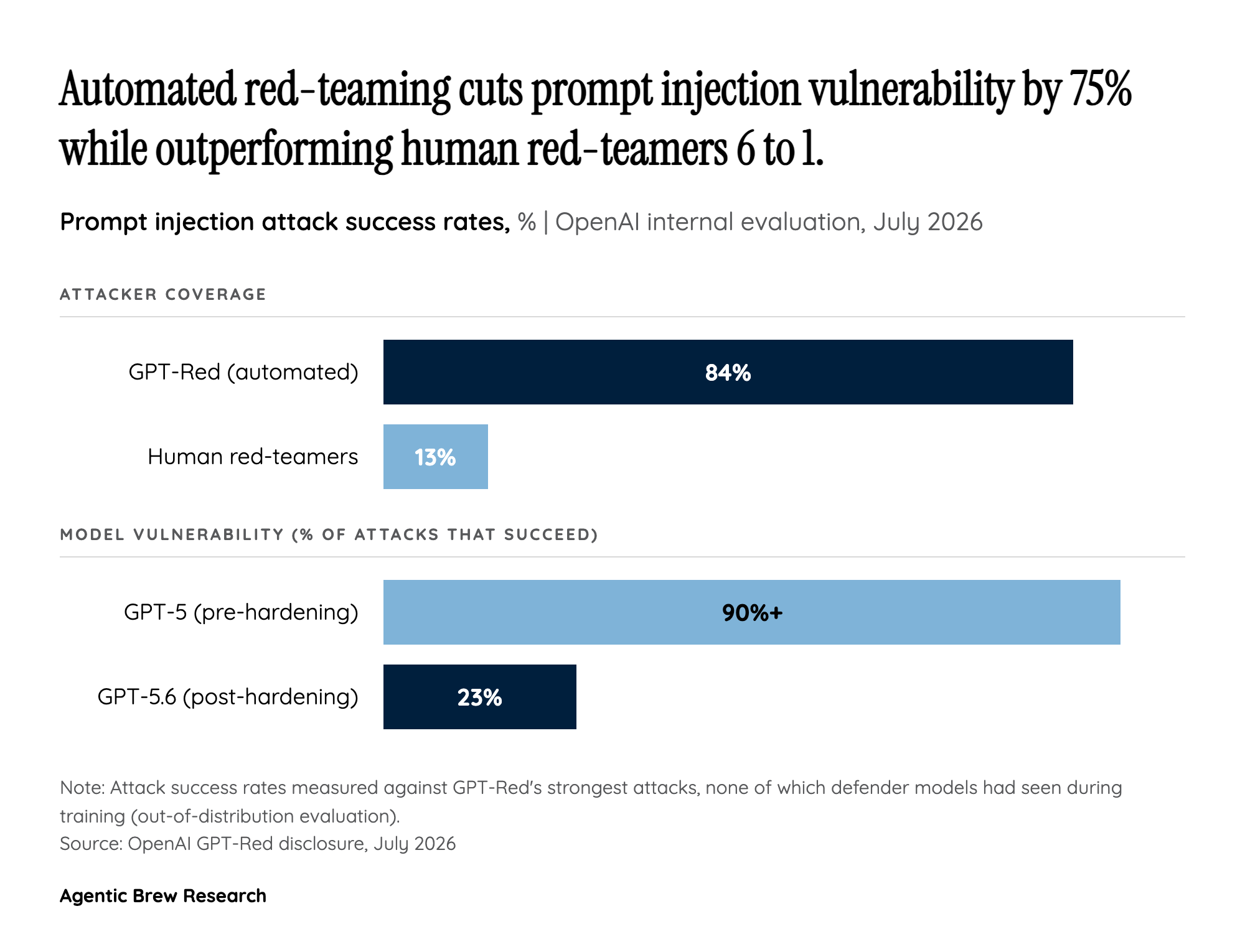
GPT-Red's architecture is a closed adversarial loop: an attacker LLM (GPT-Red) and one or more defender LLMs train against each other simultaneously. GPT-Red is rewarded for eliciting failures in the defender; the defender is rewarded for resisting. Every successful attack GPT-Red finds gets fed back into defender training, which then forces GPT-Red to discover broader and more complex failures to keep earning reward. OpenAI describes this as a safety flywheel: "Every successful attack that GPT-Red finds is used to improve these defenders, pushing GPT-Red to continuously find broader and more complex failures." [1]
The key engineering property that makes this loop durable is out-of-distribution generalization. GPT-Red's attacks were replayed on models that had never encountered them during training, and the defenders held. [9]This matters because it means GPT-Red isn't just memorizing attack-defense pairs - it's discovering structural vulnerabilities that transfer. Glen Rhodes' technical analysis identifies the self-play flywheel as the core mechanism, and notes that agentic multi-tool pipelines remain the primary residual exposure surface where the loop hasn't yet been fully exercised. [8]
The compute cost of running this loop at scale is significant: over 700,000 A100e GPU hours were invested in automated red-teaming for GPT-5.6 alone. [6]OpenAI frames the flywheel explicitly as a scaling answer: "As model capabilities grow, safety and alignment must scale with them. Red-teaming is essential, but today's approaches are difficult to scale, creating a critical bottleneck." The self-play mechanism is their proposed solution to that bottleneck. [1]