ChatGPT Virtual Try-On Shopping Feature
TECH

ChatGPT Virtual Try-On Shopping Feature

26+
Signals

Strategic Overview

  • 01.
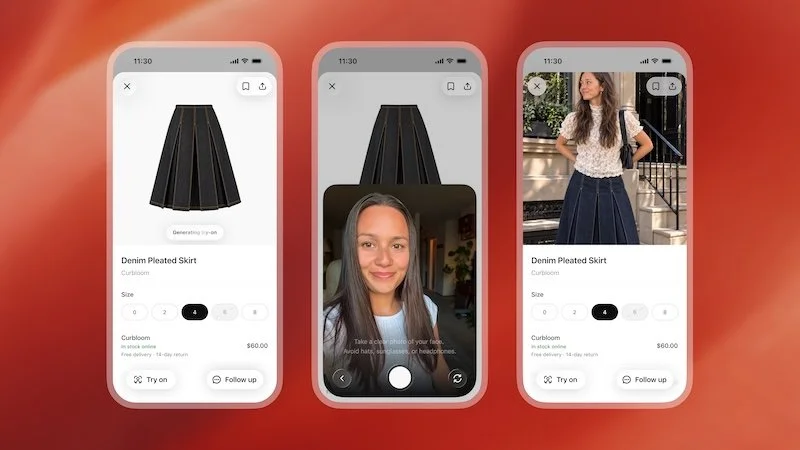
    OpenAI announced the global launch of two new shopping features in ChatGPT on October 1, 2026: a 'Try on' button that shows how clothing and accessories might look on the user, and a Favorites function that saves products to the ChatGPT Library.
  • 02.
    Users select the Try On button on a product listing, then take or upload a selfie to generate a virtual try-on image; the reference photo is saved for future try-ons.
  • 03.
    Users can also upload a picture of clothing or accessories, a web link, a screenshot from any online store, or a photo of a celebrity outfit and ask ChatGPT to generate a virtual try-on, so the product doesn't need to be listed within ChatGPT.
  • 04.
    Both the try-on and Favorites features run on OpenAI's newly launched ChatGPT Images 2.5 model and work on both web and mobile.
  • 05.
    The Favorites feature lets users save products they discover to a Library in the app, stored alongside their generated try-on images.
  • 06.
    OpenAI warns the virtual try-on images are not a substitute for real fit checks, advising users to check official merchant size charts and return policies.

From Checkout to Discovery: OpenAI's Retreat-and-Pivot

OpenAI's virtual try-on launch is less a new idea than a reset. In September 2025, OpenAI introduced Instant Checkout, letting ChatGPT users complete purchases without leaving the chat, starting with Etsy and later Shopify merchants [1]. By March 2026, OpenAI quietly discontinued Instant Checkout after roughly six months, citing inaccurate item information and merchant onboarding so difficult that only about 12 of Shopify's millions of merchants ever went live [1]. Gartner analyst Bob Hetu summed up the failure: 'OpenAI underestimated the complexity of implementing transactions. On one hand, it's somewhat surprising, but on the other, it's challenging for retailers.' [1]The October 1, 2026 launch of Try On and Favorites is OpenAI's answer: instead of trying to own the transaction, ChatGPT now focuses on visual discovery and sends users back to the retailer's own site to actually buy [1]and [2]. That retailers are still willing to play along is notable - Walmart is integrating its fashion catalog into Virtual Try On, Shop This Look, and Favourites 'from day one,' despite having watched the checkout experiment fail [3]. The pivot suggests OpenAI learned a narrower lesson from Instant Checkout: own the moment a shopper decides what they want, not the moment they pay for it.

The Selfie Trade-Off: Privacy Costs of Try-On

Virtual try-on only works because ChatGPT keeps a copy of your body. OpenAI stores the uploaded reference photo so it can generate future try-ons without asking again, though it can be deleted under Settings > Personalization > Reference photos [4]. The bigger question is what else happens to that photo: OpenAI's data policy allows uploaded content to be used to train its models unless a user explicitly opts out via 'Improve the model for everyone' in Data controls, and a selfie or full-body photo can carry more than just clothing-fit information - it can expose biometric details, location clues, or other background context a user never meant to share [4]. Community reaction has leaned skeptical on exactly this point, with early commenters flagging unease about handing more body and biometric data to a large tech company for what some see as a marginal gimmick. For a feature that depends on normalizing photo uploads at scale, the gap between OpenAI's opt-out-by-default training policy and users' casual willingness to upload a selfie is the quiet risk sitting underneath the shopping pitch.

Deja Vu: Virtual Try-On Isn't New, and Fit Still Isn't Solved

ChatGPT is a late entrant here, not a pioneer. Google Shopping already added its own virtual try-on tool in 2025, using a custom fashion image-generation model built specifically to render how fabric drapes on a user's body type [5]. Against that backdrop, part of the Reddit reaction to OpenAI's launch was pointed skepticism - commenters noted that ChatGPT's own prior image model could already do outfit swaps, and questioned whether AI-generated try-on images that skew toward idealized proportions can be trusted to represent how an item will actually look on an average body. OpenAI itself concedes the limitation: it explicitly warns that 'virtual images cannot tell you how a shirt will fit in real life' and tells users to still check official merchant size charts and return policies before buying [6]. That caveat matters commercially, not just cosmetically - 15.8% of U.S. retail sales were returned in 2025, a combined $849.9 billion, with online returns running even higher at 19.3% [7]. Virtual try-on is being pitched as a dent in that number, but until the rendering problem is actually solved, it risks adding a plausible-looking preview on top of the same guesswork.

Beyond Apparel: Images 2.5 as a Shopping Platform Bet

Try On and Favorites both run on ChatGPT Images 2.5, the image-generation model OpenAI shipped in September 2026 that cut generation latency by up to 50% versus its predecessor [8]. That speed matters because OpenAI is positioning the underlying model as infrastructure for a broader shopping layer, not a one-off clothing gimmick: users can paste a web link, upload a screenshot from any online store, or even share a photo of a celebrity's outfit to generate a try-on, so a product never has to be listed inside ChatGPT at all [6]. One early social reaction framed the real stakes precisely: the try-on button is a flashier front door, but the Favorites library quietly saving products over time is the feature actually built for retention. On X, Aaron (@aaronp613) posted describing a ChatGPT feature called 'Virtual Try-On' that let users upload a full-body photo to see clothing on themselves, a description that matches what later shipped.

Historical Context

2025-09
OpenAI launched Instant Checkout in ChatGPT, allowing users to confirm orders, delivery, and payment without leaving the chat interface, starting with Etsy and later Shopify merchants.
2025
Google added its own virtual try-on tool to Google Shopping, letting users upload a full-length photo to see how apparel might look on their body type, using a custom fashion image-generation model.
2026-03
After roughly six months of testing, OpenAI discontinued Instant Checkout, citing inaccurate item information and difficulty onboarding merchants (only about 12 of Shopify's millions of merchants went live); users are now redirected to retailers' own websites to complete purchases.
2026-09-08
OpenAI released the ChatGPT Images 2.5 model update, introducing a Sketch feature and cutting image-generation latency, which now underpins the virtual try-on feature.
2026-10-01
Global launch of ChatGPT's virtual Try On button and Favorites/Library feature, positioned as OpenAI's renewed push into AI-driven shopping discovery after retreating from direct in-chat checkout.

Power Map

Key Players
Subject

ChatGPT Virtual Try-On Shopping Feature

OP

OpenAI

Developer of ChatGPT and the virtual try-on/Favorites features and the underlying ChatGPT Images 2.5 model

WA

Walmart

Retail partner bringing its fashion catalog into ChatGPT's Virtual Try On, Shop this Look, and Favourites from day one

GO

Google (Google Shopping)

Competitor that launched its own virtual try-on tool in 2025 using a custom fashion image-generation model to render fabric drape on a user's body type

ET

Etsy, Shopify

Earlier merchant partners for OpenAI's now-discontinued Instant Checkout feature, cited as context for OpenAI's shifting shopping strategy

Fact Check

8 cited
  1. [1] OpenAI Abandons Instant Checkout Feature in ChatGPT
  2. [2] OpenAI Adds Virtual Try-On Feature To ChatGPT
  3. [3] Walmart Joins OpenAI's ChatGPT Fashion Push as Virtual Try-On and Favourites Launch
  4. [4] ChatGPT Virtual Try-On Saves Your Selfie: What To Know Before You Upload
  5. [5] Google's Virtual Try-On Fuses Fashion
  6. [6] ChatGPT Virtual Try-On Clothing Shopping Feature
  7. [7] AI Retail Startups: Virtual Try-On Tech and Margins
  8. [8] ChatGPT Virtual Try-On Clothes Images 2.5

Source Articles

Top 5

THE SIGNAL.

Analysts

“Characterized OpenAI's underestimation of the complexity of implementing e-commerce transactions as a key reason Instant Checkout struggled to gain merchant traction.”

Bob Hetu (Gartner analyst)
Assessed why OpenAI's prior Instant Checkout effort struggled
The Crowd

“OpenAI is rolling out new shopping features for ChatGPT that let users virtually try on clothing and accessories using their own photos and save products they like to a Favorites library.”

@@TechCrunch225

“OpenAI is working on a feature for ChatGPT called "Virtual Try-On" You upload a full-body picture of yourself and ChatGPT can show you what different clothing pieces can look like on you.”

@@aaronp613119

“I read this as OpenAI nudging ChatGPT from “help me choose” to “keep your cart here,” and shopping punishes mistakes. Images 2.5 may make virtual try on look sharper and faster, but if it guesses fit or texture wrong, it just drives returns. Favorites in the Library is the sticky”

@@TansuYegen5

“ChatGPT can now virtually try on clothes for you”

@u/efap17010
Broadcast
How to Change Clothes in Photo with Chat Gpt Ai

How to Change Clothes in Photo with Chat Gpt Ai

How to Try Any Clothes With This ChatGPT Skill

How to Try Any Clothes With This ChatGPT Skill

L'Oréal brings Maybelline virtual try-on to ChatGPT

L'Oréal brings Maybelline virtual try-on to ChatGPT

ChatGPT Virtual Try-On Shopping Feature — AI News | Agentic Brew