SK Hynix's US Nasdaq debut and AI chip expansion
TECH

SK Hynix's US Nasdaq debut and AI chip expansion

30+
Signals

Strategic Overview

  • 01.
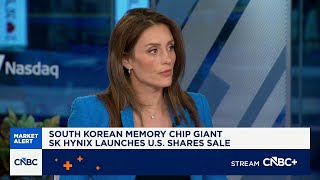
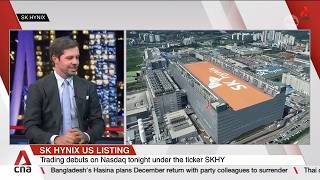
    SK Hynix's American depositary receipts began trading on the Nasdaq under the temporary symbol SKHYV, priced at $149 and opening around $170 for a roughly 14% first-day gain before switching to SKHY on Tuesday.
  • 02.
    The offering raised $26.5 billion, the largest first-time US listing by a foreign company on record, topping Alibaba's US IPO per Bloomberg data, with the deal oversubscribed more than seven times.
  • 03.
    SK Group Chairman Chey Tae-won framed the debut as a 'dream come true' tied to the AI boom, telling CNBC that HBM demand is 'enormous' and signaling openness to a much larger US manufacturing footprint if site conditions can be met.

Deep Analysis

The Korea Discount: Better Than Micron, Priced Like an Afterthought

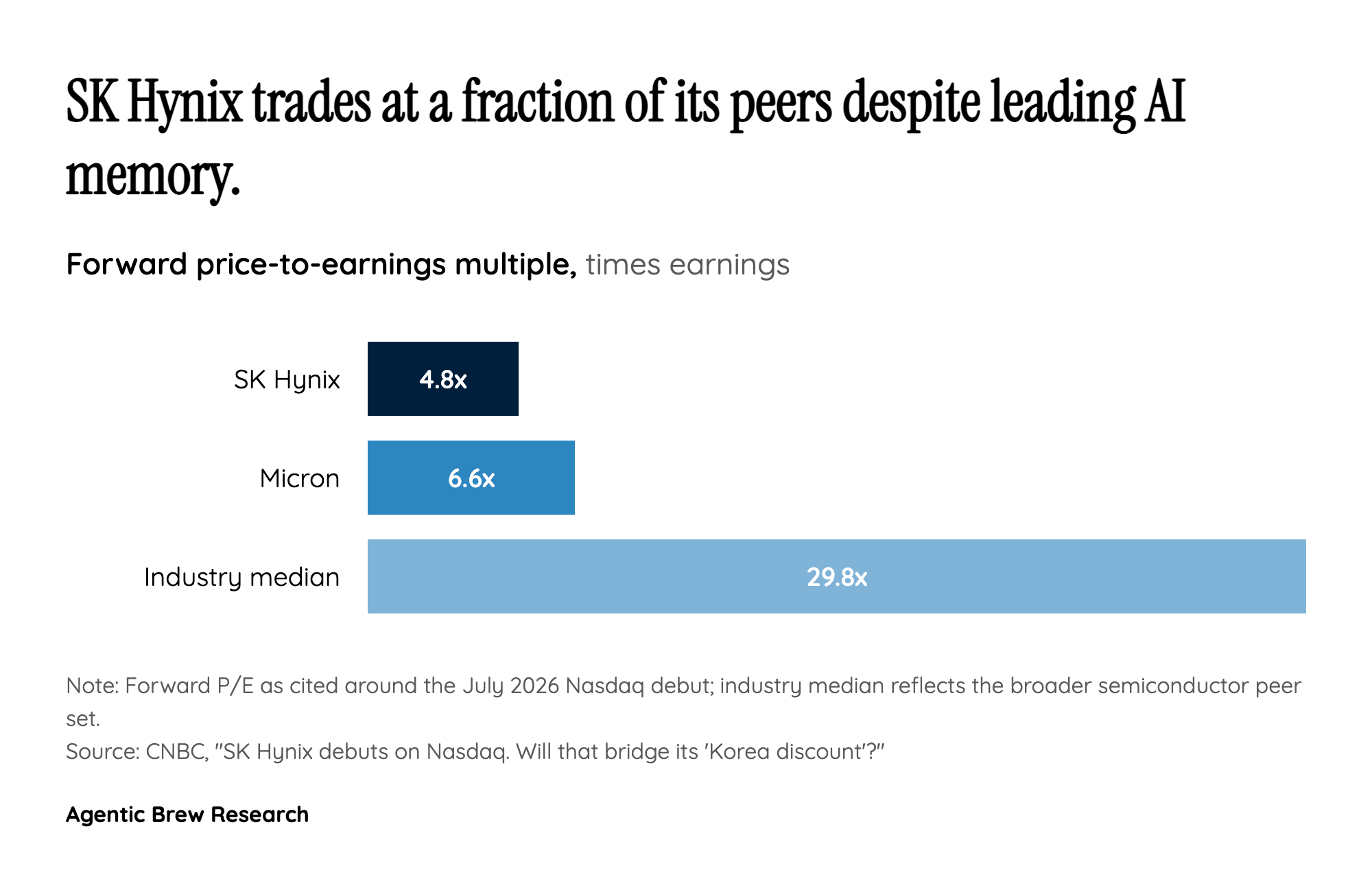
The oddity at the center of this listing is valuation. SK Hynix leads the world in high-bandwidth memory, the scarce component that makes Nvidia's AI accelerators run, yet it has long traded at roughly 4.8x forward earnings - against an industry median near 29.8x and even US rival Micron's 6.6x [1]. That gap has a name: the Korea discount. eToro's Zavier Wong argues the cause is prosaic - 'access and familiarity,' with limited accessibility for US funds keeping the multiple depressed for years despite a stronger position in AI memory [1]. The Nasdaq ADRs are the direct fix: put the shares where the largest pools of US capital can actually buy them. Futurum's Rolf Bulk expects the gap to narrow but not vanish, and Barclays estimates up to $14 billion in passive buying as SK Hynix is pulled into major indices over the coming months [1]. The debut's own math endorsed the thesis - priced at $149, the ADRs opened near $170 for a roughly 14% pop, and the book was oversubscribed more than seven times [4][8]. Whether a re-rating sticks is the open question; a listing venue changes who can buy, not the cyclical nature of memory.
A $26 Billion Raise It Didn't Actually Need

The headline is the money - $26.5 billion, the biggest first-time US listing by a foreign company on record, edging past Alibaba [3]. The subtlety is that SK Hynix barely needed it. Bulk points out the company will generate more than $90 billion in free cash flow this year, meaning the proceeds are almost incidental; the listing is about broadening the US shareholder base, not filling a funding hole [1]. That reframes what the debut is for. Publicly the story is capacity: proceeds help fund EUV lithography and new fabs, though the bulk of that build-out - a roughly $390 billion Yongin cluster - sits in South Korea, with US work concentrated in a $4 billion advanced-packaging plant in Indiana backed by up to $458 million in CHIPS Act funding [5][6]. Strategically, the listing hands Chairman Chey Tae-won a US-currency-and-visibility platform at the exact moment he is dangling a 'much bigger' American footprint - he says he will build US memory fabs if a site can deliver power, clean water, land, workforce and a supply chain [5]. The raise, in other words, looks less like financing and more like positioning: for a re-rating, for index inclusion, and for the political optics of expanding in America.

By The Numbers: Sizing the Record Debut

By The Numbers: Sizing the Record Debut
SK Hynix's ~4.8x forward P/E sits far below Micron's 6.6x and the ~29.8x industry median - the Korea discount the Nasdaq listing aims to close.

The scale of the offering is best read through its figures. SK Hynix issued 177.9 million ADSs at $149 apiece, opening near $170 for a roughly 14% first-day gain, and raised $26.5 billion - the largest first-time US listing by a foreign company on record and the second-largest US equity offering behind SpaceX, with the book oversubscribed more than seven times [3][8]. The valuation gap that drove the listing is stark: a forward P/E around 4.8x against an industry median near 29.8x and Micron's 6.6x [1]. On the business itself, SK Hynix commands roughly 56% of the HBM market, though analysts project a slide toward the low-40% range as Samsung and Micron add capacity [1][7]. The company now carries a valuation above $1 trillion, employs about 46,900 people, and has its DRAM, NAND and HBM output sold out through 2026, much of it earmarked for Nvidia [6][7]. Barclays pegs incoming passive demand at up to $14 billion as index inclusion follows [1].

The Bear Case: Selling Cyclical Peaks and a Slipping Share

For all the celebration, a skeptical camp reads the timing differently. SK Hynix's supply is sold out through 2026 and its share position is commanding, but Bulk expects HBM share to erode from roughly 56% toward the low-40% range as Samsung gains ground and Micron establishes itself as a credible third player - the binding constraint being who can add capacity fastest, not who holds share today [1][7]. Memory is famously cyclical, and community discussion around the debut split along exactly that fault line: enthusiasm for direct AI-memory exposure ran against a dilution bear case warning that a producer raising tens of billions at a cyclical peak is the classic 'buy cyclicals at high P/E, sell at low P/E' setup, with some arguing Micron is the cleaner, non-Korea-based way to play the same trade. A retail-access thread ran underneath it all, since the primary allocation went to institutions rather than individual buyers. The counterpoint from the bulls is durability: Chey insists demand shows no sign of shrinking [2], and Bulk frames a cycle turn as requiring capacity to outpace demand - a moment the market is 'nowhere near.' The historical arc lends weight to the optimists. A business that nearly collapsed after the Asian financial crisis, was renamed Hynix in 2001 and rescued by SK Group in 2012, now debuts above a $1 trillion valuation - a reminder of how completely the AI-memory boom has rewritten this company's fortunes [6].

Historical Context

1983
SK Hynix's roots trace to Gukdo Construction, founded in 1949, which entered electronics in 1983 as Hyundai Electronics.
2001
The business was renamed Hynix Semiconductor in 2001 after the Asian financial crisis forced restructuring and a split from Hyundai.
2012
Capital-starved Hynix was rescued by SK Group in 2012, becoming SK Hynix, and SK began investing in then-unprofitable high-bandwidth memory.
2026-07-10
Now valued above $1 trillion and employing roughly 46,900 people, SK Hynix debuted its ADRs on the Nasdaq in a record foreign listing.

Power Map

Key Players
Subject

SK Hynix's US Nasdaq debut and AI chip expansion

SK

SK Group / Chairman Chey Tae-won

Parent conglomerate and chairman championing the US listing and controlling expansion strategy; called the debut a 'dream come true' and pointed to enormous HBM demand.

NV

Nvidia

Dominant HBM customer whose AI accelerators absorb much of SK Hynix's committed HBM3E and HBM4 supply, anchoring demand through 2026.

MI

Micron Technology

US HBM rival that trades at a higher forward multiple partly on US-market familiarity, and an emerging third major HBM player often cited as a cleaner US-listed way to play AI memory.

SA

Samsung Electronics

Chief HBM competitor expected to gain share and facing parallel pressure to expand US investment.

Fact Check

8 cited
  1. [1] SK Hynix debuts on Nasdaq. Will that bridge its 'Korea discount'?
  2. [2] SK Hynix opens at $170 on Nasdaq. Chairman tells CNBC 'demand is enormous'
  3. [3] Chip giant SK Hynix raises $26.5 billion in blockbuster US share offering
  4. [4] SK Hynix makes Nasdaq debut with ADR listing
  5. [5] SK Group chairman on SK Hynix listing day and US investment plans
  6. [6] SK Hynix: from near-collapse to a $1 trillion valuation and a Nasdaq listing
  7. [7] SK hynix sells out its DRAM, NAND and HBM chip supply to Nvidia through 2026
  8. [8] SK Hynix Nasdaq IPO Oversubscribed More Than Seven Times

Source Articles

Top 5

THE SIGNAL.

Analysts

"Expects the ADR listing to narrow but not fully close SK Hynix's Korea discount, and projects HBM share sliding from the high-50s toward the low-40% range, with capacity - not share - as the real constraint. He also notes SK Hynix will generate more than $90 billion in free cash flow this year, so it does not need the proceeds; the listing is about broadening the US investor base."

Rolf Bulk
Head of semiconductors and infrastructure, Futurum Group

"Attributes SK Hynix's lower valuation versus Micron mainly to access and familiarity, arguing limited US-fund accessibility has depressed its multiple for years despite a stronger AI-memory position."

Zavier Wong
Market analyst, eToro

"Frames the debut as a lifelong ambition realized, sees no sign of HBM demand shrinking, and is open to a much larger US footprint if a site can supply power, clean water, land, workforce and a supply-chain ecosystem."

Chey Tae-won
Chairman, SK Group
The Crowd

"SK Hynix Launches Historic U.S. Listing. SK Hynix sold 177.9 million ADRs at $149 each, raising $26.5 billion in one of the largest U.S. equity offerings ever. The deal is more than 7x oversubscribed, highlighting massive institutional demand for AI semiconductors."

@@BullTheoryio328

"BREAKING: SK Hynix ($SKHY) is live on Solana. The $28B Nasdaq listing is the largest foreign share issuance in US market history. Onchain from day one, available globally."

@@solana283

"SK Hynix opened at $170 per share on the Nasdaq on Friday, rising about 14%, as U.S. investors jumped at the opportunity to get a stake in South Korea second-most valuable company. The stock is trading under the ticker symbol SKHYV, and will switch to SKHY as of Tuesday."

@@CNBC24

"SK Hynix is on Nasdaq Tomorrow"

@u/NaderNation841900
Broadcast
SK Hynix Just Started Trading on the Nasdaq!

SK Hynix Just Started Trading on the Nasdaq!

SK Hynix shares rise ahead of Nasdaq debut

SK Hynix shares rise ahead of Nasdaq debut

SK HYNIX US LISTING: Chipmaker pulls off Wall Street biggest foreign ADR listing

SK HYNIX US LISTING: Chipmaker pulls off Wall Street biggest foreign ADR listing