SenseTime launches SenseNova U1 Pro multimodal model
TECH

SenseTime launches SenseNova U1 Pro multimodal model

24+
Signals

Strategic Overview

  • 01.
    On July 18, 2026, at WAIC (World Artificial Intelligence Conference) 2026 in Shanghai, SenseTime officially released SenseNova U1 Pro, the flagship of its 'SenseNova U' model family.
  • 02.
    U1 Pro is positioned as a delivery-grade native multimodal agent foundation model for long-horizon tasks, unifying understanding, generation, and action - a shift from 'content generation' to 'system-level delivery.'
  • 03.
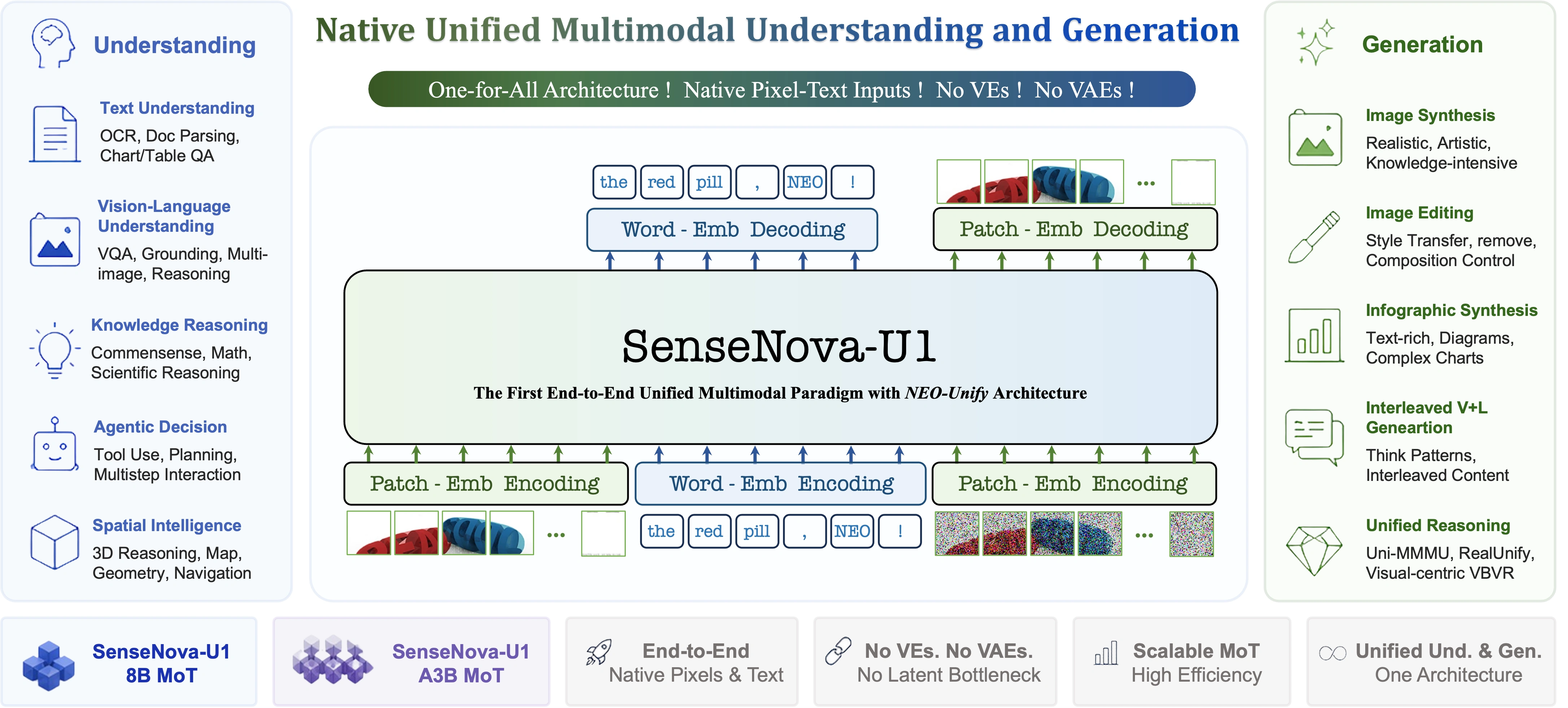
    The model is built on SenseTime's self-developed NEO-unify 'inner kernel' architecture, which unifies language and visual representation and breaks down the barrier between understanding and generation.
  • 04.
    U1 Pro delivers four core capabilities: professional-design-grade image generation, native 8K resolution output, high-density image-text/infographic integration with low text-rendering error rates, and a long-horizon 'Agentic Generation Loop' - dozens of rounds of iterative understand-plan-execute-check-correct refinement.
  • 05.
    As a flagship demonstration, U1 Pro generated a 4:1 ultra-wide traditional Chinese ink-style landscape scroll depicting WAIC's nine-year evolution (2018-2026), incorporating rivers, mountains, landmark buildings, and dense text information.
  • 06.
    The U1 Pro preview has opened invite-only testing; the public version, with API access and commercial pricing, is planned to launch in August 2026.
  • 07.
    The open-source base SenseNova U1 model, released April 29, 2026 under Apache 2.0, preceded U1 Pro and shipped in two variants: an 8B dense model (U1-8B-MoT) and a mixture-of-experts model (U1-A3B-MoT).

Deep Analysis

The Architectural Bet: NEO-unify
The Architectural Bet: NEO-unify
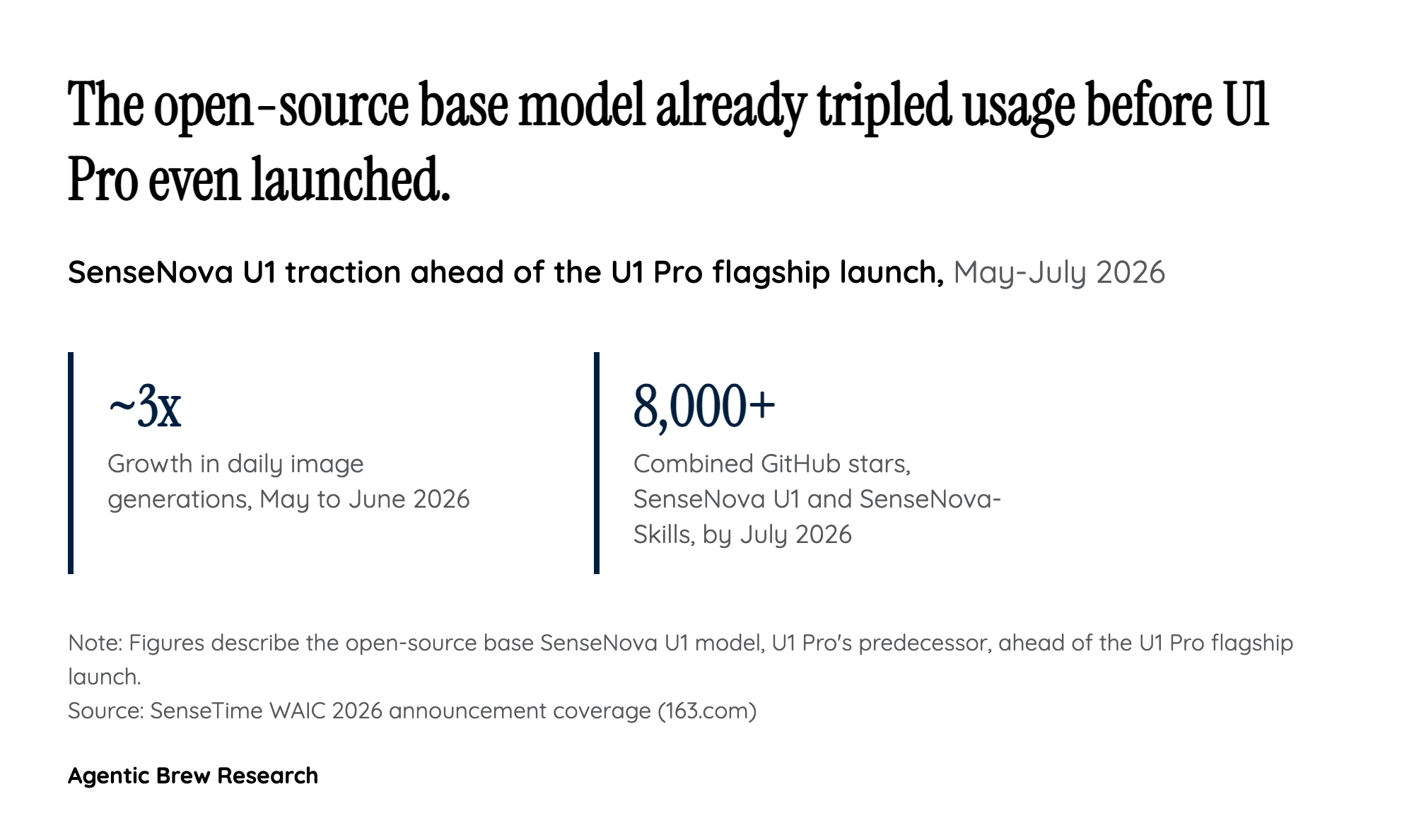
The open-source base SenseNova U1 model tripled daily image-generation usage between May and June 2026 and passed 8,000 combined GitHub stars, ahead of U1 Pro's July flagship launch.

SenseTime's core wager with U1 Pro is architectural, not just a bigger model. NEO-unify, first introduced through a March 2026 research collaboration with NTU [1], unifies language and visual representation inside a single 'inner kernel' rather than bolting a separate image-generation module onto a text-focused LLM [3]. Per SenseTime's own architecture description on the model's GitHub repository, NEO-unify 'eliminates both Visual Encoder (VE) and Variational Auto-Encoder (VAE)' by design - a first-principles choice rather than an incremental fix [4]. That same architecture underlies both the open-source base U1 models released in April 2026 [2]and the newer flagship U1 Pro announced in July [3], though the VE/VAE-elimination claim specifically describes the NEO-unify design rather than being independently confirmed for each downstream variant. The bet appears to be paying off in adoption terms for the base model at least: daily image-generation volume on U1 roughly tripled between May and June 2026, and combined GitHub stars across U1 and SenseNova-Skills passed 8,000 by July [8].

Lin Dahua's Coding-vs-Vision Pitch

SenseTime Chief Scientist Lin Dahua has framed U1 Pro's launch as part of a broader thesis: that multimodality, not coding, is AI's next competitive battleground. Speaking around WAIC 2026, he argued that 'a large amount of perceptual detail cannot be exhausted by language,' and drew a sharp line between machine-facing interfaces and human-facing ones - 'CLI is machine-facing, while vision is human-experience-facing' [5]. He backed the claim with a concrete, checkable example: code models' frontend output is still 'visibly AI-generated at a glance,' which in his view exposes the limits of text/code-only generation as a proxy for genuine capability [5]. Lin made this case directly to peers, hosting a WAIC 2026 forum on foundation-model architecture alongside Qiu Xipeng (Fudan), Zhao Deli (Alibaba DAMO), Zhang Xiangyu (StepFun), and Liu Ziwei (NTU), where the group debated whether multimodality is merely an 'add-on' to next-generation AI or its 'soul' [6]. U1 Pro is SenseTime's product answer to that debate: a model whose headline capabilities - 8K resolution, dense infographic text, the multi-round Agentic Generation Loop - are all aimed squarely at the human-perceptual side of the argument Lin is making [3].

The Reception Gap: Agent Framing vs. GPT-Image-2 Framing

SenseTime frames U1 Pro as a 'delivery-grade native multimodal agent foundation model' - language built around workflows, iterative loops, and system-level output [3]. Public reception, so far, mostly treats it as a straightforward image-generation contender instead. One widely-shared X post described U1 Pro simply as 'the Chinese image model ... which can output 8K images and apparently beats GPT Image 2.' About 17 days (roughly two and a half weeks) before the official unveiling, a Reddit post in r/comfyui had already surfaced a similar comparison from an early preview: U1 Pro's native 8K output pitched against GPT-Image-2's reported 4K ceiling, illustrated with a single-pass film-storyboard example rendered at over 16,000x24,000 pixels containing 40 to 60 annotated panels covering shot type, camera angle, and mood - an independent, pre-announcement data point that echoes SenseTime's own native-8K claim. Separately, independent reviewers who tested the open-source base U1 model (not U1 Pro itself) confirmed it is architecturally a genuinely unified system - one Qwen3-based LLM with a single vision path, rather than an LLM glued to a separate image-generation adapter - and one review, from xCreate, benchmarked base U1 at a score of 46.6 on infographic and text-rendering tasks, ahead of GPT-Image, Google's Nano Banana, and SeaDream as of June 2026. That result speaks to the base model's real competitiveness on a specific benchmark, but it does not extend to U1 Pro's flagship-only claims - true native 8K output and the multi-round Agentic Generation Loop - which so far exist only in SenseTime's own demos and remain untested by any independent reviewer with actual U1 Pro access.

WAIC's Rivalry Pattern and the Verification Gap

WAIC has become an annual proving ground where China's leading AI labs stage competing launches. At WAIC 2025, SenseTime unveiled SenseNova V6.5, claiming it outperformed Gemini 2.5 Pro and Claude 4-Sonnet on some benchmarks, the same week Tencent introduced its Hunyuan 3D World Model [7]. U1 Pro's WAIC 2026 debut continues that rivalry pattern, but shifts the terrain: instead of another benchmark-chasing text/reasoning model, SenseTime is staking its year on multimodal generation and 'delivery' - a bet Lin Dahua has publicly framed as the next battleground after coding [5][6]. A public API and pricing, promised for August 2026 [3], will be the real test of whether U1 Pro's claims hold up outside curated showcases.

Historical Context

2025-07-27
At WAIC 2025, SenseTime launched SenseNova V6.5, claiming it outperformed Gemini 2.5 Pro and Claude 4-Sonnet on some benchmarks, while Tencent simultaneously unveiled its Hunyuan 3D World Model - establishing the WAIC pattern of rival launches that U1 Pro's 2026 debut continues.
2026-03-06
SenseTime, in collaboration with NTU, first introduced the NEO-unify native unified multimodal paradigm in a research publication.
2026-04-29
SenseTime fully open-sourced the base SenseNova U1 model family under Apache 2.0, in an 8B dense variant (U1-8B-MoT) and a mixture-of-experts variant (U1-A3B-MoT). Both are built on NEO-unify, which SenseTime's own architecture description characterizes as eliminating separate Visual Encoder and VAE components by design.
2026-07-18
SenseNova U1 Pro officially unveiled at WAIC 2026 as the flagship of the SenseNova U series, moving from 'content generation' to 'system-level delivery.'

Power Map

Key Players
Subject

SenseTime launches SenseNova U1 Pro multimodal model

SE

SenseTime (商汤科技)

Developer and publisher of SenseNova U1 Pro; positions the model as its flagship native multimodal agent foundation, competing directly on multimodal generation and delivery capability against domestic and international rivals.

LI

Lin Dahua (林达华), Chief Scientist, SenseTime

Public face of SenseTime's multimodal strategy; hosted the WAIC 2026 foundation-model architecture forum and argued in a dedicated interview that multimodality is the next major battleground after AI coding.

TE

Tencent

Unveiled its own new AI models (e.g., Hunyuan 3D World Model) at the prior year's WAIC Shanghai event, illustrating the competitive dynamic among Chinese tech firms that SenseTime's U1 Pro launch continues.

QI

Qiu Xipeng (Fudan University), Zhao Deli (Alibaba DAMO Academy), Zhang Xiangyu (StepFun), Liu Ziwei (NTU)

Co-panelists with Lin Dahua at the WAIC 2026 base-model architecture forum, debating multimodality's role in next-generation AI alongside SenseTime's product push.

Fact Check

8 cited
  1. [1] NEO-unify: SenseTime's Native Unified Multimodal Architecture
  2. [2] SenseTime Open-Sources SenseNova U1 Native Multimodal Model
  3. [3] SenseTime Unveils SenseNova U1 Pro Flagship Multimodal Model
  4. [4] SenseNova-U1 GitHub Repository
  5. [5] Lin Dahua Interview: Multimodality Is the Next Battleground After AI Coding
  6. [6] WAIC 2026 Chief Scientist Forum on Foundation Model Architecture
  7. [7] WAIC Shanghai: Tencent, SenseTime Launch New AI Models, Stir Industry Rivalry
  8. [8] SenseTime's U1 Pro Scroll Demo and Base-Model Adoption Figures

Source Articles

Top 3

THE SIGNAL.

Analysts

"Argues multimodality is the next major competitive battleground after AI coding, because vision captures perceptual detail and human experience that language alone cannot express."

Lin Dahua (林达华)
Chief Scientist, SenseTime

"Distinguishes machine-facing interfaces like coding/CLI from human-facing vision, positioning multimodal generation as fundamentally about human experience rather than machine execution."

Lin Dahua (林达华)
Chief Scientist, SenseTime

"Points to visible limits of current coding-focused models - AI-generated frontend output is still easy to spot at a glance - as motivation for investing in multimodal capability instead."

Lin Dahua (林达华)
Chief Scientist, SenseTime
The Crowd

"🚨 Update: U1 Pro, the Chinese image model I talked about last month which can output 8K images and apparently beats GPT Image 2, is released today and they have a blog out"

@@Lentils801994

"SenseNova-U1 Pro is coming, possible ComfyUI integration in the future?"

@u/Right_Hunt679012
Broadcast
SenseNova U1 First Test – A New Kind of Open Source Image Model!

SenseNova U1 First Test – A New Kind of Open Source Image Model!

SenseNovaU1: The Open-Source Model That Thinks in Images

SenseNovaU1: The Open-Source Model That Thinks in Images

New #1 Open Source Image AI? | SenseNova-U1 Mac & Windows Guide & TESTS

New #1 Open Source Image AI? | SenseNova-U1 Mac & Windows Guide & TESTS