The Day a Rumor Erased Billions
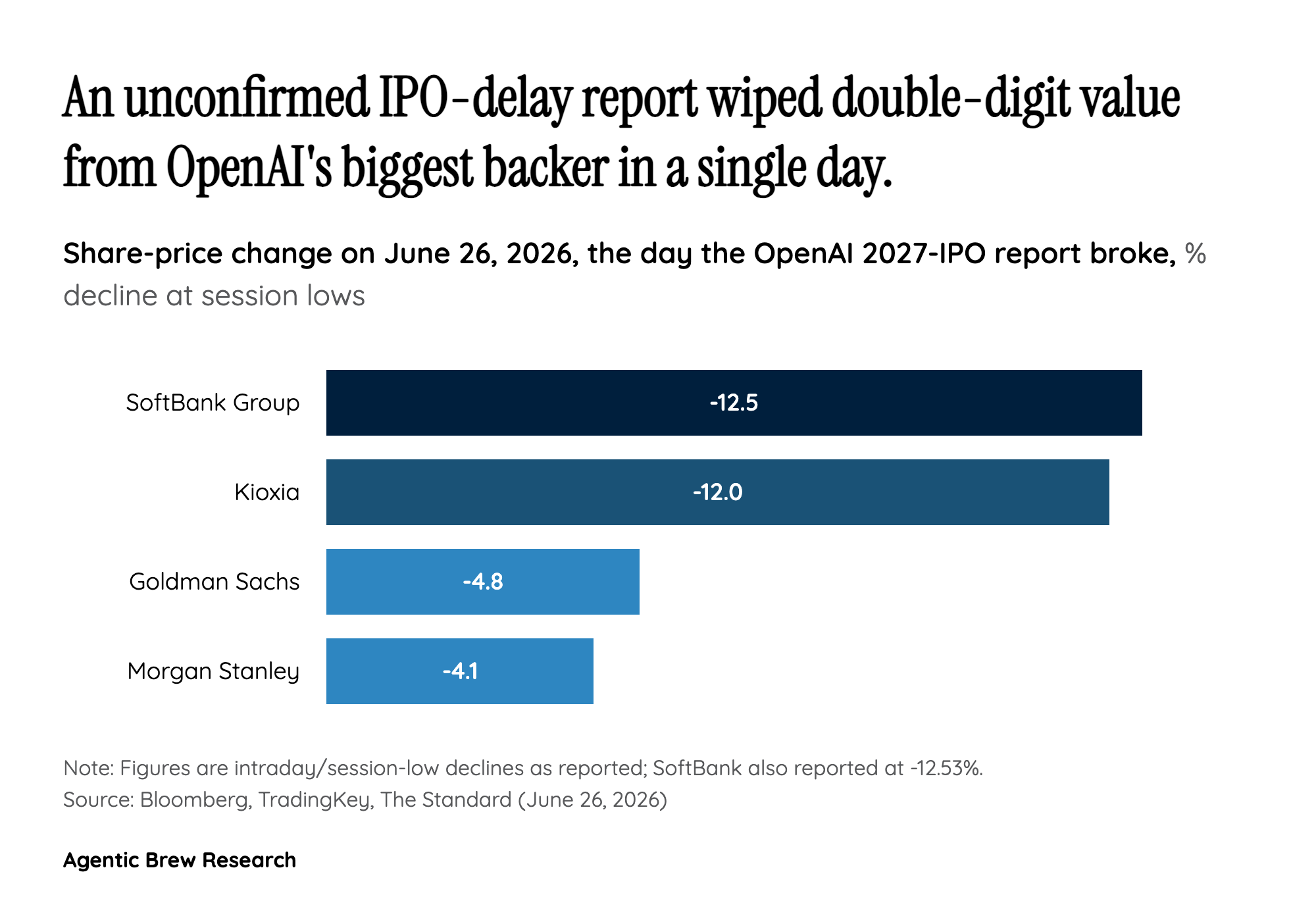
No one filed anything. No one announced anything. A single New York Times report, citing people involved in OpenAI's deliberations, said only that the company was leaning toward a 2027 listing rather than 2026 [1]. That was enough to set off a global selloff. SoftBank Group, OpenAI's second-largest external shareholder, fell over 12% - reported as a 12.53% drop to 6,246 yen, because its entire asset-revaluation story is collateralized on OpenAI's eventual public price [2]. In Japan, Kioxia, the AI-memory chipmaker that is the most valuable company on the Nikkei 225, slid 12% as the contagion spread to anything tagged AI [3].
The damage did not stop at shareholders. The two banks lined up to underwrite the deal took the hit too: Goldman Sachs fell as much as 4.8% and Morgan Stanley as much as 4.1%, pricing in underwriting fees that just got pushed a year further out [4]. The remarkable part is the asymmetry. A report about a preference - not a decision, not a filing change - moved tens of billions in market value across three continents in a single session. It is the clearest evidence yet of how much of the current AI rally is leveraged on one not-yet-existent IPO.