DeepSeek V4.1-Flash Launch, Pricing Cuts and V4-Pro Retirement
TECH

DeepSeek V4.1-Flash Launch, Pricing Cuts and V4-Pro Retirement

36+
Signals

Strategic Overview

  • 01.
    DeepSeek officially released DeepSeek-V4.1-Flash on September 10, 2026, a 552-billion-parameter mixture-of-experts model built on a new Causal Encoder-Decoder architecture with native visual understanding and a 1-million-token context window.
  • 02.
    DeepSeek says internal and external testing showed V4.1-Flash surpasses its own flagship V4-Pro on performance, cost, speed and total completion time, and is therefore retiring V4-Pro, rerouting V4-Pro API requests to V4.1-Flash at Flash-series pricing starting September 14, 2026.
  • 03.
    Off-peak API pricing is $0.003 per million cached input tokens, $0.15 per million uncached input tokens and $0.60 per million output tokens, with rates doubling during weekday peak windows.
  • 04.
    V4.1-Flash was released with open model weights on Hugging Face under the MIT license, permitting commercial use.

The Architecture Bet: An Asymmetric Encoder-Decoder Beats Brute-Force Scale

V4.1-Flash's 552-billion-parameter mixture-of-experts backbone is deceptively large, but its Causal Encoder-Decoder architecture is what actually does the work: a 20-layer encoder reads the prompt using just 8 billion active parameters, then a separate 20-layer decoder writes the reply using 16 billion active parameters [1]. That is a break from the decoder-only transformer convention most large language models still use, where every token - whether it is being read or written - pays the same per-token compute cost regardless of its role [2]. DeepSeek's framing is direct: 'A 20-layer encoder reads your input using just 8 billion active parameters, then a 20-layer decoder writes the reply using 16 billion' [2].

The architectural split is also what enables the model's aggressive memory footprint reduction. KV cache size compresses to roughly 890 bytes per token, about one-quarter of predecessor V4-Flash's requirement, which cuts HBM needs by roughly 4x and persistent SSD storage needs by roughly 8x [2][5]. Alongside the 552B backbone, DeepSeek added a separate 196-billion-parameter set of sparsely-accessed 'Engram' conditional-memory modules that are consulted only when needed rather than kept fully active [4][5]. Put together, the model is not simply 'bigger' than its predecessor - it is restructured so that most of its parameter count sits in memory-efficient, selectively-activated blocks rather than in dense compute that has to run on every token, which is the underlying reason DeepSeek can offer sustained streaming speeds above 180 tokens per second, with some testers reporting 300 to 400 tokens per second, at a fraction of the usual API cost [2].
Cheap But Uneven: What the Benchmarks Actually Show

Cheap But Uneven: What the Benchmarks Actually Show
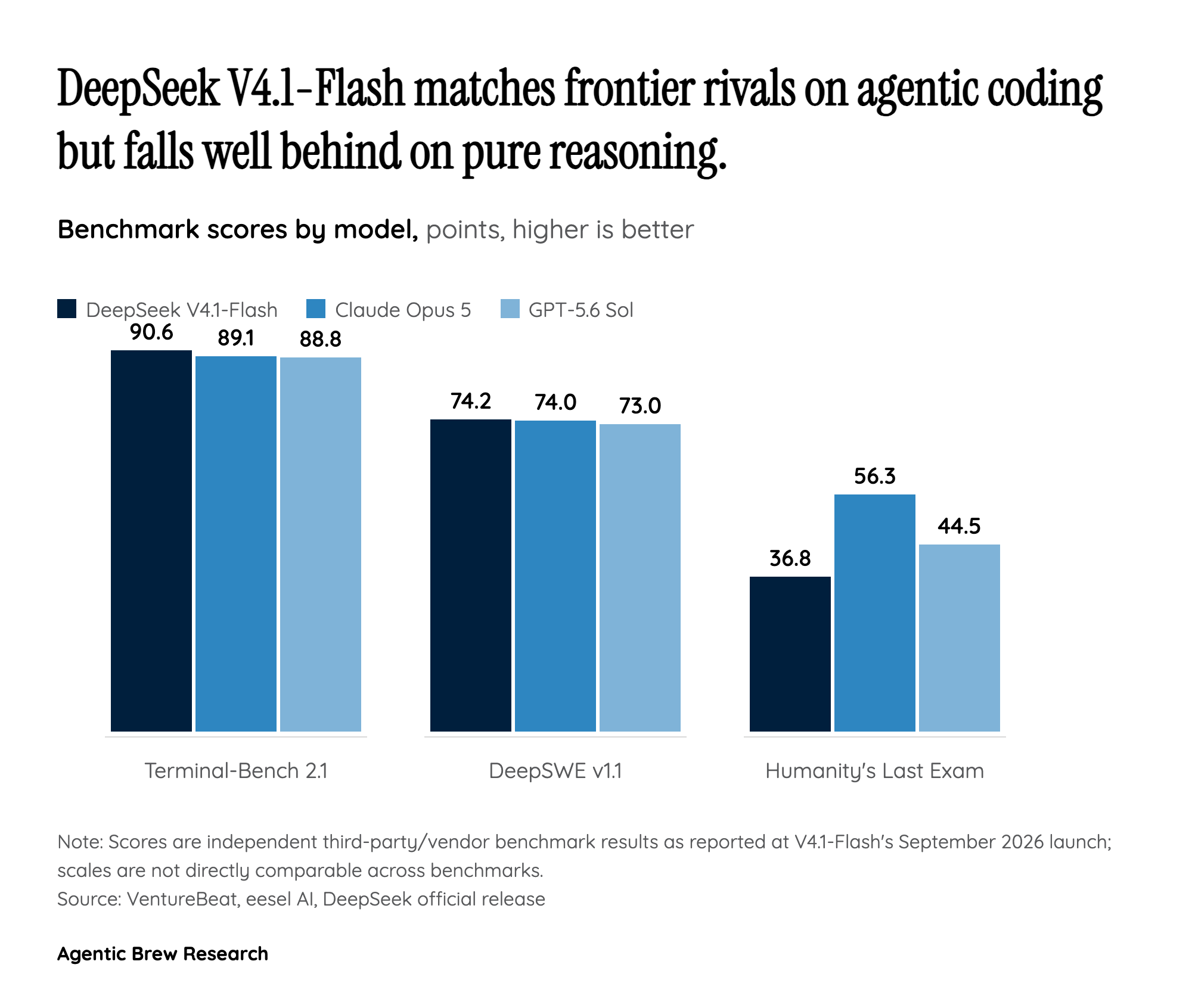
DeepSeek V4.1-Flash matches Claude Opus 5 and GPT-5.6 Sol on agentic coding benchmarks but trails both by a wide margin on Humanity's Last Exam, a pure-reasoning test.

On agentic and coding-adjacent evaluations, V4.1-Flash genuinely competes with - and occasionally edges out - both Claude Opus 5 and GPT-5.6 Sol. It scored 90.6 on Terminal-Bench 2.1 versus 89.1 and 88.8 for its rivals, and 74.2 on DeepSWE v1.1 versus 74.0 and 73.0 [2][3], all while charging a fraction of what OpenAI and Anthropic charge for comparable throughput [3]. Independent evaluator OpenDesign found V4.1-Flash delivered '98% of GPT-6 Astra's quality score at 1.4% of its cost' on design tasks [3], a result DeepSeek and its supporters have pointed to as evidence the model closes the gap with far pricier frontier systems on real-world, tool-using work.

But the picture flips sharply on tests of pure reasoning. On Humanity's Last Exam, V4.1-Flash scored 36.8 against GPT-5.6 Sol's 44.5 and Claude Opus 5's 56.3, and on the harder Terminal-Bench 3.0 it scored 30.0 against 34.4 and 43.3 respectively [3]. That gap suggests V4.1-Flash was optimized specifically for cheap, cache-heavy agentic and tool-use workloads rather than general reasoning depth. It also explains why the OpenDesign-style benchmark wins have drawn pushback: skeptics have dismissed narrow, LLM-judged front-end design comparisons as 'benchmaxxing' rather than a meaningful measure of capability, and at least one direct user reported that output quality noticeably degraded mid-session after a routing change - a complaint that cuts directly against the marketing narrative of a uniformly stronger model.

A Forced Migration Dressed Up As A Feature

DeepSeek's stated rationale for retiring V4-Pro is straightforward: internal and external testing found V4.1-Flash beats its own flagship on performance, cost, speed and total completion time [6]. The mechanics of that retirement are less straightforward for anyone actually running production workloads on V4-Pro. Starting at 04:00 UTC on September 14, 2026, all deepseek-v4-pro requests were set to automatically route to V4.1-Flash and be billed at Flash-series rates, continuing until a future V4.1-Pro ships [6][7]. Following user pushback, DeepSeek said it would keep V4-Pro API access available past that date at unchanged billing [7]- a partial reversal that suggests the original plan underestimated how disruptive an involuntary model swap would be for paying customers.

The underlying concern, raised on Hacker News, is one of hosted-API reliability rather than model quality: 'The model you are carefully tested and optimized against can change' [2]. For teams that tuned prompts, evals, and guardrails against V4-Pro's specific behavior, a silent swap to a differently-shaped model - even a nominally better one - can break carefully calibrated systems. DeepSeek's simultaneous release of V4.1-Flash's weights on Hugging Face under an MIT license [8]offers a theoretical self-hosting escape hatch from that dependency risk, but as the model's own hardware requirements make clear, that escape hatch is not a realistic option for most of the customers it would need to protect.

The Price War That Erased Billions Overnight

The market reaction to V4.1-Flash's pricing was immediate and measurable. Bloomberg reported that shares in MiniMax Group and Z.ai plunged more than 8% in Hong Kong trading on announcement day, while Alibaba Group Holding slid more than 2%, with the report framing DeepSeek's cut-rate pricing as dealing 'a fresh blow to OpenAI' as well [9]. DeepSeek also positioned V4.1-Flash as outperforming Moonshot AI's Kimi K3 while undercutting it on price, extending the squeeze to a third Chinese rival in the same news cycle [9].

The timing is not incidental. DeepSeek is preparing a domestic listing on Shanghai's STAR Market, reportedly having engaged CITIC Securities and seeking a valuation around $75 billion in current fundraising [2][4]. A launch that simultaneously tops benchmark leaderboards and crushes prices strengthens exactly the narrative an IPO roadshow needs. That narrative got complicated on the very same day: SiliconANGLE reported that Anthropic identified DeepSeek among seven China-based labs it says are running distillation campaigns against Claude, citing 12.1 million such exchanges in July alone [10]. DeepSeek's cost and capability gains are, in other words, advancing under scrutiny over how the underlying model was trained - a tension that sits uneasily next to a company simultaneously polishing its pitch to public-market investors.

Flash In Name Only: A Branding Backlash From Local-Hosting Hobbyists

The 'Flash' label has historically signaled DeepSeek's smaller, cheaper, more self-hostable tier - V4-Flash launched in April 2026 at 284 billion total parameters with 13 billion active [11]. V4.1-Flash's 552-billion-parameter backbone, plus a separate 196-billion-parameter Engram memory system, is nearly double that predecessor's size [2][4]. On r/LocalLLaMA, that mismatch between the name and the reality prompted the local-hosting community to start calling it 'Flash Max,' with discussion centering on the 256GB-plus of system RAM and NVMe offloading of Engram weights required to run it at home - a far cry from what 'Flash' has previously implied for consumer hardware.

That tension points to a broader split in how the launch is being read. The same architecture and cost innovations that thrill API customers running cache-heavy agentic workloads - sustained streaming above 180 tokens per second, with one tester reporting 300 to 400 tok/s [2]- work directly against DeepSeek's original value proposition for the self-hosting crowd that made R1 a global phenomenon in the first place [12]. It also feeds a more skeptical read circulating among some direct users: that V4.1-Flash is less a genuine architectural leap than a substantially larger Flash tier, launched with an aggressive marketing and pricing push timed for maximum pre-IPO attention.

Historical Context

2025-01-20
DeepSeek-R1 released and became the most-downloaded free app on the US iOS App Store within a week, the moment that first put DeepSeek on the global map.
2026-04-24
DeepSeek released V4 as successor to V3.2 in two tiers: deepseek-v4-flash (284B params, 13B active) and deepseek-v4-pro (1.6T params, 49B active).
2026-07-31
DeepSeek unveiled a public beta API for its flagship V4-Flash model.
2026-08-06
DeepSeek announced plans for a 'significant' price increase to its AI services, a move later reversed by the September price cut.
2026-08-21
DeepSeek unveiled a test model aimed at rivaling Anthropic's Opus 4.8, a precursor to V4.1-Flash.
2026-09-10
DeepSeek formally launched V4.1-Flash, retiring V4-Flash and V4-Flash-Vision-Exp and announcing the phased retirement and rerouting of V4-Pro.

Power Map

Key Players
Subject

DeepSeek V4.1-Flash Launch, Pricing Cuts and V4-Pro Retirement

DE

DeepSeek

Developer of V4.1-Flash, simultaneously preparing a Shanghai STAR Market IPO with CITIC Securities engaged and a reported valuation target near $75 billion; a benchmark-topping, price-crushing launch functions as investor-facing proof ahead of that listing.

OP

OpenAI

Maker of GPT-5.6 Sol, V4.1-Flash's primary benchmark and pricing target; Bloomberg said DeepSeek's cheap pricing 'deals a fresh blow to OpenAI.'

AN

Anthropic

Maker of Claude Opus 5, the other benchmark target; V4.1-Flash matches or edges Opus 5 on some agentic tests but trails it significantly on reasoning evals, while Anthropic separately alleged DeepSeek is among several China-based labs distilling Claude's outputs.

Z.

Z.ai, MiniMax Group and Alibaba

Chinese AI and tech rivals whose shares fell on announcement day - MiniMax and Z.ai more than 8% in Hong Kong trading, Alibaba more than 2% - reflecting investor expectation that DeepSeek's pricing squeezes their margins.

EX

Existing V4-Pro API customers

Paying users whose production deployments are being auto-migrated to a different underlying model without a conventional deprecation window, prompting reliability concerns; DeepSeek partly reversed course after user pushback, keeping V4-Pro access available past September 14 at unchanged billing.

Fact Check

12 cited
  1. [1] DeepSeek-V4.1-Flash
  2. [2] DeepSeek V4.1-Flash
  3. [3] DeepSeek V4.1-Flash debuts with $0.003/1M off-peak cached input rate and benchmarks eclipsing GPT-5.6 Sol, Claude Opus 5
  4. [4] DeepSeek V4.1-Flash launch and STAR Market IPO
  5. [5] DeepSeek V4.1-Flash Model Launch
  6. [6] DeepSeek formally launches V4.1-Flash, routes V4-Pro requests to Flash
  7. [7] DeepSeek V4.1-Flash: Pricing, Specs, and V4-Pro Routing
  8. [8] DeepSeek V4.1-Flash released on Hugging Face, replacing V4-Pro
  9. [9] DeepSeek's New Low-Cost Model Deals a Fresh Blow to OpenAI, Z.ai
  10. [10] DeepSeek releases V4.1-Flash, says it outperforms flagship V4-Pro
  11. [11] DeepSeek Unveils Newest Flagship a Year After AI Breakthrough
  12. [12] DeepSeek (chatbot)

Source Articles

Top 5

THE SIGNAL.

Analysts

Praised V4.1-Flash's raw throughput, saying: 'I was getting something like 300-400 tok/s which was just insanity. It was running so much faster than the toolcalls themselves.'

Community tester
Independent tester, cited by eesel AI

Found V4.1-Flash delivers near-parity quality with a much pricier frontier model on design tasks: '98% of GPT-6 Astra's quality score at 1.4% of its cost.'

OpenDesign
Independent benchmark evaluator, cited by VentureBeat

Characterized the scale of the price cut and the broader Chinese low-cost-model trend as squeezing margins for US model makers, calling it a 'death zone for US model makers.'

Bloomberg Intelligence analysts
Analysts, Bloomberg Intelligence, cited by eesel AI
The Crowd

🚀 Introducing DeepSeek-V4.1-Flash: smarter, faster, more efficient. 🔹 Introducing the smallest model in our new architecture family, with native visual understanding. 🔹 Designed for greater capability, faster inference, higher throughput, and scaling to larger models. 1/6

@@deepseek_ai27254

I've asked Astra to read the DeepSeek v4.1 Flash paper and compare it to the original Transformer architecture in 3D - you can zoom in an inspect each element side by side. Things have changed quite a bit. Try yourself: architecture.petergostev.chatgpt.site

@@petergostev2251

DeepSeek V4.1 Flash just beat GPT 6 Astra on the BridgeBench ocean sunset test. For 3 cents. $0.03 vs $0.59. Twenty times cheaper. Faster too. And look at the two oceans. The DeepSeek one is better. Five days ago I said OpenAI might kill Anthropic on cost. Now a Chinese lab

@@bridgemindai2119

DeepSeek V4-1 Flash is out

@u/tiguidoio1500
Broadcast
DeepSeek V4.1 Flash Is INSANELY GOOD! Fast, Cheap, Powerful! (Fully Tested)

DeepSeek V4.1 Flash Is INSANELY GOOD! Fast, Cheap, Powerful! (Fully Tested)

NOVO DeepSeek V4.1 Flash é MUITO MELHOR do que você pensa

NOVO DeepSeek V4.1 Flash é MUITO MELHOR do que você pensa

Deepseek V4.1 Flash (Fully Tested): 200 TPS & Beats Astra!? (+New Architecture Overview)

Deepseek V4.1 Flash (Fully Tested): 200 TPS & Beats Astra!? (+New Architecture Overview)

DeepSeek V4.1-Flash Launch, Pricing Cuts and V4-Pro Retirement — AI News | Agentic Brew