OpenAI launches Workspace Agents for ChatGPT business plans
TECH

OpenAI launches Workspace Agents for ChatGPT business plans

32+
Signals

Strategic Overview

  • 01.
    OpenAI launched Workspace Agents in research preview on April 22, 2026 for ChatGPT Business, Enterprise, Edu, and Teachers plans, positioning them as the Codex-powered successor to custom GPTs.
  • 02.
    Unlike per-user GPTs, Workspace Agents are shared, cloud-hosted agents that execute long-running, multi-step workflows across Slack, Gmail, Google Drive, Salesforce, Notion, and Atlassian Rovo, and continue running while users are offline.
  • 03.
    Workspace Agents are free during the research preview and switch to credit-based pricing starting May 6, 2026, introducing usage-metered revenue on top of seat licenses.
  • 04.
    OpenAI will require organizations on Business, Enterprise, Edu, and Teachers plans to convert existing custom GPTs into Workspace Agents, signaling a full deprecation of the GPTs surface for organizational use.

The Quiet Obsolescence of Custom GPTs

The most consequential detail in OpenAI's launch is not what Workspace Agents add, but what they replace. Custom GPTs — the showpiece of DevDay 2023 and the foundation of a nascent GPT Store — are being effectively retired inside the enterprise. OpenAI has told Business, Enterprise, Edu, and Teachers customers that they will be required to convert GPTs into Workspace Agents, a migration path that signals the older primitive was never really fit for team workflows.

The reason is structural. Custom GPTs were per-user, static, and answered one prompt at a time; they could not hold shared team context, could not schedule themselves, and could not chain tools across long-running tasks. Workspace Agents invert each of those defaults: they are shared by construction, run in the cloud while users are offline, and can be put on schedules or wired into Slack channels to pick up requests on their own. For companies that invested in GPTs as internal knowledge assistants, the migration is not cosmetic — it is a rebuild around a fundamentally different execution model.
Co-opetition With Slack, Salesforce, and Google Gets Awkward

Workspace Agents are only as powerful as the apps they can reach, and OpenAI's connector list reads like a tour of its competitors. Slack and Salesforce, both owned by Salesforce, are cited as first-class integration surfaces — yet Salesforce's own Agentforce platform sells enterprises the opposite pitch: let Salesforce's models orchestrate your workflows. Google Drive and Gmail are named connectors, but Google simultaneously sells Agentspace. Microsoft 365 sits adjacent to the same automation territory targeted by Copilot Studio.

The tension is that each integration point doubles as a potential kill switch. A decision by Salesforce to tighten Slack's API terms, or by Google to throttle Gmail agent access, would materially shrink the blast radius of Workspace Agents. OpenAI is betting that enterprise customers will pull the integrations through by demand faster than incumbents can close them off — a bet that is plausible given Aaron Levie's framing that AI agents turn enterprise SaaS into 'headless software' consumed by other agents, but one that leaves OpenAI dependent on partners whose strategic interests point the other direction.

From Seats to Credits: A New Revenue Model Hides in the Fine Print

Buried in the launch is a pricing detail with outsized strategic weight: Workspace Agents are free only until May 6, 2026, after which OpenAI shifts to credit-based pricing. Enterprise ChatGPT has until now been a seat-license business anchored at roughly $20 per user per month for the Business tier. Credit-based pricing breaks that symmetry. An agent that runs autonomously on a cron schedule, hits Slack every few minutes, and fans out to Salesforce and Gmail does not consume one seat — it consumes compute measurable in tokens and tool calls.

This matters for two reasons. First, it aligns OpenAI's revenue with the heaviest use cases exactly as Microsoft Copilot struggles with low per-seat utilization (Futurum's data shows Copilot at roughly 15 million paid seats against 450 million Microsoft 365 commercial users, about 3.3% penetration). A credit model captures spend even when humans are not in the loop. Second, it inverts enterprise budgeting: procurement teams accustomed to forecasting AI cost per headcount will need new controls, since a single poorly scoped agent can burn credits in a weekend. The May 6 date is effectively the meter-on moment for autonomous ChatGPT.

The Lock-In Argument Gets Harder to Ignore

The most pointed pushback on Workspace Agents comes from analysts focused on model-routing architecture. Dr. Alistair Finch argues that dynamic routing to the most cost-effective model is now a competitive necessity, not a luxury. Constellation Research's 2025 estimate that single-vendor AI commitments can carry switching costs exceeding 200% of initial investment within three years lands harder when the agent's orchestration logic, memory, scheduling, and tool bindings all live inside one vendor's cloud.

Workspace Agents do not expose a routing layer. They run on Codex, on OpenAI's infrastructure, with memory and governance stored in OpenAI's systems. For IT buyers who have spent the past year standing up LLM gateways and model-agnostic abstractions — LangChain, LlamaIndex, or custom routers — the product is a step back toward vertical integration. The counter-argument, echoed by TechBuzz.ai's framing that 'the enterprise AI battle is moving from features to autonomous capability,' is that autonomy reliability is so difficult that a single-stack approach is worth the lock-in. Which view wins will be decided not in 2026 but in the procurement cycles of 2027, when credit bills come due and renewal leverage gets tested.

Security Debt Is Being Written Faster Than Governance Can Pay It Down

OpenAI is shipping role-based access, Compliance API visibility, approval policies for sensitive actions, and agent suspension into the preview. But the attack surface expands faster than those controls. An agent with Gmail send rights, Drive read rights, and Slack posting rights is a prompt-injection target the moment it processes untrusted content — a customer email, a shared doc, a pasted link. WebProNews and SiliconANGLE both flag that agent permissions in practice tend to exceed intended scopes.

The governance model also assumes a sophistication many IT orgs do not yet have. Approval workflows only work if admins know which actions to gate; Compliance API logging only helps if someone is reading the logs. Edu and Teachers plans — newly in scope — introduce an even thinner administrative layer, with school districts inheriting enterprise-grade tooling without enterprise-grade security teams. Workspace Agents are arriving in classrooms and CRMs simultaneously, and the visibility features OpenAI cites are, by its own admission, still rolling out.

Historical Context

2023-11-06
OpenAI introduced custom GPTs at DevDay, letting users build customized ChatGPT versions for specific roles and tasks — the direct predecessor to Workspace Agents.
2026-04-22
OpenAI announced Workspace Agents in research preview for Business, Enterprise, Edu, and Teachers plans, powered by Codex and integrated with Slack, Gmail, Salesforce, Notion and more.
2026-05-06
Scheduled end of the free research-preview window; Workspace Agents transition to credit-based pricing, introducing usage-metered economics to ChatGPT's enterprise tiers.

Power Map

Key Players
Subject

OpenAI launches Workspace Agents for ChatGPT business plans

OP

OpenAI

Vendor launching Workspace Agents and repositioning ChatGPT from a chatbot into an enterprise automation platform; owner of the Codex models that power the agents.

CH

ChatGPT Business, Enterprise, Edu, and Teachers customers

Target users of the research preview; get access to build, share, and schedule agents subject to admin governance, and must eventually migrate their custom GPTs.

SL

Slack (Salesforce) and Salesforce CRM

Primary messaging and CRM integration surfaces where agents pick up requests and update records; Salesforce is simultaneously a competitor via its Agentforce platform.

MI

Microsoft

Incumbent enterprise AI rival with Copilot Studio and Copilot agents embedded in Microsoft 365; Workspace Agents directly target Copilot's productivity niche.

GO

Google, Notion, Atlassian Rovo

Connected app ecosystem providing data sources and actions (Drive, Gmail, docs, tickets); Google is simultaneously a competitor through Agentspace.

EN

Enterprise and IT administrators

Responsible for role-based access, approval policies for sensitive actions, and Compliance API auditing of agent activity; front-line owners of the new governance risk surface.

THE SIGNAL.

Analysts

"Argues that dynamic, model-agnostic routing has become a competitive necessity, implying Workspace Agents' single-vendor Codex dependency is a strategic liability for cost-sensitive enterprises. 'The ability to dynamically route tasks to the most cost-effective model is no longer a luxury; it's a competitive necessity.'"

Dr. Alistair Finch
AI strategist cited by Epsilla

"Warns that single-vendor AI commitments carry severe switching costs, a risk amplified by Workspace Agents' OpenAI-only architecture: 'enterprises that heavily rely on a single proprietary AI vendor face switching costs that can exceed 200% of their initial investment within three years.'"

Constellation Research
Industry analyst firm (2025 report cited by Epsilla)

"Frames Workspace Agents as a regime change in enterprise AI, arguing that 'the shift from conversational assistants to autonomous task execution changes the value proposition entirely' and that 'the enterprise AI battle is moving from features to autonomous capability.'"

TechBuzz.ai editorial
AI trade publication
The Crowd

"Introducing workspace agents in ChatGPT—shared agents that can handle complex tasks and long-running workflows across tools and teams."

@@OpenAI0

"This is probably the biggest news yet in software going headless, and will bring knowledge work agents to the masses. The new ChatGPT agents have access to any of the tools and data you want to work with, with complete coding and tool use available to them."

@@levie0

"I hereby proclaim 2026 is the year of AI agents. "Today, we're introducing workspace agents in ChatGPT. Teams can now create shared agents that handle complex tasks and long-running workflows." "Workspace agents are an evolution of GPTs. Powered by Codex, they can take on many...""

@@firstadopter0
Broadcast
Introducing workspace agents in ChatGPT

Introducing workspace agents in ChatGPT

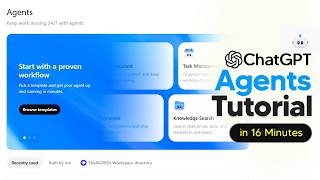
How To Use ChatGPT Agents - Workspace Agents Tutorial

How To Use ChatGPT Agents - Workspace Agents Tutorial

ChatGPT Workspace Agents by OpenAI

ChatGPT Workspace Agents by OpenAI