Chinese AI labs design their own inference chips
TECH

Chinese AI labs design their own inference chips

37+
Signals

Strategic Overview

  • 01.
    DeepSeek is developing a custom AI chip designed for inference rather than training, working with external partners and privately hiring chip-design engineers to cut its reliance on Nvidia and Huawei.
  • 02.
    DeepSeek is simultaneously raising about $7 billion in its first outside funding round, at a reported valuation of $52 billion to $59 billion.
  • 03.
    Zhipu AI is weighing its own custom ASIC after demand for its GLM-5.2 model reportedly surged as much as 27x in a week, though it has made only early inquiries and has not selected a chip-design partner.
  • 04.
    US export controls on advanced foundries and high-bandwidth memory remain the main obstacle, and any viable custom chip is likely years away.

Deep Analysis

China's Labs Aren't Trying to Out-Nvidia Nvidia

DeepSeek has spent roughly the past year quietly building a custom chip aimed squarely at inference - the stage where a trained model actually answers users, as opposed to the training runs that create it [1]. That distinction is the whole strategy. Training demands the most flexible, most powerful silicon available; inference runs the same fixed set of operations billions of times, which is exactly the workload a purpose-built ASIC can execute more cheaply and at lower power than a general-purpose GPU. A chip narrowed to DeepSeek's own model architecture does not have to beat an Nvidia flagship at everything - it only has to run DeepSeek's models well, on hardware the company can actually obtain.

Zhipu, the Beijing lab behind the open GLM family, is weighing the same move for the same reason, after daily token usage of its GLM-5.2 model reportedly jumped as much as 27x in a single week [2]. Neither lab is trying to become a merchant chipmaker selling to the world. The goal is control: when the most capable Nvidia parts are off-limits and even domestic supply is uncertain, owning the silicon your product runs on stops being a cost decision and becomes a question of whether you can keep serving users at all.

The $7 Billion Tell

The clearest signal of how serious this is comes from DeepSeek's balance sheet, not its lab. The company is raising roughly $7 billion in its first-ever outside funding round, at a reported valuation between $52 billion and $59 billion [1]. For a firm that built the world's most talked-about efficient models while famously refusing outside capital, reversing that stance is telling - designing a competitive AI chip is estimated to cost on the order of $500 million and take years, not months [5]. Model efficiency alone does not buy a foundry relationship or a memory-supply contract.

That capital intensity is also why this is a rich-lab story. Only labs with a runaway model and a balance sheet to match can credibly fund custom silicon, which is part of why DeepSeek and Zhipu - not smaller Chinese startups - are the ones at the front of the line. The raise reframes DeepSeek from a scrappy efficiency shop into something closer to a vertically integrated AI company willing to spend heavily to own its stack.

A Design Is the Easy Part

The skeptics' point, repeated across every serious discussion of this news, is that drawing a chip is not the same as manufacturing one. US export controls bar Chinese designers from the most advanced overseas foundries, so any DeepSeek or Zhipu part would have to be produced on domestic fabs that trail the leading edge [1]. A separate set of curbs restricts access to high-bandwidth memory - and HBM sits at the center of inference performance, making it precisely the wrong component to be short of. Analyst Richard Windsor of Radio Free Mobile put the ceiling bluntly, arguing DeepSeek has almost no chance of selling silicon outside China unless it gains access to leading-edge manufacturing [3].

Zhipu's own internal estimate reportedly puts a viable custom ASIC more than two years out [2]. In other words, the announcements describe intent and early hiring, not a product anyone can buy today - and the binding constraints are exactly the parts of the supply chain that export policy was designed to choke. That gap between ambition and manufacturable reality is where most of the honest disagreement about this story lives.

Huawei, Not Nvidia, Has the Most to Lose

Huawei, Not Nvidia, Has the Most to Lose
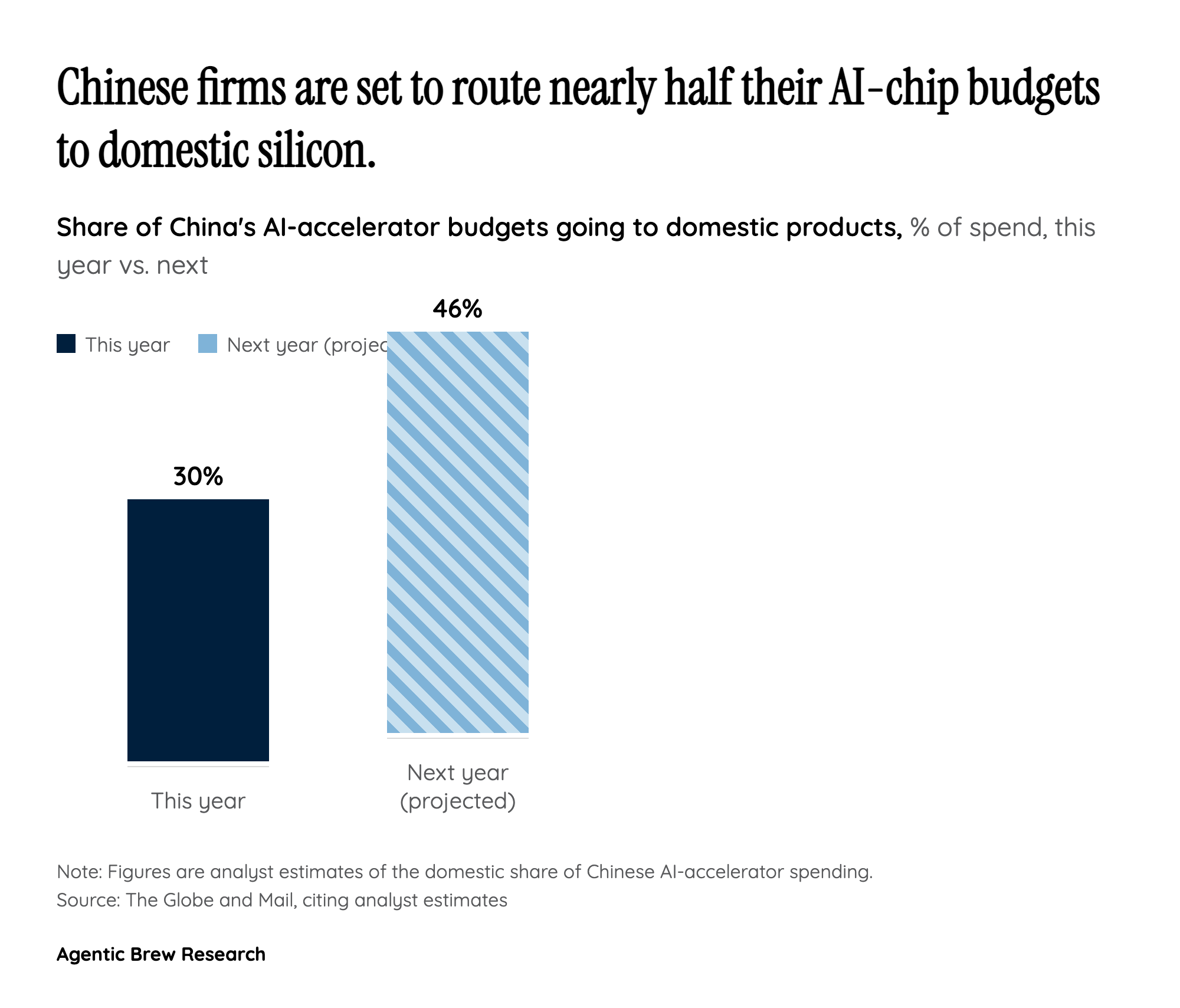
Analyst estimates show the domestic share of China AI-accelerator budgets rising from about 30% to 46%.

The reflexive read is that this is bad news for Nvidia, whose shares slipped about 1.6 percent on the report [3]. But Nvidia's most advanced chips are already effectively barred from China's data-center market, so the incremental damage there is limited. The party with more exposure is Huawei. As US parts vanished, Huawei's Ascend line filled the gap - and DeepSeek itself shifted to Huawei's Ascend chips for its V4 model earlier in 2026 [1]. DeepSeek and Zhipu now building their own silicon points the same self-reliance logic one layer down, at the domestic incumbent that replaced Nvidia.

The market structure shows why that matters. Reporting citing analyst data projects Huawei holding the majority of China's AI accelerator market in 2026, with Cambricon a distant second [4]. Every lab that brings inference in-house chips away at that concentration and feeds a domestic ASIC design-services market that barely existed two years ago. The paradox is hard to miss: an export policy meant to slow China's AI stack is, at the margin, pushing it to build every layer of that stack itself.

What the Crowd Is Arguing About

The community reaction split along a predictable line: enthusiasm for the strategic logic, skepticism about the physics. On Reddit, the dominant thread welcomed more competition and treated in-house silicon as inevitable, with one engineer's plain-English breakdown of why an application-specific chip beats a general-purpose GPU for repetitive inference drawing the most agreement. The sharpest counter-voices kept returning to manufacturing - hiring chip designers is easy, one popular comment noted, but lithography and advanced nodes are not. A widely-shared quip captured the market's confusion by mocking the incoherence of simultaneously believing DeepSeek needs no advanced chips and that it secretly hoards them.

On X, the story spread first as breaking-news relay from finance and market accounts, framed around what a cheaper, DeepSeek-optimized part would mean for Nvidia and the broader semiconductor trade. YouTube coverage leaned two ways at once - market commentators reading it as a fresh threat to semiconductor margins, and technical channels revisiting DeepSeek's earlier work running inference on Huawei hardware. The throughline across all three platforms is consistent: almost no one doubts the motive, and almost everyone doubts the timeline.

Historical Context

2024
DeepSeek's founder acknowledged in a rare interview that US export controls had become a major obstacle for the company.
2025-01-27
Nvidia lost close to $600 billion in market value in a single day, its largest one-day loss ever, after DeepSeek's R1 stoked fears that cheaper models would cut GPU demand.
2026-04
DeepSeek released its V4 model optimized for Huawei's Ascend chips, deepening a domestic-hardware reliance it is now moving to reduce.
2026-06-24
OpenAI unveiled its first custom inference chip, co-designed with Broadcom, underscoring an industry-wide move toward in-house inference silicon.
2026-07-07
Reuters reported that DeepSeek is quietly developing its own inference chip, prompting a wave of coverage across news and social platforms.

Power Map

Key Players
Subject

Chinese AI labs design their own inference chips

DE

DeepSeek

Hangzhou lab designing a custom inference chip while raising its first external funding round; seeks operational control over compute after export limits cut off Nvidia's top parts.

ZH

Zhipu AI

Beijing lab behind the open GLM models; exploring a custom ASIC after GLM-5.2 demand turned compute into a ceiling on growth rather than a line item.

NV

Nvidia

Incumbent GPU leader already barred from selling its most advanced chips in China; shares slipped on the DeepSeek report, though its China data-center exposure is already limited.

HU

Huawei

Dominant domestic supplier via its Ascend line that DeepSeek and Zhipu currently lean on; its grip weakens as those same labs move to build their own silicon.

CA

Cambricon and domestic ASIC design houses

Chinese chip designers competing for the new customer segment US export policy created; Cambricon is projected to hold a meaningful slice of China's accelerator market in 2026.

BE

Beijing

Pressing domestic champions toward indigenous chip alternatives as a matter of strategic self-reliance, shaping the incentives every Chinese lab now faces.

Fact Check

5 cited
  1. [1] DeepSeek Is Building Its Own AI Chip to Cut Reliance on Nvidia and Huawei
  2. [2] Zhipu AI's Custom Chip Play for GLM Silicon
  3. [3] China's DeepSeek developing its own AI chip, sources say, sending Nvidia shares lower
  4. [4] China ASIC chip design gains ground as Huawei and Nvidia vie for AI accelerator market
  5. [5] DeepSeek and Zhipu AI advance self-developed chips

Source Articles

Top 5

THE SIGNAL.

Analysts

"Downplays the near-term threat to Nvidia, arguing Nvidia is already at zero in China and that DeepSeek has almost no chance of selling silicon outside China without access to leading-edge manufacturing."

Richard Windsor
Analyst, Radio Free Mobile

"Estimates that under free trade China would buy roughly 1.5 million H200 chips, about $30 billion in revenue, underscoring the scale of Nvidia sales the export regime forgoes."

John Vinh
Analyst, KeyBanc

"Expects the shift of Chinese AI-accelerator budgets toward domestic products to accelerate significantly between 2026 and 2028."

Goldman Sachs
Investment bank research

"Data cited in reporting suggests Huawei's Ascend 950 and Cambricon's Siyuan 690 can outperform Nvidia's China-market H20 by 50 to 150 percent in tokens per second."

Morgan Stanley
Investment bank research (cited by DigiTimes)
The Crowd

"BREAKING: China's DeepSeek is reportedly developing its own AI chip to cut dependence on Nvidia."

@@Polymarket889

"JUST IN: China's AI lab Ziphu weighs custom chip as demand for its GLM model soars - The Information."

@@WhaleInsider553

"SITUATION EXPLAINED: DeepSeek and ZAI are both developing their own custom AI chips. • ZAI: daily token usage up 27x since GLM's launch, making preliminary inquiries with Chinese chip design houses about a bespoke AI processor optimized for its models • DeepSeek: developing"

@@MTSlive30

"China's DeepSeek is developing its own AI chip"

@u/vigneshsmarther614
Broadcast
China's AI BAN?!, Qwen 4, GPT-5.6 Thursday, Grok 4.5 Today, Deepseek AI Chip, & Claude AGI! AI NEWS

China's AI BAN?!, Qwen 4, GPT-5.6 Thursday, Grok 4.5 Today, Deepseek AI Chip, & Claude AGI! AI NEWS

Tech In Major Trouble As DeepSeek Debuts New Chip, Silver Rejected And Bullish

Tech In Major Trouble As DeepSeek Debuts New Chip, Silver Rejected And Bullish

Deepseek is building their own AI Chips & GPUs!

Deepseek is building their own AI Chips & GPUs!