Meta and Microsoft Q2 2026 earnings: AI capex surge and investor reaction
TECH

Meta and Microsoft Q2 2026 earnings: AI capex surge and investor reaction

37+
Signals

Strategic Overview

  • 01.
    Meta's Q2 2026 revenue rose 28% year-over-year to $60.8 billion, but free cash flow collapsed 91% to $784 million from $8.55 billion a year earlier, and shares fell about 10% in after-hours trading.
  • 02.
    Meta's Q2 2026 capital expenditure was $31.1 billion, nearly double the $17.0 billion spent in Q2 2025.
  • 03.
    Meta narrowed and effectively raised its full-year 2026 capex guidance to $130-145 billion, up from the prior $125-145 billion range.
  • 04.
    Mark Zuckerberg defended Meta's compute buildout, saying the company is turning down outside offers to buy spare capacity at a premium in order to keep it for internal training and product use.
  • 05.
    Microsoft's fiscal Q4 2026 results, reported the same night as Meta's, beat expectations, with Azure cloud growth exceeding forecasts and shares rising rather than falling.
  • 06.
    Microsoft's net income for the quarter ended June 30, 2026 rose to $35.77 billion ($4.81 per share), up from $27.23 billion ($3.65 per share) a year earlier.
  • 07.
    Microsoft guided calendar-year 2026 capex to roughly $190 billion and disclosed FY2027 capex guidance of $255-260 billion, a roughly 35% jump.
  • 08.
    Combined 2026 capex across Alphabet, Microsoft, Meta and Amazon is projected to reach up to $725 billion, a 77% increase from the prior year.

Deep Analysis

Inside Meta's Free Cash Flow Collapse

Meta's Q2 2026 revenue grew 28% year-over-year to $60.8 billion, comfortably beating expectations [1]. But that growth was overshadowed by a near-total collapse in free cash flow, which fell 91% year-over-year to just $784 million, down from $8.55 billion in the same quarter a year earlier [2]. Investors reacted immediately, sending Meta shares down roughly 10% in after-hours trading [2].

The mechanism behind the collapse is straightforward. Meta's Q2 capital expenditure jumped to $31.1 billion, more than double the $17.0 billion it spent in the same period a year earlier [1]. Facing a widening bill for AI infrastructure, Meta narrowed and effectively raised its full-year 2026 capex guidance to a range of $130-145 billion [4]. CFO Susan Li attributed the increase to higher component pricing and additional data center costs [5], spending built ahead of future-year capacity needs [13], an admission that spending is running ahead of realized revenue rather than tracking it.

CEO Mark Zuckerberg pushed back directly on skepticism about the payoff, noting that Meta is fielding outside offers to buy its compute at a significant premium to what it paid, but is choosing not to sell [3]. He called it foolish to sell off compute for a short-term profit instead of reserving it for Meta's own AI roadmap, adding that he personally believes AI investors are going to be rewarded and feel very good over time [3].


Same Night, Opposite Verdicts: Microsoft vs. Meta

Microsoft reported its fiscal Q4 2026 results the same night as Meta, and the market's reaction could not have been more different. Azure cloud growth exceeded the 39.6% analysts had expected, helping send Microsoft shares up roughly 2% after the report [6]. Net income for the quarter ended June 30, 2026 rose to $35.77 billion, or $4.81 per share, up from $27.23 billion a year earlier [7].

Microsoft is spending just as aggressively as Meta, if not more so. It guided calendar-year 2026 capex to roughly $190 billion and disclosed FY2027 capex guidance of $255-260 billion, a roughly 35% jump [8]. CFO Amy Hood attributed about $25 billion of the increase to higher component pricing [5], echoing Meta's own explanation for its ballooning capex. The difference is that Microsoft's spending maps visibly onto Azure's accelerating growth rate, giving investors a legible return story that Meta's internal-model-training narrative does not yet offer.

Analyst Thomas Monteiro summarized the pattern investors are now applying across the sector, noting that Meta's report echoes what markets saw from Alphabet and Tesla the prior week: strong revenue growth, but even faster growth in spending [2]. That gap between spending growth and revenue growth, not the absolute size of the capex number, appears to be the variable driving whether a stock rises or falls on earnings night.

The $725 Billion Arms Race

Meta and Microsoft's earnings landed inside a much larger pattern. Combined 2026 capital expenditure across Alphabet, Microsoft, Meta and Amazon is projected to reach up to $725 billion, a 77% increase from the prior year [5][9], a figure commentators noted exceeds the GDP of a country like Switzerland or Turkey.

Alphabet had already previewed the market's new skepticism less than a week earlier: on July 23, 2026, it raised its 2026 capex guidance to $180-190 billion citing unprecedented AI compute demand, and its stock still fell roughly 7% despite record profit [10]. Amazon, by contrast, held its 2026 capex guidance steady at $200 billion [5]. Meta itself had already signaled this trajectory back in April 2026, when it first raised full-year capex guidance to $125-145 billion and saw shares drop 6-7% despite a revenue beat [11], meaning the market's punishing reaction to Meta's Q2 print was the continuation of a months-long repricing of AI capex risk that CNBC had already flagged as an industry-wide cash-flow squeeze back in February [12].

Credit Risk and the Limits of Investor Patience

Beyond the immediate stock reactions, the scale of hyperscaler spending is starting to raise structural concerns. Moody's vice president Kevin McNeil warned that even large, established players are embarking upon almost unprecedented capital investment that could pressure credit quality as they shift from asset-light to asset-heavy balance sheets [10].

UBS analysts separately flagged limited visibility into hyperscaler capex plans beyond 2027 as a continuing overhang on investor risk appetite, even where near-term AI demand looks solid [10]. That uncertainty is compounded by the fact that a meaningful share of the new spending is not purely demand-driven: both Meta and Microsoft cited rising component and memory pricing, not just AI compute demand, as a driver of their higher guidance [5], while Meta separately pointed to additional data center costs to support future-year capacity, meaning some of the spending is being built ahead of, rather than in direct response to, realized demand [13].

How Retail and Trading Communities Are Reading the Split

Retail investor communities have converged on a no-win framing for hyperscaler capex: raising it fuels fear of margin destruction, while cutting it would signal the AI buildout itself isn't working. Trading forums focused on memory-chip suppliers, which stand to benefit most directly from hyperscaler capex, read Meta and Microsoft's results as validating continued chip demand even as sentiment toward Meta's own stock stayed cautious, with one active thread debating whether Microsoft can throttle spending more freely than Meta given the different shape of their AI product roadmaps.

On social platforms, chatter around Meta's results skewed skeptical, drawing unfavorable comparisons to Microsoft's more explicit commitment to staying free-cash-flow positive despite its own rising capex, a contrast some read as an implicit dig at Meta's cash-flow trajectory. Commentary among finance-focused video channels framed the market as newly bifurcating hyperscalers by capex intensity, rewarding capex-lite business models and punishing heavy spenders unless the spending shows up in growth metrics like Azure's, which is roughly how the Meta-Microsoft divergence played out in practice.

Historical Context

2026-04-29
Meta's Q1 2026 earnings call raised full-year capex guidance to $125-145 billion (from $115-135 billion), sending shares down 6-7% despite a revenue beat.
2026-07-23
Alphabet guided full-year 2026 capex to $180-190 billion and its stock fell roughly 7% despite record profit, foreshadowing the capex-driven investor anxiety seen in Meta's and Microsoft's reports days later.
2025-07
Meta's Q2 2025 capex was $17.0 billion and full-year 2025 capex totaled $72.2 billion, both roughly half of the corresponding 2026 figures.
2026-02-06
Combined Big Tech AI spending was already approaching $700 billion for 2026 with free cash flow taking a hit industry-wide, a trend that culminated in the July 29 earnings reactions.

Power Map

Key Players
Subject

Meta and Microsoft Q2 2026 earnings: AI capex surge and investor reaction

ME

Meta Platforms / Mark Zuckerberg

CEO driving an aggressive AI infrastructure buildout; framed compute spend as feeding internal model training and 'personal agents' rather than external cloud rental, while free cash flow cratered and shares dropped roughly 10%

ME

Meta CFO Susan Li

Explained the capex guidance raise via higher component pricing and additional data center costs

MI

Microsoft / CFO Amy Hood

Guided calendar-year 2026 capex to roughly $190 billion and disclosed FY2027 capex of $255-260 billion

AL

Alphabet/Google CFO Anat Ashkenazi

Comparator hyperscaler executive; raised 2026 capex to $180-190 billion citing 'unprecedented' AI compute demand, yet Alphabet shares still fell roughly 7% on the guidance

AM

Amazon

Comparator hyperscaler holding 2026 capex guidance at $200 billion, unchanged

MO

Moody's (Kevin McNeil, Vice President)

Credit-rating agency figure warning that hyperscalers' unprecedented capital investment could pressure credit quality as they shift from asset-light to asset-heavy business models

UB

UBS analysts

Flagged limited visibility on hyperscaler capex trajectory beyond 2027 as a risk to investor risk appetite despite solid near-term AI demand

DA

Daniel Newman, CEO, The Futurum Group

Bullish industry analyst arguing the earnings night validated AI capex as demand-driven rather than speculative

Fact Check

13 cited
  1. [1] Meta Q2 2026 earnings report
  2. [2] Meta Platforms shares drop on AI spending concerns
  3. [3] Meta earnings: Zuckerberg defends free cash flow drop and AI capex
  4. [4] Meta Q2 beats revenue while legal charges and AI spending destroy free cash flow
  5. [5] Microsoft, Meta and Google silence AI spending critics as Big Tech capex swells to $725 billion
  6. [6] Microsoft reports Q4 earnings: will its massive AI capex finally pay off?
  7. [7] Microsoft (MSFT) Q4 2026 earnings report
  8. [8] Microsoft MSFT Q4 FY2026 earnings preview: Azure and capex take center stage
  9. [9] Big Tech's AI spending plans reach $725 billion
  10. [10] Meta, Microsoft and Amazon test the limits of AI capital spending
  11. [11] Zuckerberg defends $145 billion AI spending and its return on investment
  12. [12] Google, Microsoft, Meta and Amazon's AI cash burn
  13. [13] Meta just bumped its 2026 capex guidance

Source Articles

Top 5

THE SIGNAL.

Analysts

Sees Meta's results as part of a broader pattern among AI-spending megacaps in which revenue growth is being outpaced by even faster spending growth.

Thomas Monteiro
Analyst, Investing.com

Argues the same-night results from Microsoft, Meta and Google disprove the thesis that AI capex is speculative overbuilding.

Daniel Newman
CEO, The Futurum Group

Cautions that even large, established hyperscalers are taking on almost unprecedented capital investment levels that could ultimately threaten credit quality.

Kevin McNeil
Vice President, Moody's
The Crowd

Meta just reported Q2 earnings. Revenue was $60.8 billion, up 28%, and beat estimates. But costs grew 55%, more than double the revenue growth. Operating margin fell from 43% to 31%. EPS came in at $6.18 against estimates of $7.22, a 14% miss. Free cash flow dropped to $784...

@@HedgieMarkets322

Microsoft came out indirectly insulting Meta saying "we will remain FCF positive in 2027 despite increasing our CapEx."

@@pequityresearch28

Mark Zuckerberg, CEO of Meta, on why the AI bubble question matters less than everyone assumes: Zuckerberg starts by conceding the part almost nobody argues about anymore: "I think most people at this point view that AI is going to transform pretty much every category of..."

@@realBigBrainAI121

Both META and MSFT capex are up.

@u/Clackamas_river58
Broadcast
Investors punish heavy AI spenders, while rewarding the capex-lite business models

Investors punish heavy AI spenders, while rewarding the capex-lite business models

Microsoft Reports Record Spend on AI Hardware, as Earnings Beat Estimates

Microsoft Reports Record Spend on AI Hardware, as Earnings Beat Estimates

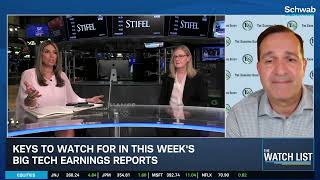
MSFT, META & AMZN CapEx & AI ROI to Set Stock Market Tone

MSFT, META & AMZN CapEx & AI ROI to Set Stock Market Tone