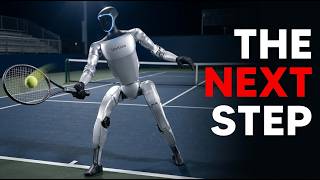
Humanoid robot beats human in autonomous tennis match
TECH

Humanoid robot beats human in autonomous tennis match

26+
Signals

Strategic Overview

  • 01.
    Galbot ET1, a humanoid robot from Galaxy General (Yinhe Tongyong) built with Tsinghua University, played a singles match against former professional champion Zheng Jie and a mixed-doubles exhibition at the opening ceremony of the Second World Humanoid Robot Games on August 22, 2026, in what organizers and state media billed as the world's first fully autonomous human-robot tennis match.
  • 02.
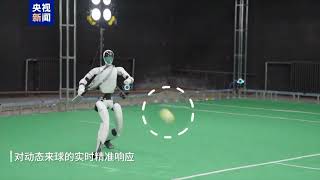
    CGTN reported the robot sensed incoming balls, predicted trajectories, adjusted its position, and returned shots without preset scripts or human control, with serves reportedly exceeding 100 km/h; the robot fell mid-rally once and got back up on its own.
  • 03.
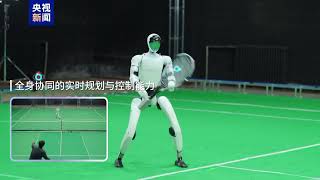
    The performance is powered by AstraBrain, which Galaxy General describes as the first model to unify a 'cerebrum' layer for tactical decision-making with a 'cerebellum' layer for whole-body motion control in a single architecture.
  • 04.
    None of the outlets that covered the match - Global Times, CGTN, SCMP, 36Kr, and BigGo - report that the robot defeated Zheng Jie in a scored contest; coverage consistently frames the encounter as an exhibition in which the robot held its own and traded shots evenly.

Deep Analysis

What Happened, and the AstraBrain Architecture Behind It

At the opening ceremony of the Second World Humanoid Robot Games on August 22, 2026, at Beijing's National Speed Skating Oval, Galaxy General's (Yinhe Tongyong) Galbot ET1 - developed with Tsinghua University - played a singles match against former professional champion Zheng Jie, plus a mixed-doubles exhibition, in what organizers and state media billed as the world's first fully autonomous human-robot tennis match. [1][2]

CGTN described the robot's play as fully self-directed: it sensed incoming balls, predicted their trajectories, adjusted its position, and returned shots "without preset scripts or human control." [3]Serves reportedly exceeded 100 km/h, leaving the robot only fractions of a second to react, and at one point the robot fell mid-rally and got back up on its own. [4][5]

The performance is powered by AstraBrain ("Galaxy StarBrain"), which Galaxy General describes as unifying a "cerebrum" layer handling task understanding and tactical decision-making with a "cerebellum" layer handling whole-body motion control in one architecture - "the world's first model capable of simultaneously handling 'thinking clearly' and 'executing properly.'" [4][5]Wang He, Galaxy General's founder and CTO, put the difficulty in physical terms: tennis "requires precise control of the robot's entire body to maintain balance, while its wrist movements must be highly precise, so the racket makes contact with the ball." [6]The ET1 itself had been unveiled just days earlier at the 2026 World Robot Conference. [6]
Correction: A Rally, Not a Confirmed Win

The topic is widely shared online as a robot "beating" a human player, but that claim does not hold up against the sourcing. None of the outlets that actually covered the match - Global Times, CGTN, SCMP, 36Kr, or BigGo - report a scored result or state that Galbot ET1 defeated Zheng Jie. Coverage instead consistently frames the encounter as an exhibition in which the robot "held its own" and traded shots evenly with a professional opponent. [4][7]The distinction matters: sustaining a rally against human-level serve speeds and shot placement is itself the milestone here, and it does not require inflating the result into a competitive victory that no source actually documents.

The Real Technical Story: Data-Efficient Training

The most concrete, underreported detail sits in a technical breakdown of the training method behind the skill: a research system called LATENT (Learns Athletic Tennis skills from imperfect human motion data), a collaboration between Tsinghua University, Peking University, GalBot, and Shanghai AI Lab, described as the technical lineage behind AstraBrain's tennis capability. What stands out is how little data it needed - just 5 hours of motion-capture footage from 5 amateur players, captured in a 3m x 5m practice space roughly 17 times smaller than a real tennis court. A three-layer architecture (a motion tracker, a latent action space, and a high-level policy) translates fragments of that human movement into motion the robot can execute, first trained in randomized, noisy simulation to close the sim-to-real gap. The reported results: 91% forehand and 78% backhand success on the physical robot (97%/82% in simulation), tracking balls arriving at 50-30 m/s. Standard reinforcement-learning baselines reportedly failed to sustain rallies at all under the same conditions - the data efficiency, not just the final demo, is the part worth paying attention to.

What the Games' Own Schedule Says Is Still Unsolved

Zoomed out, the 2026 Games are large: 2,056 robots, 666 teams from 16 countries, and 51 events (30 competitive, 21 work-scenario) across 1,301 matches, up 311% in robot count and 138% in teams year-over-year, with 96% of entries from China. [8][9]The prior 2025 edition drew 280 teams and 500+ robots across 26 events, though no breakdown of those events is available. [9]

An independent analysis of the full 2026 event schedule found several capability categories still require teleoperation or are absent from competition entirely: hurdles and jumping, weightlifting, kickboxing, obstacle navigation, stairs and ladder climbing, unstructured terrain, battery-endurance testing, and safe human-robot physical collaboration. [8]That gap suggests closed-loop perception at speed, explosive dynamics with hard landings, and adversarial contact remain largely unsolved industry-wide - even as a single showcase skill like tennis rallying clears a high bar.

Social Reception: Admiration, Skepticism, and the Company's Own Framing

Galaxy General's own account leaned into the milestone framing, posting "From AlphaGo to AstraTennis" and separately claiming the robot completed "100+ consecutive autonomous tennis rallies with zero mistakes" - claims made by the company itself, not independently verified in the press coverage above.

On r/singularity, a thread on the live-streamed doubles match showed genuine admiration for the ball-tracking and racket control, alongside an acknowledgment that the robots "aren't winning Wimbledon." One commenter argued the tracking, positioning, and coordination achievement is itself underrated by critics. By contrast, two r/SECourses threads were more skeptical, questioning whether the on-court speed is really impressive and noting the match took place in a controlled setting far removed from unstructured real-world tasks like pruning a tree or building a shed; the few comments there noted the robot still can't serve at professional speeds. A separate, unrelated project called AdaPT (Noitom Robotics, Shanghai AI Lab, Dobot, and SJTU), which learns pro-style strokes from broadcast footage of players like Nadal and Federer, also circulated on X during the same window - it is a different system from Galbot and AstraBrain and should not be conflated with this story.

Historical Context

2025-08-15
280 teams and 500+ humanoid robots competed across 26 events; no breakdown of event types is available in the sourcing.
2026-08-22
Opened at Beijing's National Speed Skating Oval with 2,056 robots, 666 teams from 16 countries, and 51 events (30 competitive, 21 work-scenario) across 1,301 matches - up 311% in robots and 138% in teams year-over-year, with 96% of entries from China. Tennis and table tennis were added for the first time; no end date for the Games is reported anywhere.
2026-08-22
Reportedly ran the 100m in 9.39s and cleared a 2.88m standing high jump, both said to exceed human records - a different robot from Galbot ET1, unrelated to AstraBrain.
2026-04-28
A non-humanoid, unrelated robot that won 3 of 5 matches against elite amateurs but only 1 of 7 games against professionals.

Power Map

Key Players
Subject

Humanoid robot beats human in autonomous tennis match

GA

Galaxy General / Galbot (Yinhe Tongyong)

Developer of the Galbot ET1 robot and the AstraBrain model

ZH

Zheng Jie

Former professional tennis champion, human opponent in the match

WA

Wang He

Founder and CTO of Galaxy General

TS

Tsinghua University

Academic collaborator on the Galbot ET1

CH

China Media Group (CMG)

Broadcast the match live globally

WO

World Humanoid Robot Games organizers (Beijing Municipal Government, World Robot Cooperation Organization, Asia-Pacific Robot World Cup International Council)

Co-organized the Games where the match took place

Fact Check

9 cited
  1. [1] World's first autonomous tennis-playing humanoid robot takes to the court
  2. [2] China's Galbot robot takes on tennis star Zheng Jie
  3. [3] Humanoid robot takes on tennis, testing AI's next frontier
  4. [4] World's First Human vs Robot Tennis Match Debuts
  5. [5] World's First Live Human-Robot Tennis Match Concludes: Galaxy General's Robot Gets Up After Falling and Keeps Playing
  6. [6] Galbot unveils sporty new humanoid model
  7. [7] Chinese robots tackle tennis, smash track records at World Humanoid Robot Games
  8. [8] The World Humanoid Robot Games Events Are A Market Map
  9. [9] World Humanoid Robot Games

Source Articles

Top 3

THE SIGNAL.

Analysts

Tennis is an extremely complex activity. It requires precise control of the robot's entire body to maintain balance, while its wrist movements must be highly precise, so the racket makes contact with the ball.

Wang He
Founder and CTO, Galaxy General

On the Games' broader trajectory: "Last year it was about whether they could run to the finish line. This year it's about whether they can get the job done."

Wang Peng
Researcher, Beijing Academy of Social Sciences
The Crowd

From AlphaGo to AstraTennis. In 2016, AlphaGo showed AI could master the digital world. A decade later, AI enters the physical world. Today, Galbot robots achieved the world's first live autonomous humanoid robot tennis match, competing against human athletes at the World https://t.co/Gbm6UaD4PL

@@GalbotRobotics205

WORLD RECORD! Galbot robot completed 100+ consecutive autonomous tennis rallies with zero mistakes! 🎾 Fully autonomous. 📷 Live Broadcast. A new milestone for humanoid robot tennis! #AstraTennis #EmbodiedAI #HumanoidRobots #WHRG #Galbot

@@GalbotRobotics40

Humanoid robots can now play tennis in the style of Nadal, Federer, and Djokovic, learned from broadcast footage. AdaPT (Noitom Robotics, Shanghai AI Lab, Dobot, SJTU) extracts professional player motions from TV broadcasts, retargets them to a humanoid, and learns both

@@TheHumanoidHub1091

WHRG'26 featured the first-ever live-streamed human-robot doubles tennis match, featuring Galbot humanoid robots

@u/Distinct-Question-16561
Broadcast
World First! China Creates Fully Autonomous Tennis-Playing Humanoid Robot

World First! China Creates Fully Autonomous Tennis-Playing Humanoid Robot

This Robot Can Play REAL Tennis🎾👀 China Unveils the World's First Humanoid Tennis Robot 人形机器人“网球运动员”

This Robot Can Play REAL Tennis🎾👀 China Unveils the World's First Humanoid Tennis Robot 人形机器人“网球运动员”

China's New Tennis Robot Reveals the Next Step for Humanoid Robots

China's New Tennis Robot Reveals the Next Step for Humanoid Robots