Amazon's $25B AI-infrastructure bond sale
TECH

Amazon's $25B AI-infrastructure bond sale

27+
Signals

Strategic Overview

  • 01.
    Amazon is raising at least $25 billion through a US dollar bond sale to fund its artificial intelligence infrastructure buildout, structured as eight tranches of senior unsecured notes maturing between three and 40 years.
  • 02.
    The new offering met noticeably weaker demand than Amazon's record March deal, with the order book paring to roughly $41 billion - about 1.6 times the deal size, well below the roughly 4-times average for 2026 US high-grade sales.
  • 03.
    Amazon tagged the proceeds for general corporate purposes and told its underwriters it does not plan to borrow again in 2026, bringing its total bond issuance to more than $100 billion over the past year.

Deep Analysis

The Deal Sold - But the Enthusiasm Did Not

Amazon got its money. The story is what it cost to get it. When Amazon sold its biggest-ever bond earlier in 2026, it was inundated with orders on the back of AI-boom optimism. This time the reception was measurably cooler: peak demand for the eight-part offering reached roughly $62 billion, about half the orders the March deal drew, and the book ultimately pared back to around $41 billion [2]. That works out to roughly 1.6 times the deal size, well short of the roughly 4-times oversubscription that has been average for US high-grade sales in 2026 [1].

The gap matters because bond demand is a real-time referendum on how much AI debt investors are willing to keep buying. Amazon remains a top-rated, cash-generative borrower, so this is not a credit scare. It is an appetite problem. With this sale, Amazon's total bond issuance has climbed to more than $100 billion over the past year [2], and even a balance sheet that strong is starting to test how much paper the market will absorb without demanding a richer price.

Why Investors Sold Bonds They Already Owned

The most telling signal was not in the new deal at all - it was in the secondary market. To make room for Amazon's new notes, investors dumped existing tech and hyperscaler bonds, pushing Amazon's outstanding paper about 7 to 10 basis points wider and SpaceX bonds about 9 to 13 basis points wider [3]. When buyers have to sell what they hold to fund what is coming, it is a sign that portfolios are already saturated with this kind of risk.

John Lloyd of Janus Henderson framed the rotation as housekeeping rather than panic - investors sell one position to free capital for another, the way someone sells one house before buying the next [3]. But the same firm is underweight tech and hyperscalers precisely because of the relentless supply. That combination - orderly today, but structurally cautious - is the quiet warning underneath an otherwise successful sale.

A Wall of AI Debt Only Gets Taller From Here

A Wall of AI Debt Only Gets Taller From Here
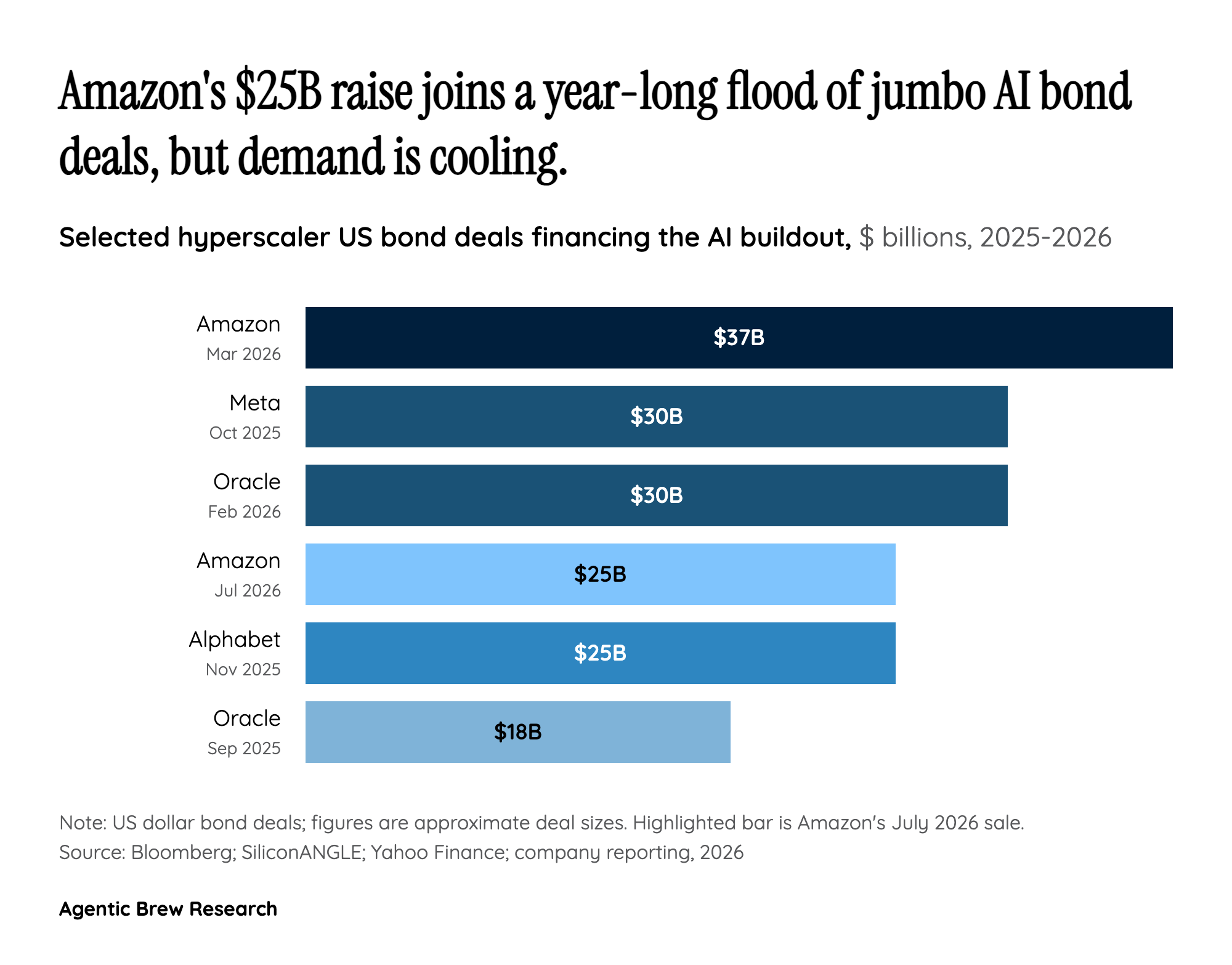
Selected 2025-2026 hyperscaler bond deals financing the AI infrastructure buildout, in US dollars

Amazon's raise is one brick in a wall that has been going up all year. Its 2026 capital-expenditure guidance sits near $200 billion, up sharply from about $131 billion in 2025 [1], and combined AI spending across Alphabet, Microsoft, Meta and Amazon is expected to top $700 billion this year [1]. Cash flow alone no longer covers that ambition, so the biggest names have turned to the bond market at a pace without precedent: the five largest hyperscalers issued about $121 billion of US corporate bonds in 2025, versus an average near $28 billion a year over 2020 to 2024 [4].

And the forecasts keep climbing. BofA Global Research raised its 2026 hyperscaler new-debt estimate to $175 billion from $140 billion after Amazon's deal [4], while global AI-linked debt issuance has already reached roughly $335 billion in 2026, more than double 2025 levels [2]. The wave has grown exotic as well as large - Alphabet sold the first 100-year tech bond in decades, and Oracle stacked a $30 billion February deal on top of an $18 billion one from the prior autumn [6]. Each new jumbo deal makes the next one harder to place.

What the Skeptics Are Watching

The bears are not arguing that Amazon will miss a coupon. They are questioning the shape of the financing. RBC BlueBay's Andrzej Skiba has warned that spreads will stay under pressure unless hyperscalers show more large-scale equity raising to fund capex rather than leaning almost entirely on debt [3]. The structure of this very deal sharpens that concern: the longest tranche is a note due in 2066 priced around 1.45 percentage points over Treasuries [5], ultra-long debt funding hardware that turns over far faster than 40 years. A separate skeptical read has cast the broader boom as AI increasingly financed by borrowing rather than earnings [6].

Retail investors picked up the same thread from a different angle. Community reaction skewed cynical and consumer-facing, with the loudest voices treating the raise as a cost that will eventually land on customers rather than a signal of financial strength, while a more analytical minority defended debt as a rational, tax-efficient way to match long-dated infrastructure to long-dated funding. That split - Wall Street asking whether the funding mix is sustainable and Main Street asking who ultimately pays - is the tension worth tracking as the next round of hyperscaler deals arrives.

Historical Context

2025-09
Oracle issued $18 billion of bonds in September 2025 as it ramped up borrowing to fund AI and data-center spending.
2025-10-30
Meta sold $30 billion of bonds backed by a roughly $125 billion order book, one of the largest corporate deals of the AI cycle.
2025-11
Alphabet raised $25 billion in November 2025 and in February 2026 sold the first 100-year bond from a tech issuer in decades.
2026-02
Oracle followed its September deal with a further $30 billion bond sale in February 2026.
2026-03
Amazon's record roughly $37 billion US bond deal in March 2026 drew far heavier demand than its July offering would.

Power Map

Key Players
Subject

Amazon's $25B AI-infrastructure bond sale

AM

Amazon

The issuer, borrowing to help fund a capital-spending program guided at roughly $200 billion in 2026; its decision to signal no further 2026 debt is meant to reassure a market growing wary of hyperscaler supply.

BA

Barclays, Goldman Sachs, JPMorgan Chase and Morgan Stanley

The lead underwriters managing the sale, who trimmed the spread on offer as orders came in and set the pricing that gauges investor appetite for AI-linked debt.

JA

Janus Henderson Investors

A bond investor that is underweight tech and hyperscalers and sold existing hyperscaler bonds to free up capital for the new deal, illustrating the crowding pressure building in the sector.

RB

RBC BlueBay Asset Management

A bond investor warning that hyperscaler spreads will stay under pressure unless issuers show more large-scale equity raising to fund AI capex rather than leaning on debt.

BO

BofA Global Research

Sell-side analysts whose revised forecasts frame how much more hyperscaler debt the market expects to absorb this year, after they raised their 2026 new-debt call to $175 billion from $140 billion.

Fact Check

6 cited
  1. [1] Amazon launches $25B bond sale to fund AI infrastructure
  2. [2] Amazon's New Bonds Get Cooler Reception as AI Debt Floods Market
  3. [3] Traders Are Dumping Tech Bonds to Make Room for Amazon's Deal
  4. [4] Analysts Revise AI Hyperscaler Debt Forecasts Higher
  5. [5] Amazon Targets $25 Billion Bond Sale to Accelerate AI Infrastructure
  6. [6] Is Your AI Funded By Junk Bonds?

Source Articles

Top 5

THE SIGNAL.

Analysts

"Frames the selling of hyperscaler bonds as portfolio rotation rather than distress: investors are freeing up capital to buy the new Amazon issue, the same reason people sell one house before buying another."

John Lloyd
Global head of multi-sector credit, Janus Henderson Investors

"Argues that unless the market sees more evidence of large-scale equity raising to fund AI capex, spreads on hyperscaler debt are likely to remain under pressure."

Andrzej Skiba
Head of BlueBay US fixed income, RBC Global Asset Management

"Expects continued heavy issuance, saying there remains an expectation of a lot of capital to be raised in this sector."

John Servidea
Co-head of investment-grade debt capital markets, JPMorgan

"Describes current conditions as fertile ground in capital markets, encouraging issuers to move early in the year while demand holds."

George Catrambone
Head of fixed income, Americas, DWS
The Crowd

"JUST IN: Amazon reportedly seeking to raise at least $25,000,000,000.00 in bond sales as it ramps up AI spending."

@@Polymarket475

"Amazon plans to raise at least $25 billion through an eight-part bond sale, as it looks to continue its massive artificial intelligence buildout, sources told CNBC's David Faber. The company has also shared with its underwriters that it won't issue any more debt this year,"

@@CNBC21

"JUST IN: Amazon to raise $25 billion from bond sale"

@@Kalshi192

"Amazon aims to raise $25 billion from bond sale, Bloomberg News reports"

@u/spicykimchi_inmybutt1600
Broadcast
Amazon Bond Sale Looks to Raise At Least $37 Billion | Bloomberg Tech 3/10/2026

Amazon Bond Sale Looks to Raise At Least $37 Billion | Bloomberg Tech 3/10/2026

Amazon Looks to Raise At Least $37 Billion with Bond Sale | Bloomberg Tech

Amazon Looks to Raise At Least $37 Billion with Bond Sale | Bloomberg Tech

Amazon’s $42B AI Debt

Amazon’s $42B AI Debt