Meta's Own Benchmarks Diverge Sharply From Independent Scoring
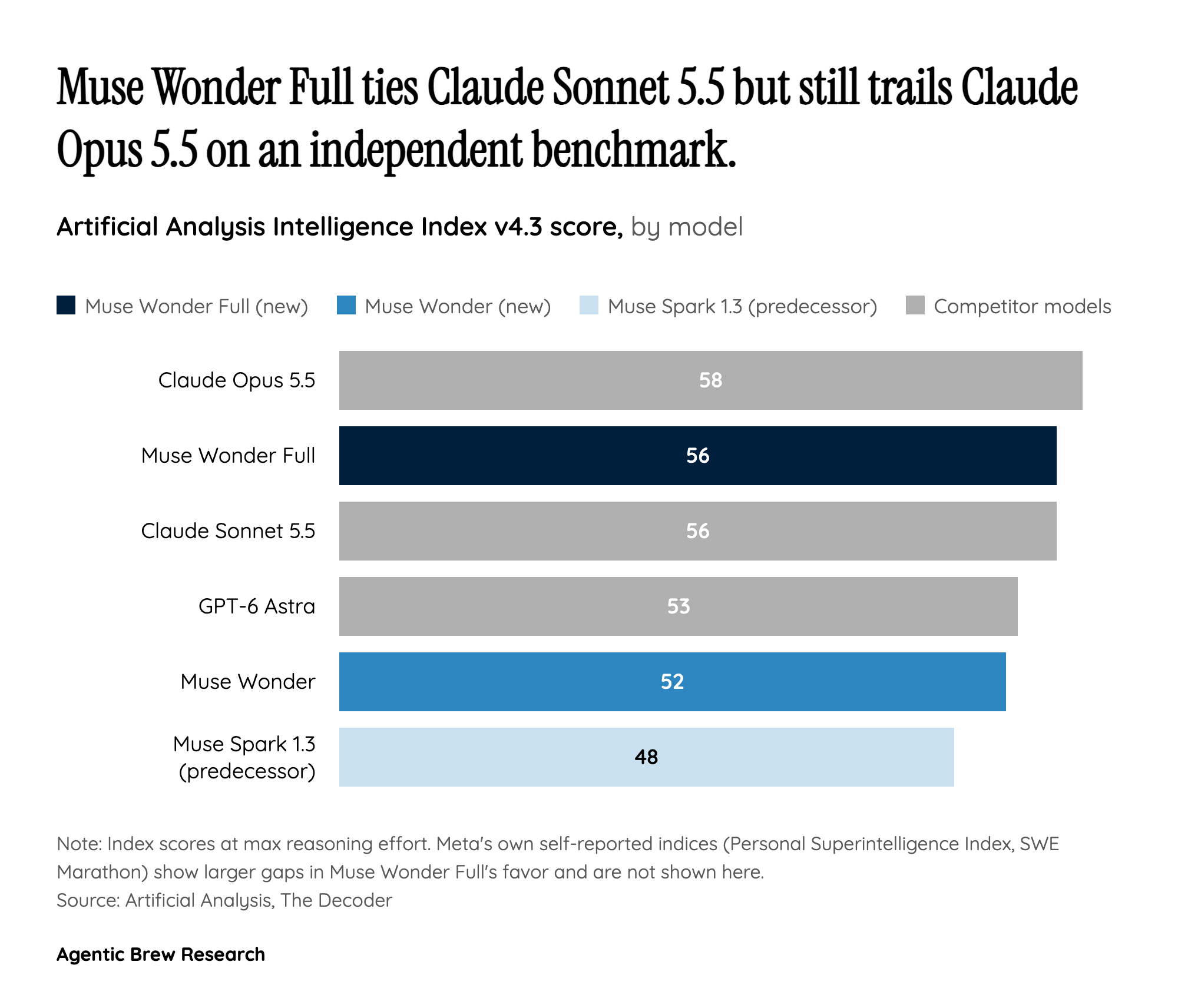
Meta's own benchmark claims and third-party verification tell different stories about where Muse Wonder actually lands. On the Artificial Analysis Intelligence Index v4.3, Muse Wonder Full scores 56 and the lighter Muse Wonder scores 52, compared with Claude Opus 5.5's 58, Claude Sonnet 5.5's 56, and GPT-6 Astra's 53 - tying Wonder Full with Sonnet 5.5 but leaving Opus 5.5 still ahead [1]. On the Artificial Analysis Coding Agents Index, Wonder Full reaches 68 at max effort, matching Claude Code on Sonnet 5.5, while Terminal-Bench 4.0 agentic performance jumped from 33% for the predecessor model to 57% for Wonder Full [1]. Wonder Full also solves 94 of 100 problems on ProofBench, a math-proof benchmark, up from 58 for its predecessor, and Meta reports its hallucination rate falling to 23% from 33% [1]. Meta's own launch materials frame the release as 'the next step on our scaling ladder and a major leap toward personal superintelligence' [2]. The same self-favorable framing shows up in Meta's own internal metrics: its 'Personal Superintelligence Index' claims Wonder Full scores 59.1, ahead of Claude Opus 5.5 and GPT-6 Astra, and its 'SWE Marathon' claim puts Wonder Full at 57.5 against 46.3 for Opus 5.5 - both benchmarks Meta created itself, in contrast with the independent Artificial Analysis Intelligence Index, which still puts Wonder Full at 56, behind Opus 5.5's 58. An independent coding benchmark tells a starker version of the same story: BridgeBench rated Muse Wonder at only 611 points - 8th of 29 models tested and 149 points behind the category leader [3]- and the benchmark's operator publicly accused Meta of gaming its self-reported scores. That gap between vendor-reported and independently verified results is the real story behind the launch.