Google caps Meta access to Gemini AI over compute capacity
TECH

Google caps Meta access to Gemini AI over compute capacity

19+
Signals

Strategic Overview

  • 01.
    Google told Meta around March 2026 that it could not meet the full Gemini computing capacity Meta had sought to purchase, after Meta requested more than Google could provide.
  • 02.
    The capacity shortfall disrupted and delayed some of Meta's internal AI projects, and in response Meta encouraged staff to be more efficient with AI tokens, the units used to measure AI usage.
  • 03.
    Meta had used Gemini for content moderation, scam detection, customer service, advertising tools, and software development, and has been shifting some of those workloads to its own Muse Spark model.
  • 04.
    The story was first reported by the Financial Times, with follow-on coverage from Reuters and Bloomberg on June 28, 2026.

Deep Analysis

Compute, not capital, is now the ceiling on AI

The headline reads like a rivalry story, but the mechanism underneath is purely physical. Google did not refuse Meta - it told Meta around March that it simply could not provide all the Gemini capacity Meta wanted to buy [1]. That is a remarkable admission from the company with arguably the deepest chip supply in the industry. The constraint is infrastructure, not money: GPUs, memory, power, and data centers, as one strategy analysis put it, when even a trillion-dollar buyer gets rationed [3]. Sundar Pichai had already signaled this on the April earnings call, saying Google Cloud is compute-constrained in the near-term and that cloud revenue would have been higher had it been able to meet demand [4]. In other words, Google is leaving revenue on the table not because customers won't pay, but because there are not enough serving racks to sell.
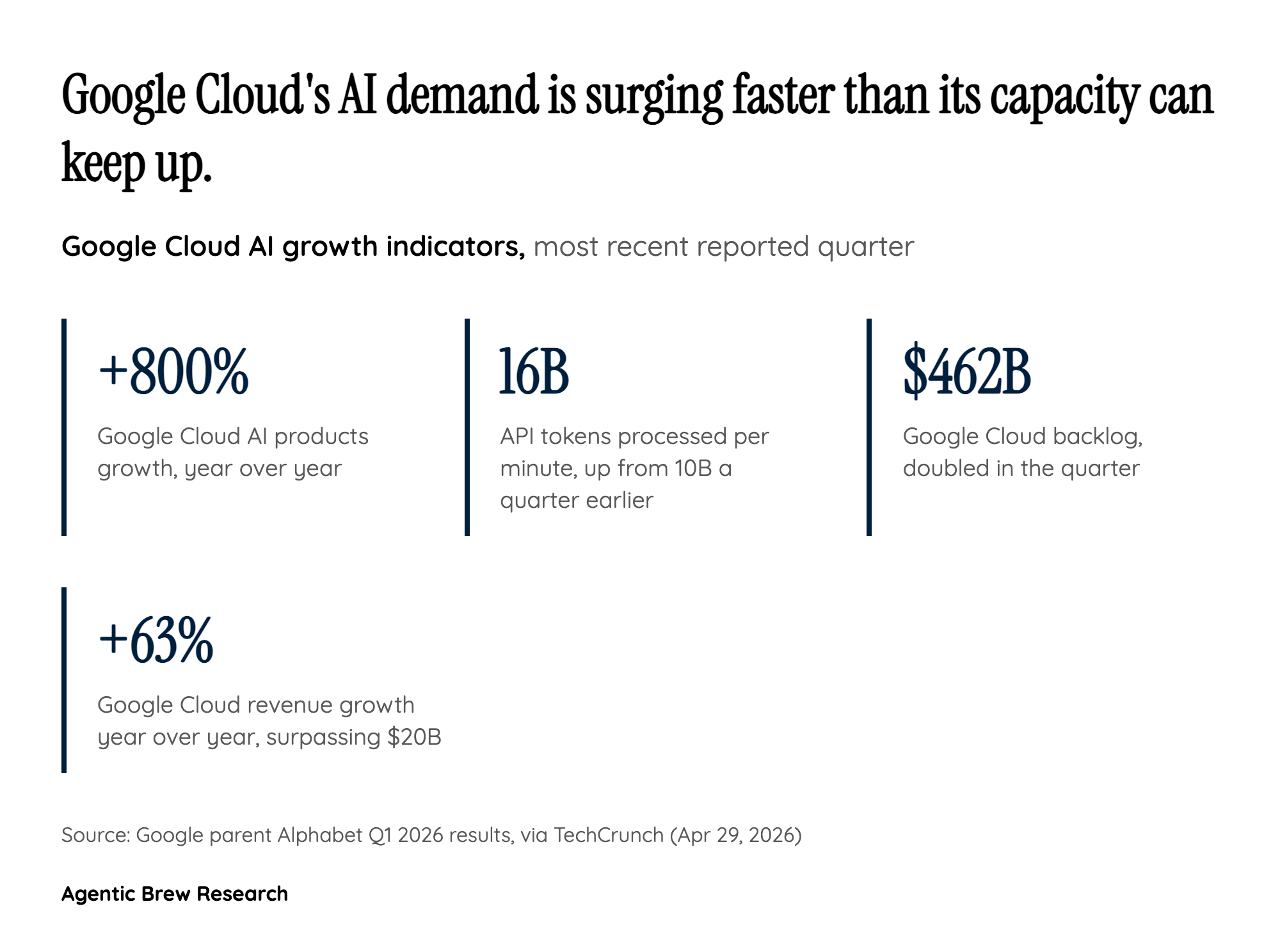

Why a compute shortage caps a cloud sale

Why a compute shortage caps a cloud sale
Google Cloud AI growth indicators for the most recent reported quarter, underscoring why capacity is strained.

Selling Gemini access is not like selling software licenses - every token a customer processes consumes real-time inference capacity on physical accelerators that can also be serving Google's own products. When aggregate demand exceeds the fleet, the provider has to allocate, and the largest single buyer is the most visible thing to throttle. Meta was reportedly among Google's largest AI customers, which is exactly why its exceptionally high demand made it the hardest-hit when Google began rationing [1]. The scale of the underlying growth explains the squeeze: Google Cloud's AI products grew roughly 800% year-over-year, API token processing hit 16 billion tokens per minute (up from 10 billion a quarter earlier), and backlog doubled to $462 billion [4]. Back in November, Google's own infrastructure team had warned staff it must double serving capacity every six months just to keep pace [5]- a treadmill that the Meta cap shows it is still losing ground on.

Meta's quiet pivot to in-house models

The cap did more than delay projects - it sharpened Meta's incentive to depend less on a competitor's cloud. Meta had leaned on Gemini for content moderation, scam detection, customer service, advertising tools, and software development, and is now shifting some of those workloads to its own Muse Spark model while investing in its own infrastructure [2]. Internally, the response was austerity: Meta encouraged staff to be more efficient with AI tokens, the units that measure usage [1]. There is an irony worth naming - Google was willing to sell its flagship model to a direct rival, and the relationship strained not over strategy but over supply. The demand-side context matters too: industry commentary has framed Meta's appetite for Gemini against setbacks in Meta's own model efforts, which is part of why it wanted so much external capacity in the first place.

The reaction: is the demand even real?

Across social platforms the dominant read was that this confirms physical compute - chips, data centers, power - as the true bottleneck of the AI build-out, with the sharpest framing being that compute is the scarcest resource in AI, not corporate rivalry. Semiconductor-investor circles took it as bullish, expecting Google to raise capex in response. But the most interesting friction was a contrarian thread questioning whether AI 'demand' is even genuine, with skeptics arguing that auto-injected AI summaries and forced features inflate token usage, countered by others pointing to real, voluntary workloads. That tension - genuine demand versus manufactured demand - is the unresolved question lurking beneath every capacity-constraint story: if Google must double serving capacity every six months [5], it matters enormously whether that curve is being driven by users who want the product or by products that inject themselves.

Historical Context

2025-11-21
Google's AI infrastructure boss told employees the company must double its AI serving capacity every six months to meet demand.
2026-03-01
Google told Meta around March it could not provide the full Gemini capacity Meta sought, disrupting some of Meta's internal AI projects.
2026-04-29
Google Cloud surpassed $20 billion in quarterly revenue but said growth was capacity-constrained, with backlog doubling to $462 billion.
2026-06-28
The Gemini cap on Meta was reported publicly, first by the Financial Times and then carried by Reuters and Bloomberg.

Power Map

Key Players
Subject

Google caps Meta access to Gemini AI over compute capacity

GO

Google (Alphabet)

Cloud and AI provider that capped Gemini access; admits being compute-constrained in the near-term, with cloud revenue that would have been higher had it been able to meet demand.

ME

Meta Platforms

One of Google's largest AI customers; its exceptionally high Gemini demand made it the hardest-hit by the cap, delaying internal projects and forcing token rationing.

SU

Sundar Pichai (Alphabet CEO)

Acknowledged Google Cloud is compute-constrained in the near-term and that revenue would have been higher had it met customer demand.

OT

Other Google Cloud customers

Also affected by the capacity constraints, but to a lesser extent than Meta.

Fact Check

5 cited
  1. [1] Google limits Meta's use of its Gemini AI models
  2. [2] Google Limits Meta's Gemini AI Access Amid Rising Compute Demand
  3. [3] Google Caps Meta Gemini Access amid Compute Crunch
  4. [4] Google Cloud surpasses $20B but says growth was capacity-constrained
  5. [5] Google must double AI serving capacity every 6 months to meet demand

Source Articles

Top 4

THE SIGNAL.

Analysts

"Google Cloud is compute-constrained in the near-term, and cloud revenue would have been higher if Google had been able to meet customer demand."

Sundar Pichai
CEO, Alphabet

"The binding constraint is physical infrastructure, not money; when a trillion-dollar company rations tokens, inference economics become a management problem."

FourWeekMBA analysis
Business strategy publication
The Crowd

"Google reportedly limited Meta's use of Gemini due to a shortage of compute resources. — FT Google is in a position where it can't sell Gemini to Meta as freely as it might want to. Compute remains power, and the scarcest resource in AI."

@@jukan05833

"JUST IN: Google placed limits on Meta's access to its Gemini AI models after Meta requested more computing capacity than Google could supply."

@@WhaleInsider329

"Google has placed limits on Meta's use of its Gemini AI models because it could not provide as much computing capacity as the social media company wanted, the Financial Times reported."

@@business117

"Google caps Meta's Gemini use as AI demand strains capacity"

@u/marketrent135
Broadcast
Will Meta License Google Gemini? | Editor's Cut

Will Meta License Google Gemini? | Editor's Cut