SpaceX AI revenue forecast and IPO valuation
TECH

SpaceX AI revenue forecast and IPO valuation

38+
Signals

Strategic Overview

  • 01.
    SpaceX is pricing its IPO at $135 per share for a $1.75-1.78 trillion valuation, raising approximately $75 billion via 555.6 million shares — the largest IPO in history, with Nasdaq pricing on June 11 and debut June 12, 2026.
  • 02.
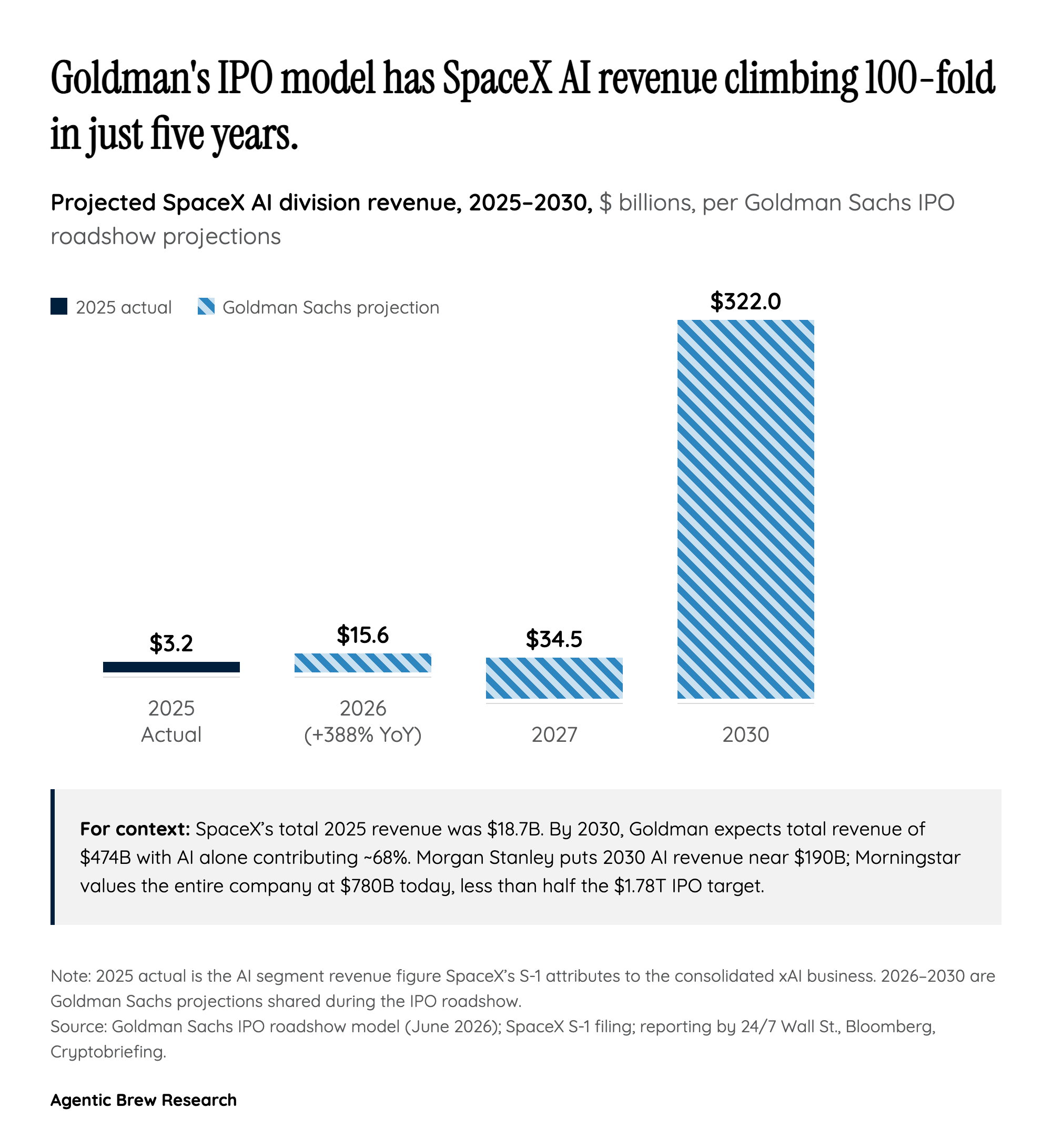
    Goldman Sachs, the lead-left bookrunner, projects SpaceX's AI division revenue will grow 100x from $3.2 billion in 2025 to $322 billion in 2030, with 2026 alone jumping 388% to $15.6 billion.
  • 03.
    Morgan Stanley corroborates a less aggressive but still extraordinary trajectory — $190B AI revenue by 2030 and $3.4 trillion total revenue by 2040 — while Morningstar values the entire company at roughly $780 billion, less than half the IPO target.
  • 04.
    The S-1 repositions SpaceX as a vertically integrated AI infrastructure platform — launch, satellites, energy, compute — with orbital AI compute satellites planned for as early as 2028, anchoring a claimed $28.5 trillion addressable market.

The 100x Forecast IS the Valuation

SpaceX did $18.7 billion in revenue in 2025 against a $4.94 billion net loss and a $41.3 billion accumulated deficit, with the consolidated xAI segment alone bleeding $6.36 billion [1]. None of those numbers support a $1.75 trillion market cap on any conventional multiple — the implied figure is 94 times trailing sales, and 107 times when adjusting for one-time items [2]. The only way to back into the valuation is to assume the AI division grows roughly 100-fold in five years.

That is exactly what Goldman Sachs's IPO roadshow model does. The bank projects AI revenue at $3.2B in 2025, $15.6B in 2026 (a 388% jump), $34.5B in 2027, and $322B in 2030 — total 2030 revenue of $474B with AI alone contributing about two-thirds of the company [3]. By 2031 the model has adjusted EBITDA at $352B (versus $6.6B in 2025) and free cash flow flipping from negative $13.8B to positive $72B [3]. Strip the 100x AI ramp out and the math collapses: the rocket and Starlink businesses, however good, do not justify a 7-week valuation jump from $800 billion to $1.78 trillion [4].

Goldman analysts have effectively published a single number — $322 billion of 2030 AI revenue — that has to be true for the IPO to be priced rationally. This is not a sensitivity case or one scenario among many. It is the load-bearing wall. Strip it out and the next-highest credible valuation is Morningstar's $780 billion fair value — Starlink at $611B plus roughly $170B of probability-weighted AI optionality — implying that buying at the IPO price is paying for a 100x AI scenario at near-certainty [8].
Who Gets Paid When This Number Hits

The 100x AI forecast was written by the same bank collecting fees on the $75 billion raise. Goldman Sachs is lead-left bookrunner; Morgan Stanley, Bank of America, Citigroup, and JPMorgan Chase are co-leads, with Goldman winning the mandate from Morgan Stanley in a competitive bake-off [6]. Investor-facing skeptics have gone straight to the conflict-of-interest read: the institution authoring the projection earns more if the number it publishes is high enough to clear an aggressive price.

Morgan Stanley's projection is best read in the same light. Its $190B AI revenue figure for 2030 is a third lower than Goldman's, but its 2040 model — $3.4 trillion in revenue and over $2.7 trillion in EBITDA — gives the deal a two-bank consensus aesthetic that institutional allocators look for [7]. Evercore ISI's even-more-bullish read (over $755B of AI revenue by 2031) lands in the same spot [17]: every published model from a sell-side desk pushes the same direction, while the only major independent voice — Morningstar — comes in at less than half [8].

The retail side of the trade is being constructed in parallel. SpaceX launched a dedicated IPO website for retail buyers alongside the roadshow, expanding demand beyond institutions [9]. With S&P Dow Jones Indices refusing to fast-track SpaceX into the S&P 500 — removing the passive-flow backstop institutions had been counting on [10]— the deal needs that retail demand. The structure now looks much closer to exit liquidity than to capital formation.

Why the Data-Centers-in-Space Pitch Is More Than a Moonshot

The orbital AI data center thesis sounds like a moonshot until the constraint stack on terrestrial AI compute is laid out next to it. Earth-bound AI infrastructure is increasingly throttled by grid power, water for cooling, transmission line build-out, and local zoning fights — the kind of soft ceilings that don't show up in a model until they bind hard [11]. SpaceX's S-1 frames its answer as a closed loop: launch capacity it already owns, solar power available 24/7 in low-earth orbit, vacuum cooling via radiators, and Starlink-class downlink. Vertical integration from rocket to compute is structurally unavailable to any of the hyperscalers competing for the same workloads [12].

Stratechery's Ben Thompson makes the most defensible bull-case argument for why the math could work despite the engineering risk. His framing: 'Agentic inference will be the largest market by far, because that is the market that won't be limited by humans or time' [5]. Inference compute scales with the number of running agents and their tick rate, not with the number of humans typing. If agents become the dominant compute workload — even if a fraction of that compute migrates to orbit — the total addressable market the S-1 cites (a claimed $28.5 trillion) starts to look less absurd, even if the precise number is marketing [1].

The failure modes are real and named in the bear case. Skeptics highlight unresolved questions on radiation hardening, in-orbit maintenance and GPU swap-out, thermal stability for sustained 300MW loads, and a capex envelope that could exceed $100B over five years for a single constellation generation [13]. SpaceX's plan to begin deploying orbital AI compute satellites 'as early as 2028' [12]is a credible engineering aspiration; it is not yet a revenue stream — and the gap between those two states is where the contrarian case lives.

What Wall Street's Cheerleaders Are Missing

What Wall Street's Cheerleaders Are Missing
Goldman's IPO roadshow model projects SpaceX AI revenue climbing 100-fold from $3.2B in 2025 to $322B by 2030 — the single number that supports the $1.78T valuation.

The most pointed gap in the bull narrative is Grok's market share. Among U.S. AI chatbots, Grok holds roughly 3.6% of visits — fifth place, behind ChatGPT, Gemini, Claude, and Microsoft's Copilot. To justify the Goldman number, that share would need to either explode toward leadership or be backstopped by enterprise compute contracts that have not yet materialized publicly [14]. The only concrete contract surfaced in coverage is Anthropic taking 300MW of compute from the SpaceX/xAI stack — meaningful, but a fraction of the demand profile the forecast implicitly assumes [13].

Veteran traders are also reaching for dot-com analogies. Larry McDonald, founder of The Bear Traps Report and a former Lehman trader, told subscribers that 'investing in SpaceX right now is akin to buying Amazon in the spring of 2000 at the peak of the dot-com bubble' [15]— accurate or not, that comp anchors how a slice of buy-side risk officers will benchmark the trade. Michael Burry's view that 'neither a valuation of 1 nor of 2 trillion dollars can be derived from the IPO filings; any increase rests on hype and technical factors' [16]directly attacks the underwriters' analytical bridge rather than the engineering.

Developer and retail-investor communities are concentrating on a different gap the sell-side models don't capture: the demand side. Skeptics frame the IPO as exit liquidity rather than capital formation — pension funds and passive ETFs absorbing supply at a price that Morningstar's own decomposition (Starlink $611B + ~$170B AI optionality) caps near half [8]. The aerospace voices in the discussion are skeptical of orbital data centers specifically; the market-mechanics voices are skeptical of the implied passive-flow extraction now that the S&P 500 fast-track has been denied [10]. Neither group is dispositive, but the angle dominating community discussion — the gap between the load-bearing AI forecast and demonstrated enterprise demand — is the one Wall Street research has the most incentive to ignore.

Historical Context

2024-06
June 2024 tender offer valued SpaceX at roughly $210 billion, the starting point of an eight-fold valuation climb to the IPO price.
2025-12
Secondary tender priced shares around $421, implying an ~$800 billion valuation and setting up the 2026 IPO conversation.
2026-02
SpaceX fully consolidated xAI in an all-stock deal valued at roughly $250 billion, folding Musk's AI lab inside the rocket company and creating the AI segment that anchors the IPO pitch.
2026-05-20
First S-1 filing publicly disclosed 2025 financials — $18.7B revenue, $4.94B net loss, $41.3B accumulated deficit — establishing the gap between the company's current scale and the IPO's implied math.
2026-06-03
IPO roadshow launched at $135 per share for a $1.77T valuation and $75B raise — the largest IPO in history.

Power Map

Key Players
Subject

SpaceX AI revenue forecast and IPO valuation

GO

Goldman Sachs

Lead-left bookrunner who beat Morgan Stanley for the mandate and authored the $322B-by-2030 AI revenue model that anchors the trillion-dollar pricing. Goldman's projection IS the valuation argument.

MO

Morgan Stanley

Co-lead underwriter whose 2040 $3.4 trillion revenue / $2.7 trillion EBITDA model functions as the second-bank corroboration of the AI thesis, even though its 2030 AI number ($190B) is materially lower than Goldman's.

EL

Elon Musk

CEO and controlling shareholder who consolidated xAI into SpaceX in February 2026 in a ~$250B all-stock deal, giving xAI access to Starlink's cash flow and IPO proceeds to fund the orbital data-center build-out.

MO

Morningstar

Independent equity research house whose $780B fair-value estimate — less than half the IPO target — has become the most-cited bear marker in retail coverage, including a recommendation to wait for post-IPO weakness.

AN

Anthropic

Reported customer of SpaceX's compute platform — a 300MW supply backed by ~220,000 Nvidia GPUs through xAI's Colossus 1 — and a real-revenue data point underneath the AI forecast.

S&

S&P Dow Jones Indices

Index gatekeeper that denied SpaceX fast-track entry to the S&P 500, removing the institutional passive-flow backstop that would have otherwise mechanically absorbed supply on listing day.

Fact Check

17 cited
  1. [1] Assessing SpaceX Finances, Addressable Market and the AI Pitch Ahead of IPO
  2. [2] SpaceX (SPCX) IPO S-1 Teardown & Valuation 2026
  3. [3] Goldman Sachs Predicts SpaceX Revenue Will Surge 100x by 2030
  4. [4] SpaceX Targets $800 Billion Valuation in Secondary Sale, Eyes 2026 IPO
  5. [5] The SpaceX IPO and Data Centers in Space
  6. [6] SpaceX Sets IPO Price at $135 a Share for Record $75 Billion Raise
  7. [7] Morgan Stanley Sees SpaceX's Revenue Reaching $3.4 Trillion in 2040
  8. [8] Morningstar Says SpaceX IPO Is Significantly Overvalued
  9. [9] SpaceX Confirms It Will Seek $75 Billion in Record IPO
  10. [10] SpaceX IPO Roadshow: Wall Street Hypes 100x AI Growth, S&P No Fast Track
  11. [11] Are Orbital Data Centers the Next Frontier of AI Infrastructure?
  12. [12] SpaceX IPO Filing Recasts Company as AI Infrastructure Giant
  13. [13] SpaceX's IPO: Do You Believe in Space Data Centers and xAI's Potential?
  14. [14] Goldman Sachs Just Predicted SpaceX's AI Revenue Will Be This Number by 2030
  15. [15] TSLA Stock SpaceX IPO Dotcom Bubble Warning
  16. [16] SpaceX IPO Valuation Critics
  17. [17] Wall Street Sees SpaceX's AI Revenue 100 Times Higher by 2030

Source Articles

Top 5

THE SIGNAL.

Analysts

"Pegs fair value at roughly $780 billion (Starlink $611B plus ~$170B probability-weighted AI optionality) and explicitly advises waiting for a lower entry post-IPO: 'We think the company has been significantly overvalued and investors will have opportunities to buy the stock at more attractive levels after the IPO.'"

Nicolas Owens
Equity analyst, Morningstar

"Calls the S-1 'unserious, empty, hallucinatory, and borderline dishonest,' flagging that the deal prices SpaceX at 107x sales — a multiple no public AI infrastructure company has ever sustained."

Ed Elson
Co-host, Prof G Markets podcast

"Frames the $1.75T cap as 67 times sales — three times Nvidia's multiple — a comp that implies AI growth assumptions even more aggressive than the chipmaker's."

Dan Coatsworth
Investment analyst, AJ Bell

"Compares the IPO to Amazon at the spring 2000 dot-com peak, warning the price 'prematurely priced in enormous future earnings potential' the way the 2000 vintage of tech IPOs did before drawing down 80-95%."

Larry McDonald
Founder, The Bear Traps Report (former Lehman Brothers trader)

"Argues that 'neither a valuation of 1 nor of 2 trillion dollars can be derived from the IPO filings; any increase rests on hype and technical factors' — a direct attack on the analytical bridge underwriters are selling."

Michael Burry
Investor, Cassandra Unchained Substack

"Defends the orbital data-center bull case on first-principles grounds: 'Agentic inference will be the largest market by far, because that is the market that won't be limited by humans or time,' and argues earth-bound data centers face zoning and grid constraints that orbit doesn't."

Ben Thompson
Analyst, Stratechery
The Crowd

"GOLDMAN SEES SPACEX AI REVENUE EXPLODING TO $322B BY 2030 Goldman Sachs projects SpaceX AI revenue rising from $3.2B in 2025 to $322B by 2030, a ~100x increase, forming the core justification for its $1.78T IPO valuation. Total revenue is forecast to reach $474B, with Starlink"

@@DeItaone1737

"$SPCX - SPACEX IPO SETS $75B RECORD LISTING TERMS SpaceX set IPO terms at $135 per share, raising about $75 billion through 555.6 million shares, implying a $1.75 trillion valuation. The roadshow begins with institutional orders processed via S&P Global's Equity Bookbuild"

@@DeItaone404

"Goldman Sachs expects SpaceX's AI revenue to surge 100 times by 2030 https://t.co/T6DyELyfpN"

@@FT340

"The SpaceX IPO is going to tank the market"

@u/El_Nahual14000
Broadcast
Musk's SpaceX Files Blockbuster IPO | OpenAI, Anthropic Race to Go Public | Vantage on Firstpost |4K

Musk's SpaceX Files Blockbuster IPO | OpenAI, Anthropic Race to Go Public | Vantage on Firstpost |4K

2026 IPO Boom: Spacex, OpenAI and Anthropic

2026 IPO Boom: Spacex, OpenAI and Anthropic

SpaceX's IPO and the most ambitious AI bet ever attempted

SpaceX's IPO and the most ambitious AI bet ever attempted