SoftBank-led Asian tech selloff over AI infrastructure costs
TECH

SoftBank-led Asian tech selloff over AI infrastructure costs

34+
Signals

Strategic Overview

  • 01.
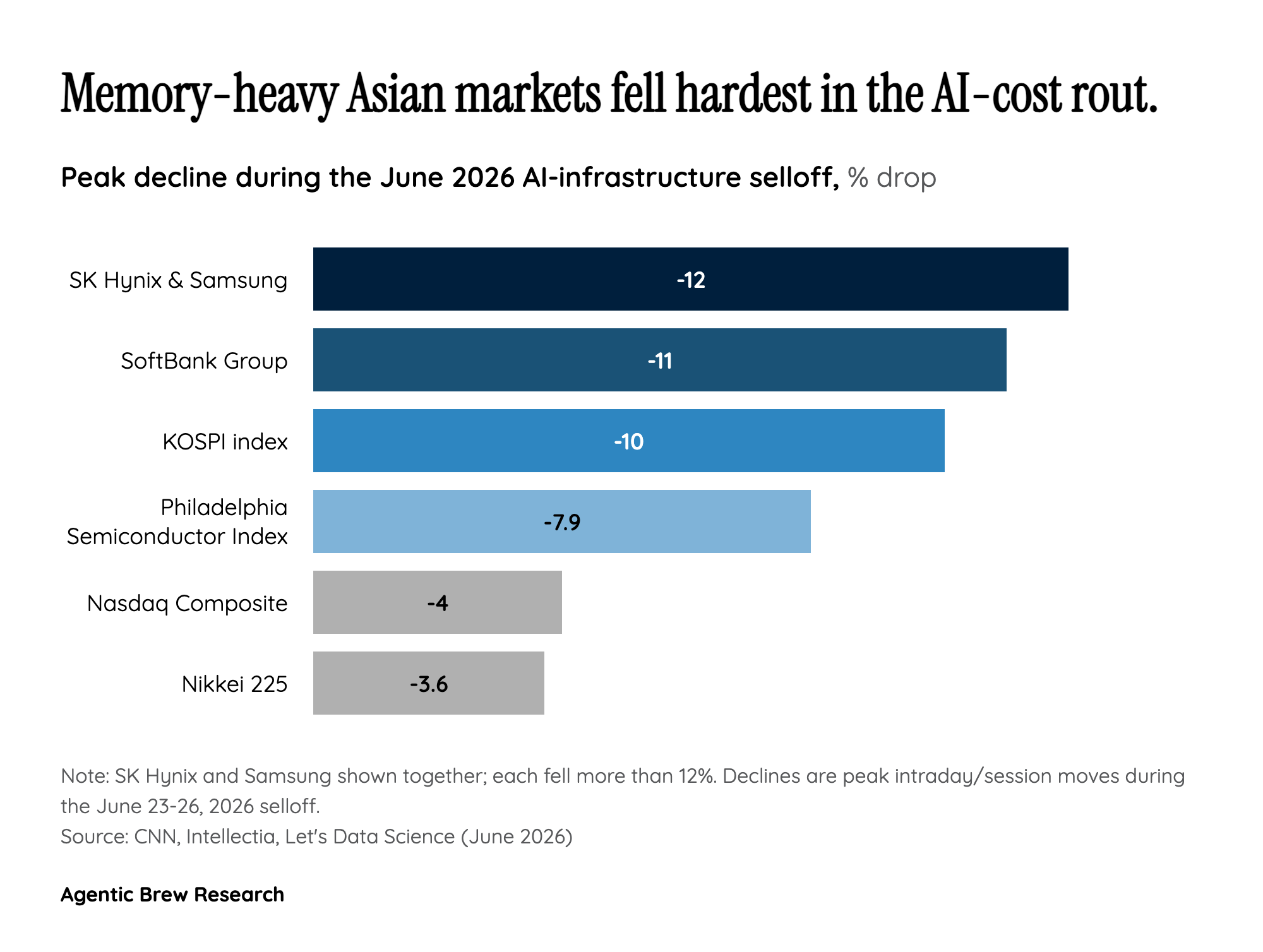
    SoftBank Group plunged about 11% on June 26, 2026, leading a broad selloff in Asian technology stocks driven by anxiety that AI infrastructure spending is outpacing AI revenue.
  • 02.
    Days earlier, on June 23, South Korea's KOSPI tumbled about 10% and tripped a circuit breaker for a 20-minute cooling-off session as memory chipmakers SK Hynix and Samsung each fell more than 12%.
  • 03.
    The rout was aggravated as Apple raised MacBook and iPad prices citing higher AI-driven component costs, transmitting data-center memory inflation to consumers.
  • 04.
    Micron's blowout quarterly earnings on June 25 reversed the global tech selloff, easing fears that AI demand had peaked and reframing surging memory prices as a chipmaker profit engine.

Deep Analysis

Why SoftBank falls hardest: the AI-sentiment proxy

When traders want to express a view on the entire AI trade in one ticker, they reach for SoftBank. Its roughly $65B exposure to OpenAI and an AI-heavy portfolio turn the stock into a high-beta proxy for the whole theme, which is why it dropped about 11% on June 26, 2026 while the broader Asian complex slid less [1]. The same dynamic played out in early November 2025, when SoftBank shed nearly $50B in market cap in a single week, its worst since March 2020, after OpenAI disclosed projected losses including a $74B operating loss in 2028 [6].

The leverage cuts both ways and explains the violence of the moves. Because SoftBank's value is so tightly coupled to a single private AI bet, any crack in confidence in OpenAI's path to profitability, including reports that its IPO could slip from 2026 to 2027, gets amplified into a double-digit equity drawdown [5]. That makes SoftBank less a company being repriced on its own fundamentals than a sentiment gauge: when the market's faith in AI returns wavers, SoftBank is where that doubt is registered first and most loudly.
Following the memory tax from HBM to your MacBook

The mechanism transmitting AI infrastructure costs into both chipmaker profits and consumer prices is what Bank of America's Vivek Arya calls the memory tax. Memory now accounts for roughly 35% of AI infrastructure capex, and Arya warns that 'elevated memory pricing could act as a tax on data center customer capex growth, while also leading to potential demand destruction in price-sensitive end markets like mobile and auto.' [2]As hyperscalers bid aggressively for high-bandwidth memory to fill data centers, the price of memory rises across the board, and that cost does not stay inside the data center.

The clearest evidence is on store shelves. Apple raised MacBook and iPad prices by as much as about $300 and Microsoft lifted Xbox prices by $100-150, both citing higher AI-driven component and memory costs [1]. That is the memory tax surfacing as a consumer price increase, effectively a third wave of inflation routed through AI hardware. The same surge that squeezes data-center budgets and end markets is, paradoxically, a windfall for the memory makers selling into it, which sets up the bifurcation that followed.

Why the market bifurcated and how Micron reversed the rout

Why the market bifurcated and how Micron reversed the rout
Peak declines during the June 2026 AI-cost selloff: memory and chip-concentrated markets (SK Hynix/Samsung, SoftBank, KOSPI, semis) fell far more than broad indices.

What made this episode different is that the market stopped treating AI as one undifferentiated trade. Investors began discriminating: HBM memory plays with locked-in multi-year contracts are seen as insulated, while rate-sensitive hyperscaler and infrastructure names carry the return-uncertainty risk [7]. The concentration that made the rout so violent in Korea, where SK Hynix and Samsung make up about half of KOSPI value and their slides tripped a circuit breaker, is the same concentration that now invites selective positioning rather than blanket selling [8].

Micron's earnings on June 25 crystallized the split and reversed the global selloff. The company posted revenue of $41.5B against $35.9B consensus, DRAM up 67% quarter over quarter, core data-center revenue up 653% year over year, 84.9% gross margins, and signed 16 five-year contracts worth $22B in commitments [2]. Those numbers reframed the memory tax as a chipmaker profit engine with contractually guaranteed demand through 2030, easing fears that AI demand had peaked [2]. Community discussion echoed the nuance, with some observers noting the original trigger was South Korean memory news rather than a US-led contagion, and pointing to Micron's print as the tell that demand was intact.

Gut check or dot-com replay: what 2026 returns must prove

The selloff exposed a genuine analyst split over whether this is a buying opportunity or the early innings of a bust. Wedbush's Dan Ives calls it a gut check moment, arguing the AI build is still early but adding that 'the market's patience is not unlimited. 2026 is the year AI spending must start showing returns.' [9]Quilter Cheviot's Mamta Valechha captures the mood shift on the other side, noting investors 'have suddenly gone from the fear that you cannot be last, to investors questioning every single angle in this AI race,' with Amazon's roughly $200B capex guide in the crosshairs [4]. Morningstar's Michael Field reduces it to a binary: 'Either a big pay off if these investments come good, or a huge waste of shareholder's cash if it goes wrong.' [4]

The bear case is sharper still. Michael Burry argues AI earnings are inflated by understated hardware depreciation and that end-user demand is laughably small, warning that conditions resemble the final months of the dot-com bubble and estimating up to $176B in overstated profits across major firms from 2026-2028 [3][5]. The pressure point everyone agrees on is the capex-to-revenue gap: hyperscalers are planning roughly $600-700B in 2026 AI capex, a 36-71% jump, and more than $1.35T in Big Tech market value evaporated in a single week as investors doubted that spending would convert to commensurate returns [4]. The verdict now hinges on whether 2026 produces the returns Ives says the market is no longer willing to wait for.

Historical Context

2025-01
China's DeepSeek showed comparable AI performance at lower cost, sending Nvidia down 17% (about $600B in market value) in a single day.
2025-10
Market concentration peaked, with the five largest companies holding about 30% of the S&P 500 and Nvidia topping a $5T valuation.
2025-11
SoftBank lost nearly $50B in a week (its worst since March 2020) as OpenAI disclosed projected losses including a $74B operating loss in 2028.
2025-12
Burry intensified AI-bubble warnings, citing depreciation gaming and estimating up to $176B in overstated profits across major firms from 2026-2028.
2026-06-23
KOSPI plunged about 10% and hit a circuit breaker as SK Hynix and Samsung fell more than 12% on AI-bubble fears.
2026-06-26
SoftBank fell about 11% leading an Asian tech rout as Apple and Microsoft passed AI-driven chip costs to consumers.

Power Map

Key Players
Subject

SoftBank-led Asian tech selloff over AI infrastructure costs

SO

SoftBank Group

Epicenter of the selloff; its roughly $65B OpenAI exposure and AI-heavy portfolio make it a proxy for AI sentiment, so it falls hardest (about 11% on June 26) when AI fears spike.

SK

SK Hynix & Samsung Electronics

South Korean memory-chip giants making up roughly half of KOSPI market value; their drops of more than 12% dragged the whole index into a circuit breaker.

HY

Hyperscalers (Amazon, Microsoft, Alphabet, Meta)

Collectively planning roughly $600-700B in 2026 AI capex; the gap between their spending and AI revenue is the core anxiety driving the rout.

AP

Apple & Microsoft

Passed AI-driven chip and memory cost increases to consumers (MacBook/iPad and Xbox price hikes), signaling the memory tax reaching end markets and adding selloff pressure.

MI

Micron Technology

Memory maker whose blowout quarterly earnings reversed the selloff and reframed the memory tax as a profit driver for chipmakers.

Fact Check

9 cited
  1. [1] SoftBank shares fall 11% amid AI cost concerns
  2. [2] Why the tech selloff stopped: Micron
  3. [3] Why Michael Burry thinks the AI bubble will unravel
  4. [4] Big Tech loses $1.35T as AI spending fears spark selloff
  5. [5] AI bubble - Wikipedia
  6. [6] SoftBank logs almost $50 billion in weekly losses as investors sour on AI
  7. [7] AI selloff exposes concentration risk in South Korea's stock market
  8. [8] AI fears shake markets from Wall Street to Asia
  9. [9] AI chip stocks slide but Wedbush says the selloff is a buying opportunity

Source Articles

Top 5

THE SIGNAL.

Analysts

"Reads the selloff as a gut check moment and buying opportunity rather than weakening demand. He frames the AI build as still early but warns the clock is running: 'We are in the early innings of a multi-year AI infrastructure build, but the market's patience is not unlimited. 2026 is the year AI spending must start showing returns.'"

Dan Ives
Analyst, Wedbush Securities

"Warns that elevated memory pricing acts as a tax on data-center capex and could destroy demand in price-sensitive end markets: 'Elevated memory pricing could act as a tax on data center customer capex growth, while also leading to potential demand destruction in price-sensitive end markets like mobile and auto.' He still projects the AI data-center systems market reaching roughly $1.7T by 2030."

Vivek Arya
Lead semiconductor analyst, Bank of America

"Sees sentiment flipping from fear of missing the AI race to forensic scrutiny of spending: 'We have suddenly gone from the fear that you cannot be last, to investors questioning every single angle in this AI race.' She flagged Amazon's roughly $200B capex guide as the key focus."

Mamta Valechha
Analyst, Quilter Cheviot

"Frames hyperscaler AI investment as a binary wager: 'The bet is becoming binary. Either a big pay off if these investments come good, or a huge waste of shareholder's cash if it goes wrong.'"

Michael Field
Analyst, Morningstar

"Argues AI earnings are artificially inflated by understated hardware depreciation, that end-user demand is laughably small, and that a drawn-out selloff worse than the dot-com bust looms, saying AI market conditions resembled the final months of the dot-com bubble."

Michael Burry
Investor and AI-bubble bear
The Crowd

"Sam Altman just crashed two stock markets in 4 hours and exposed the AI bubble. OpenAI is delaying its public listing until 2027 because Altman REFUSES to accept a single dollar under a $1 trillion valuation. Asia opened to the news and the panic was instant: SoftBank fell 13%"

@@Ric_RTP11

"APPLE'S BIGGEST SELLOFF IN OVER A YEAR. $AAPL fell 6.12% after raising prices across much of its product lineup. Apple blamed rising AI memory and infrastructure costs. With Apple leaving the door open for more increases, analysts now expect the iPhone could be next."

@@CryptosR_Us28

"SOMETHING VERY BAD IS HAPPENING The top 10 stocks now make up around 40% of the S&P 500 AI-related stocks (direct AI + infrastructure) account for up to 50% The market has basically turned into one massive bet on artificial intelligence This is an overvalued AI bubble"

@@lenion21

"US AI stock sell-off shakes markets from Wall Street to Asia"

@u/JustMyOpinionz623
Broadcast
Tech stocks tumble over AI cost concerns

Tech stocks tumble over AI cost concerns

The AI Sell-Off Is Happening Again. Here's What I'm Actually Doing

The AI Sell-Off Is Happening Again. Here's What I'm Actually Doing

Softbank Shares Slide Amid Concerns Of A Growing AI Bubble

Softbank Shares Slide Amid Concerns Of A Growing AI Bubble