The Price-Performance Disruption
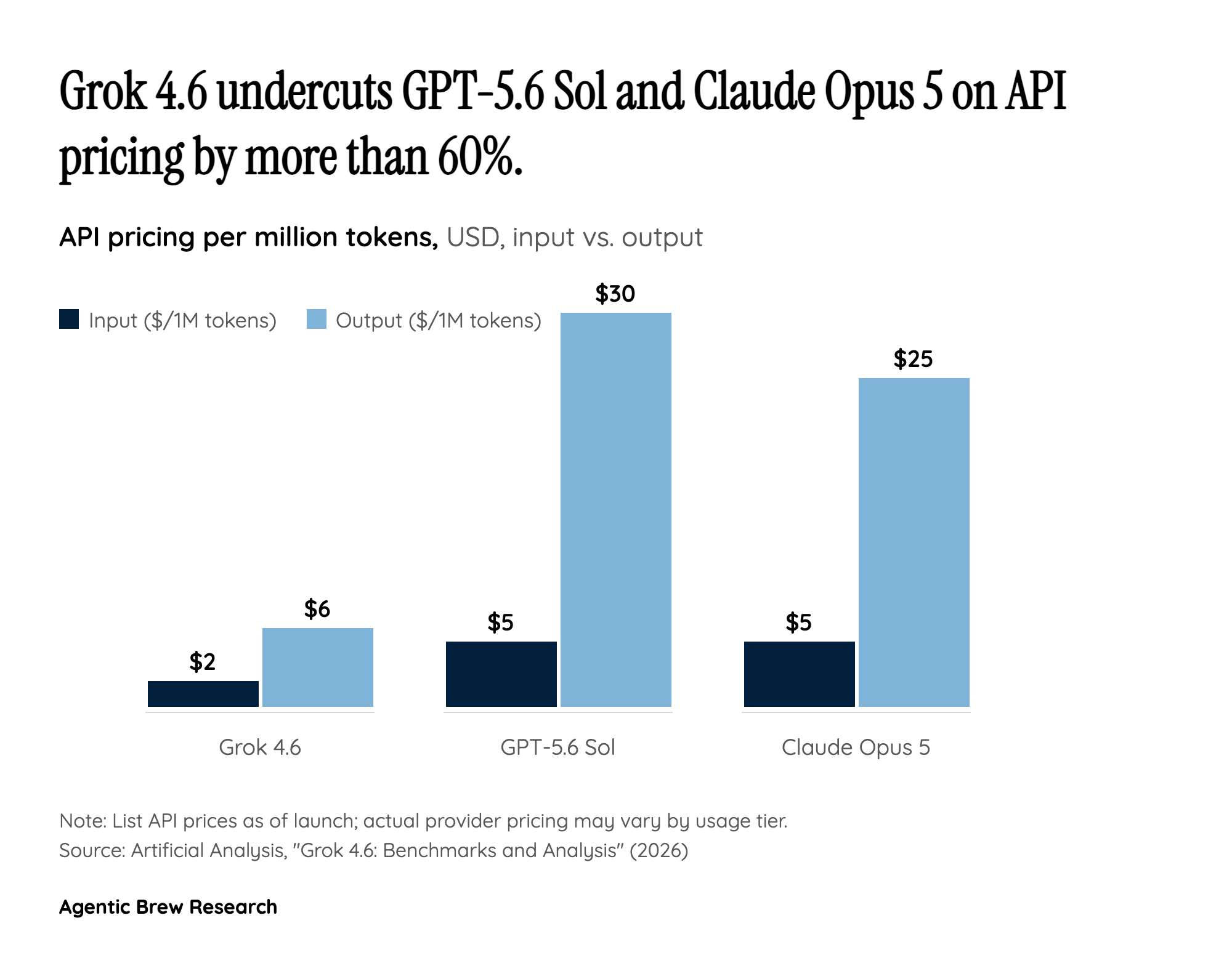
xAI held Grok 4.6's pricing flat at $2 per million input tokens and $6 per million output tokens - identical to Grok 4.5 - which puts it more than 60% below GPT-5.6 Sol ($5/$30) and Claude Opus 5 ($5/$25) [1]. That gap would be unremarkable if Grok 4.6 were a budget model, but it scores 61 on the Artificial Analysis Intelligence Index, tying GPT-5.6 Sol and sitting just two points behind Claude Opus 5 (63) [1]. The efficiency story is arguably more consequential than the headline price: on long-horizon agentic tasks, Grok 4.6 averages roughly 53 turns and 0.5 billion input tokens to complete a task, versus about 103 turns and 2.0 billion input tokens for Claude Opus 5 [1], which compounds the sticker-price advantage into a much larger real-world cost gap. At $0.84 per completed task, Grok 4.6 sits on the intelligence-versus-cost Pareto frontier [1]. Independent reviewers frame this less as a coding story and more as a margin threat: Anthropic and OpenAI are both said to be approaching IPOs, and a frontier-adjacent model priced this aggressively pressures the inference margins investors will scrutinize [2]. Microsoft's Azure business provides some buffer for OpenAI's economics, but Anthropic in particular has less insulation from a price war it did not start. Hands-on testing outside the official benchmarks reached a similar conclusion from a different angle: independent creator comparisons running the same tasks across providers found Grok 4.6 landing near frontier quality while running at roughly a quarter of the cost of Claude's top-tier models, echoing the same price-performance gap the official numbers show.