New York enacts first US statewide data center moratorium
TECH

New York enacts first US statewide data center moratorium

30+
Signals

Strategic Overview

  • 01.
    On July 14, 2026, Governor Kathy Hochul signed an executive order creating the nation's first statewide moratorium on new hyperscale data centers, pausing state permitting for up to one year while a Generic Environmental Impact Statement is developed.
  • 02.
    The executive order applies only to large data centers requiring 50 megawatts or more, exempting smaller facilities that serve hospitals, universities, and back-office finance.
  • 03.
    The order is distinct from a separate 20 MW-threshold moratorium bill (the Responsible Data Center Development Act, S10642/A11560) passed by the NY Legislature on June 4, 2026, which Hochul had left unsigned.
  • 04.
    Hochul also said she will pursue legislation to repeal sales-tax exemptions for large data centers and directed a Community Investment Framework to be issued within 60 days.

Deep Analysis

The Two-Track Gambit: Why Hochul Chose an Order Over the Bill

New York now has two competing versions of the same idea, and the gap between them is the whole story. In June, the Legislature passed the Responsible Data Center Development Act by wide margins - Senate 44-16, Assembly 102-39 - a moratorium that bites at 20 megawatts [3]. Hochul let that bill sit unsigned and instead issued her own executive order, which only pauses projects at 50 megawatts or more [2].

That 30-megawatt spread is not a rounding error. It is a deliberate carve-out. The executive route lets Hochul act immediately without ceding the negotiating leverage a signed statute would lock in, and the higher threshold keeps mid-sized facilities - the ones serving hospitals, universities, and finance back offices - out of the freeze entirely [2]. Mechanically, during the pause the Department of Environmental Conservation simply stops issuing discretionary permits that are not already deemed complete, so projects holding every required approval sail through untouched [1].

The real work happens in the year the moratorium buys. Hochul directed the Department of Public Service to build a Generic Environmental Impact Statement covering energy demand, water use, and air quality, and the freeze stays in force while that study runs [1]. In other words, the order is less a ban than a forced timeout to write the rulebook before the next wave of gigawatt-scale campuses lands.

Follow the Money: Who Actually Pays for a Hyperscale Campus

Follow the Money: Who Actually Pays for a Hyperscale Campus
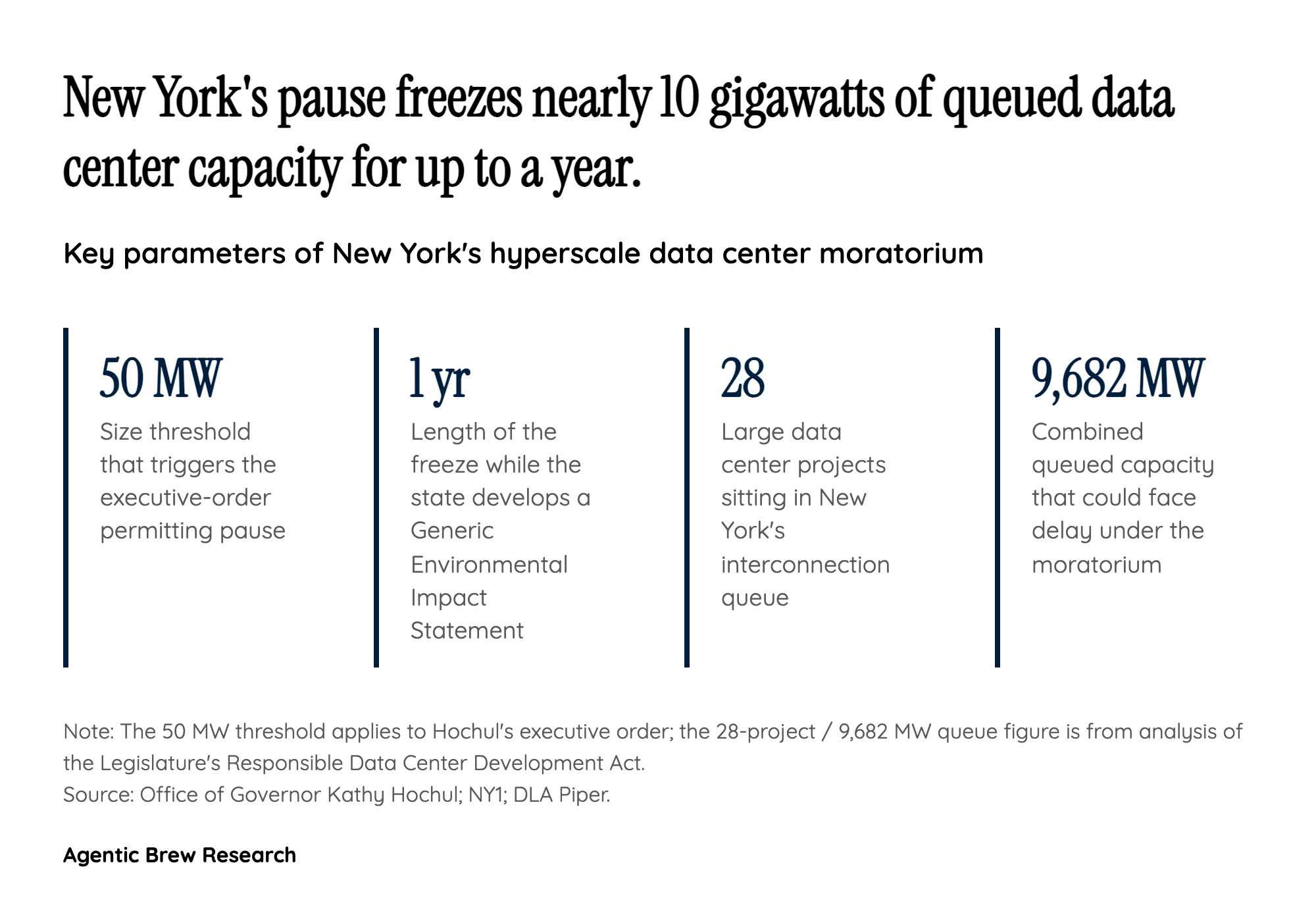
Key parameters of New York's hyperscale data center moratorium: the 50 MW threshold, one-year pause, and roughly 9,682 MW of queued capacity across 28 projects that could be delayed.

Strip away the environmental language and this is a fight about electricity bills. Hochul's core argument is that hyperscale AI centers draw enormous power that threatens to outpace grid capacity and shift costs onto ordinary ratepayers - a bill she says she refuses to pass on to New Yorkers [2]. The scale of what is queued up makes that concrete: roughly 28 large data centers totaling about 9,682 megawatts sit in the NYISO interconnection queue and could face delays under the moratorium's logic [3].

The state's answer is to change who holds the meter. New York is pursuing separate utility rate classes so that infrastructure and commodity-price costs land on data center operators rather than other customers, meaning those operators may have to pay premiums or supply their own power [3]. Hochul is pairing that with a push to repeal the sales-tax exemptions large data centers currently enjoy [4]. Put together, the message to hyperscalers is that New York wants the industry to internalize the grid costs it creates rather than socialize them.

The Reddit response tracked this economic argument almost exactly. In r/Buffalo and r/news, the sharpest threads zeroed in on utility economics - that data centers already buy power but their bulk-rate discounts and surging demand raise transmission and substation costs that flow to everyone else. The dominant community read is not anti-technology so much as anti-cost-shifting, which is precisely the frame the state chose to fight on.

Why Now: A Political Coalition the Industry Did Not See Coming

Moratoriums used to be a fringe position. They are not anymore. A March 2026 Gallup survey found 70% of Americans oppose building AI data centers in their local area, with 48% strongly opposed [5]. That is the political oxygen behind a cascade of local pauses - Seattle, Spokane, Broomfield, Prince George's County, and Sarasota County all moved before New York went statewide [6]. New York simply scaled a trend that was already running at the municipal level.

The path here also ran straight through organized labor, and that tension is unresolved. Reporting on the bill's evolution shows the original three-year proposal was cut to a single year after building-trades unions warned of lost construction jobs. On X, the sentiment split along exactly this seam: progressive and activist voices, led by Senator Bernie Sanders framing moratoriums as a stand against corporate power, ran into a hard counter-current of building-trades unions now working to kill the measure or push Hochul toward a veto of the stricter bill. This is not a topic the public universally cheers - it is a genuine coalition fight between climate and ratepayer advocates on one side and construction labor and economic-development interests on the other.

Maine is the cautionary tale that shaped New York's caution. Maine passed the first state moratorium in April, only for Governor Janet Mills to veto it over a single-site exemption dispute, leaving nothing in force [8]. Hochul's executive-order route reads as a direct lesson from that near-miss: act now, negotiate the details later, and do not let one carve-out sink the whole effort.

The Contrarian Read: Economic Self-Sabotage or a Loophole in Disguise

The opposition case is not just noise, and it comes from two very different directions. Business, tech, and construction groups warn that the pause sidelines New York economically, disadvantages the upstate regions hungriest for investment, and risks ceding AI-race ground to China at a moment when major tech firms are expected to spend more than $700 billion on AI infrastructure in 2026 [5]. The Niagara USA Chamber's framing - an economic stop sign rather than thoughtful regulation - captures the fear that a blanket freeze is a blunt instrument aimed at a fast-moving industry [7].

The more interesting critique, though, came from the pro-moratorium side itself. Across r/news and r/newyork, technically fluent commenters pointed out that a 50-megawatt floor is gameable: a developer could split one large campus into several sub-50-megawatt facilities and walk right through the exemption. The same threads noted that the order leaves content-delivery and interconnection facilities untouched, so a large majority of data infrastructure is unaffected - which is exactly why NYPIRG is already pushing to pull the 5-to-50-megawatt band into scope [9]. The durable skepticism is that a one-year pause either becomes permanent by inertia or gets engineered around by clever site planning. Either way, the size cutoff that makes the order politically palatable is also its most obvious weakness.

Historical Context

2026-04-09
Maine's legislature (LD 307) became the first to pass a data center moratorium, targeting facilities over 20 MW until November 2027.
2026-04-24
Mills vetoed Maine's moratorium bill, saying she would have signed it with an exemption for the Androscoggin Mill site in Jay, leaving no state moratorium in force.
2026-06-04
Passed the Responsible Data Center Development Act (S10642/A11560) by Senate 44-16 and Assembly 102-39, a 20 MW-threshold moratorium bill Hochul had not signed.
2026-07-07
Local pauses proliferated before NY's statewide order, including Seattle (June 9), Spokane (June 23), Broomfield CO, Prince George's County MD, and Sarasota County FL.

Power Map

Key Players
Subject

New York enacts first US statewide data center moratorium

GO

Gov. Kathy Hochul

Signed the executive order and controls its scope; frames the pause as protecting ratepayers, the grid, and the environment, and is weighing stricter legislation plus a repeal of data center sales-tax exemptions.

HY

Hyperscalers (Alphabet/Google, Microsoft, Meta, Amazon, Oracle, OpenAI)

The direct targets as builders of large AI data centers; they declined to comment publicly, and industry backers argue such bans cost local jobs and cede ground to China in the AI race.

NY

NYPIRG (New York Public Interest Research Group)

Consumer and environmental advocate that praised the moratorium but is pushing to extend it to facilities using 5-50 MW that fall outside the order's scope.

NI

Niagara USA Chamber of Commerce and business/construction groups

Opponents who characterize a blanket moratorium as an 'economic stop sign' that sidelines New York and disadvantages upstate.

Fact Check

9 cited
  1. [1] First Statewide Moratorium on New Hyperscale Data Centers Launched by Governor Kathy Hochul
  2. [2] Hochul Enacts First Statewide Data Center Moratorium
  3. [3] New York State Legislature Passes First-in-the-Nation Data Center Moratorium
  4. [4] New York Issues the Nation's First Statewide Moratorium on New Large Data Centers
  5. [5] New York to Impose the Country's First Statewide Moratorium on Data Centers
  6. [6] Updates on the Cloud: More Moratoriums on Data Centers
  7. [7] Niagara USA Chamber Letter Opposing Proposed NYS Data Center Moratorium
  8. [8] Maine Moratorium Hits Pause on Data Centers Before the Subsidy Deluge Starts
  9. [9] NYPIRG Praises Hochul's Data Center Moratorium

Source Articles

Top 5

THE SIGNAL.

Analysts

"Commends the moratorium as responsive to constituents but argues the protection should extend to 5-50 MW facilities that the order does not cover."

Eric Wood
Senior Environmental Program Coordinator, NYPIRG

"Opposes a blanket moratorium, calling it not thoughtful regulation but rather an economic stop sign."

Niagara USA Chamber of Commerce
Regional business association
The Crowd

"When I first proposed a national moratorium on AI data centers it was called a radical idea. Not anymore. Let me thank the people of Prince William County, VA for standing up to the greed of Blackstone and stopping the construction of the largest data center campus in the world."

@@SenSanders3988

"NEW: This announcement has sparked a big pushback from major building unions, now working to kill the bill and the moratorium (or urge a future Hochul veto). Updates coming."

@@YanceyRoy46

"Sources say NY lawmakers are now weighing a 1-year moratorium on data centers, viewed as more doable than the 3-year pause previously discussed (No other state has approved a moratorium) Industry concern is that other large-scale energy facilities are also targeted"

@@ragajus29

"New York to impose the country's first statewide moratorium on data centers"

@u/PopeSaintHilarius2200
Broadcast
New York enacting statewide moratorium on data centers

New York enacting statewide moratorium on data centers

N.Y. senator breaks down bill to pause construction of new large data centers | Inside City Hall

N.Y. senator breaks down bill to pause construction of new large data centers | Inside City Hall

NY could approve year-long pause on data centers

NY could approve year-long pause on data centers