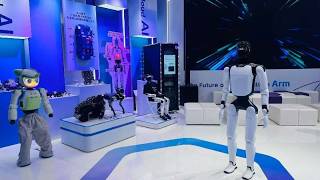
Embodied Intelligence Showcases at WAIC 2026
TECH

Embodied Intelligence Showcases at WAIC 2026

31+
Signals

Strategic Overview

  • 01.
    WAIC 2026 ran July 17-20 in Shanghai, and for the first time gave embodied intelligence equal status as a core conference track, with exhibition space surpassing 100,000 square meters and more than 1,100 companies exhibiting.
  • 02.
    The show floor displayed 108 chips, 261 foundation models, 208 embodied-intelligence terminals and more than 300 working robots, anchored by a dedicated Embodied Intelligence Pavilion.
  • 03.
    Roughly 60 humanoid robots from companies including Zhiyuan and Keenon were put to work in live public-service roles at the venue itself, described as the first large-scale deployment of full-size humanoids at a major exhibition.
  • 04.
    Keenon Robotics built a fully autonomous "Embodied Community" covering supermarket, coffee shop, bakery and a new hotel-laundry scenario, running without remote operation on a self-developed VLA architecture fused with a world model, and framed a "job-ization" path for putting its robots into real employment roles.
  • 05.
    Tsinghua researcher Su Hang's TUTOR method, presented at the AGIBOT-hosted Embodied AI Forum, raised long-horizon task autonomous success from 8.3% to 35% by focusing on recoverability.
  • 06.
    At the same forum, Zhiyuan's GE-Sim 2.0 world model was reported topping the WorldArena simulation leaderboard, with its GO-2 robot posting a 98.7% task-success rate.
  • 07.
    Wanxun Robotics debuted its Std16A industrial-grade and Eco12 lightweight dexterous hands doing real 618 e-commerce warehouse sorting work at a brand's actual warehouse rather than a demo booth, part of a broader shift at WAIC 2026 toward production-grade hardware over stage tricks.
  • 08.
    Crossverse Intelligence ran a live closed-loop demo of a robot performing supermarket barcode-scanning sorting and phone-box packing using its DexWorldModel, alongside its DexVerse simulation engine - which it describes as the only engine supporting multi-physics-field coupling in a single scene - and a 2-million-plus-sample Aligned DexWorld dataset.

Deep Analysis

The Three Walls: Why Physical AI's Data Problem Dwarfs Language Models'

Zhiyuan partner Yao Maoqing gave WAIC 2026's clearest framing of what stands between today's demos and commercially reliable robots: a data wall, a representation wall and a closed-loop wall, in his words the model determines the starting point but data determines the endgame [1]. The scale problem is stark. According to figures shared at the AGIBOT-hosted forum, physical AI's current data volume is only about 1/20000 of what large language models trained on, and reaching a genuine physical-world ChatGPT moment would require at least 100 million hours of real interaction data [2]. That is a fraction of the roughly 100 billion hours believed to underlie LLM training, but still an enormous gap from where the field sits today. Zhiyuan and Embodied Technology's response is to open-source infrastructure rather than hoard it - their AGIBOT WORLD dataset, described as the industry's first million-scale real robot dataset, has already logged more than 1.2 million cumulative downloads. Meanwhile Georgia Tech's Xu Danfei reported his team has independently accumulated 20,000 hours of human first-person-view data and observed something resembling a linear scaling law, evidence that more data reliably buys more capability even if nobody has enough of it yet.

From Backflips to Uptime: WAIC's Reliability Pivot

In past WAIC events, robot makers competed on joint degrees of freedom, backflips and fluid dance routines; this year exhibitors leaned instead on production capacity, yield rates and standardized delivery capability [3]. That shift showed up concretely on the floor: Keenon's entire "Embodied Community" ran without remote operation across supermarket, coffee-shop, bakery and hotel-laundry scenarios, explicitly framed around a "job-ization" path rather than a stage trick, while Dyna Robotics demonstrated DYNA-1 folding towels at 99.4% success and completing more than 85 towels in 24 hours of continuous, unattended operation before moving directly into real restaurant testing [4]. The throughline across both companies is that operational data collected in live commercial settings, not curated lab benchmarks, is what each treats as its actual moat - Keenon calls this a data flywheel, and Dyna's own commercial deployments function the same way. That reliability-over-spectacle framing showed up in how outside observers read the show, too: alongside celebratory coverage of the more theatrical exhibits, at least one independent industry voice's read of WAIC 2026 was that robots are shifting from an AI problem into an industrial engineering problem, with the next bottleneck sitting in compute, power, sensors and manufacturing rather than model intelligence alone - a framing that echoes the same production-over-performance pivot playing out on the show floor.

Generalist Ambition Meets Reliability Skepticism

The forum's sharpest disagreement was not about timelines but about strategy. Ma Yecheng argued bluntly that the industry has too many generalist models that can attempt almost anything but succeed reliably at nothing, calling that approach commercially worthless and pushing for reliability pursued to the extreme even at the cost of narrower scope [1]. That critique lands directly on companies pursuing the opposite bet: Physical Intelligence's pi0.7 was presented at the same forum as evidence of compositional generalization, recombining previously trained skills to handle tasks it was never explicitly taught, including zero-shot transfer to an untrained robot arm [5][6]. Zhiyuan occupies a middle position, betting on a full-stack flywheel across data, representation and closed-loop infrastructure rather than picking one pole. Notably, the panel converged on one point of consensus that cuts across this generalist-specialist split: VLA architectures and world models were described not as competing routes but as fused and coexisting, with world models treated as a core component inside the VLA ecosystem rather than an alternative to it [7].

How Long Until Robotics' ChatGPT Moment

How Long Until Robotics' ChatGPT Moment
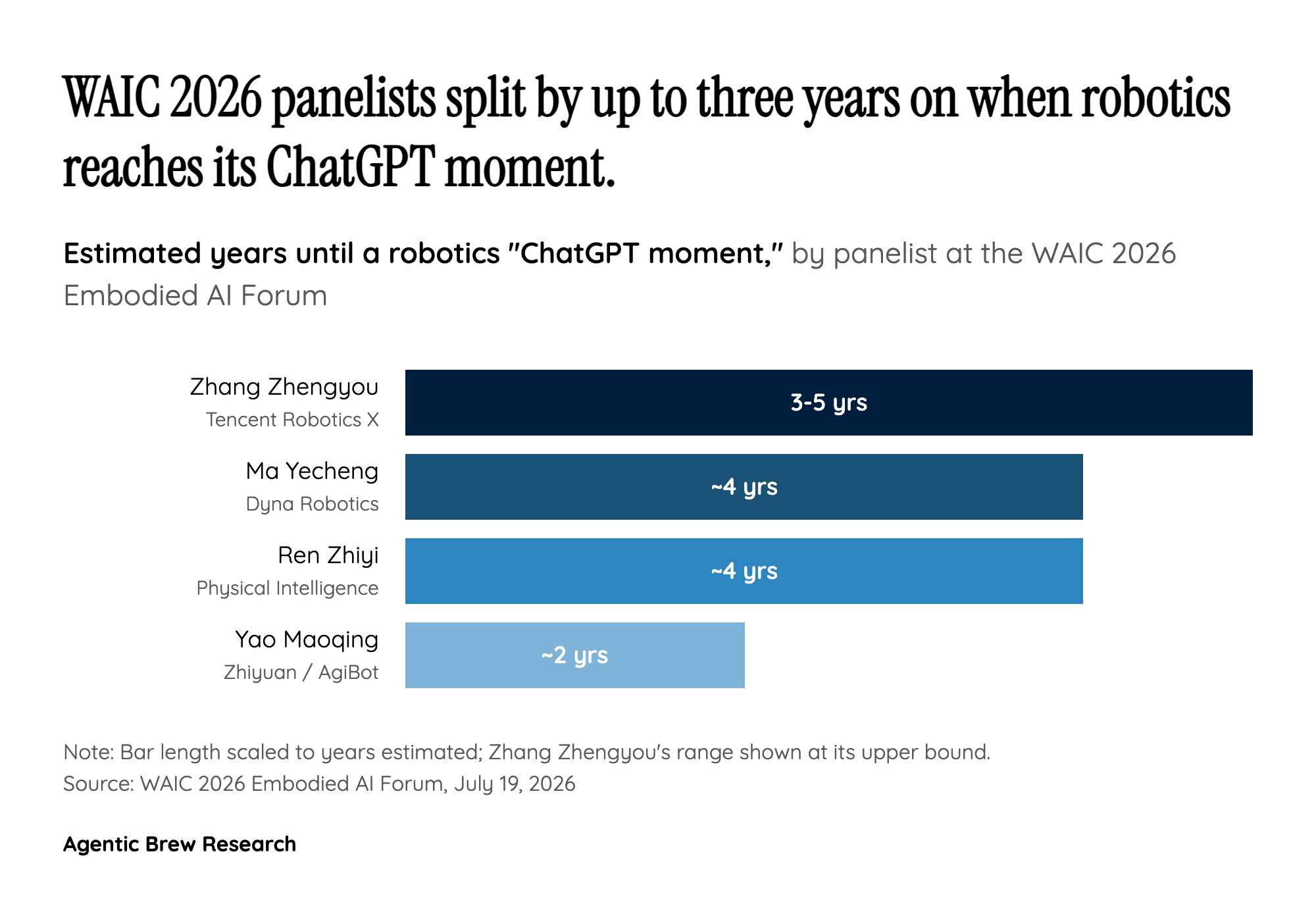
WAIC 2026 panelists gave ChatGPT-moment timeline estimates ranging from 2 to 5 years.

Ask WAIC 2026's panelists when embodied intelligence gets its ChatGPT moment and the answers cluster but do not agree. Yao Maoqing was the most bullish, putting a number on it - as fast as two years, contingent on closing the data gap [1]. Physical Intelligence's Ren Zhiyi and Dyna's Ma Yecheng each landed closer to four years [1], while Tencent Robotics X chief scientist Zhang Zhengyou was the most conservative voice, estimating three to five years and using his caution to argue that robotics startups should stay focused on a single layer, the model brain, rather than spreading resources across hardware and software at once [2]. The debate borrows its framing from NVIDIA CEO Jensen Huang, who has already described his company's Isaac GR00T N1.6 as the ChatGPT moment for robotics - a claim WAIC's panelists are effectively arguing over the timing of, not the eventual arrival [8].

Dexterous Hands Converge on a Spec Sheet

Beneath the model debates, WAIC 2026's hardware also told a convergence story. AGIBOT's OmniHand 3 Ultra-M packs 20 degrees of freedom into 630 grams with a 5-kilogram grip and 0.3-second open and close speed [9], while Wanxun Robotics brought two purpose-built hands into a real 618 e-commerce warehouse rather than a demo booth: the Std16A, an industrial combat-grade hand weighing no more than 1,100 grams with 16 active degrees of freedom and at least 60 newtons of four-finger grip force, and the lighter Eco12, at 500 grams, 12 degrees of freedom and 45 newtons of grip. Both Wanxun hands use self-developed micro servo motors rated to 250 newtons of pull force at roughly 31 grams each, an approach the company frames as a full-stack "micro servo motor plus biomimetic multi-DOF hand plus operation solution" rather than a single component sale. Feeding this hardware requires matching simulation and data infrastructure: Crossverse's DexVerse claims to be the only engine supporting multi-physics-field coupling within a single scene, a broader capability range than NVIDIA's Isaac Sim, and its Aligned DexWorld dataset aligns space, action and time across more than 2 million heterogeneous samples specifically to solve the problem of hard-to-cotrain data from different robot platforms [10].

Historical Context

2025-04-29
Unveiled DYNA-1, described as the first commercial-ready robot foundation model offering fully autonomous round-the-clock dexterity, later shown running in real restaurants, factories and laundromats.
2026-04-16
Unveiled pi0.7, a generalist foundation model demonstrating compositional generalization - recombining trained skills to handle unseen tasks such as zero-shot laundry folding and cooking in a never-before-seen appliance.
2026-07-19
AGIBOT hosted the WAIC 2026 Embodied AI Forum at the Golden Hall of the Shanghai World Expo Center, bringing Physical Intelligence, Dyna Robotics, Genesis AI, Sunday Robotics, Zhiyuan, Tsinghua University and Tencent Robotics X onto the same stage.

Power Map

Key Players
Subject

Embodied Intelligence Showcases at WAIC 2026

KE

Keenon Robotics

Built the fully autonomous WAIC 2026 "Embodied Community"; ranked the world's top commercial service-robot shipper by 2025 volume, with 100,000-plus robots deployed across 70-plus countries.

AG

AGIBOT / Zhiyuan Robotics

Unveiled the A3 Ultra full-size humanoid, X2 Edu, G2 Max and OmniHand 3 Ultra-M dexterous hand; hosted the WAIC 2026 Embodied AI Forum; showed GE-Sim 2.0 and the GO-2 robot.

PH

Physical Intelligence

Presented pi0.7's compositional-generalization results at the forum via research scientist Ren Zhiyi, demonstrating zero-shot task transfer to untrained robot arms.

DY

Dyna Robotics

Showcased DYNA-1 folding towels commercially and running 24/7 in real restaurants and factories; co-founder Ma Yecheng argued for reliability over broad generality.

TE

Tencent Robotics X (Zhang Zhengyou)

Tencent chief scientist advocated a focused "brain-only" strategy for startups and estimated a 3-5 year timeline to a robotics ChatGPT moment.

CR

Crossverse Intelligence (跨维智能)

Showcased its DexVerse simulation engine and Aligned DexWorld dataset as "physical AI infrastructure," plus a live closed-loop robot demo, positioning itself as underlying infrastructure for general embodied intelligence.

WA

Wanxun Robotics (万勋机器人)

Debuted the Std16A industrial dexterous hand and Eco12 lightweight hand doing live 618 warehouse-sorting work at WAIC, one of the earliest deployments of a dexterous hand in a real commercial operation.

TS

Tsinghua University (Su Hang)

Proposed the TUTOR method for recoverable long-horizon robot task execution, lifting autonomous success rates from 8.3% to 35%.

Fact Check

10 cited
  1. [1] WAIC panel: Yao Maoqing, Ren Zhiyi and Ma Yecheng on the three walls of physical AI
  2. [2] AGIBOT-hosted WAIC 2026 Embodied AI Forum coverage
  3. [3] Pudu Robotics showcases embodied AI portfolio at WAIC 2026
  4. [4] Dyna Robotics unveils DYNA-1
  5. [5] Physical Intelligence: pi0.7
  6. [6] Physical Intelligence says its new robot brain can figure out tasks it was never taught
  7. [7] WAIC panel consensus: VLA and world models are fusion, not competition
  8. [8] Embodied intelligence and robotics in 2026
  9. [9] AGIBOT unveils four new products at WAIC 2026
  10. [10] Crossverse Intelligence DexVerse and Aligned DexWorld coverage

Source Articles

Top 5

THE SIGNAL.

Analysts

"Frames the core obstacle to commercial-grade robotics as three sequential barriers - a data wall, a representation wall and a closed-loop wall - arguing that the model determines the starting point but data determines the endgame, and predicts a robotics ChatGPT moment could arrive in as little as two years given roughly 100 million hours of real interaction data."

Yao Maoqing (姚卯青)
Partner, Zhiyuan / AgiBot

"Argues generalization emerges once model capacity is sufficient, warns that carelessly stuffing historical context and coarse language guidance into a model can corrupt it, and puts the ChatGPT-moment timeline at roughly four years."

Ren Zhiyi (任至意)
Research Scientist, Physical Intelligence

"Criticizes the proliferation of generalist models that attempt many tasks but succeed reliably at none, calling that approach commercially worthless, and pushes for reliability-first deployment over breadth; estimates the ChatGPT moment at roughly four years out."

Ma Yecheng (马也骋)
Co-founder and Chief Scientist, Dyna Robotics

"Advocates a focused "brain-only" strategy for robotics startups rather than diluting effort across both hardware and software, and estimates a longer 3-5 year path to a robotics ChatGPT moment."

Zhang Zhengyou
Chief Scientist, Tencent Robotics X

"Reports his team has accumulated 20,000 hours of human first-person-view data and observed a linear scaling law in the embodied intelligence field, suggesting performance gains track data volume in a predictable way."

Xu Danfei
Georgia Tech
The Crowd

"At #WAIC 2026, this ultra-realistic humanoid robot from AheadForm looks so real. Powered by over 200 high-precision micro-expression control points, it can reproduce the subtle movements of 43 human facial muscles. #robot #robotics #HumanoidRobot #AI #WAIC2026"

@@XHNews9

"At the WAIC 2026 Embodied AI Forum hosted by AGIBOT, Dr. Yao Maoqing, Partner, Senior Vice President and President of the Embodied AI Business Unit, shared how foundation models and data flywheels are accelerating the emergence of Physical AI. Together with leading researchers..."

@@AGIBOT_US7

"The biggest signal from WAIC 2026: Robots are transitioning from an AI problem into an industrial engineering problem. The next bottleneck is not only intelligence but also the physical stack, such as compute, power, memory, sensors, motion control, packaging, and manufacturing."

@@ANNYYUSZ2

"WAIC 2026 Robots"

@u/violentviolinz33
Broadcast
Live: Inside the robot hands bringing embodied AI into everyday life at WAIC 2026

Live: Inside the robot hands bringing embodied AI into everyday life at WAIC 2026

Inside WAIC 2026: a glimpse of embodied AI innovations, humanoid robots

Inside WAIC 2026: a glimpse of embodied AI innovations, humanoid robots

Live: A walk through AI – present and future – at WAIC 2026

Live: A walk through AI – present and future – at WAIC 2026