Z.ai releases GLM-5.2 open-weights model
TECH

Z.ai releases GLM-5.2 open-weights model

37+
Signals

Strategic Overview

  • 01.
    Z.ai (Zhipu AI) released GLM-5.2 on June 13, 2026, an open-weights Mixture-of-Experts flagship of roughly 744-756B total parameters (about 40B active per token) under an MIT license with no regional limits, with weights on HuggingFace and ModelScope.
  • 02.
    The model ships a usable 1M-token context window, a 5x jump over GLM-5.1's 200K limit, plus dual reasoning efforts (high and xhigh) tuned for long-horizon coding and agentic work.
  • 03.
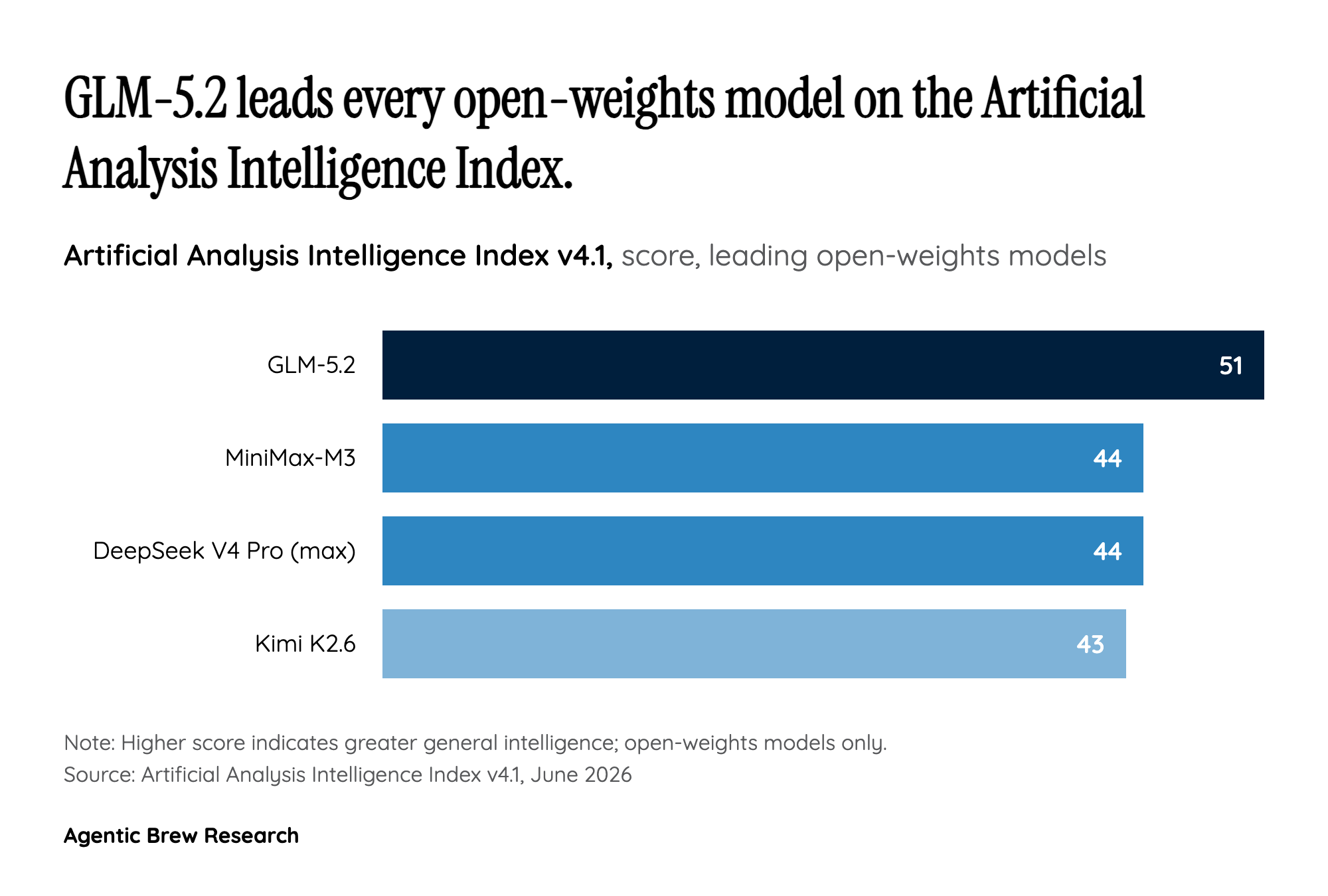
    GLM-5.2 tops the Artificial Analysis Intelligence Index v4.1 with a score of 51, the leading open-weights model ahead of MiniMax-M3 and DeepSeek V4 Pro max (both 44), and scored 74.4% on FrontierSWE, trailing Claude Opus 4.8 by about one point while edging out GPT-5.5.
  • 04.
    The release landed one day after a US export-control directive forced Anthropic to pull Fable 5 and Mythos 5 offline, and Zhipu's Hong Kong-listed stock closed up nearly 33% on the news.

The open-weights gap to frontier closed models just collapsed
The open-weights gap to frontier closed models just collapsed
GLM-5.2 tops the Artificial Analysis Intelligence Index v4.1 (score 51) ahead of MiniMax-M3 (44), DeepSeek V4 Pro max (44), and Kimi K2.6 (43).

GLM-5.2's headline achievement is not that it wins a benchmark outright, but how close it gets to the frontier while remaining downloadable. It tops the Artificial Analysis Intelligence Index v4.1 at 51, the leading open-weights model by a wide margin over MiniMax-M3 (44), DeepSeek V4 Pro max (44), and Kimi K2.6 (43) [2]. On long-horizon coding the picture is even sharper: 74.4% on FrontierSWE places it within roughly one point of Claude Opus 4.8 (75.1%) and just above GPT-5.5 (72.6%), while Terminal-Bench 2.1 jumped to 81.0 from GLM-5.1's 63.5 [1].

The economic argument is what makes the benchmark argument matter. At $1.40 input and $4.40 output per 1M tokens on OpenRouter, GLM-5.2 runs roughly 9x cheaper than GPT-5.5 and about 8x cheaper than Opus, and Artificial Analysis pegs the cost at about $0.46 per Intelligence Index task [2][4]. Independent benchmark coverage found the model beats GPT-5.5 on multiple long-horizon coding benchmarks for a fraction of the cost [8]. The contrarian footnote from practitioners: GLM-5.2 is token-inefficient, spending around 43k output tokens per task, but at this price the verbosity is cheap.

Geopolitical timing: you cannot export-control open source

GLM-5.2 shipped on June 13, 2026, exactly one day after a US Commerce Department export-control directive forced Anthropic to suspend Fable 5 and Mythos 5 globally [5]. The juxtaposition is the story: as Western frontier models were pulled offline by policy, an MIT-licensed Chinese model with no regional limits became downloadable to anyone, anywhere, the next morning [1]. Z.ai leaned into the framing, rolling GLM-5.2 across every tier of its GLM Coding Plan immediately [5].

The market read it as vindication: Zhipu's Hong Kong-listed stock (Knowledge Atlas Technology) closed up 32.8% on release and is up roughly 820% since its January 2026 IPO [7]. The deeper point is structural. Export controls are designed to restrict the flow of a product through a vendor's distribution chain, but open weights have no distribution chokepoint once published; the model itself becomes the artifact that crosses borders. GLM-5.2 is the clearest demonstration yet that licensing strategy is now a geopolitical instrument, and that an open release can convert a competitor's regulatory setback directly into market share.

The enterprise governance paradox: open weights vs. hosted-API risk

For enterprises, GLM-5.2 splits cleanly into two very different risk profiles depending on how it is deployed, and analysts were emphatic about the distinction. Pareekh Jain of Pareekh Consulting framed the core tension bluntly: the risk flips completely if you use Z.ai's hosted API instead, because Chinese national security rules could require domestic companies to cooperate with government requests [3]. The same model, self-hosted from MIT-licensed weights inside your own infrastructure, carries no such data-cooperation exposure, while the convenient hosted endpoint reintroduces it entirely. DHS and House lawmakers have separately flagged PRC-origin model data risks under China's National Intelligence Law [5].

Beyond jurisdiction, the analysts converged on what GLM-5.2 still has to prove. Lian Jye Su of Omdia noted the cost advantages are real but warned that picking any foreign vendor, American or Chinese, exposes non-US Western enterprises to zero control over the availability and uptime of these models [3]. Tulika Sheel of Kadence International added that demonstrated success in real-world deployments and transparent governance will be just as important as benchmark scores [3]. The paradox, then, is that GLM-5.2's biggest enterprise advantage (self-hostable open weights) and its biggest enterprise liability (a jurisdictionally-exposed hosted API) live inside the same release.

How GLM-5.2 sustains 1M context: IndexShare and speculative decoding

The 1M-token context window (1,048,576 tokens, with up to 131,072 tokens of output) is a 5x increase over GLM-5.1's 200K, but the engineering interest is in how the model keeps that context affordable [1]. GLM-5.2 introduces IndexShare, which reuses a single indexer across every four sparse-attention layers and cuts per-token FLOPs by 2.9x at 1M context [1]. On top of that, Multi-Token Prediction (MTP) speculative decoding raises acceptance length by up to 20%, improving throughput on long generations [1].

Architecturally this is a Mixture-of-Experts design of roughly 744-756B total parameters with only about 40B active per token, which is what makes a model this capable cheap enough to serve at frontier-rivaling prices [2]. The combination of sparse attention reuse plus a sparse expert mix is the technical reason GLM-5.2 can stably sustain long-horizon work that would otherwise blow up FLOPs and cost at this context length. It shipped with day-zero support across transformers, vLLM, and SGLang, which is why practitioners were able to inspect and run these mechanisms within hours of release.

The 'is it really local?' reality check

The celebration of GLM-5.2 as a win for local AI deserves a sharp caveat that practitioners surfaced quickly. At roughly 744-756B total parameters, the model's full footprint is far too large for consumer hardware, and a debate on r/LocalLLaMA acknowledged that the 753B weight class simply will not load on a typical desktop GPU [2]. What 'local' actually means today is narrower: some enthusiasts report running the model on 512GB Mac configurations at 1-10 tokens per second, and one Hugging Face engineer demonstrated GLM-5.2 running across two M3 Ultra Mac Studios via MLX, calling it comparable to the latest closed models with weights you can download, quantize, and fine-tune.

The realistic near-term value of the open weights, then, is less about everyone running it on a laptop and more about the distillation and fine-tuning headroom the MIT license unlocks, plus the option for organizations with serious hardware to self-host. There are also capability gaps the community flagged: GLM-5.2 has no multimodal or image input, so it is a text-and-code specialist rather than a drop-in general frontier replacement, with users pairing it with a separate vision model when they need one.

Historical Context

2026-01
Zhipu AI (Knowledge Atlas Technology) IPO'd on the Hong Kong exchange in early January 2026; its stock has since risen roughly 820%.
2026-06-12
A US export-control directive led Anthropic to suspend Fable 5 and Mythos 5 globally.
2026-06-13
Z.ai released GLM-5.2 and rolled it out across all tiers of the GLM Coding Plan with 1M context, one day after the Anthropic suspension.

Power Map

Key Players
Subject

Z.ai releases GLM-5.2 open-weights model

Z.

Z.ai (Zhipu AI / Knowledge Atlas Technology)

Developer and releaser of GLM-5.2, positioning the model as a low-cost open alternative to restricted Western frontier models. Its Hong Kong-listed stock surged about 33% on the release.

OL

Ollama

Hosts GLM-5.2 as a cloud-only model running on US-based NVIDIA Blackwell datacenter GPUs, accessible via 'ollama run glm-5.2:cloud'.

OP

OpenRouter

Distributes GLM-5.2 API access at $1.40 input / $4.40 output per 1M tokens, roughly 9x cheaper than GPT-5.5.

AN

Anthropic

Competitor whose Fable 5 and Mythos 5 were pulled offline by US export controls, creating the market opening GLM-5.2 fills; Opus 4.8 remains GLM-5.2's nearest benchmark rival.

US

US Government (Commerce Dept / DHS / House lawmakers)

Issued the export-control directive that triggered the Anthropic suspension; DHS and House lawmakers flag PRC-origin model data risks under China's National Intelligence Law.

Fact Check

8 cited
  1. [1] GLM-5.2: Frontier Intelligence, Open Weights
  2. [2] GLM-5.2 is the new leading open weights model on the Artificial Analysis Intelligence Index
  3. [3] Z.ai pitches GLM-5.2 for long-running software engineering tasks
  4. [4] GLM-5.2 - Z.AI
  5. [5] GLM-5.2: Zhipu's China AI response to the Fable 5 ban
  6. [6] glm-5.2
  7. [7] Zhipu AI's stock rockets after Chinese firm makes GLM-5.2 open source
  8. [8] Z.ai's open-weights GLM-5.2 beats GPT-5.5 on multiple long-horizon coding benchmarks for 1/6th the cost

Source Articles

Top 5

THE SIGNAL.

Analysts

"Western enterprises will want independent benchmark validation, successful global deployments, strong security and governance controls, and long-term support before committing; the risk profile changes entirely depending on deployment, since Chinese national security rules could compel domestic companies to cooperate with government requests if you use the hosted API rather than self-hosted weights."

Pareekh Jain
CEO, Pareekh Consulting

"Enterprise leaders weigh performance against competitors and cost of adoption; GLM-5.2 performs well in long-horizon agentic coding and carries clear cost advantages as open source, but selecting either American or Chinese vendors exposes non-US Western enterprises to the risk of zero control over model availability and uptime."

Lian Jye Su
Chief analyst, Omdia

"GLM-5.2 still needs to prove it can operate as a stable enterprise product; real-world deployment success and transparent governance will matter just as much as benchmark scores."

Tulika Sheel
Senior VP, Kadence International

"Called GLM-5.2 the first open model he could comfortably swap in for Opus or GPT in his own workflows."

Sentdex
AI developer and commentator (X)

"Suggested GLM-5.2 functions as a better agent than Gemini in some settings."

Nathan Lambert
AI researcher (X)
The Crowd

"GLM-5.2 (Max) by @Zai_org ranks #10 on the new Agent Arena leaderboard, closely matching Claude-Opus-4.8 (non-thinking) and is the #1 open model by a wide margin! In Agent Arena, we measure models on millions of real-world, long-horizon agentic tasks from a global community of"

@@arena644

"GLM 5.2 has just been released 🔥 Here it's already running with MLX on two Mac Studios (M3 Ultra). This is comparable to the latest closed models, with weights you can download, quantize, distill, fine-tune, run."

@@pcuenq592

"GLM-5.2 is comparable to Opus 4.8 🔥🥵 with 1M context > new IS attention reuses one indexer every 4 sparse layers (2.9× per-token FLOPs at 1M > improved MTP layer for spec decoding > flexible thinking-effort levels > day-0 in transformers + vLLM + SGLang, MIT license 🤗"

@@mervenoyann358

"GLM-5.2 (max) is currently the third best model available, across both open and proprietary."

@u/okaycan481
Broadcast
GLM-5.2 Is INSANE – Is This the BEST New Open Source Model?

GLM-5.2 Is INSANE – Is This the BEST New Open Source Model?

GLM-5.2 (Fully Tested): I got EARLY ACCESS & This MODEL is CRAZY!

GLM-5.2 (Fully Tested): I got EARLY ACCESS & This MODEL is CRAZY!

I Tested NEW GLM-5.2 on Four Projects. Wow.

I Tested NEW GLM-5.2 on Four Projects. Wow.