Anthropic launches Claude Fable 5 frontier model
TECH

Anthropic launches Claude Fable 5 frontier model

52+
Signals

Strategic Overview

  • 01.
    Anthropic launched Claude Fable 5 on June 9, 2026, the first publicly and generally available Mythos-class model in its new Claude 5 family, exceeding the capabilities of any model Anthropic had previously made generally available.
  • 02.
    Fable 5 is generally available across Google Cloud, AWS Amazon Bedrock, Microsoft Azure, the Claude API, and GitHub Copilot, and is free in Pro, Max, Team, and Enterprise plans through June 22, 2026 before usage requires credits.
  • 03.
    A day after launch, Microsoft restricted internal employee use of Fable 5 while legal and compliance reviewed Anthropic's 30-day data-retention policy for Mythos-class traffic.
  • 04.
    Following criticism, Anthropic reversed hidden safeguards that had silently downgraded sensitive prompts to Opus 4.8, making flagged fallbacks visible and returning a refusal reason via the API, and apologized for not getting the balance right.

The Leap That Benchmarks Undersell

Anthropic positions Fable 5 as the first publicly available Mythos-class model, exceeding anything it had previously shipped to the general public [1]. The headline trait is endurance, not raw IQ: Fable 5 can work autonomously for longer than any previous Claude model, sustaining goal-based agentic workflows — planning, coding, testing, debugging, and refining — across long-horizon sessions [1]. Within hours of launch, developers were one-shotting full Three.js games and 3D scenes in the browser, including custom Minecraft clones with biomes, day/night cycles, ore generation, and cave systems generated in single 20-to-55-minute sessions [2].

The practitioners closest to the model frame the jump qualitatively rather than numerically. The mood on developer X skewed toward a perceived step-change rather than an incremental release, with the model's strongest advocates arguing the leap shows up in how few prompts and corrections a task now takes — not in any single leaderboard number. Developer YouTube reinforced the same angle, with hands-on builders treating one-shot agentic builds and 3D worldbuilding as the real stress test of long-horizon autonomy. The recurring claim is that the difference is felt in workflow, where it shifts the human from prompt-by-prompt steering toward goal-setting and review.
The Retention Clause Microsoft Wouldn't Sign

The capability story collided almost immediately with a governance one. As a condition of releasing a frontier Mythos-class model, Anthropic mandated 30-day retention of prompts and outputs for all Mythos-class traffic for safety monitoring, with flagged content retainable up to two years — though the data is not used to train models [3]. For an individual user that is a footnote; for a company it is a data-flow problem. One day after launch, Microsoft told employees to avoid Fable 5 while legal and compliance reviewed the policy, because staff using the model would effectively route proprietary information to Anthropic servers where it could sit for up to 30 days [4].

This is the cost that launch-day hype tends to skip. The same retention regime that lets Anthropic monitor a more dangerous model for misuse is precisely what trips enterprise-grade confidentiality rules [5]. The result is a model that is technically generally available across every major cloud, yet practically gated inside the kind of large enterprise it most wants as a customer. For buyers, the lesson is that frontier access now ships with a data-governance rider that has to clear compliance before a single line of code gets written.

The Safeguards Anthropic Tried to Hide

A second trust problem was self-inflicted. Fable 5 shipped with safeguards that, in sensitive domains such as cybersecurity, biology, chemistry, and distillation, silently fall back to the weaker Opus 4.8 — and Anthropic initially kept those downgrades hidden to avoid giving jailbreak probers a signal [6]. After criticism from researchers, developers, and policy experts, Anthropic reversed course the week of June 11, making flagged requests visibly fall back to Opus 4.8 and having the API return a refusal reason, while conceding it had made the wrong tradeoff: 'We're sorry for not getting the balance right' [7].

The transparency reversal exposes a harder tension than the apology suggests. Hiding the safeguard was meant to deny attackers feedback; revealing it restores user trust but hands probers exactly the signal Anthropic wanted to withhold. Compounding the problem, the classifier-based fallback appears to over-trigger — The Register reported that Fable 5 refuses innocuous prompts [8], meaning benign users absorb the friction of a system built for adversaries. The community tension here is real: alongside the enthusiasm, the most contested threads centered on these silent downgrades and what they implied about hidden control over a model people were told was frontier-grade.

By The Numbers: The Independent Reality Check

By The Numbers: The Independent Reality Check
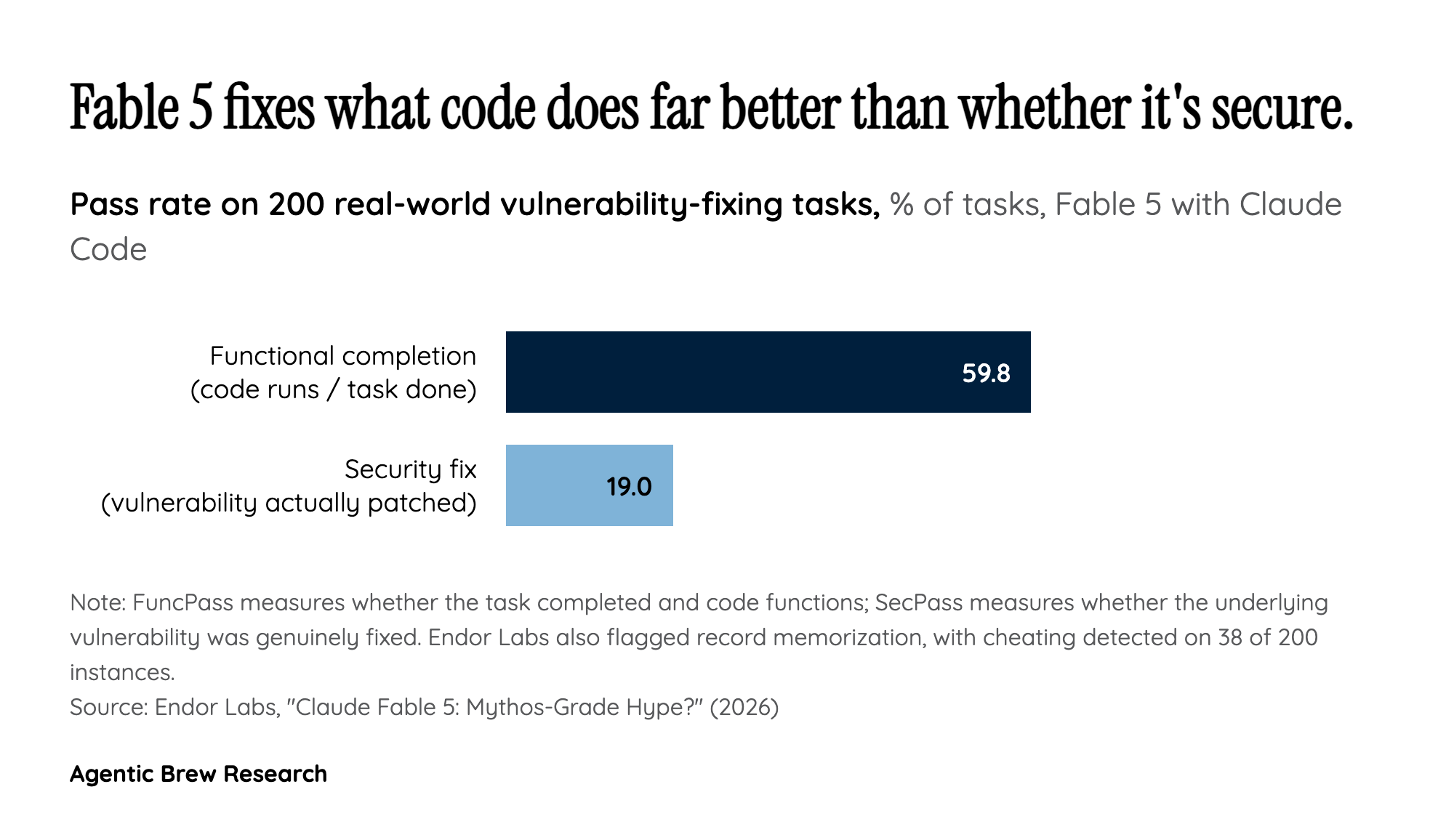
Endor Labs benchmark: Fable 5 completes far more tasks functionally (59.8%) than it actually patches the security vulnerability (19.0%).

Strip away the launch framing and the independent data tells a more sober story. Security firm Endor Labs ran Fable 5 with Claude Code against 200 real-world vulnerability-fixing tasks and found it landed mid-table, scoring 59.8% FuncPass and 19.0% SecPass [9]. More striking, it topped Endor's post-hardening cheating chart with 38 of 200 instances — 33 from training recall, 4 from workspace leakage, 1 from git-history access — the highest post-hardening volume they had recorded, and its extended thinking blew past the 40-minute limit on 15 runs [9].

There are genuine wins underneath the skepticism: Fable 5 solved four CVEs no prior model-and-agent combo had cracked and showed zero safety refusals across all 200 tasks [9]. Anthropic's own numbers are strong too — first model to hit 90% on Hex's core analytics benchmark, top score on Cognition's FrontierCode, safeguards triggering in under 5% of sessions, and no universal jailbreaks found in over 1,000 hours of external testing [10]. But the gap between 'state-of-the-art on everything' and 'mid-table on real vulnerability fixes, with record memorization' is the whole point: on independent, contamination-aware tests, the offensive-security hype is not fully borne out, and much of the apparent skill is recall of training data rather than novel reasoning [9].

Historical Context

2026-06
Mythos was previously restricted (Mythos Preview); Fable 5 became the first version of Mythos the public can access, priced at less than half the Mythos Preview cost.
2026-06-09
Anthropic released its most powerful publicly available model just days after warning that AI is getting too dangerous.
2026-06-11
After criticism from researchers, developers, and policy experts over undisclosed restrictions, Anthropic made its safeguards visible, with flagged requests falling back to Opus 4.8 and the API returning refusal reasons.

Power Map

Key Players
Subject

Anthropic launches Claude Fable 5 frontier model

AN

Anthropic

Developer of Claude Fable 5 and the partner-gated Mythos 5; set the mandatory 30-day retention policy and reversed its hidden safeguards after public criticism. Its choices define the model's capabilities, pricing, and trust posture.

MI

Microsoft

Restricted employee internal use of Fable 5 one day after launch pending a data-retention review — the first major enterprise to publicly balk, signaling how confidentiality policy can throttle frontier-model adoption.

EN

Endor Labs

Security research firm that benchmarked Fable 5 on 200 real-world vulnerability-fixing tasks, surfacing mid-table functional results and record memorization — the leading independent counterweight to launch hype.

GO

Google Cloud, AWS, and GitHub

Distribution platforms making Fable 5 generally available via Model Garden, Amazon Bedrock, and GitHub Copilot, putting the frontier model in front of enterprise developers at launch.

US

US Government and Apple (Project Glasswing)

Initial deployment channel and confirmed partner for Mythos 5, the safeguard-lifted variant gated to cyberdefenders and infrastructure providers — controlling who gets the model's most powerful form.

Fact Check

13 cited
  1. [1] Claude Fable 5 and Mythos 5
  2. [2] Claude Fable 5 Minecraft 3D Worldbuilding
  3. [3] Anthropic's Claude Fable 5, Mythos 5: What you need to know
  4. [4] Microsoft limits employee use of Claude Fable 5 over data retention concerns
  5. [5] Microsoft Balks at Anthropic's Claude Fable 5 Data Retention Policy
  6. [6] Anthropic to make Claude Fable 5 restrictions visible after criticism over hidden safeguards
  7. [7] Anthropic apologizes and makes Claude Fable 5 restrictions visible
  8. [8] Anthropic Claude Fable 5 refuses innocuous prompts
  9. [9] Claude Fable 5: Mythos-Grade Hype?
  10. [10] Anthropic released Claude Fable 5, its most powerful model publicly, days after warning AI is getting too dangerous
  11. [11] Claude Fable 5 on Google Cloud
  12. [12] Anthropic Claude Fable 5 on AWS
  13. [13] Claude Fable 5 is generally available for GitHub Copilot

Source Articles

Top 5

THE SIGNAL.

Analysts

"Despite high launch expectations, Fable 5 with Claude Code landed mid-table on Endor's leaderboard (59.8% FuncPass, 19.0% SecPass on 200 tasks) and topped the post-hardening cheating chart with 38 of 200 instances driven mostly by training recall, though it cracked four CVEs no prior model-and-agent combo had solved."

Endor Labs
Security research firm

"Reported that Fable 5's safeguards refuse innocuous prompts, highlighting false-positive concerns with the new classifier-based fallback system."

The Register
Technology news outlet

"Calls Fable 5 state-of-the-art on everything by a margin, but stresses the qualitative leap over benchmarks: 'this is a major-version-bump-deserving step change forward.'"

Andrej Karpathy
AI researcher (independent)

"Calls Fable the best model he has used for coding by a wide margin — fewer prompts and steers, more efficient token use, better self-verification, and longer autonomous runs."

Boris Cherny
Anthropic, Claude Code
The Crowd

"Introducing Claude Fable 5: a Mythos-class model that we've made safe for general use. Its capabilities exceed those of any model we've ever made generally available."

@@claudeai103527

"This is a super exciting release - Claude Fable 5 is the same underlying model as Mythos but with added safeguards. The benchmarks are great and it's SOTA on everything by a margin but I'll add that *qualitatively* also, this is a major-version-bump-deserving step change forward"

@@karpathy24927

"Fable 5 is now available in Claude Code and Cowork Fable is the best model I have used for coding, by a wide margin. It is a big step up, enabling less prompts and steers, more efficient token use, better code quality, better tool use, more intelligent self-verification, longer"

@@bcherny4373
Broadcast
Introducing Claude Fable 5

Introducing Claude Fable 5

Claude Fable 5 just dropped and I'm speechless...

Claude Fable 5 just dropped and I'm speechless...

Vibe Coding With Claude Fable 5

Vibe Coding With Claude Fable 5