DoorDash launches Ask DoorDash AI assistant
TECH

DoorDash launches Ask DoorDash AI assistant

31+
Signals

Strategic Overview

  • 01.
    DoorDash launched Ask DoorDash on June 11, 2026, an in-app conversational AI assistant that lets users search restaurants, shop for groceries, and (soon) book reservations using natural-language text, photos, or voice instead of scrolling menus.
  • 02.
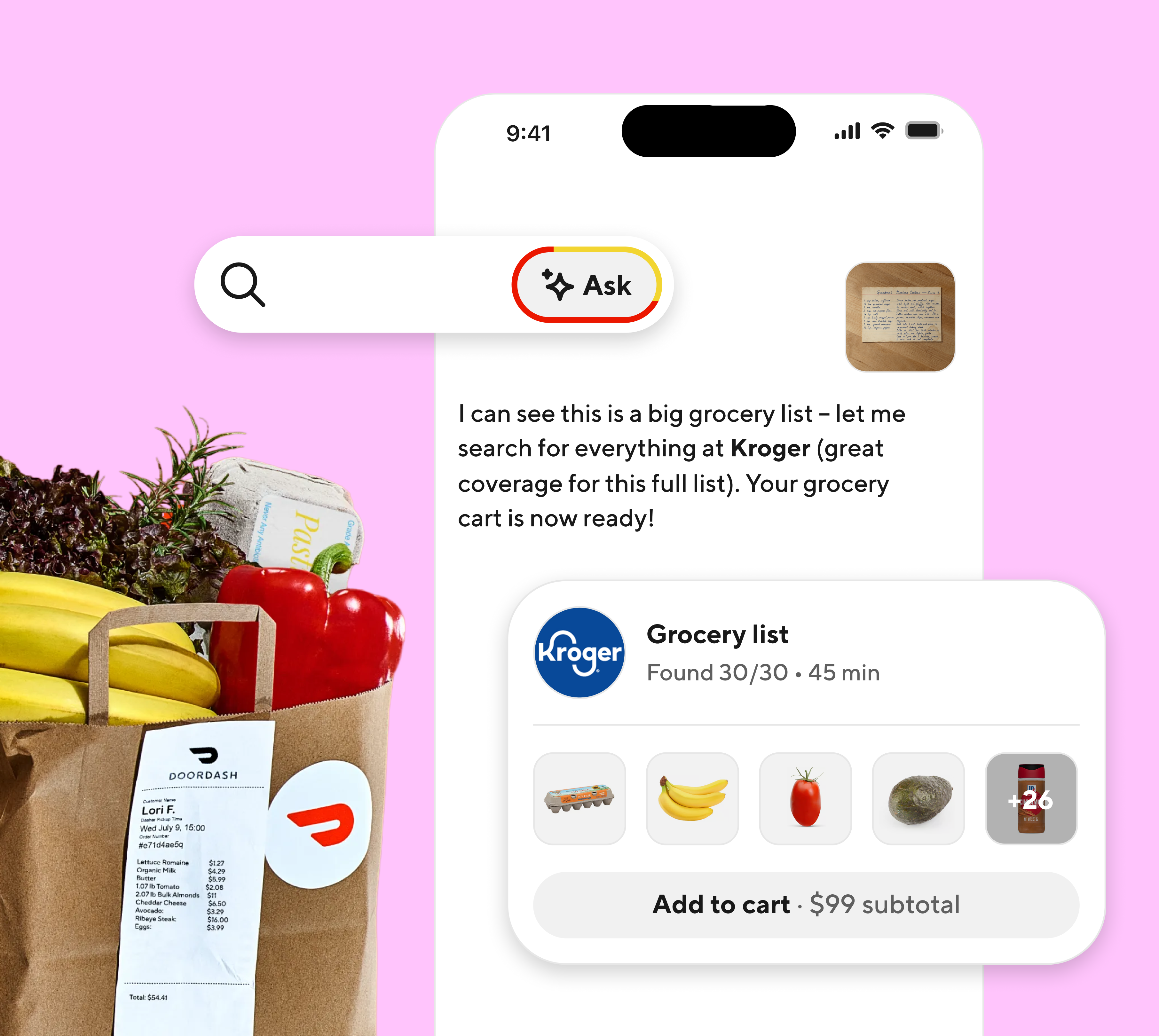
    For groceries, users can upload a cookbook photo, snap a handwritten grocery list, or paste a recipe link, and the app builds a cart with the correct ingredients and quantities, prompting about staples like sugar and butter to avoid duplicate purchases.
  • 03.
    The feature is rolling out on iOS in select U.S. regions for restaurant search and grocery shopping, with SevenRooms-powered reservations and additional cities expanding in the coming weeks.
  • 04.
    The assistant draws on AI models from OpenAI, Anthropic, and Google, supplemented by open-source models to reduce cost; DoorDash began internal work on a conversational ordering tool in 2023 but held off shipping until the models matured.

The launch metrics suggest conversational ordering actually shifts behavior
The launch metrics suggest conversational ordering actually shifts behavior
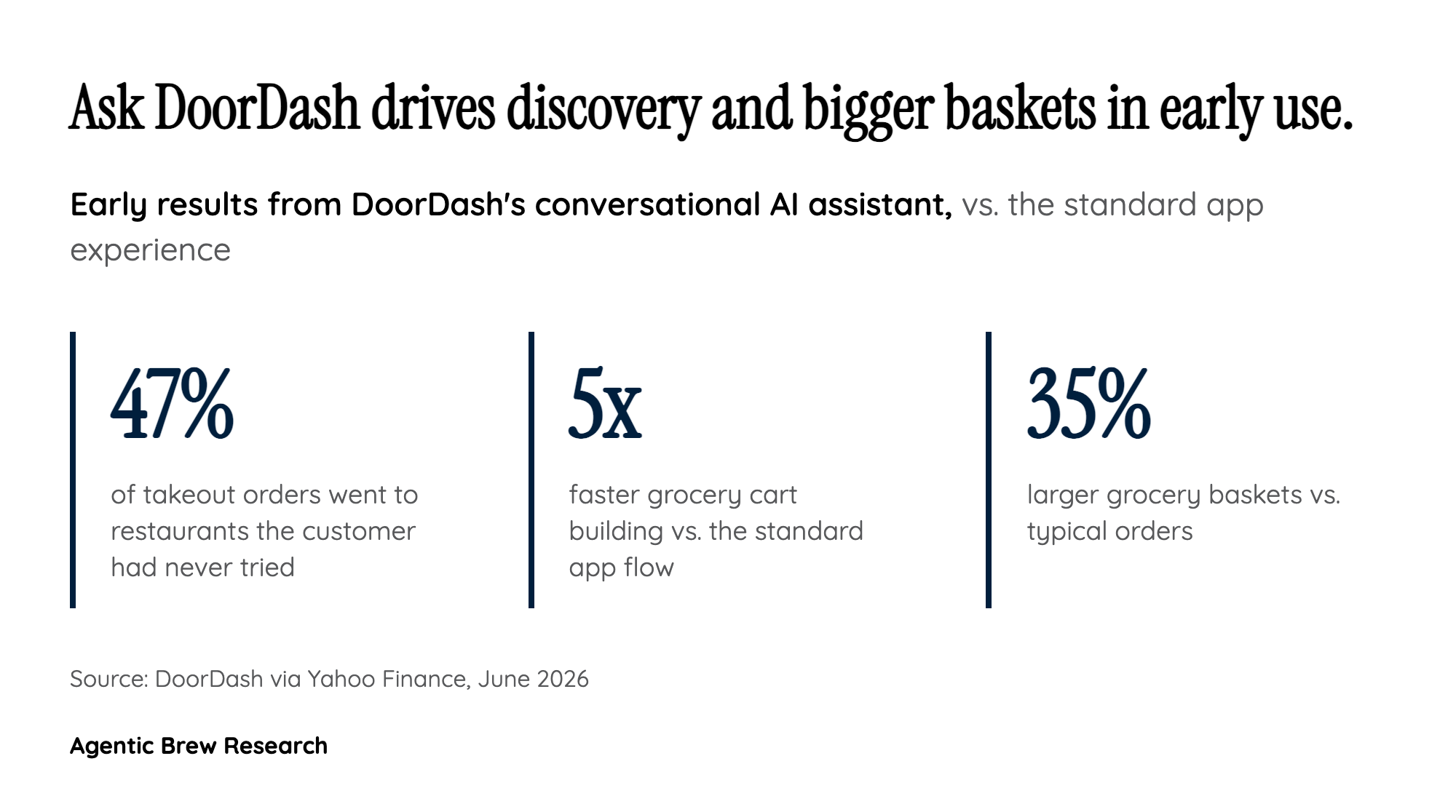
Early Ask DoorDash usage: 47% of takeout orders went to never-before-tried restaurants, grocery carts built 5x faster, and baskets ran 35% larger than the standard app flow.

The most striking thing about Ask DoorDash is not the chatbot itself but what early usage data shows. Nearly half of takeout orders placed through the tool came from restaurants the customer had never used before, and co-founder Andy Fang says it drives more new-restaurant trial than anything else the company has tried in the app [2]. On the grocery side, customers build carts roughly five times faster and produce baskets about 35% larger than the standard flow [2]. Those are not marginal funnel improvements; they point to the interface changing what people order, not just how fast they order it. For a marketplace whose economics hinge on discovery and basket size, a feature that simultaneously expands the long tail of restaurants and inflates grocery subtotals is close to ideal.

The mechanism: photos and prompts collapse a multi-step task into one message

Ask DoorDash works by absorbing messy, real-world inputs and resolving them into a structured order. A user can type 'filling dinner for a family of 4,' and the app surfaces restaurants with a personalized blurb, then refines on dietary preference, budget, group size, and past orders in real time [1]. For groceries, the unlock is multimodal input: upload a cookbook photo, snap a handwritten list, or paste a recipe link, and the app builds a cart with correct ingredients and quantities, even prompting about pantry staples like sugar and butter so you don't double-buy [4][5]. The technical backbone is a blend of frontier models from OpenAI, Anthropic, and Google, with open-source models layered in to control cost [2]. That cost discipline matters at DoorDash's scale: running large models against every grocery photo is expensive, and the open-source supplement likely helps keep per-order inference affordable as the feature expands across the U.S.

This is a defensive play to own the end-to-end flow

Behind the consumer polish is an existential bet. CEO Tony Xu's argument is that even if external AI agents start handling the first steps of food delivery, DoorDash can orchestrate the entire flow end-to-end and keep customers from drifting to third-party assistants [3]. Analysts have been pressing exactly this question: MoffettNathanson's Michael Morton has flagged the risk that AI-driven intermediaries disrupt DoorDash's direct customer relationship [3]. Shipping its own agent is how DoorDash tries to stay the destination rather than become a backend that some other AI calls. The ambition extends further: Fang has signaled DoorDash wants to license the same agentic technology so grocers, restaurants, and retailers can power their own experiences [2]— turning a defensive consumer feature into a potential platform business.

The $5B acquisition machine is finally visible to consumers

Ask DoorDash is also where DoorDash's recent dealmaking surfaces as a product. The forthcoming reservations capability — describe 'a table for two downtown for a date-night dinner around 8 PM' and see restaurants with availability — runs on SevenRooms, the reservations and CRM platform DoorDash bought for $1.2 billion [6]. The roughly $4 billion Deliveroo acquisition extends the global footprint and ties Deliveroo's consumer platform to that same reservation tech [7]. Stitched together, restaurant search, grocery, and reservations become a single conversational surface rather than three separate products. That unification is the payoff DoorDash needs to justify spending north of five billion dollars on M&A, and it explains why the company plans to put several hundred million dollars into new products and technology this year [3].

The contrarian read: a prompt box may be the wrong tool for impulse cravings

Not everyone is convinced the behavior change sticks. An eMarketer analyst notes that food delivery is often impulse-driven — users beeline to a known restaurant and place a familiar order — and 'a prompt-based interface may not save time for someone who already has a craving for a pizza with mushrooms and green peppers from their go-to spot' [3]. The skeptic's point is real: the impressive discovery and basket metrics may reflect early-adopter exploration rather than the median habitual orderer, for whom typing a sentence is slower than tapping a saved favorite. Notably, the launch's own framing concedes this — DoorDash positions Ask DoorDash for the moments when you don't already know what you want, not as a replacement for the one-tap reorder. Whether the tool converts habitual orderers or settles in as a discovery layer for the undecided is the open question that the launch metrics, drawn from early users, can't yet answer.

Historical Context

2023
DoorDash began internal development on a conversational ordering tool but chose not to ship until underlying AI models matured.
2025-05-06
DoorDash announced a $1.2 billion deal to acquire reservations and CRM platform SevenRooms, entering the restaurant-reservations business.
2025
DoorDash agreed to acquire UK-based Deliveroo for nearly $4 billion, expanding its global footprint.
2026-06-11
DoorDash launched Ask DoorDash, integrating restaurant search, grocery cart-building, and forthcoming SevenRooms-powered reservations into one conversational AI assistant.

Power Map

Key Players
Subject

DoorDash launches Ask DoorDash AI assistant

DO

DoorDash

Launching company, unifying its tech stack into an end-to-end commerce platform to defend its direct customer relationship against AI intermediaries.

OP

OpenAI, Anthropic, and Google

Model providers powering Ask DoorDash, supplemented by open-source models to cut cost.

SE

SevenRooms

Reservations and CRM platform DoorDash acquired for $1.2 billion, powering the forthcoming Ask DoorDash Reservations capability.

DE

Deliveroo

Roughly $4 billion DoorDash acquisition extending its global footprint and tying its consumer platform to SevenRooms reservation tech.

UB

Uber Eats and Instacart

Competitors racing toward agentic shopping; Uber Eats launched an AI cart assistant earlier in 2026 and Instacart introduced AI tools for grocers late last year.

GR

Grocers, restaurants, and retailers

Future partners DoorDash wants to help power their own agentic experiences using the same technology.

Fact Check

7 cited
  1. [1] Introducing Ask DoorDash
  2. [2] DoorDash Built an AI Chatbot to Help With Orders, Reservations and Grocery Lists
  3. [3] DoorDash launches Ask DoorDash AI shopping assistant
  4. [4] DoorDash launches an in-app AI chatbot to let users order food and groceries with photos and prompts
  5. [5] DoorDash's new AI chatbot lets you order with prompts and photos
  6. [6] DoorDash acquires SevenRooms for $1.2 billion
  7. [7] DoorDash to acquire Deliveroo and reservations firm SevenRooms

Source Articles

Top 5

THE SIGNAL.

Analysts

"Frames Ask DoorDash as removing friction: 'We've spent over a decade building an app that puts everything in your city at your fingertips, but more options shouldn't mean more work.' He says the team now feels good about the experience's responsiveness and its ability to understand requests and surface compelling suggestions."

Andy Fang
Co-founder, DoorDash

"Reports the tool drives more new-restaurant trial than anything else the company has tried: 'We're seeing customers trying out new restaurants much more frequently through this experience than anything else we've tried to do in the app when it comes to ordering from restaurants.'"

Andy Fang
Co-founder, DoorDash

"Argues that even if AI agents handle the first steps of food delivery, DoorDash can orchestrate the entire flow end-to-end, which is how it will retain customers rather than ceding them to external assistants."

Tony Xu
CEO, DoorDash

"Skeptical that a prompt interface saves time for habitual orderers: 'Food delivery is often impulse-driven, with users quickly navigating to a known restaurant and placing an order. A prompt-based interface may not save time for someone who already has a craving for a pizza with mushrooms and green peppers from their go-to spot.'"

eMarketer analyst
Analyst, eMarketer

"Raised the risk that AI-driven intermediaries could disrupt DoorDash's direct relationship with its customers."

Michael Morton
Analyst, MoffettNathanson
The Crowd
Broadcast
[6/11 14:00] Google turns to Samsung for future AI chip / DoorDash launches Ask DoorDash AI chatbot

[6/11 14:00] Google turns to Samsung for future AI chip / DoorDash launches Ask DoorDash AI chatbot

DoorDash Introduces AI-powered voice ordering technology for restaurants

DoorDash Introduces AI-powered voice ordering technology for restaurants

DoorDash is Working on an AI Chatbot to Speed Up Food Ordering

DoorDash is Working on an AI Chatbot to Speed Up Food Ordering