TSMC's AI-Driven Capacity Expansion and Earnings Surge
TECH

TSMC's AI-Driven Capacity Expansion and Earnings Surge

23+
Signals

Strategic Overview

  • 01.
    TSMC reported Q2 2026 revenue of about $40.2 billion (NT$1,270.38 billion), up 36.0% year-over-year, with net income up 77.4% YoY, a record for the fifth consecutive quarter.
  • 02.
    TSMC raised 2026 capex guidance to $60-64 billion and its full-year revenue growth outlook to above 40%, while committing an additional $100 billion to Arizona, bringing total spend there to $265 billion for at least four more fabs plus packaging facilities.
  • 03.
    ASML posted Q2 2026 net sales of €9.3 billion and net income of €2.9 billion, both above guidance, and raised its full-year outlook to €43-45 billion in sales while planning a 30% expansion of EUV lithography capacity for 2027.
  • 04.
    Two of TSMC's four newly announced Arizona fabs will run 2-nanometer-class nodes, even though 2nm made up only 3% of Q2 wafer revenue - a sign the most advanced ramp is just getting started.

Deep Analysis

The Real Constraint Is Packaging, Not Wafers

TSMC's C.C. Wei told investors that packaging capacity, not wafer capacity, is now the binding constraint on customer growth [1]. In his words: "Our packaging capacity is so tight that now it's limiting my customers' growth. We welcome that additional flexibility" [1]. That framing lines up with the shape of the new $100 billion Arizona commitment itself: the expansion adds at least four more fabs plus dedicated advanced packaging facilities [2], and analysts describe CoWoS - the process that binds AI processors to high-bandwidth memory - as the industry's real chokepoint, ahead of raw fab output [3]. The node-mix data underscores how early the wafer side of that ramp still is: 2-nanometer shipments were just 3% of Q2 wafer revenue even as two of the four new Arizona fabs are slated to run 2nm-class nodes [2].
A Simultaneous Capex-and-Revenue Raise Is a Rare Signal

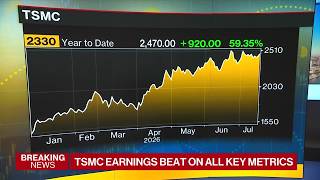
TSMC did not just beat estimates - it raised both its 2026 capex guidance, to $60-64 billion from $52-56 billion, and its revenue growth outlook, to above 40%, in the same earnings call [2]. Commentary around the earnings coverage drew a pointed contrast with Samsung's own quarter, where a large profit jump still triggered a share slump, framing TSMC's simultaneous raise as close to the cleanest available read on real-world AI hardware demand, given that TSMC manufactures for Nvidia, AMD, Apple and Broadcom alike. That reading lines up with how analysts characterized the demand itself. Omdia's Simon Chen argued the current cycle is different in kind from past speculative run-ups: "The demand we see is structural, backed by massive, tangible capital expenditures from hyperscalers" [4]. Counterpoint's William Li largely agrees that demand is exceptionally strong, but notably locates the risk on the supply side rather than the demand side [4].

ASML's EUV Backlog Sets the Industry's Speed Limit

Because ASML remains the sole global supplier of EUV lithography systems, its capacity roadmap effectively caps how fast TSMC, Samsung and Intel can add advanced-node capacity, regardless of how much capex those chipmakers commit. ASML's own Q2 2026 results - €9.3 billion in net sales and 54.0% gross margin, both ahead of guidance - reflect that leverage, and the company raised its full-year outlook to €43-45 billion in sales on the back of what it called extremely strong order intake tied to AI investment across Logic and Memory customers [5]. Crucially, ASML is planning to expand EUV capacity by 30% for 2027 versus its 2026 base of roughly 65 systems, with a further 30% increase under investigation for 2028 [5]. Market watchers pointed to a concrete sign of that demand this quarter: ASML sold 16 of its most advanced EUV lithography machines in Q2 alone. Community discussion of ASML's tool economics (advanced EUV systems running well over $300 million apiece) helps explain why that expansion, not TSMC's or ASML's headline capex figures alone, may be the tighter constraint on how quickly the industry's AI capacity can actually grow.

Why the Stock Fell on a Record Quarter

Despite the record results and the raised guidance, TSMC shares slipped in the days around the report - a reaction market commentary attributed to expectations already being priced in rather than to any weakness in the underlying numbers. The skepticism has a margin-side justification: Counterpoint's William Li flagged that EUV supply constraints and overseas fab investment could weigh on TSMC's margins near term [4], and the aggressive N2 ramp is expected to dilute second-half gross margin by roughly three to four percentage points [4]. That tension between headline growth and margin drag is compounded by the sheer scale of the new spending commitment - $60-64 billion in 2026 capex alone [2]- which investors have to weigh against near-term profitability. Retail investor discussion floated a second, unrelated explanation for the drop: rotation pressure from a resurgent Chinese memory-chip competitor entering the market, rather than anything specific to TSMC's own numbers. At the same time, community breakdowns of fab and EUV tool costs (roughly $10 billion per fab, plus $300 million-plus per advanced lithography system) argued the $100 billion Arizona figure is grounded in real unit economics rather than a speculative round number, pushing back on the idea that the spend itself is the problem.

Arizona's Six-Year Climb - and Its Geopolitical Asterisk

TSMC's Arizona commitment has compounded steadily: $12 billion in 2020 [6], $40 billion by the end of 2022 [6], past $65 billion alongside a preliminary CHIPS Act agreement in 2024 [7], $165 billion after a further $100 billion pledge in March 2025 [8], and now $265 billion following this quarter's additional $100 billion commitment [9]. That trajectory is widely framed, including in community discussion, as a geopolitical hedge against a disruption in Taiwan - a concern with real weight given that Taiwan still produces more than 90% of the world's most advanced semiconductors [3]. But the hedge comes with a caveat raised in that same discussion: Arizona's fabs reportedly still cannot operate fully independently of TSMC's Taiwan headquarters and know-how today, meaning the buildout reduces geographic concentration in dollars committed well before it reduces operational dependency on Taiwan itself.

Historical Context

2020-05
TSMC first announced a $12 billion investment to build an advanced fab in Phoenix, Arizona.
2022-12
TSMC committed to a second Phoenix fab, raising total Arizona investment to $40 billion.
2024-04
TSMC and Commerce signed a preliminary CHIPS Act funding agreement (up to $6.6B), and TSMC announced a third fab, pushing Phoenix site capex past $65 billion.
2025-03
TSMC announced at least $100 billion more for three additional Arizona fabs plus two advanced packaging facilities and an R&D center, taking total announced Arizona investment to $165 billion.
2025-Q4
TSMC's N2 (2nm) process began volume production.
2026-07-16
TSMC reported record Q2 2026 results and announced a further $100 billion Arizona investment, bringing the cumulative total to $265 billion.

Power Map

Key Players
Subject

TSMC's AI-Driven Capacity Expansion and Earnings Surge

TS

TSMC (Taiwan Semiconductor Manufacturing Co.)

World's largest contract chipmaker, producing over 90% of the world's most advanced semiconductors, giving it leverage over Nvidia, AMD, Apple and other fabless AI chip designers who depend on its advanced nodes and CoWoS packaging capacity.

AS

ASML

Sole global supplier of EUV lithography systems required for leading-edge chip production; its order backlog and capacity decisions gate how fast TSMC, Samsung and Intel can add advanced capacity.

C.

C.C. Wei, TSMC Chairman and CEO

Set the company's AI demand narrative and announced the additional $100B Arizona commitment, publicly framing advanced packaging (CoWoS), not wafer capacity, as the binding constraint on customer growth.

ST

State of Arizona / City of Phoenix

Host jurisdiction for TSMC's $265B cumulative fab and packaging buildout, described as the largest direct foreign investment in American history.

HY

Hyperscalers / AI chip designers (Nvidia, AMD, and CPU vendors on x86/Arm/RISC-V)

Demand-side drivers; TSMC noted essentially all CPU architectures are its customers, and its own packaging capacity constraints are currently limiting these customers' growth.

Fact Check

9 cited
  1. [1] BiGGo News: TSMC (TSM) Coverage, July 16, 2026
  2. [2] TSMC Boosts Arizona Fab Investment to $100B After Strong Second Quarter
  3. [3] BiGGo News: TSMC Advanced Packaging Coverage
  4. [4] Taiwan Chipmaker TSMC Reports Record Quarter Amid AI Boom
  5. [5] Q2 2026 Financial Results
  6. [6] TSMC Arizona
  7. [7] TSMC SEC Filing, April 8, 2024 (CHIPS Act Preliminary Agreement)
  8. [8] TSMC SEC Filing: TSMC Expands Investment in the United States
  9. [9] TSMC Lifts Arizona Investment to $265 Billion After Record Quarter

Source Articles

Top 4

THE SIGNAL.

Analysts

"Says AI infrastructure investment remains exceptionally strong despite macro uncertainty, but flags EUV supply constraints and overseas fab investments as potential near-term margin risks."

William Li
Senior Analyst, Counterpoint Research

"Dismisses AI bubble concerns as overstated, arguing demand is structurally backed by hyperscaler capex rather than speculative."

Simon Chen
Principal Analyst, Omdia

"Asserts a durable, multi-year AI demand trend, with advanced packaging (CoWoS) currently the binding constraint on customer growth rather than wafer capacity."

C.C. Wei
Chairman and CEO, TSMC
The Crowd

"TSMC is accelerating Arizona factory buildout to capitalize on AI 'megatrend,' CFO says"

@@CNBC35

"Just finished up the $TSM conference call. TSMC does not see demand slowing down anytime soon, announcing an additional $100B in CapEx to build 4 more fabs. Management spends tremendous resources tracking real-time customer data and wouldn't deploy this level of capital"

@@QualCompounders15

"$ASML sold 16 of its most advanced Extreme Ultraviolet lithography (EUV) machines during Q2"

@@StockMKTNewz218

"Taiwan computer chipmaker TSMC pledges another $100 billion to expand US chipmaking capacity"

@u/Presently_Naked1100
Broadcast
TSMC Beats Estimates Amid Sustained AI Demand

TSMC Beats Estimates Amid Sustained AI Demand

CONFIRMED: TSMC Raises 2026 Forecast as AI Chip Demand Explodes

CONFIRMED: TSMC Raises 2026 Forecast as AI Chip Demand Explodes

TSMC's Profit Surges as AI Investment Boosts Demand

TSMC's Profit Surges as AI Investment Boosts Demand