Nvidia's first bond sale since 2021 to fund AI expansion
TECH

Nvidia's first bond sale since 2021 to fund AI expansion

18+
Signals

Strategic Overview

  • 01.
    Nvidia priced a $25 billion investment-grade bond sale on June 15, 2026 — its first since 2021 — upsized from an initial ~$20 billion target after orders reached as high as $85 billion.
  • 02.
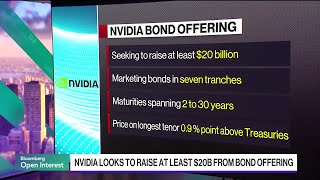
    The offering was sold in seven tranches with maturities spanning from 2 to 30 years, with the longest portion pricing about 0.65 percentage points above Treasuries.
  • 03.
    Proceeds are earmarked for general corporate purposes, including repaying and refinancing existing notes and funding Nvidia's AI investments.
  • 04.
    Demand at its peak reached more than four times the minimum offering amount, letting Nvidia enlarge the deal and tighten pricing.

Deep Analysis

The cash-rich-company-borrows paradox

The puzzle that dominated community reaction is genuine: why does a company as cash-generative as Nvidia need to borrow $25 billion? The answer is that Nvidia's AI ambitions now outrun even its formidable cash generation, and debt lets it preserve cash while avoiding shareholder dilution [1]. Nvidia has been writing very large checks across the AI stack — $5 billion into Intel, up to $10 billion pledged to Anthropic, and $30 billion contributed to OpenAI's latest funding round [1]. Funding those commitments with equity would dilute shareholders; draining the cash pile would strip its strategic flexibility. Borrowing — especially at investment-grade rates — is simply the cheapest lever.

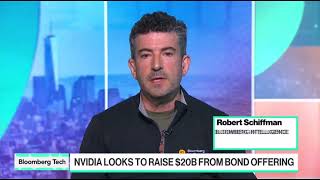
As Bloomberg Intelligence senior credit analyst Robert Schiffman framed it, inexpensive long-dated debt lowers Nvidia's weighted average cost of capital (the blended cost of financing itself through both debt and equity) and helps bankroll its AI investments without threatening its AA credit rating [1]. The Reddit r/StockMarket crowd reached the same conclusion organically: with a borrowing rate below inflation and AA credit at its strongest, locking in cheap money now reads as a rational move rather than a sign of distress.
An $85 billion order book: the bond market is desperate for AI exposure

An $85 billion order book: the bond market is desperate for AI exposure
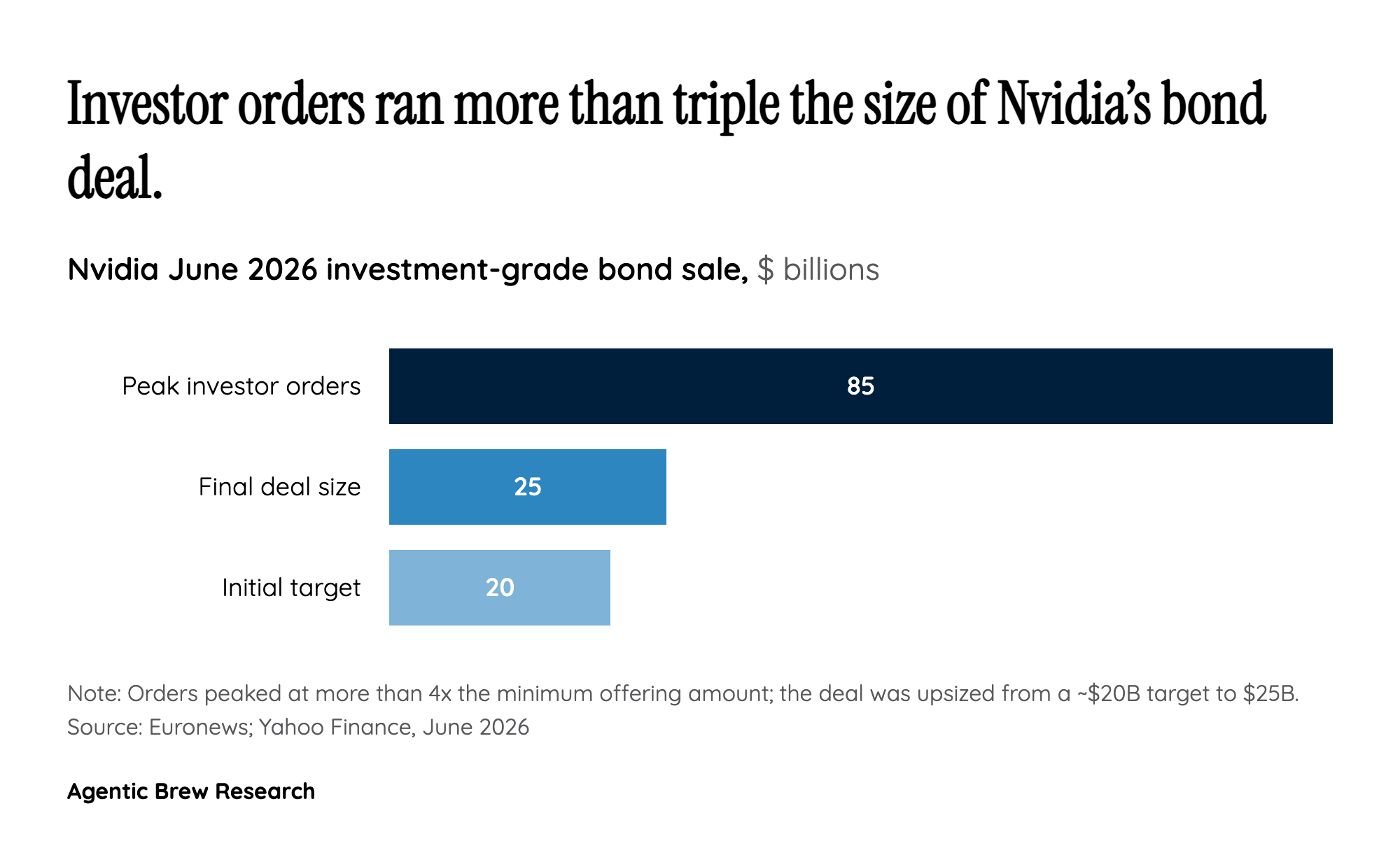
Investor orders peaked near $85B, more than triple the $25B deal Nvidia ultimately priced (upsized from a ~$20B target).

The demand side of this deal is arguably the bigger signal. Orders reached as high as $85 billion against a deal that started life at roughly $20 billion — more than three times the offering, and at its peak more than four times the minimum amount on the table [2]. That oversubscription gave Nvidia the leverage to do two things at once: enlarge the deal to $25 billion and tighten pricing. The yield on the longest, 30-year portion fell by 0.25 percentage points from initial price talk to land at about 0.65 percentage points above Treasuries — meaning investors accepted a thinner premium over the risk-free rate to hold Nvidia paper [2].

For context, this is Nvidia's largest-ever debt deal and roughly five times the $5 billion it raised across four maturities in its prior 2021 outing [1]. The takeaway: investment-grade investors are not merely tolerating AI-sector credit, they are competing for it, and a marquee name like Nvidia can dictate terms.

Cheap funding now, rollover risk later

Not everyone reads the enthusiasm as healthy. Moody's Analytics chief economist Mark Zandi has warned that aggressive borrowing by AI companies should be on the radar as a mounting potential threat to the financial system and broader economy, projecting that the ten largest AI firms will issue more than $120 billion in debt this year — a pace that exceeds pre-dot-com-crash levels [3]. The risk he flags is conditional but real: if AI firms miss lofty expectations and their stock prices fall, the debt they have piled on could quickly become a problem [3].

That worry echoed loudly across the skeptical corners of Reddit, where the dominant frame was alarmed — recurring 'Big Short' and 'house of cards' analogies, and pointed concern about smaller data-center builders issuing A-grade bonds at high effective rates and facing a wall of refinancing when those notes mature. The bull case (cheap debt, strongest-ever credit) and the bear case (an industry levering up against still-unproven returns) are both arguing from the same fact set; this deal is where they collide.

Circular financing: Nvidia's debt indirectly funds its own customers

What makes Nvidia's raise distinct from a generic corporate refinancing is where the money points. Nvidia is simultaneously a chip supplier and a major investor in the companies that buy its chips — its capital commitments span OpenAI, Anthropic, Intel, and others across the AI ecosystem [1]. Borrowing to help finance partners who in turn purchase Nvidia hardware creates a circular financing loop, and that structure is precisely what fuels both the bull and bear narratives. Optimists see vertical integration and ecosystem control; skeptics see demand being manufactured with borrowed money.

Community speculation picked up on this directly, floating acquisition and deeper-integration scenarios involving names like CoreWeave and OpenAI. Whatever the framing, the bond sale converts Nvidia from a purely self-funded AI champion into a leveraged participant in the buildout — a strategic posture shift rather than a quantified balance-sheet event, since the reporting did not confirm a specific change to Nvidia's total debt.

Historical Context

2021-06
Nvidia last tapped the investment-grade market in June 2021, selling $5 billion of notes across four maturities.
2025-12-09
Moody's chief economist publicly flagged the AI debt boom as a mounting threat to the financial system months before Nvidia's sale.
2026-06-15
Nvidia priced its $25B offering, its largest-ever debt deal and roughly five times its 2021 issuance.

Power Map

Key Players
Subject

Nvidia's first bond sale since 2021 to fund AI expansion

NV

Nvidia

Issuer; raised $25B in debt to preserve cash and fund its AI buildout without diluting shareholders, while keeping its AA credit profile intact.

IN

Investment-grade bond investors

Demand drivers; placed roughly $85B in orders, signaling strong appetite for AI-sector debt exposure and enabling the upsize and tighter pricing.

NV

Nvidia's AI partners (OpenAI, Anthropic, Intel)

Beneficiaries of Nvidia's capital commitments; Nvidia has invested $5B in Intel, pledged up to $10B to Anthropic, and contributed $30B to OpenAI's latest funding round.

Fact Check

3 cited
  1. [1] Nvidia raises over €21.5bn in first bond sale since 2021 as AI growth race continues
  2. [2] Nvidia Reportedly Attracts $85B in Orders for Bond Sale
  3. [3] AI debt and bond issuance is a potential threat to the financial system, top economist warns

Source Articles

Top 5

THE SIGNAL.

Analysts

"Inexpensive long-dated debt lowers Nvidia's weighted average cost of capital and helps bankroll its AI investments without threatening its AA credit rating."

Robert Schiffman
Senior Credit Analyst, Bloomberg Intelligence

"Borrowing by AI companies should be on the radar screen as a mounting potential threat to the financial system and broader economy, with the ten largest AI firms set to issue more than $120B in debt this year."

Mark Zandi
Chief Economist, Moody's Analytics
The Crowd

"NVIDIA SEEKS TO RAISE AT LEAST $20B IN BOND SALE $NVDA"

@@Investingcom284

"🔥 NEW: Nvidia is planning a $20B U.S. bond sale split across seven tranches, per Bloomberg."

@@Cointelegraph198

"Nvidia set to raise $25 bln from investment-grade bond sale. $NVDA"

@@financialjuice44

"Nvidia Looks to Raise at Least $20 Billion From Bond Offering"

@u/Quixotus1900
Broadcast
The News Today On NVIDIA Stock, Anthropic, NVIDIA Bond Sale - NVDA Update

The News Today On NVIDIA Stock, Anthropic, NVIDIA Bond Sale - NVDA Update

Nvidia Looks to Raise $20 Billion in First Bond Sale Since 2021

Nvidia Looks to Raise $20 Billion in First Bond Sale Since 2021

Nvidia Looks To Raise $20B From Bond Offering (June. 15, 2026)

Nvidia Looks To Raise $20B From Bond Offering (June. 15, 2026)