Nvidia Q2 FY2026 Earnings Report and AI Trade Reaction
TECH

Nvidia Q2 FY2026 Earnings Report and AI Trade Reaction

30+
Signals

Strategic Overview

  • 01.
    Nvidia reported Q2 (fiscal Q2 2027, ended July 26, 2026) revenue of $96.2 billion, up 106% year-over-year, with Data Center revenue of $89.0 billion, up 117% year-over-year.
  • 02.
    Nvidia posted GAAP diluted EPS of $2.46 and non-GAAP diluted EPS of $2.22, more than double the year-ago figure, with gross margin of 75.0%.
  • 03.
    Nvidia guided next-quarter (Q3 FY2027) revenue to $108 billion, plus or minus 2%, beating the ~$104.2 billion analyst consensus; the outlook assumes zero data-center sales to China.
  • 04.
    CFO Colette Kress said Nvidia expects to grow revenue by approximately 70% in fiscal 2028, well above the roughly 45% growth analysts had modeled.
  • 05.
    Ahead of results, Wall Street consensus called for roughly $92 billion in revenue (about 96-97% YoY growth) and adjusted EPS near $2.09, against Nvidia's own prior guidance of $91 billion plus or minus 2%.
  • 06.
    Nvidia stock fell for seven straight trading sessions heading into the report, its longest losing streak in about four years, a cumulative decline of roughly 7.5% (about $407 billion in market cap).

Deep Analysis

The Beat That Still Wasn't Enough

Nvidia's fiscal Q2 2027 report beat on every headline metric: revenue of $96.2 billion against a roughly $92 billion consensus, EPS above estimates, Data Center revenue up 117% year-over-year, and a Q3 guide of $108 billion that cleared the $104.2 billion Street number despite assuming zero China data-center sales [1][2][3]. And yet the stock dropped after hours. Community reaction on Reddit's r/stockstobuytoday framed this bluntly as the '4th straight beat-and-drop' - a now-familiar pattern where the headline numbers land clean but the stock sells off anyway, with the community's own read pointing to softer margin guidance, the China exclusion, and rising memory costs as the specific culprits investors fixated on rather than the beat itself. That framing lines up with the stock's own recent history: Nvidia has beaten estimates in 22 of its last 24 quarters but still fallen the day after earnings in 8 of the last 13, including a 5.5% drop after Q4 FY2026 and a 1.8% drop after Q1 FY2027 [4]. The stock also walked into this print already down roughly 7.5% over a 7-session losing streak that had erased about $407 billion in market value, its longest skid in four years [5]. That pre-earnings slide had already reset the stock's valuation to roughly 18-19x forward earnings, a meaningful compression from its historical premium - a reset that Bloomberg Tech's pre-earnings coverage described as the stock's worst losing streak since September 2022. A beat that would have been an unambiguous win a year ago now has to clear a much higher bar of investor skepticism before the stock actually moves higher.

Retail Optimism, Institutional Caution: The Social Read on the Print

The reaction split visibly along institutional-versus-retail lines. Data-focused breakdowns circulating on X, like Wall St Engine's line-by-line rundown of the beat against every estimate, treated the print as an unambiguous, clean win. A separate pre-earnings post from DeFiTracer had framed the report as a binary threshold event for the entire AI trade - a clear beat above the low-$90 billions bullish, anything under roughly $90 billion bearish - underscoring how much weight the market had put on this single print. But the framing that spread the widest was the opposite read: a viral reaction post juxtaposing Nvidia's record $96.2 billion quarterly revenue against the stock dropping after hours, framed as a bulls-versus-bears question, captured the confusion a lot of traders felt watching a record quarter get sold. On Reddit, the two communities split in a similar way. r/stockstobuytoday's 'beat-and-drop' framing channeled the frustration, while a more measured post in r/NVDA_Stock did the analytical work: it confirmed the beat was strong by recent standards - among the largest margins-over-guide of the last five quarters - but concluded that the real story investors should be pricing was never the Q2 print itself, but the Q3 guide, the margin trajectory, and the hyperscaler customer split. A third, more reflective post in the same community went further, theorizing that Nvidia's now-familiar 'sell the beat' pattern could eventually become self-defeating: if enough investors pre-sell in anticipation of a post-earnings drop, that anticipatory selling itself dampens the actual crash, potentially breaking the pattern over time. Institutional analysts, for their part, mostly stayed unmoved by the noise - the 28-analyst coverage universe still averaged a $304.73 price target with 59 of 62 ratings at Buy or higher heading into the quarter [7], a reminder that the loudest reactions online are not always where the actual price-setting is happening.

Guiding Higher Without China: A De-Risking Bet, Not a Write-Off

Nvidia's Q3 guide of $108 billion, plus or minus 2%, assumes zero data-center revenue from China and still cleared the roughly $104.2 billion consensus [2]. That is a notable fact, but it is worth being precise about what it does and doesn't mean. It does not mean Nvidia has written off China as a market - it means the company built a guide conservative enough to beat expectations without needing that revenue at all, which is a statement about the resilience and diversification of demand everywhere else, not a forecast that China stays closed forever. CFO Colette Kress's accompanying FY2028 growth guide of roughly 70%, well above the roughly 45% consensus [1], was built on that same China-free base, reinforcing that the rest of the business is doing more than enough heavy lifting on its own. If Chinese data-center demand were to return under a different regulatory or export environment, it would arrive as incremental upside on top of an already-raised bar, not as a lifeline the company is depending on. The guidance raise is best read as evidence of how de-risked Nvidia's forward numbers now are from a single geopolitical variable, not evidence that the China market has stopped mattering to the long-term AI buildout.

Rotation, Not Retreat: What the Chip Selloff Really Means

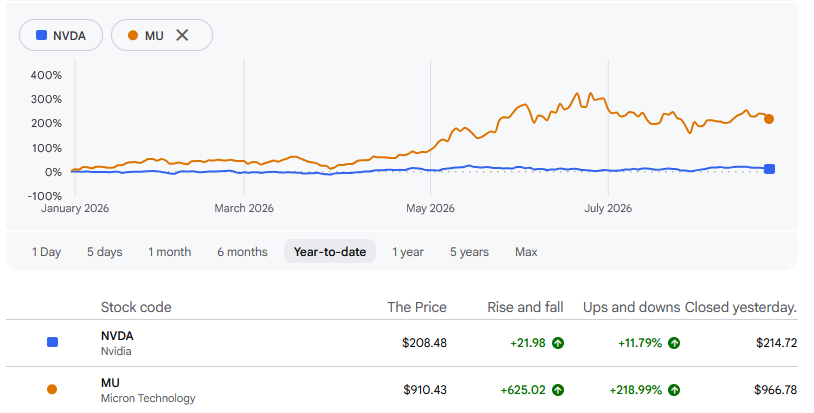
In the days before Nvidia reported, the broader chip sector sold off hard: Intel fell 5% to $85.98, AMD dropped 4% to $454.36, Taiwan Semiconductor slipped 3% to $406.40, and sector ETFs SOXX and IYW fell 4% and 2% respectively, with some commentary drawing dot-com-era comparisons [6]. But the more precise read, from TradingKey's earnings preview, is that this looked like rotation rather than retreat: capital flowing out of Nvidia and into names like Micron does not mean investors believe GPU demand is about to vanish, rather the market was searching within the AI supply chain for segments with tighter supply, faster earnings growth, and lower valuations [7]. That framing is consistent with the fact that Wall Street's own price targets on Nvidia stayed elevated through the selloff - JPMorgan at $280, Rosenblatt at $325, KeyBanc at $330, and Cantor Fitzgerald at $350, with an average 12-month target of $304.73 across 28 analysts and 59 of 62 ratings at Buy or higher [7]. Analysts were not backing away from the AI trade broadly; they were reallocating within it.

The Hyperscaler Risk Hiding Inside the Blowout Quarter

Underneath the headline beat sits a concentration risk that doesn't show up in the quarterly numbers themselves: Nvidia's largest Data Center customers are Amazon, Google, and Microsoft, the same hyperscalers that are simultaneously building their own competing AI chips [8]. A blowout quarter driven so heavily by a small number of buyers who are also the companies with the most resources and incentive to reduce their dependence on Nvidia over time is a structurally different kind of risk than a demand slowdown - it's a customer-concentration risk that can take years to show up in the numbers. The exposure runs both directions through the supply chain too: equipment and component suppliers like ASML, BE Semiconductor, and Jenoptik are tied to Nvidia's capital-spending cycle just as tightly as Nvidia is tied to its hyperscaler customers' willingness to keep spending [8]. That is part of why coverage of this quarter kept returning to the idea that Nvidia's results function as a barometer for the entire AI trade, not just for Nvidia itself [9]- a single company's guidance now moves sentiment across an entire ecosystem of customers, competitors, and suppliers built on top of it.

Historical Context

2025-07
Q2 FY2026 (year-ago quarter): revenue $46.7B (up 56% YoY), Data Center revenue $41.1B, non-GAAP EPS $1.05, gross margin 72.7%; Huang called Blackwell 'the AI platform the world has been waiting for.'
2026-01
Stock fell 5.5% the day after Q4 FY2026 earnings, part of a pattern of post-earnings declines despite beats.
2026-04
Stock fell 1.8% the day after Q1 FY2027 earnings, extending a four-quarter streak of post-earnings declines.
2023-04
Largest post-earnings single-day gain over the past 13 quarters was 24.4%; largest decline was -8.5% (January 2025), illustrating no consistent correlation between beat size and stock reaction.

Power Map

Key Players
Subject

Nvidia Q2 FY2026 Earnings Report and AI Trade Reaction

NV

Nvidia

Reporting company; largest AI chipmaker, treated as the AI trade's bellwether

JE

Jensen Huang

Nvidia Founder & CEO; commentary on demand/inflection point drives market reaction

CO

Colette Kress

Nvidia CFO; issued FY2028 ~70% revenue growth guidance

IN

Intel, AMD, Taiwan Semiconductor (TSMC)

Peer semiconductor names that sold off ahead of Nvidia's report (Intel -5%, AMD -4%, TSMC -3% on Aug 24, 2026)

AM

Amazon, Google, Microsoft

Major cloud customers also building proprietary AI chips; their concentration in Nvidia revenue is a watched risk factor

JP

JPMorgan, Rosenblatt, KeyBanc, Cantor Fitzgerald

Sell-side analysts with price targets ($280-$350) on NVDA ahead of earnings

AS

ASML, BE Semiconductor, Jenoptik

European chip-equipment makers whose stocks are affected by Nvidia's guidance

Fact Check

9 cited
  1. [1] Nasdaq Futures Rise on Bullish Nvidia Sales Growth: Markets Wrap
  2. [2] Nvidia Tops Earnings Estimates, Guides to $108 Billion in Revenue Next Quarter
  3. [3] Nvidia Stock Slips Before Earnings, $92 Billion Revenue Forecast in Focus
  4. [4] NVDA Stock: Earnings Q2 Date Aug. 26
  5. [5] NVDA Stock's 7-Day Losing Streak Sets Up Make-or-Break AI Earnings Test, Retail Expects Yet Another Beat
  6. [6] Semiconductor Stocks Slide Ahead of Nvidia Earnings: Intel Falls 5%, AMD Slides 4%, Taiwan Semiconductor Slips 3%
  7. [7] Nvidia Q2 Earnings Preview - TradingKey
  8. [8] Nvidia Earnings Preview: The Report the Entire Market Is Waiting On
  9. [9] Nvidia Earnings Give Investors a Barometer for State of AI Trade

Source Articles

Top 5

THE SIGNAL.

Analysts

Framed the results as proof AI compute demand is durable and productive, not speculative.

Jensen Huang (Nvidia CEO)
CEO

Skeptical that even a strong beat-and-raise would be enough to prevent a post-earnings sell-off, given Nvidia's recent pattern of falling despite beats.

Unnamed retail trader (Stocktwits)
Retail investor commentary

Rotation of capital from Nvidia into other AI-supply-chain names (e.g., Micron) reflects a search for tighter-supply, faster-growth, lower-valuation plays rather than doubt about GPU demand itself.

TradingKey analysts
Market strategists
The Crowd

Nvidia $NVDA Q2’27 EARNINGS HIGHLIGHTS 🔹 Revenue: $96.2B (Est. $92.2B) 🟢; +106% YoY 🔹 Adj. EPS: $2.22 (Est. $2.10) 🟢; +120% YoY 🔹 Data Center: $89.0B (Est. $85.8B) 🟢; +117% YoY 🔹 Adj Gross Margin: 75.0% (Est. 75%) 🟡; +250 bps YoY Q3 Guide: 🔹 Revenue: $108.0B +/- 2%

@@wallstengine1533

REMINDER: NVIDIA will release its revenue report today at 4:20 PM ET: If revenue > $94 Billion → Bullish for AI-stocks If revenue = $92-93 Billion → AI-stocks stay flat If revenue < $90 Billion → Bearish for AI-stocks $NVDA is the most important report for the whole AI

@@DeFiTracer125

🚨 $NVDA EARNINGS ARE OUT! Absolute madness. NVIDIA reports a record $96.2 BILLION in quarterly revenue… And the stock drops 4% after hours. 📉 Where are you positioned? 🐂 BULLS vs. BEARS 🐻 Drop your $NVDA positions below 👇

@@mayaivanoff19

NVIDIA crushed it again… and the stock still dropped. Why? 😅

@u/aks_intel121
Broadcast
Nvidia Earnings, Apple's AI Macs and OpenAI's Chip Push | Bloomberg Tech 8/25/2026

Nvidia Earnings, Apple's AI Macs and OpenAI's Chip Push | Bloomberg Tech 8/25/2026

Nvidia Q2 FY2026 Earnings Report and AI Trade Reaction — AI News | Agentic Brew