RAISE US workforce nonprofit launch backed by rival AI labs
TECH

RAISE US workforce nonprofit launch backed by rival AI labs

31+
Signals

Strategic Overview

  • 01.
    On June 25, 2026, former Commerce Secretary Gina Raimondo and former Indiana Governor Eric Holcomb launched RAISE US, a nonpartisan national nonprofit to help the US workforce train, transition, and thrive in the AI economy.
  • 02.
    RAISE US is anchored by rival AI developers OpenAI, Anthropic, Amazon, and Microsoft, and aims to raise $1 billion in multi-year commitments, of which it has already secured over $500 million.
  • 03.
    The group is launching with bipartisan pilot partnerships in four states - Arkansas, Connecticut, Maryland, and Utah - to design and test corporate retraining incentives and training models tied to changing employer demand.
  • 04.
    RAISE US frames itself as a rare independent effort in which competing tech companies set aside rivalry to jointly fund workforce preparation under the tagline 'America's Workforce. AI Ready.'

Deep Analysis

The Arsonists Are Funding the Fire Department

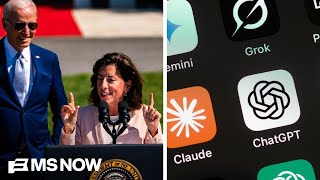
The detail that makes RAISE US unusual is not its $1 billion target or its bipartisan governors - it is the donor list. The four anchor partners are OpenAI, Anthropic, Amazon, and Microsoft [1], four companies that almost never appear on the same press release because they compete head-on for cloud contracts, frontier models, and talent. RAISE US itself leans into the rarity: as one launch account framed it, this is 'the first one I know of where competitors in the tech industry have put aside their competition' [3].

What unites them is that their products are implicated in the very disruption the nonprofit exists to soften. Amazon and Microsoft were among the firms that explicitly cited AI in their 2025 layoffs [4], and Amazon went on to cut nearly 30,000 corporate roles since October 2025 - the largest reduction in its history - while pointing to an aggressive AI shift [5]. So the same balance sheets generating the displacement are now underwriting the retraining. Microsoft's Brad Smith supplies the optimistic gloss, arguing the technology 'creates an opportunity to transfer people from jobs that are being eliminated to jobs that are being created' [3]. Whether you read that as corporate responsibility or reputational insurance is the question every other section of this story circles back to.
Why Statehouses, Not Washington

RAISE US is deliberately not a federal program, and Raimondo - a former Commerce Secretary who knows exactly how Washington works - is blunt about why. 'I don't have a lot of hope for bold action by Congress in the next few years on this issue, and I don't think we can wait a few years' [2]. Her diagnosis is that the country has a technology strategy to win the AI race but no matching 'people strategy,' and that the gap is dangerous enough that philanthropy and states have to move first.

So the structure routes around Washington entirely. The nonprofit is launching with pilot partnerships in four bipartisan states - Arkansas, Connecticut, Maryland, and Utah [1]- where it will design and test corporate retraining incentives and training models tied to actual employer demand, measuring itself on whether workers land and keep good jobs. The bet is that governors can act faster than a gridlocked Congress, and that pairing a Democratic former Commerce Secretary with a Republican former governor inoculates the effort against being read as a partisan project. The trade-off is candor about its own limits: a voluntary, privately funded, state-piloted response is a substitute for federal labor policy, not a version of it, and Raimondo frames the stakes in near-existential terms, warning that AI-driven unemployment at scale 'could destabilize our country and our democracy' [2].

$1 Billion Against 25 Million Jobs

$1 Billion Against 25 Million Jobs
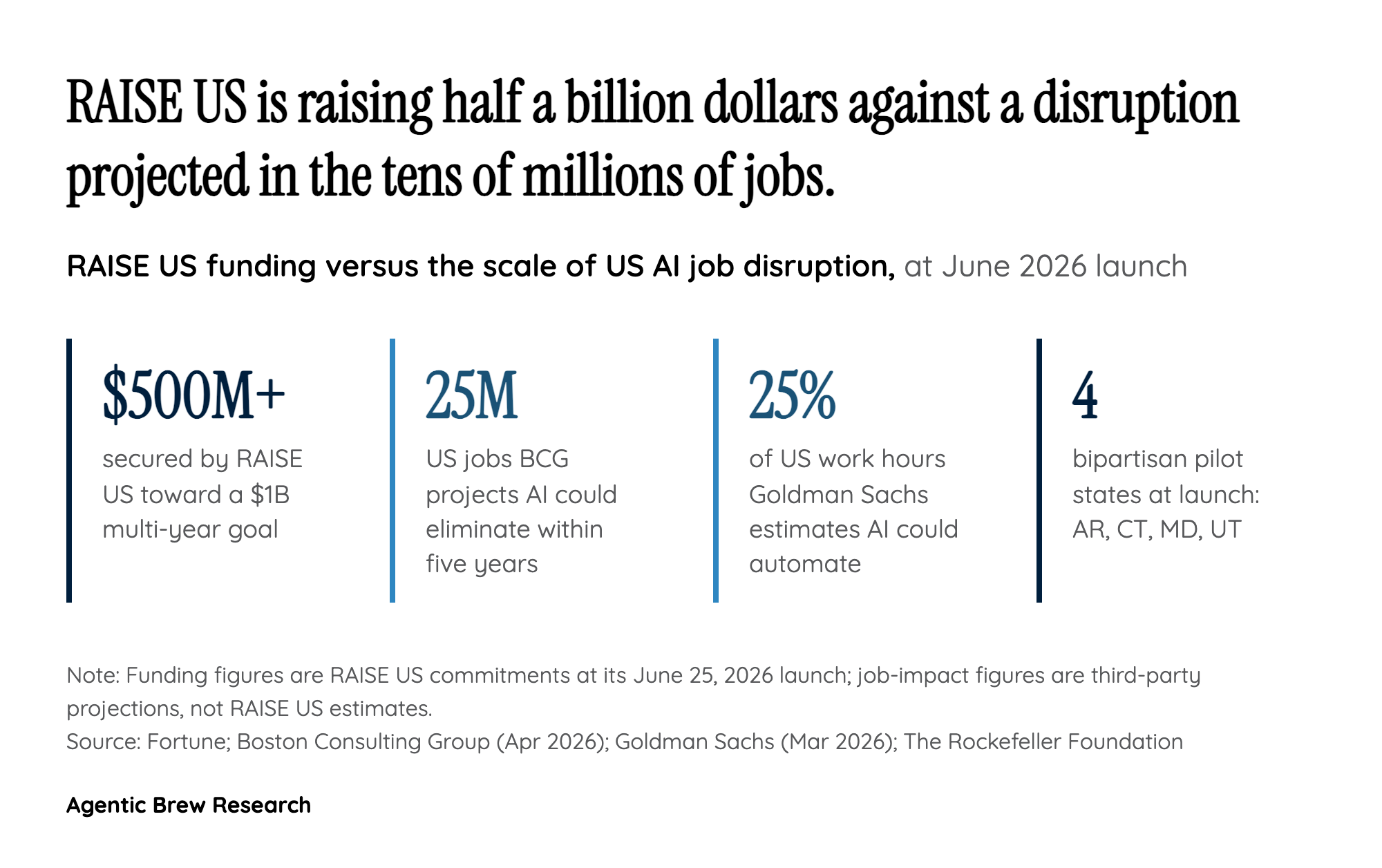
RAISE US has secured over $500M of a $1B goal - set against third-party projections of up to 25 million US jobs reshaped by AI within five years.

Set the funding goal next to the projections it is meant to address and the scale mismatch is stark. RAISE US is targeting $1 billion in multi-year commitments and has secured over $500 million so far [2]. The disruption it is sized against is measured in the tens of millions: Boston Consulting Group projected in April 2026 that roughly 50% of US jobs will be reshaped by AI and as many as 25 million could be eliminated within five years, while Goldman Sachs estimated in March 2026 that a quarter of US work hours could be automated [2].

The near-term numbers are already moving in that direction. AI was linked to almost 55,000 US layoffs in 2025 [4], and by mid-2026 tech layoffs were running at roughly 1,115 cuts per day [6], with Amazon alone accounting for nearly 30,000 corporate roles [5]. A half-billion dollars raised against a projection of 25 million reshaped jobs works out to a small sum per affected worker, which is why RAISE US presents itself as a designer and piloter of incentives and training models rather than a direct payer of retraining at national scale - the money is meant to seed approaches that states and employers then adopt, not to absorb the displacement itself.

What the Skeptics Are Asking

Away from the founding partners, the reception is sharply more cynical. Skeptics on the AI-critical community r/BetterOffline read the launch less as workforce policy than as marketing: the argument is that the first donors are the AI companies who profit from displacement, that retraining funded by tax-deductible corporate gifts effectively subsidizes the donors' own revenue, and that a response of this kind should be financed through taxes rather than voluntary philanthropy. The sharpest critique is a paradox aimed straight at the labs: if the AI these companies are building is as world-changing as their own forecasts claim, why is retraining even possible - and if retraining works, doesn't that quietly concede the most dystopian predictions are overhyped?

This tension is the real story of the rollout. The official and partner channels are uniformly on-message and promotional, while the load-bearing criticism lives in the skeptic corners and frames the whole thing as conflict-of-interest reputation management. Even the critics surface one constructive note - that a service-year model could route displaced workers into healthcare and education roles that are harder to automate - which is close to the kind of demand-tied training RAISE US says it wants to pilot. The unresolved question the launch leaves open is governance: a privately funded nonprofit run by the industry it is meant to check has every incentive to define 'success' generously, and nothing in the launch materials yet explains who holds it accountable if the retraining doesn't keep pace with the cuts.

Historical Context

2025-12-21
Multiple major firms cited AI as a factor in 2025 layoffs, with AI linked to almost 55,000 US layoffs over the year.
2026-04-24
Meta and Microsoft revealed plans for more than 20,000 potential job cuts, raising concern that an AI-driven labor crisis had arrived.
2026-06-25
Raimondo's launch framing echoes her TED Talk 'A plan to stop AI from automating our decline,' arguing AI is a 100-year technology that needs a 100-year response.
2026-06-25
Raimondo and Holcomb formally launched RAISE US with over $500 million secured of a $1 billion goal, anchored by OpenAI, Anthropic, Amazon, and Microsoft.

Power Map

Key Players
Subject

RAISE US workforce nonprofit launch backed by rival AI labs

GI

Gina Raimondo

Co-founder and CEO of RAISE US; former US Secretary of Commerce and Governor of Rhode Island. Her policy stature and convening power are what brought rival labs to the same table.

ER

Eric Holcomb

Co-chair of RAISE US and former Republican Governor of Indiana. He provides the bipartisan cover that lets the effort be framed as nonpartisan rather than industry lobbying.

OP

OpenAI, Anthropic, Amazon, and Microsoft

Anchor partners funding the nonprofit. They are rival AI developers whose own products and layoffs are tied to the workforce disruption RAISE US aims to address.

BR

Brad Smith

Microsoft Vice Chair and President. His framing - moving workers from eliminated jobs into newly created ones - sets the optimistic narrative the anchor companies are underwriting.

TH

The Rockefeller Foundation

Philanthropic supporter lending institutional credibility; its president Dr. Rajiv J. Shah publicly endorsed the effort and the foundation announced the launch.

Fact Check

6 cited
  1. [1] RAISE US Launches, Uniting the Nation's Leading Employers and Bipartisan Governors Behind American Workers
  2. [2] Gina Raimondo's new $500 million nonprofit RAISE US wants to retrain American workers for the AI economy
  3. [3] AI giants are funding a nonprofit to retrain the workers their tech is displacing
  4. [4] Amazon, Microsoft and more cited AI for 2025 layoffs
  5. [5] Amazon Layoffs 2026: Job Cuts and AI Impact
  6. [6] Tech Layoffs Hit 1,115 a Day in 2026 as Companies Cite AI

Source Articles

Top 5

THE SIGNAL.

Analysts

"Argues the US has a technology strategy to win the AI race but no corresponding people strategy: 'If we build the best AI systems in the world and leave millions of Americans behind, we won't have won anything.'"

Gina Raimondo
CEO, RAISE US; former US Secretary of Commerce

"Explains the choice of state-led, philanthropy-funded action because she expects no federal help soon: 'I don't have a lot of hope for bold action by Congress in the next few years on this issue, and I don't think we can wait a few years.'"

Gina Raimondo
CEO, RAISE US

"Casts the effort as urgent and explicitly nonpartisan: 'This isn't red versus blue; it's an all-hands-on-deck moment.'"

Eric Holcomb
Co-chair, RAISE US; former Governor of Indiana

"Frames AI disruption as a transfer rather than a loss: 'It creates an opportunity to transfer people from jobs that are being eliminated to jobs that are being created.'"

Brad Smith
Vice Chair and President, Microsoft

"Warns the disruption is broad and fast: 'AI is now disrupting multiple sectors simultaneously, faster than any institution can respond.'"

Vivienne Ming
Neuroscientist

"Endorses the initiative as a way to keep AI's gains open to workers: 'The Rockefeller Foundation is proud to support RAISE US so that AI opens doors for America's workers instead of closing them.'"

Dr. Rajiv J. Shah
President, The Rockefeller Foundation
The Crowd

"Today, we're launching RAISE US. America has a technology strategy for AI. It doesn't have a people strategy yet. We're here to build one. RAISE US is co-chaired by @GinaRaimondo and Eric Holcomb. We're working with governors, employers, and educators to help workers train,"

@@raiseus_ai245

"We're joining @raiseus_ai as a founding partner. RAISE US is a nonprofit coalition working to strengthen the American workforce through employer-led action, AI-enabled training, and policy innovation to support the transition to transformative AI."

@@AnthropicAI2300

"The country needs a broad partnership to ensure AI creates better opportunities for more people to pursue better jobs. We believe RAISE US brings together the extensive range of partners, the high ambition, and the non-partisan spirit needed to ensure AI benefits people across"

@@BradSmi37

"$500 million AI jobs push launches with bipartisan backing"

@u/ksjdragon18
Broadcast
The former Biden Commerce Secretary leading the FIGHT against A.I. job loss in America

The former Biden Commerce Secretary leading the FIGHT against A.I. job loss in America

Nonprofit aims to help displaced workers as businesses adopt artificial intelligence

Nonprofit aims to help displaced workers as businesses adopt artificial intelligence

A Plan to Stop AI from Automating Our Decline | Gina Raimondo | TED

A Plan to Stop AI from Automating Our Decline | Gina Raimondo | TED