Nvidia's expanding AI compute empire spanning the SpaceX IPO and space data centers
TECH

Nvidia's expanding AI compute empire spanning the SpaceX IPO and space data centers

22+
Signals

Strategic Overview

  • 01.
    SpaceX signed a deal in which Google will pay it $920 million per month from October 2026 through June 2029 for access to roughly 110,000 Nvidia GPUs plus CPUs, memory and related components, with the total estimated around $30 billion.
  • 02.
    The compute deal was announced roughly one week before SpaceX's stock was expected to begin trading on Nasdaq, in an IPO targeting about $75 billion raised at a valuation near $1.75 trillion.
  • 03.
    Nvidia launched a space-computing initiative at GTC 2026, unveiling the Vera Rubin Space-1 module for orbital AI data centers and claiming up to 25x more AI compute for space-based inferencing versus the H100, with six space companies adopting its platforms.
  • 04.
    The Nvidia GPU capacity SpaceX is leasing to Google was originally built by Musk for his AI lab xAI, which lagged competitors; SpaceX had previously locked in a reported $1.25 billion monthly compute deal with Anthropic.

Deep Analysis

The week-before-IPO compute deal that markets can't agree on

Timing is everything here. SpaceX disclosed that Google would pay it $920 million per month from October 2026 through June 2029 for access to roughly 110,000 Nvidia GPUs plus CPUs, memory and related components, a contract estimated near $30 billion, just one week before SpaceX's stock was expected to start trading on Nasdaq [2]. The IPO itself is historic, targeting about $75 billion raised at a valuation around $1.75 trillion, with some intraday reads pushing past $2 trillion [2]. The bull read is straightforward: a marquee, multi-year, multi-billion-dollar revenue stream landing on the prospectus right before pricing. The skeptical read is harder to dismiss. Pointing to Google's standing as one of SpaceX's largest institutional investors, parts of the investing community framed this as circular financing, an investor effectively routing money back to inflate the asset it is about to take public. That same suspicion echoed at the top of the market: investor Michael Burry reportedly labeled the broader Nvidia-xAI chip arrangement "fugazi." The countervailing crowd waved him off, joking that he has predicted far more crashes than have ever arrived, and the community split cleanly between 2008-bubble analogies and traders dismissing the doom. What is not in dispute is the underlying hardware story: this capacity was originally built by Musk for xAI, which lagged competitors, so leasing it to Google and earlier to Anthropic turns a sunk cost into recurring revenue [5].

The TPU red herring: why a chip maker rents a rocket company's Nvidia GPUs

The most disorienting fact in this story is that Google, which designs and operates its own TPU accelerators, is paying nearly a billion dollars a month to rent 110,000 Nvidia GPUs from a rocket company. Google's own framing insists this is not a structural admission: a Google Cloud spokesperson called it "a short-term, timely agreement to ensure we have bridge capacity to meet surging customer demand for our agent platform, Gemini Enterprise, which has been even higher than we expected" [2]. To the bull camp, the paradox is the whole point. The Motley Fool argues that even a TPU owner reaching for Nvidia silicon under demand pressure proves "Nvidia's position in the AI data center chip realm is not just secure but becoming ever more foundational" [3], the core of the "red herring" thesis that custom silicon doesn't actually threaten Nvidia. The bear camp reads the same event as a temporary reprieve inside a longer decline. In a piece titled "The Great Decoupling," TokenRing AI argues that hyperscaler ASICs are neutralizing the CUDA moat, declaring "the era of the $40,000 general-purpose GPU as the only path to AI success is officially over" [4]. Both can be selectively true: Nvidia wins the urgent bridge-capacity market today even as custom silicon chips away at steady-state inference.

Nvidia goes off-planet, and the physics skeptics push back

Beyond the leasing economics, Nvidia is making a literal land grab in orbit. At GTC 2026 it launched a space-computing initiative and the Vera Rubin Space-1 module, a solar-powered accelerator pitched for energy-efficient AI inferencing at the edge in orbit, claiming up to 25x more AI compute for space-based inferencing than the H100 [1]. The thesis is that satellite constellations generate more data than can be downlinked, so inference belongs where the data is born, a market Nvidia is first to define [1]. Six space companies, Aetherflux, Axiom Space, Kepler Communications, Planet Labs, Sophia Space, and Starcloud, are already building on Nvidia platforms spanning the Space-1 module, IGX Thor, and Jetson Orin [1]. CNBC's coverage of the orbital data-center push underscored how concrete this has become [6], and Nvidia-backed Starcloud has already moved toward launching an AI-equipped satellite. But the skeptic chorus is loud: prominent commentators have flatly dismissed orbital AI data centers as not yet viable, bluntly calling the idea "still dumb" for now. The split mirrors the financial debate, technically credible scale on one side, hard practical doubts on the other.

Hopper versus Blackwell: why Google pays more per GPU than Anthropic

Hopper versus Blackwell: why Google pays more per GPU than Anthropic
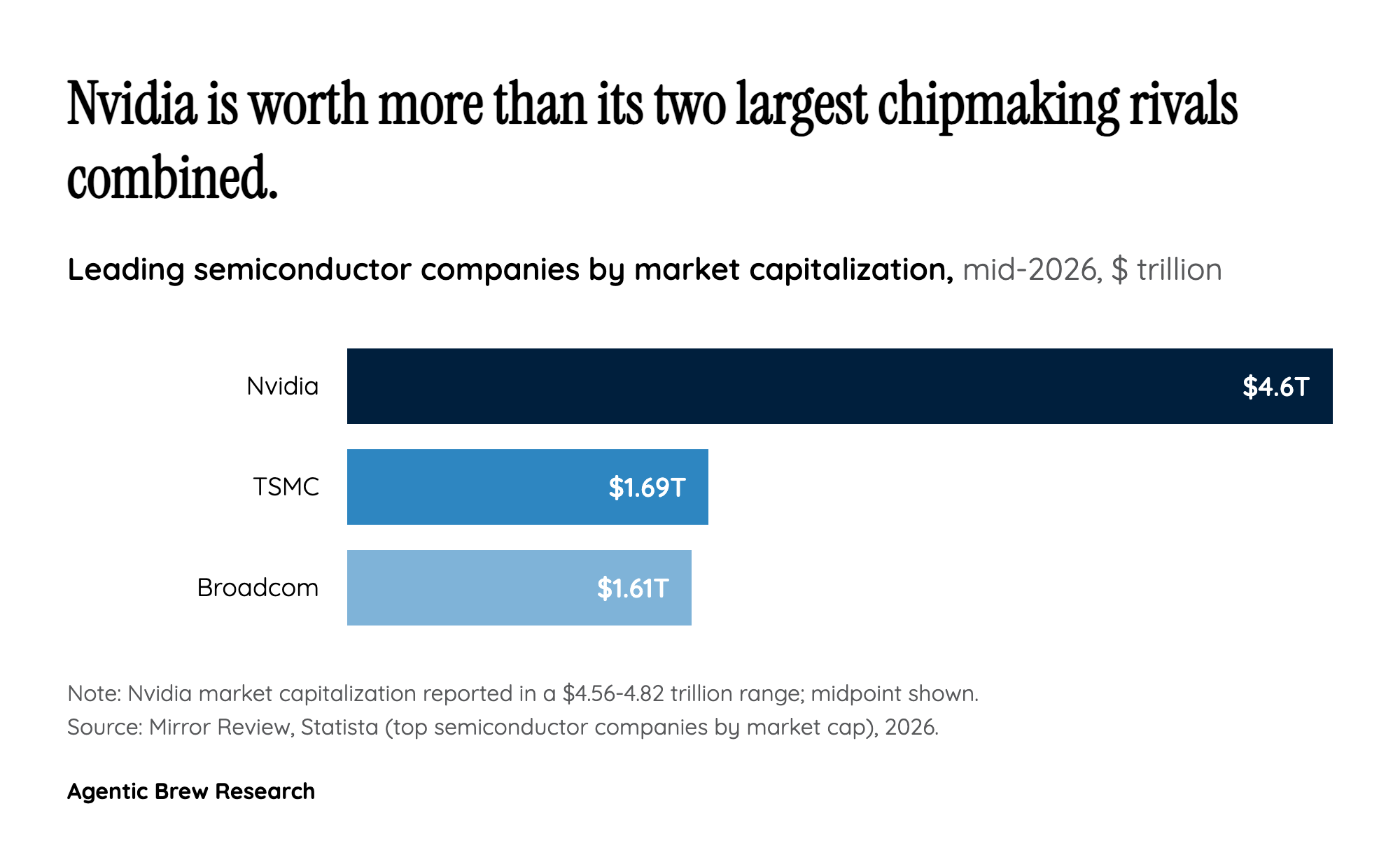
Nvidia market cap (~$4.6T midpoint) versus TSMC and Broadcom, mid-2026.

A subtle detail explains an apparent pricing anomaly. SpaceX previously locked in a reported $1.25 billion per month deal with Anthropic for the larger Colossus 1 cluster [5], yet Google's $920 million per month buys only about 110,000 GPUs, implying Google pays meaningfully more per card. The technically literate read circulating in the community attributes this to GPU generation mix rather than financial trickery: the older Colossus 1 capacity runs on Hopper-class chips, while newer Colossus 2 capacity uses Blackwell-class GB200 hardware delivering roughly 2.5x the throughput per card, so identical headline GPU counts do not mean identical compute. That nuance reframes the circular-financing suspicion: a chunk of the price gap is explained by what generation of silicon each customer is actually renting. It also reinforces why this remains a Nvidia story end to end, the value of the lease tracks the Nvidia roadmap from Hopper to Blackwell to the forthcoming Vera Rubin line. Against the backdrop of Nvidia's reported market cap of $4.56 to $4.82 trillion as the largest semiconductor company, far ahead of TSMC near $1.69 trillion and Broadcom near $1.61 trillion [7], even a bridge deal priced off generation mix keeps Nvidia's roadmap as the unit of account for the entire AI compute economy.

Historical Context

2026-03-16
Nvidia launched its space-computing initiative and the Vera Rubin Space-1 module at GTC 2026.
2026-06-05
SpaceX disclosed the $920M/month Google compute-lease deal for ~110,000 Nvidia GPUs, days before its IPO.
2026-06-10
Commentary published on SpaceX IPO timing and the Nvidia stock implications of its space data-center ambitions.

Power Map

Key Players
Subject

Nvidia's expanding AI compute empire spanning the SpaceX IPO and space data centers

NV

Nvidia

Chip designer positioning to power orbital AI data centers via the Vera Rubin Space-1 module; its GPUs are the cornerstone of SpaceX's compute capacity, deepening its foundational role in AI infrastructure.

SP

SpaceX

Building space-based data centers and monetizing Nvidia GPU capacity (originally built for xAI) by leasing it to Google and Anthropic ahead of its record IPO.

GO

Google / Alphabet

Paying SpaceX $920M/month as bridge capacity for surging Gemini Enterprise demand, validating sustained Nvidia GPU demand despite operating its own TPU program.

AN

Anthropic

Prior SpaceX compute customer with a reported $1.25 billion monthly deal at the Colossus facility in Memphis.

HY

Hyperscaler custom-silicon camp (Google TPU, Amazon, Microsoft, Broadcom)

Building custom ASICs that increasingly capture inference workloads, fueling the debate over whether Nvidia's dominance is threatened.

Fact Check

7 cited
  1. [1] NVIDIA Brings Accelerated Computing to Space
  2. [2] Google will pay SpaceX $920M per month for compute
  3. [3] SpaceX Just Announced Fantastic News for Nvidia Stock Investors
  4. [4] The Great Decoupling: How Hyperscaler Custom Silicon Is Ending Nvidia's AI Monopoly
  5. [5] SpaceX signs $920 million per month deal with Google for 110,000 Nvidia AI chips ahead of IPO
  6. [6] Nvidia chips head to orbital data centers in space AI push
  7. [7] Top Semiconductor Companies by Market Cap

Source Articles

Top 1

THE SIGNAL.

Analysts

"Frames space as the next frontier for AI compute, arguing intelligence must run wherever data is generated: "Space computing, the final frontier, has arrived. As we deploy satellite constellations and explore deeper into space, intelligence must live wherever data is generated.""

Jensen Huang
Founder and CEO, Nvidia

"Characterizes the SpaceX GPU lease as a stopgap rather than a structural shift: "This is a short-term, timely agreement to ensure we have bridge capacity to meet surging customer demand for our agent platform, Gemini Enterprise, which has been even higher than we expected.""

Google Cloud spokesperson
Google Cloud

"Argues the deal proves Nvidia's position is becoming ever more foundational, supporting the bull case that custom silicon is a red herring: "I think the SpaceX-Google agreement is simply the latest proof that Nvidia's position in the AI data center chip realm is not just secure but becoming ever more foundational.""

The Motley Fool
Investment commentary

"Argues hyperscaler custom silicon is decoupling from Nvidia by neutralizing the CUDA moat, declaring "the era of the $40,000 general-purpose GPU as the only path to AI success is officially over.""

TokenRing AI
Custom-silicon bear case
The Crowd

"Two frontier labs. One accelerated computing platform. Congrats to @SpaceX and @AnthropicAI on the new compute partnership, powered by 220,000+ NVIDIA GPUs inside Colossus 1. The future of AI runs on NVIDIA."

@@nvidia12804

"Wait. Google is paying SpaceX $920 million per month for GPUs? Google. The company that builds its own TPUs. That runs one of the largest cloud infrastructures on earth. Is renting 110,000 Nvidia GPUs from a rocket company. I'm honestly not sure what to make of this. Either"

@@aaditsh7975

"Why did xAI hand over a 220,000-GPU cluster to Anthropic? The technical backdrop to xAI's decision to hand Colossus 1 over to Anthropic in its entirety is more interesting than it appears. xAI deployed more than 220,000 NVIDIA GPUs at its Colossus 1 data center in Memphis. Of"

@@jukan054204

"SpaceX Quietly Became an AI Cloud Company and Google Is Paying Almost $1B/Month for GPU Compute"

@u/tke2485500
Broadcast
Nvidia-backed start up Starcloud sends AI-equipped satellite to space

Nvidia-backed start up Starcloud sends AI-equipped satellite to space

CNBC Today On NVIDIA Stock, Micron, SpaceX IPO - NVDA Update

CNBC Today On NVIDIA Stock, Micron, SpaceX IPO - NVDA Update

SpaceX IPO Demand SOARS to FOUR TIMES Oversubscribed - Space AI Data Centers are Still Dumb

SpaceX IPO Demand SOARS to FOUR TIMES Oversubscribed - Space AI Data Centers are Still Dumb