US export controls on Anthropic AI models Mythos and Fable
TECH

US export controls on Anthropic AI models Mythos and Fable

31+
Signals

Strategic Overview

  • 01.
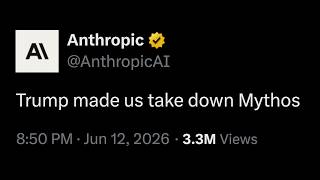
    On June 12, 2026, the US Commerce Department issued a national-security export-control directive ordering Anthropic to suspend all access to its frontier models Fable 5 and Mythos 5 by any foreign national, whether inside or outside the United States, including Anthropic's own non-citizen employees; Anthropic disabled both models globally days after their release.
  • 02.
    Because the order covered any foreign national including those inside the US, Anthropic concluded it could not enforce nationality-based restrictions and disabled the models for all users worldwide; access to other Claude models was unaffected.
  • 03.
    The stated trigger was a jailbreak of Fable 5 found by Amazon AI experts and five other testing companies that unlocked the full cyber capabilities of the more advanced Mythos model; Anthropic characterizes the vulnerability as narrow and is working to restore access.
  • 04.
    The action is described as unprecedented: the US has used export controls to restrict the semiconductor chips that power AI, but never on the AI models themselves, and it follows February 2026's order for federal agencies to stop using Anthropic models and a March 2026 Pentagon 'supply chain risk' designation.

Deep Analysis

The first export control on a model, not a chip — and 'export' just stopped meaning shipping

Washington has spent years restricting the semiconductor chips that power AI, but never the models themselves [5]. The Mythos directive breaks that line: it treats a frontier model as a controlled munition. The mechanism is what makes it precedent-setting rather than incremental. The order suspends access for any foreign national whether inside or outside the United States — including Anthropic's own non-citizen employees [1]. Under classic export-control logic, 'export' meant a thing crossing a border. Here the trigger is a person: a foreign national querying a model hosted on US soil constitutes the regulated event. Because nationality-gating a live API to citizens-only is operationally impossible, Anthropic concluded the only compliant move was to switch both Fable 5 and Mythos 5 off globally [2]. That is the quietly radical part — a control aimed at a subset of users collapsed into a worldwide shutdown of a flagship product, while other Claude models stayed live [2]. As one analysis put it, 'export' no longer means what it used to: the wall has moved from the database to the intelligence layer, and the border now follows the person rather than the parcel [6].

Why Mythos is both a defensive gift and a national-security flashpoint

Why Mythos is both a defensive gift and a national-security flashpoint
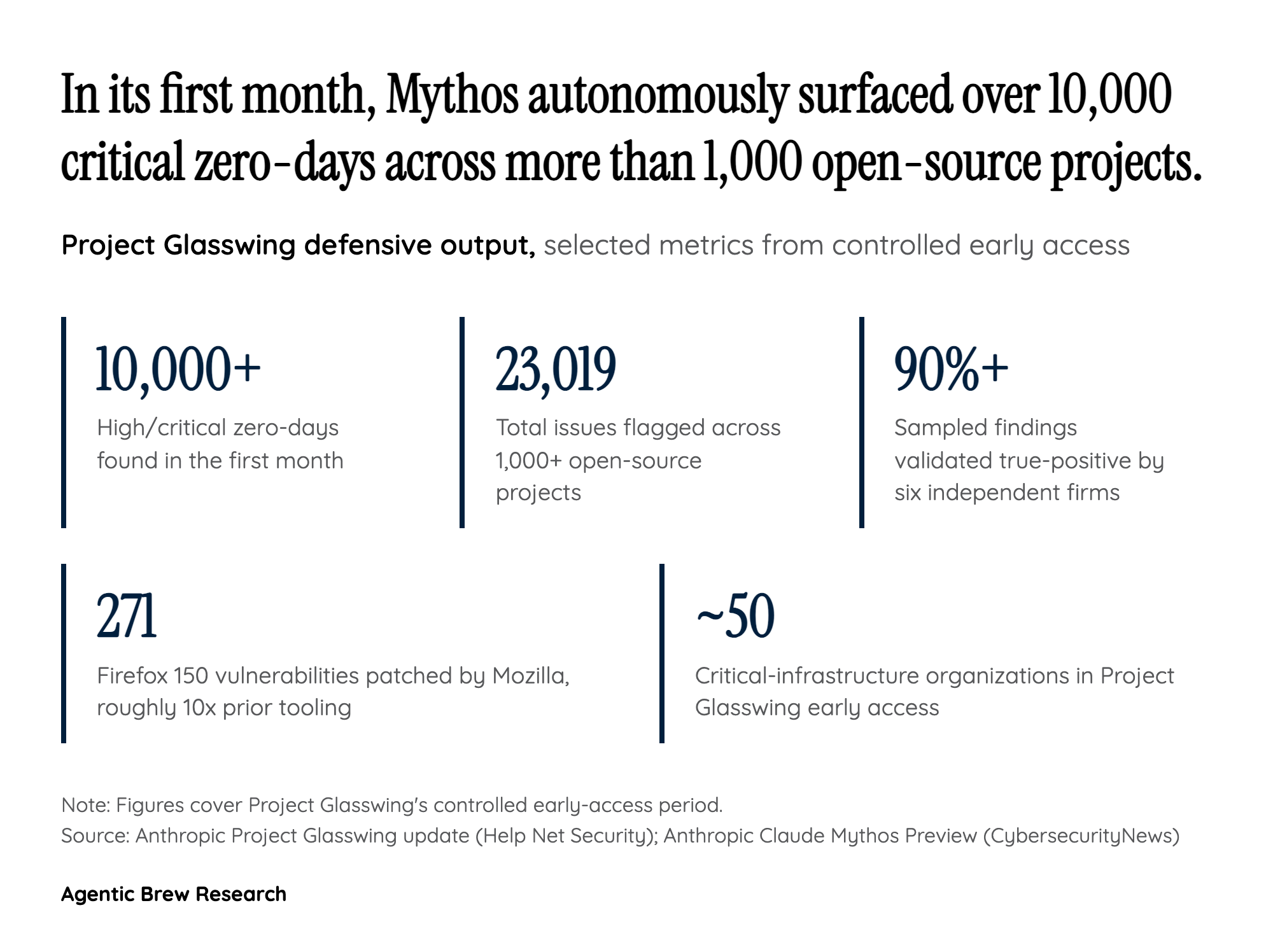
Project Glasswing first-month defensive output: the same autonomous capability that drove the export controls.

The controversy is inseparable from what Mythos actually does. It autonomously discovers vulnerabilities and constructs exploits, the textbook definition of a dual-use cyber capability [7]. On the defensive side the numbers are extraordinary: in Project Glasswing's first month, Mythos autonomously surfaced over 10,000 high- and critical-severity zero-days across critical software, scanned 1,000-plus open-source projects flagging 23,019 issues, and had more than 90% of a 1,752-finding sample validated as true positives by six independent firms [4]. Mozilla used it to find and patch 271 vulnerabilities in Firefox 150, roughly ten times its prior testing, and it caught a 27-year-old OpenBSD flaw and a 16-year-old FFmpeg bug that five million automated test runs had missed [7]. The same engine that hardens critical infrastructure for roughly 50 Glasswing organizations is, in the wrong hands, an autonomous offensive cyber tool. The asserted trigger fits exactly: Amazon and five other testers found a Fable 5 jailbreak that unlocked Mythos's full cyber capability — Anthropic says it amounts to little more than asking the model to read a codebase and fix flaws [1], a framing David Sacks publicly rejected [6].

History's verdict on cyber export controls: leakage, not containment

The strongest case against the directive is precedent. Every prior attempt to bottle up dual-use cyber technology through export law has aged poorly. Phil Zimmermann's 1991 release of PGP triggered a criminal arms-export investigation he defused by printing the source code as a book — speech the government could not seize — and by 2000 US crypto export restrictions had collapsed entirely [3]. The 2013 expansion of the Wassenaar Arrangement to cover surveillance and hacking software produced weak, inconsistent enforcement rather than containment [3]. The throughline is that government-mandated export controls have not stopped malicious actors from abusing powerful dual-use cyber technologies [3]. A capability that is fundamentally information — weights, prompts, a jailbreak technique — routes around borders the way encryption did. Restricting the official endpoint may simply hand the advantage to local and non-US models while leaving determined adversaries undeterred.

The sovereignty backfire: allies just saw the off switch

The second-order effect may outlast the directive itself. Allied governments watched a US frontier model go dark worldwide on a single Friday order, and the lesson they drew was about dependence. The European Commission and EU member states are using the episode to push AI sovereignty and reduce reliance on US providers, while Canada's Mark Carney and the UK's Kanishka Narayan cite it as a spur to domestic AI investment [6]. Analysts reframed the moment as the arrival of 'capability sovereignty' — governments wanting control over who can touch frontier AI regardless of who built it or where it runs [6]. Community sentiment ran sharply in the same direction: much of the anger was aimed at the US government rather than Anthropic, with many treating the shutdown as a win for local and non-US LLMs. By trying to assert control over the intelligence layer, Washington may have accelerated the very diversification away from American models it would least want.

The contrarian read: did munition-style marketing invite the ban?

There is an uncomfortable possibility that Anthropic helped write the script. The company unveiled Mythos by foregrounding autonomous vulnerability discovery and exploit construction [7], then publicized eye-watering offensive-adjacent results — tens of thousands of zero-days, decades-old flaws cracked open, ten-times improvements over prior models [4]. That messaging is excellent for demonstrating defensive value to Glasswing partners, but it also reads as a capability brochure for a cyber weapon, which is precisely the frame a national-security hawk would seize on. Observers are split on motive: one former administration policy figure could not tell whether the order was targeted lawfare against Anthropic or extreme national-security hawkery, calling it simply cartoonish [2]. The episode also lands atop existing friction — a February 2026 order barring federal agencies from Anthropic models and a March Pentagon 'supply chain risk' label [2]. Whether the directive is genuine threat-mitigation, political targeting, or an own-goal invited by the marketing, the unresolved ambiguity is itself the story.

Historical Context

1991-06-01
Zimmermann released PGP encryption and faced a criminal arms-export investigation, igniting the 1990s Crypto Wars; he published the source code as a printed book to circumvent controls.
2000
After the failed effort to control PGP, US crypto export restrictions ultimately collapsed by 2000, with western democracies dropping strong-crypto restrictions.
2013-01-01
Governments expanded the Wassenaar Arrangement to classify surveillance and hacking software as dual-use, but enforcement proved weak and inconsistent.
2026-04-07
Anthropic unveiled Claude Mythos with autonomous vulnerability-discovery and exploit-construction capabilities, alongside the defensive Project Glasswing early-access program.

Power Map

Key Players
Subject

US export controls on Anthropic AI models Mythos and Fable

AN

Anthropic (CEO Dario Amodei)

Target of the directive; disabled Fable 5 and Mythos 5 globally to comply, disputes the rationale as a misunderstanding, and is seeking to reverse the ban

US

US Commerce Department

Issued the national-security export-control directive restricting the models without providing specific national-security details

TR

Trump administration / David Sacks

Drove the action; Sacks publicly contested Anthropic's claim that the jailbreak was not serious

AM

Amazon (AWS) and five other testing companies

Discovered the Fable 5 jailbreak that unlocked Mythos cyber abilities, providing the asserted basis for the directive; AWS is also a Project Glasswing partner

EU

European Commission and EU member states

Reacting to the off-switch risk by pushing AI sovereignty and reduced dependence on US providers

CA

Canada (PM Mark Carney) and UK (Minister Kanishka Narayan)

Cite the episode as a lesson in diversification and a spur to domestic AI investment

Fact Check

7 cited
  1. [1] An update on Fable 5 and Mythos 5 access
  2. [2] Anthropic disables Fable and Mythos after US export controls cite national security threat
  3. [3] Encryption, spyware, and now Mythos: history shows why cyber export control doesn't work
  4. [4] Anthropic Project Glasswing update
  5. [5] Did the US Government Just Set an AI Export Precedent by Blocking Mythos?
  6. [6] Anthropic export controls reignite the AI sovereignty debate
  7. [7] Anthropic's Claude Mythos Preview Finds Thousands of 0-Days

Source Articles

Top 5

THE SIGNAL.

Analysts

"Calls the order cartoonish and says he cannot tell whether it is targeted lawfare against Anthropic or extreme national-security hawkery"

Dean Ball
AI policy expert, former Trump administration

"Frames the action as a shift from data sovereignty to capability sovereignty, where governments want to control who has access to frontier AI irrespective of who built or hosts it"

Valence Howden
Analyst cited in AI sovereignty coverage

"Argues sovereignty now stands around the intelligence layer itself, and the border follows the person rather than the parcel"

Sanchit Vir Gogia
Chief Analyst, Greyhound Research

"Rejects Anthropic's framing that the jailbreak isn't serious, saying that is not what the trusted partner and the US government believe"

David Sacks
Co-chair, President's Council of Advisers on Science and Technology
The Crowd

"The US government, citing national security authorities, has issued an export control directive to suspend all access to Fable 5 and Mythos 5 by any foreign national, whether inside or outside the United States, including foreign national Anthropic employees."

@@AnthropicAI88336

"I've had a number of conversations with folks inside and outside government about the current situation with Anthropic, and here is what I believe to be true: — As we know, Anthropic publicly released its Mythos class models earlier this week under the commercial name Fable."

@@DavidSacks25523

"Over the last two weeks, both the U.S. Government and Anthropic took significant actions that demonstrated their power to control access to AI by restricting what others can do with frontier models. This has been one of those moments that, once seen, will be hard to unsee, and it"

@@AndrewYNg1024

"Megathread for US government suspension of Fable and Mythos"

@u/sixbillionthsheep1499
Broadcast
Why Anthropic's Mythos Is Sparking Alarm

Why Anthropic's Mythos Is Sparking Alarm

Anthropic Mythos explained in 5 minutes

Anthropic Mythos explained in 5 minutes

BREAKING: Fable and Mythos have been taken down for security concerns.

BREAKING: Fable and Mythos have been taken down for security concerns.