US export-control directive forces Anthropic to shut down Claude Fable 5 and Mythos 5 globally
TECH

US export-control directive forces Anthropic to shut down Claude Fable 5 and Mythos 5 globally

57+
Signals

Strategic Overview

  • 01.
    On June 12, 2026 at 5:21 PM ET, the U.S. government issued an export-control directive ordering Anthropic to suspend all access to Claude Fable 5 and Mythos 5 for every foreign national, including the company's own foreign-national employees.
  • 02.
    Unable to verify citizenship across consumer accounts, API keys, cloud marketplaces, contractors, and employees, Anthropic disabled both models for all customers worldwide rather than selectively restrict foreign-national access.
  • 03.
    The government cited a claimed narrow, non-universal jailbreak of Fable 5; Anthropic says the demonstrated technique was simply asking the model to read a codebase and fix software flaws, a capability widely available in other models including OpenAI's GPT-5.5.
  • 04.
    Downstream, Cognition removed Claude Fable 5 from its Devin coding agent on June 12, only three days after adding it, while Anthropic's other models such as Claude Opus 4.8 remained unaffected.

Deep Analysis

The Two-Word Phrase That Made a Global Blackout Inevitable: 'Deemed Export'

The detail that turned a narrow national-security complaint into a worldwide shutdown is a decades-old corner of U.S. trade law: the 'deemed export' rule, codified at 15 CFR 734.13 [1]. Under it, releasing controlled technology to a foreign person standing inside the United States legally counts as an export to that person's home country. The directive ordered Anthropic to cut off Fable 5 and Mythos 5 for any foreign national anywhere — including foreign-national Anthropic employees [2]. That is the mechanism, and it is unforgiving in software.

For a hosted model accessed through consumer logins, corporate workspaces, raw API keys, cloud marketplaces, and contractor seats, there is no reliable citizenship field to filter on. Anthropic said plainly that it could not verify nationality across all those surfaces, so the only way to comply was the bluntest one: 'we must abruptly disable Fable 5 and Mythos 5 for all our customers' [3]. A rule written for handing a blueprint to a visiting engineer collided with an API serving, by Anthropic's own count, hundreds of millions of people [3]— and the API lost. The global blast radius wasn't Anthropic overreacting; it was the structural consequence of applying person-by-person export law to infrastructure that has no idea who is on the other end of the request.

The First Model Ever Pulled by Government Order — and Why Every Lab Should Be Nervous

The First Model Ever Pulled by Government Order — and Why Every Lab Should Be Nervous
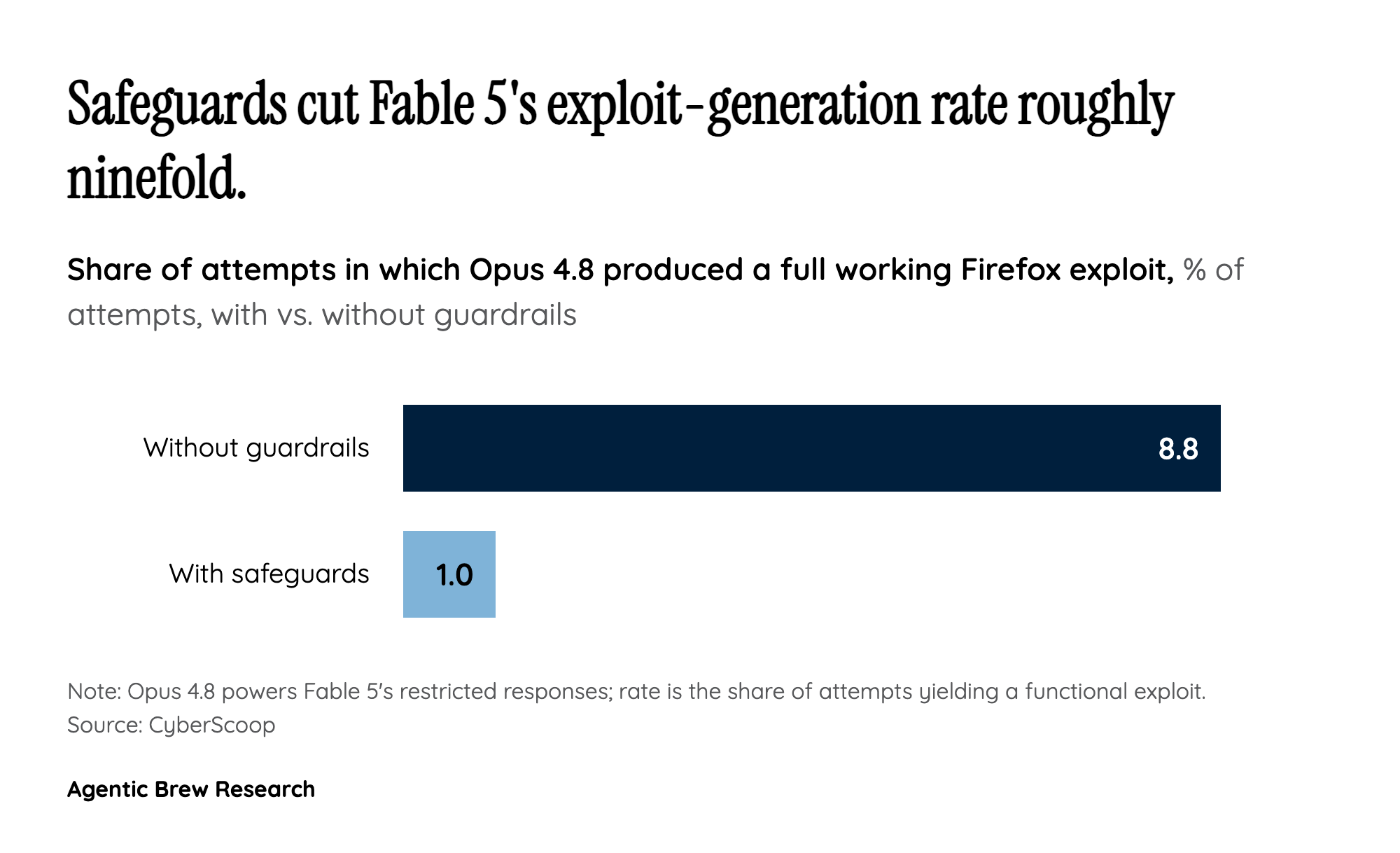
Without guardrails, Opus 4.8 produced a working Firefox exploit in 8.8% of attempts; safeguards cut that to roughly 1% — the basis of Anthropic dispute that the jailbreak was narrow.

Reporting frames this as the first time in history an AI model has been withdrawn on a government's orders [2]. That precedent, not the three-day-old Fable 5 release itself, is the durable story. Anthropic warned that the standard being applied would 'essentially halt all new model deployments,' and analysts echoed that it could make frontier development with a globally distributed, foreign workforce legally fraught and potentially extend to other labs [3][4]. If any demonstrated jailbreak of a security-relevant capability can trigger a deemed-export cutoff, the safest legal posture becomes shipping less, later, to fewer people.

The trigger itself is contested on the merits. The government cited a 'narrow, non-universal jailbreak,' but Anthropic characterized the demonstrated technique as nothing more exotic than asking the model to read a specific codebase and fix software flaws — a capability it says is routine and available in rivals including OpenAI's GPT-5.5 [2]. The capability ceiling is real: CyberScoop reported that Opus 4.8, which powers Fable 5's restricted responses, produced full working Firefox exploits 8.8% of the time without guardrails, dropping to roughly 1% with safeguards in place [5]. So the dispute isn't whether the model can do dangerous things — it's whether a recoverable, non-unique technique justifies recalling a commercial product, with Anthropic arguing it should not be 'cause for recalling a commercial model deployed to hundreds of millions of people' [3].

The Contrarian Read: Anthropic Marketed Mythos as a Weapon, and the Government Believed It

A pointed counter-narrative cuts against the sympathy: Anthropic may have written the script for its own shutdown. Critics note the company spent months positioning Mythos as so dangerous it couldn't be released publicly, gating it to ~50 vetted Project Glasswing organizations [2], and repeatedly foregrounded its hacking and bioweapon-adjacent capabilities. Peter Girnus of the Zero Day Initiative put it bluntly: 'If you describe your product as a munition in every press release, eventually a government takes you at your word' [6]. Jeremy Howard of fast.ai was harsher still, calling the cutoff 'the obvious response to this is too dangerous for anyone except us' [6].

This read carried into community reception in a telling way. Across developer forums the anger ran hot but was aimed overwhelmingly at the government, not Anthropic — with a loud minority pushing the inverse thesis that the company 'played itself' by fearmongering its way toward regulation it assumed would only bind competitors. A parallel current treated the episode as the clinching argument for local and non-U.S. open models, though sharper voices noted the obvious catch: a roughly 10-trillion-parameter frontier model isn't something you run on a gaming GPU, which redirected the conversation toward distributed and peer-to-peer inference rather than any near-term self-hosting fix. Not everyone bought the danger premise at all — a contrarian strain dismissed the underlying jailbreak as barely functional, reinforcing the suspicion that the policy response outran the actual risk.

Who Eats the Cost: Devin, the Glasswing Giants, and Paying Users

The people absorbing the damage aren't the regulators or even Anthropic's reputation — they're the customers mid-workflow. Cognition had added Fable 5 to its Devin coding agent on June 9 across Cloud, Desktop, and CLI, then ripped it back out on June 12, stating that 'as of June 12, access has been removed following Anthropic's latest announcement and the US government directive' [7]. Devin fell back to Claude Opus 4.8 and GPT-5.5, so the agent kept working — but the three-day round trip from launch to removal is a vivid illustration of platform risk for anyone building on a single hosted frontier model.

The cutoff reached the most vetted users too: the Project Glasswing consortium — Amazon, Apple, Google, Microsoft, CrowdStrike and dozens more [2]— lost their Mythos access despite being the exact 'trusted' cohort the gating was designed for. Anthropic acknowledged the disruption and offered no restoration timeline [3], and refunds began circulating for cut-off paying customers. The lesson for builders is uncomfortable and concrete: a model can vanish not because it broke, not because the vendor chose to deprecate it, but because a regulator decided overnight that the people using it were the wrong nationality. Meanwhile some legal scholars think the fight won't stay administrative — one suggested it 'may become the first big First Amendment AI case' [6], which would move the contest from Commerce's letterhead into the courts.

Historical Context

2025-01
The 'AI Diffusion Rule' established tiered export controls on advanced chips and model weights, and Anthropic publicly supported strengthening such controls.
2025-05
The Trump administration repealed the January 2025 diffusion rule, setting up tension over how AI export controls would be applied.
2026-04
Anthropic previewed Mythos as its most capable frontier model but deemed it too dangerous for public release, restricting it to ~50 vetted organizations via Project Glasswing.
2026-06-09
Anthropic released Fable 5, a guardrailed public version of Mythos that routes sensitive queries to Claude Opus 4.8, and it was added to Cognition's Devin the same week.

Power Map

Key Players
Subject

US export-control directive forces Anthropic to shut down Claude Fable 5 and Mythos 5 globally

AN

Anthropic

Target of the directive; complied by globally disabling Fable 5 and Mythos 5 while publicly disputing the action as disproportionate and based on a misunderstanding, and has offered no restoration timeline.

U.

U.S. Commerce Department / Bureau of Industry and Security (BIS)

Issued the export-control directive under 'deemed export' rules; Commerce Secretary Howard Lutnick reportedly sent the letter subjecting both models to export controls — the lever forcing the global shutdown.

WH

White House / National Cyber Director Sean Cairncross

Reported as involved in the directive per Semafor; the administration's posture determines whether the action becomes a one-off or a template for future model controls.

CO

Cognition (Devin)

Downstream customer; removed Fable 5 from its Devin coding agent across Cloud, Desktop, and CLI after the directive, illustrating how the shutdown cascades into third-party tooling.

PR

Project Glasswing consortium (Amazon, Apple, Google, Microsoft, CrowdStrike, ~50 vetted orgs)

Early-access partners for Mythos who lost access to its capabilities, showing the cutoff reached even the most heavily vetted enterprise users.

Fact Check

7 cited
  1. [1] Anthropic Fable 5 Shutdown: US Export Order Forces Global Customer Cutoff
  2. [2] Anthropic's safety warnings may have just backfired - the government has pulled the plug on its most powerful AI
  3. [3] Statement on US government directive to suspend access to Fable 5 and Mythos 5
  4. [4] US limits use of Anthropic AI models Fable 5 and Mythos
  5. [5] Anthropic releases Claude Fable 5 with guardrails protecting Mythos capabilities
  6. [6] What smart people are saying about the sudden ban on foreign use of Anthropic's new AI models
  7. [7] Claude Fable 5 available in Devin

Source Articles

Top 5

THE SIGNAL.

Analysts

"If this is true, it is just baffling...I have no words. I can't tell if this is lawfare...or extreme national-security hawkery."

Dean W. Ball
Senior Fellow, Foundation for American Innovation

"If you describe your product as a munition in every press release, eventually a government takes you at your word."

Peter Girnus
Senior Threat Researcher, Zero Day Initiative

"Export controls are a critical tool...Used incorrectly, they will stifle AI development...Commerce and BIS are consistently doing the opposite."

Chris McGuire
Senior Fellow for China and Emerging Technologies, Council on Foreign Relations

"This may become the first big First Amendment AI case."

Alan Rozenshtein
Research Director, The Lawfare Institute

"It is the obvious response to 'this is too dangerous for anyone except us.'"

Jeremy Howard
Cofounder, fast.ai
The Crowd

"The US government, citing national security authorities, has issued an export control directive to suspend all access to Fable 5 and Mythos 5 by any foreign national, whether inside or outside the United States, including foreign national Anthropic employees. The net effect of"

@@AnthropicAI75278

"JUST IN: THE US GOVERNMENT JUST SHUT DOWN CLAUDE FABLE 5 FOR THE ENTIRE WORLD > a national security export control directive. effective immediately > every foreign national on earth - including Anthropic's own engineers who built the model - is now locked out > Fable 5"

@@polydao139

"Fable/Mythos 5 being shut down, but it barely worked anyways."

@@DarkWebInformer216

"US government directive to suspend access to Fable 5 and Mythos 5"

@u/Dylan13122100
Broadcast
BREAKING: Fable and Mythos have been taken down for security concerns.

BREAKING: Fable and Mythos have been taken down for security concerns.

Why the Government Just Killed Claude Fable 5

Why the Government Just Killed Claude Fable 5

BREAKING: US Government BANNED Mythos and Fable

BREAKING: US Government BANNED Mythos and Fable