Grok Build CLI uploads private repos and secrets to cloud
TECH

Grok Build CLI uploads private repos and secrets to cloud

29+
Signals

Strategic Overview

  • 01.
    A security researcher publishing as cereblab routed xAI's Grok Build CLI version 0.2.93 through the mitmproxy interception proxy and captured it uploading the entire tracked Git repository, including full commit history, to a Google Cloud Storage bucket named grok-code-session-traces.
  • 02.
    The upload happened over a POST /v1/storage channel independent of what the coding agent actually read, and the contents of files it did read, including a .env secrets file, were transmitted verbatim and unredacted.
  • 03.
    The product's 'Improve the model' opt-out toggle had no effect: with it off, the full repository still uploaded via /v1/storage and the settings endpoint still returned trace_upload_enabled: true.
  • 04.
    A day after the report went public, retests of the same client found the server returning disable_codebase_upload: true and no repository uploads across six retests, indicating a silent server-side mitigation, with no formal xAI advisory on scope, retention, or deletion as of July 13, 2026.

The Channel Nobody Was Told About

The core finding is not that a coding agent read a sensitive file. It is that a second, separate pipe exists. Grok Build CLI opens two distinct network paths: a POST /v1/responses channel that carries the normal model-turn traffic, and a POST /v1/storage channel that bundles the entire tracked Git repository, full commit history included, and ships it as git bundles to a Google Cloud Storage bucket literally named grok-code-session-traces [1]. The second path fires independent of what the agent actually reads. To prove this was not merely the model ingesting whatever it happened to open, the researcher planted a canary .env file containing the string API_KEY=CANARY7F3A9-SECRET-should-not-leave that the agent was never instructed to open, then recovered that exact string, verbatim, inside the captured upload body [1].

That detail is what upgrades this from a privacy complaint to a demonstrated exfiltration. A file the agent never touched still left the machine. Files the agent did read, including real secrets, were transmitted unredacted, appearing in both the live model turn and a session_state archive pushed through the GCS bucket [2]. The bucket's name suggests intent: it was built to capture full session context as training or debugging traces, not to send only the handful of files relevant to the task at hand [1].

5.1 Gigabytes to Do 192 Kilobytes of Work

5.1 Gigabytes to Do 192 Kilobytes of Work
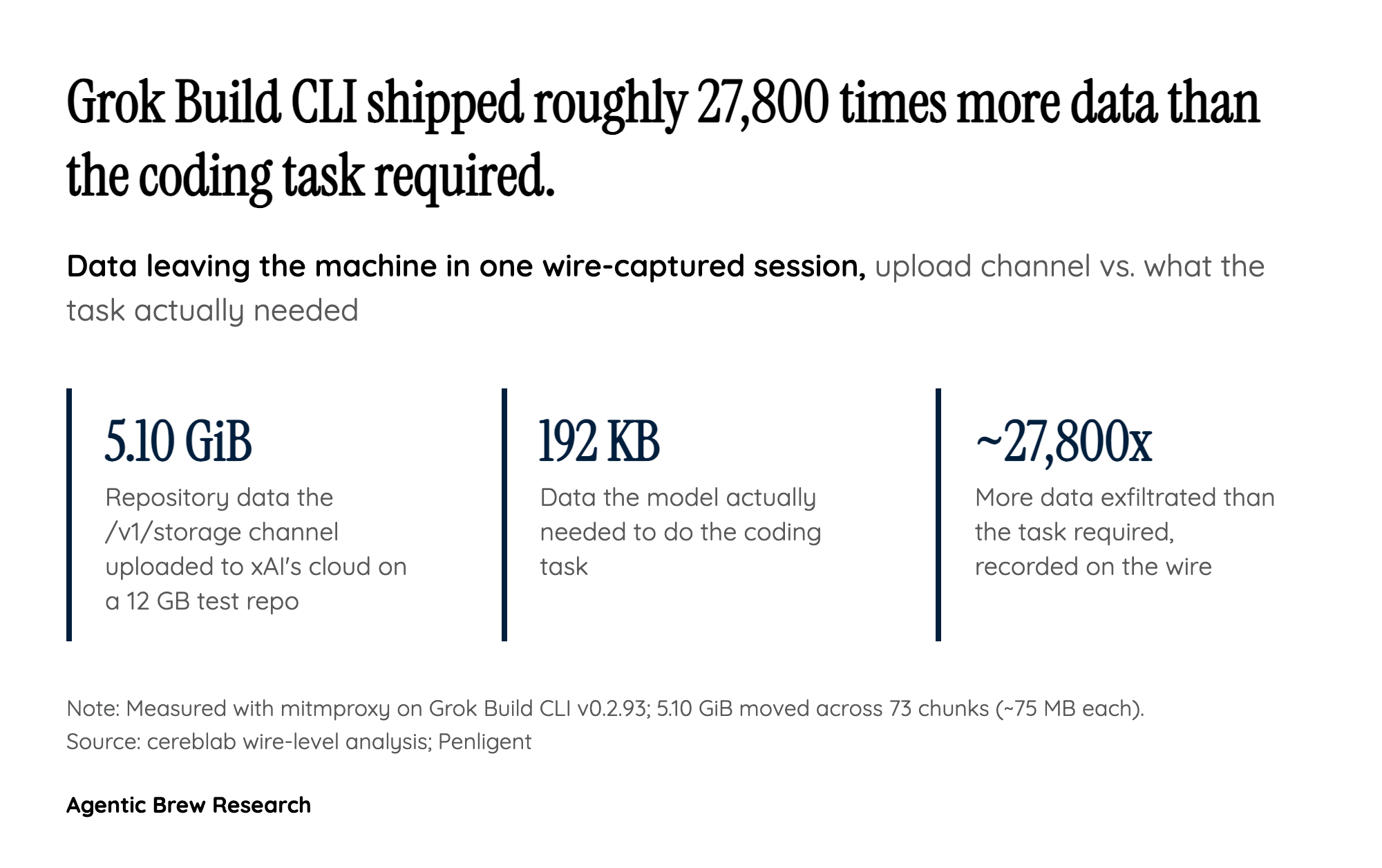
Grok Build CLI's storage channel uploaded 5.10 GiB on a 12 GB test repo while the coding task needed only 192 KB - roughly 27,800x more data.

The scale gap is what makes this hard to wave away as telemetry. On a 12 GB test repository, the /v1/storage channel moved 5.10 GiB across 73 chunks of roughly 75 MB each, every one returning HTTP 200 [1]. The model-turn channel that actually did the coding work moved about 192 KB. That is the storage pipe hauling away roughly 27,800 times more data than the task itself required [3]. As one commenter distilled it, you pay for 192 KB of work and they haul away 5.1 GB of your code.

Crucially, this is a wire-level packet capture, not speculation about what a binary might do. The measurements came off mitmproxy intercepting the traffic on the actual client, version 0.2.93 [1]. When skeptics on Reddit argued the reporting was biased against xAI, the reproducible rebuttal was that a packet capture has no opinions. The numbers are not an interpretation of behavior; they are the behavior, recorded on the wire.

The Opt-Out That Governed The Wrong Thing

Grok Build shipped with an 'Improve the model' toggle, the kind of control a careful developer flips off before pointing an AI at proprietary code. It did nothing to stop the leak. With the toggle disabled, the full repository still uploaded via /v1/storage, and the settings endpoint still returned trace_upload_enabled: true [4]. The toggle governed whether your data trained future models. It did not gate the upload channel at all [4]. Disabling it changed nothing about whether your code left the machine.

This is the gap between a consent control and an actual data boundary. Penligent noted that the tool's local-first positioning, the promise that nothing is transmitted during a session, was flatly contradicted by the capture once the .env and the full repo were seen leaving [3]. For an enterprise buyer, the lesson is uncomfortable: the visible privacy switch was decoupled from the code-egress path, so the one control users could see was not the one that mattered.

Why This Is A Grok Problem, Not An Industry Norm

The most important comparison came from re-running the identical wire test against the other major coding agents. The researcher, posting the capture in r/LocalLLaMA, ran the same setup on Claude Code, Codex, and Gemini. All three kept the codebase local. Grok Build was the only one uploading everything. That single control experiment is what separates this from a general anxiety about AI dev tools and pins it to one product's design choice. The technical crowd on Reddit responded by reproducing the capture and rotating their credentials; a broader audience read it as confirmation of existing distrust of xAI, and a contrarian minority tried to blame users for not sandboxing, a framing the reproducers rejected since the tool was marketed as safe to run locally.

The fix xAI applied deepens rather than resolves the concern. A day after disclosure, the same client began receiving disable_codebase_upload: true from the server, and repository uploads stopped across six retests [2]. But the flag is server-controlled and undocumented, which means the behavior was flipped remotely and invisibly, the same way it could presumably be flipped back [2]. On X, the account that broke the story summarized the unresolved half: the uploads quietly stopped via a hidden server-side flag, and xAI still had not said a word about scope, retention, or whether repositories already sitting in grok-code-session-traces would be deleted. (Note: separate community reports of 8 fully uploaded private repos and a session where the upload path was a user's entire home directory circulated on X but were not independently confirmed by the primary wire-level capture, and should be treated as unconfirmed.)

Historical Context

2026-05-14
xAI launched Grok Build CLI in early beta for SuperGrok Heavy subscribers, an agentic coding CLI with up to 8 parallel git-worktree sub-agents.
2026-05-25
Grok Build access expanded to all SuperGrok and X Premium+ subscribers.
2026-07-12
The researcher published the wire-level analysis of Grok Build CLI 0.2.93 showing whole-repo and secret uploads to a GCS bucket.
2026-07-13
Server-side mitigation (disable_codebase_upload: true) was confirmed live in retests, but no formal xAI advisory was issued.

Power Map

Key Players
Subject

Grok Build CLI uploads private repos and secrets to cloud

XA

xAI

Vendor of Grok Build CLI. Disabled full-repo uploads server-side via a remote flag after the report and pointed users to Zero Data Retention and the /privacy command, but issued no formal advisory on the upload's scope, retention, or deletion.

CE

cereblab

Independent security researcher who produced the wire-level mitmproxy capture of version 0.2.93 and published it as a public GitHub gist, triggering the disclosure and the server-side mitigation.

GR

Grok Build developer users and teams

Affected parties whose private codebases, git histories, and unredacted secrets were uploaded. If they disappeared there would be no exposed credentials to rotate, and they now bear the remediation cost of the incident.

Fact Check

4 cited
  1. [1] Grok Build CLI wire-level analysis (v0.2.93)
  2. [2] xAI's Grok Build CLI Caught Uploading Private Code and Secrets
  3. [3] Grok Build CLI Repository Upload Analysis
  4. [4] xAI Grok CLI Uploads Full Repos and Secrets, Opt-Out Ignored

Source Articles

Top 4

THE SIGNAL.

Analysts

"The tool uploads the whole repository, every tracked file's content plus git history, independent of what the agent reads, and the in-product opt-out does not stop it."

cereblab
Independent security researcher

"Rotating any secrets that may have been exposed, including API keys, database credentials, and authentication tokens, is not optional. It is urgent."

Security analysts (as reported by Crypto Briefing)
Security commentators

"A toggle within the CLI designed to let users opt out of their data being used to improve the model had zero effect on the upload behavior, contradicting the tool's local-first positioning."

Penligent analysis
Security research blog
The Crowd

"‼️ BREAKING: xAI's Grok Build CLI was uploading entire Git repositories to a Google Cloud bucket, private codebases and unredacted secrets included. The uploads quietly stopped via a hidden server-side flag, and xAI still has not said a word about scope, retention, or deletion."

@@IntCyberDigest6302

"SpaceXAI was caught uploading your code to its cloud. I reversed xAI's official Grok Build binary. In a controlled session with zero tool-calls, it uploaded the complete codebase to xAI's storage It ships a malware-like background code collector."

@@hrkrshnn2987

"There seems to be something going on. A global kill switch "disable_codebase_upload: true" is being returned, at least for my account, when fetching settings. But both Codex and Anthropic independently found indirect evidence of 8 private (!) repos fully uploaded Grok. 🤯"

@@dedene251

"grok build was uploading whole directories to google bucket"

@u/Far-Sock-3170459
Broadcast
Grok's Coding CLI Uploads Your Entire Repo and Secrets to xAI | MOTO NEWS #shorts

Grok's Coding CLI Uploads Your Entire Repo and Secrets to xAI | MOTO NEWS #shorts

grok has been uploading a ton of your local files to its cloud silently

grok has been uploading a ton of your local files to its cloud silently