Two brains bolted together: how Alpamayo actually reasons
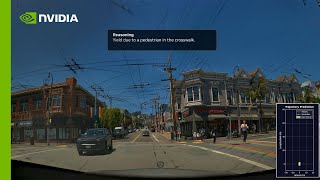
Alpamayo 2 Super is not one network but two working in sequence. A 32-billion-parameter Cosmos 3 Super Reasoner vision-language backbone ingests 360-degree footage from up to seven cameras and does the 'thinking' - it writes out a Chain-of-Causation reasoning trace, tags a high-level meta-action (yield, merge, nudge left for a stationary vehicle), and can answer grounded questions about the scene [1]. That reasoning output then hands off to a separate 2-billion-parameter diffusion-based Action Expert, which converts the language-level decision into a continuous, driveable trajectory [1]. Splitting 'why' from 'how to move' is the architectural bet: the same reasoning core can, in principle, be paired with different action heads for robotaxis, trucks, shuttles, or delivery vans, and the reasoning trace itself becomes a readable log of why the car did what it did rather than an opaque vector. NVIDIA's viral demo of the model narrating its own driving decisions in real time - 'nudging left due to stationary vehicle,' 'yielding to pedestrian in crosswalk' - is the visible product of this split, and it is the clearest evidence the pipeline is producing legible intermediate reasoning rather than a single end-to-end black box.