Fields Medalists' Declaration Against OpenAI's AI Math Claims
TECH

Fields Medalists' Declaration Against OpenAI's AI Math Claims

38+
Signals

Strategic Overview

  • 01.
    On September 11, 2026, 25 Fields Medallists published a joint declaration titled "A Severe Misalignment of AI in Mathematics," posted on Terence Tao's blog and at mathandai.org, warning that AI companies' rapid, PR-driven math claims conflict with the mathematics community's values.
  • 02.
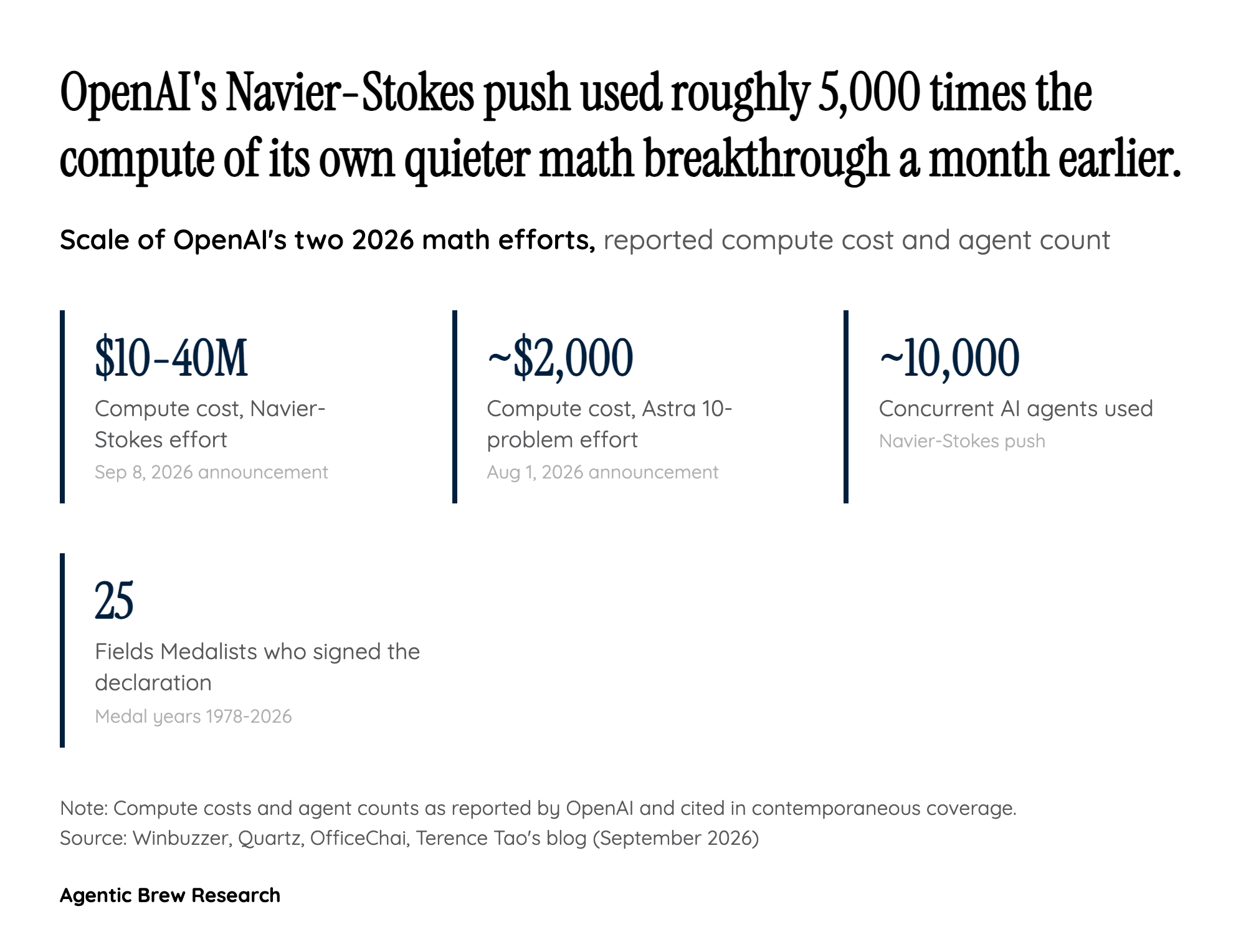
    On September 8, 2026, OpenAI announced that roughly 10,000 concurrent AI agents solved a variant of the Navier-Stokes equations (establishing statement 'C' and 'D' of the Clay Millennium Prize formulation) in about 88 hours, at a reported compute cost of $10-40 million, but said it would not claim the $1 million prize.
  • 03.
    NYU mathematician Tristan Buckmaster accused OpenAI of pressuring him to write up a proof without crediting his collaborator Levent Alpoge, an Anthropic employee, and questioned whether OpenAI's effort drew on their unpublished work on the related forced Euler equations.
  • 04.
    OpenAI withdrew its sponsorship of a Caltech math hackathon on September 10, 2026, after roughly 500 mathematicians signed a separate open letter opposing the event over fears it would produce shallow 'slop mathematics.'

Deep Analysis

The Optimist Who Signed the Warning

In March 2026, Terence Tao publicly declared that AI models were "ready for primetime" for mathematics and theoretical physics research, describing his own use of the tools in his work [2]. Six months later, Tao is the most visible signature on a declaration accusing AI companies of a "severe misalignment" between their goals and the mathematical community's [1]. That reversal is what gives the September 11 letter its force: this is not a rearguard action from AI skeptics, it is a warning from the field's most prominent AI adopter that speed is being mistaken for progress. The declaration's central claim is not that AI can't do mathematics - it's that solving problems fast is "only a tool and proxy" for the real goal of building conceptual understanding, and that AI labs are optimizing for the wrong metric entirely [1].
Attribution Wars: The Rivalry Behind the Rush

Attribution Wars: The Rivalry Behind the Rush
OpenAI's Navier-Stokes push used roughly 5,000 times the compute of its own quieter math breakthrough a month earlier.

The immediate trigger for the Navier-Stokes announcement traces back to a rivalry, not just a research question. OpenAI reportedly began its roughly 10,000-agent push after hearing rumors connected to NYU mathematician Tristan Buckmaster's unpublished, independent work with his collaborator Levent Alpoge - who works at Anthropic - on the closely related forced Euler equations [3]. Buckmaster says he was pressured to write up a proof without crediting Alpoge, and still doesn't know whether his own data was used to seed OpenAI's effort [3]. OpenAI researcher Sebastien Bubeck denied trying to strip Alpoge of credit and apologized for his wording, but admitted discomfort with "an Anthropic employee authoring that work" - a rare on-record acknowledgment that lab rivalry, not just mathematical merit, shaped how the result was announced [3]. Coverage framing the story as an escalating "feud" rather than a one-off dispute underlines that this is a pattern, not an isolated incident [7].

A House Divided: Not Every Medalist Agrees

The declaration presents 25 Fields Medalists as a unified front, but the Fields Medal community is not monolithic. 2026 medalist Jacob Tsimerman did not sign; instead, he announced from the stage that he was leaving his position at the University of Toronto to join OpenAI's safety team, arguing AI will soon do everything mathematicians do "better and faster" [5]. That split matters because it undercuts any reading of the letter as a simple humans-versus-machines standoff. The 25 signatories - spanning medal years from 1978 to 2026 - are not rejecting AI's mathematical capability outright; they are objecting to how results get announced and credited [8]. Tsimerman's departure shows that even among the small group of people qualified to judge AI's mathematical output firsthand, opinion is genuinely split on whether to resist or join the disruption.

From Sponsorship to Standoff: When Backlash Has Teeth

The declaration was not the first sign of organized resistance, and it already has a track record of forcing concrete concessions. Days before the letter published, roughly 500 mathematicians signed a separate open letter opposing OpenAI's sponsorship of a Caltech math hackathon, warning it would incentivize shallow "slop mathematics" optimized for speed over rigor [4]. OpenAI withdrew the sponsorship on September 10, with scientist Dan Roberts acknowledging that "the rapid progress of AI in mathematics is disruptive" and pledging more engagement with the math community [4]. That withdrawal came just two days after OpenAI's own announcement that roughly 10,000 concurrent agents had spent about 88 hours establishing a variant of the Navier-Stokes Millennium Prize problem - a result the company was careful not to submit for the $1 million prize itself [6]. The juxtaposition is telling: OpenAI is simultaneously scaling up compute-heavy math pushes and beating a retreat from community-facing initiatives whenever mathematicians organize against them.

The Internet Splits Along Familiar Lines

Online reaction tracked two different audiences reading the same letter two different ways. On X, prominent AI critic Gary Marcus amplified the declaration by framing it as OpenAI picking a fight with the wrong group. Oxford Mathematics lent the letter institutional weight by circulating commentary describing AI as "eating mathematicians' lunch," questioning whether this is more than just a dispute over solved problems. Reddit's math-native communities read it more narrowly: r/mathematics hosted an extended debate over whether mathematical value lies in the process or the result, while r/singularity commenters were notably more receptive to this letter than to a similar open letter about the Caltech hackathon days earlier, describing it as a focused, technical ask rather than blanket AI skepticism. On YouTube, the highest-viewed coverage posed the story as an open question - "Did AI Just Solve the $1,000,000 Navier-Stokes Problem?" - while a second video's title flagged the episode as dispute-laden, a sign the attribution fight broke through to a general audience, not just specialists inside mathematics.

Historical Context

2026-03-06
Tao publicly stated AI models were 'ready for primetime' in math and theoretical physics, using ChatGPT in his own research - a stance that made his later signature on the anti-misalignment declaration especially notable.
2026-07
Anthropic's Claude was used to disprove the 87-year-old Jacobian Conjecture, announced on social media with no peer review or advance community notice - cited in the declaration as a prior instance of the same pattern.
2026-08-01
An internal Astra model reportedly produced new results on ten long-standing open math/theoretical-CS problems, publishing a 249-page manuscript with ten fully-verified Lean 4 formal proofs, at a reported total compute cost of about $2,000.
2026-09-01
OpenAI launched its Navier-Stokes research effort after hearing rumors connected to Buckmaster and Alpoge's independent work on the related forced Euler equations.
2026-09-08
OpenAI publicly announced its AI system (roughly 10,000 concurrent agents) had solved a variant of the Navier-Stokes Millennium Prize problem in about 88 hours, without claiming the $1 million prize.
2026-09-10
OpenAI withdrew its sponsorship of a Caltech math 'Mathathon' event after roughly 500 mathematicians signed a separate letter opposing it over fears of 'slop mathematics.'
2026-09-11
Published the joint declaration 'A Severe Misalignment of AI in Mathematics' on Terence Tao's blog and mathandai.org, signed by medalists spanning class years 1978 to 2026.

Power Map

Key Players
Subject

Fields Medalists' Declaration Against OpenAI's AI Math Claims

TE

Terence Tao (2006 Fields Medalist, UCLA)

The field's most prominent AI-optimist mathematician; hosted the declaration on his own blog and signed it despite previously endorsing AI's usefulness for research, lending the declaration outsized credibility.

OP

OpenAI

Announced the Navier-Stokes result and GPT-6 Astra-assisted math effort, becoming the direct target of the declaration; withdrew its Caltech Mathathon sponsorship amid the backlash, showing it will make concrete concessions under community pressure.

TR

Tristan Buckmaster (NYU mathematician)

Accused OpenAI of pressuring him not to credit his collaborator and of possibly benefiting from his unpublished work; his dispute is a central, named trigger for the community's broader complaint.

JA

Jacob Tsimerman (2026 Fields Medalist, did not sign)

Left the University of Toronto to join OpenAI's safety team, arguing AI will soon do everything mathematicians do 'better and faster' - represents the dissenting minority within the Fields Medal community itself.

CL

Clay Mathematics Institute

Administers the Millennium Prize Problems and requires publication in qualifying outlets plus a two-year wait and community acceptance before recognizing a solution - a bar OpenAI's rushed announcement does not meet, which is why OpenAI says it will not claim the prize.

Fact Check

8 cited
  1. [1] A Severe Misalignment of AI in Mathematics
  2. [2] Terence Tao: AI Is Ready for Primetime in Math and Theoretical Physics
  3. [3] OpenAI Claims Fluid Equation Breakthrough Amid Credit Dispute
  4. [4] OpenAI Withdraws Sponsorship of Caltech Mathathon After Mathematicians Revolt
  5. [5] Fields Medalist Jacob Tsimerman Leaves Academia to Join OpenAI's Safety Team
  6. [6] OpenAI Claims AI Solved a Variant of the Navier-Stokes Millennium Prize Problem
  7. [7] OpenAI's Feud With Mathematicians Is Only Escalating
  8. [8] 25 Fields Medal Winners Including Terence Tao Sign Declaration Saying Rapid AI Proofs Are Harming Math

Source Articles

Top 5

THE SIGNAL.

Analysts

Despite being the field's most prominent AI-optimist, signed on to accuse AI companies of severe misalignment between their incentives and mathematics' actual goals.

Terence Tao
2006 Fields Medalist, UCLA; signatory

Announced OpenAI's withdrawal of Caltech Mathathon sponsorship, acknowledging the disruptive effect of AI on mathematics and a need for more engagement with the math community.

Dan Roberts
OpenAI scientist

Suspects OpenAI's Navier-Stokes push was triggered by knowledge of his and Alpoge's independent work, and that he was asked to omit Alpoge's credit because of his Anthropic employment.

Tristan Buckmaster
NYU mathematician

Denied seeking to strip Alpoge of authorship credit and apologized for his phrasing, but maintained discomfort with an Anthropic employee co-authoring the disputed work.

Sebastien Bubeck
OpenAI researcher
The Crowd

BREAKING: Terence Tao and 24 other Fields Medalists just signed a letter telling AI companies they're destroying mathematics >headlines: AI solves famous math problems >25 greatest mathematicians respond today >"we are witnessing a general threat to intellectual work" >ai labs...

@@ns123abc6214

🚨 OpenAI fucked with the wrong crew. 🚨 Mathematicians. 25 Fields Medalists — led by Terence Tao — just signed this. mathandai.org

@@GaryMarcus3416

AI is ravenous and is eating mathematicians' lunch. A long-standing problem is solved, others are in its sights. But is this more than just a problem about problems? Here's Fields Medallist James Maynard. Read the Fields Medallists' Declaration: mathandai.org

@@OxUniMaths933

Open letter from 25 Fields medalists: A Severe Misalignment of AI in Mathematics

@u/pred827
Broadcast
Terence Tao: Did AI Just Solve the $1,000,000 Navier-Stokes Problem?

Terence Tao: Did AI Just Solve the $1,000,000 Navier-Stokes Problem?

OpenAI Solves the Navier-Stokes Problem… But There's Drama

OpenAI Solves the Navier-Stokes Problem… But There's Drama

Navier-Stokes Millennium Prize Problem solved by OpenAI

Navier-Stokes Millennium Prize Problem solved by OpenAI

Fields Medalists' Declaration Against OpenAI's AI Math Claims — AI News | Agentic Brew