South Korea's national AI and semiconductor mega-investment plan
TECH

South Korea's national AI and semiconductor mega-investment plan

27+
Signals

Strategic Overview

  • 01.
    On June 29, 2026, President Lee Jae Myung unveiled three public-private mega-projects totaling over 1,000 trillion won across semiconductors, AI data centers, and physical AI, framing the package as a national survival strategy for the AI era.
  • 02.
    Samsung Electronics and SK Hynix anchor the plan, jointly pledging 896 trillion won (about $578 billion) toward two new fabrication plants each in the southwest Honam region, plus AI data centers and a national AI computing center.
  • 03.
    The build-out is structured around a 'triple axis' of semiconductors, physical AI, and data centers, with data-center capacity scaling to a target of 18.4 gigawatts by 2035 and construction beginning in the first half of 2028.

Deep Analysis

The Figure That Refuses To Sit Still
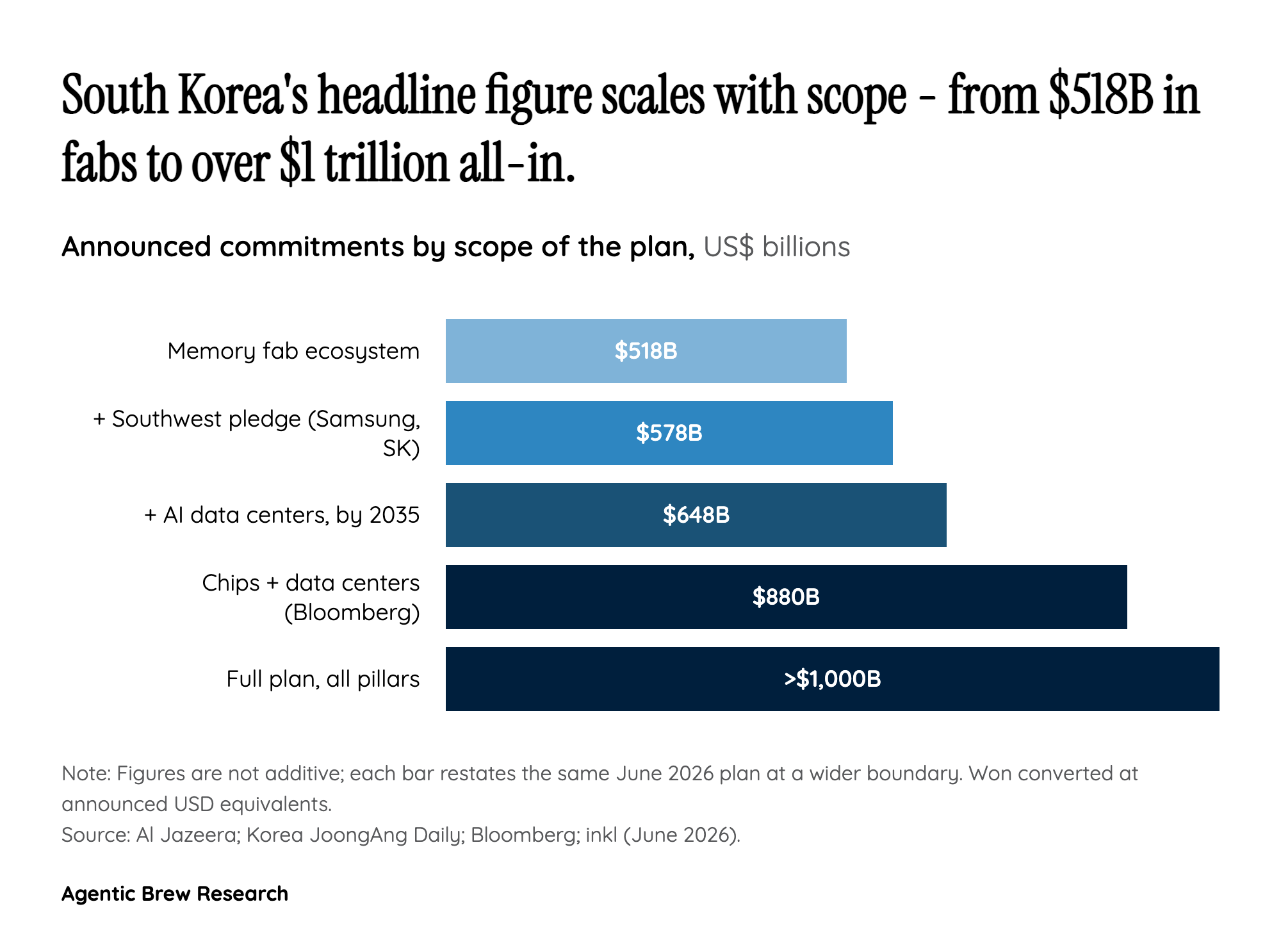
The Figure That Refuses To Sit Still
Each bar restates the same June 2026 plan at a wider boundary - the figure grows with scope, not with new money.

Depending on which headline you read, South Korea just committed $518 billion, $578 billion, $648 billion, $880 billion, or more than $1 trillion. The numbers are not contradictory - they are nested. The semiconductor ecosystem alone runs about 800 trillion won, roughly $518 billion [1]. Narrow it to the southwest pledge from Samsung and SK and you get 896 trillion won, about $578 billion, split as SK Group's 470 trillion won for two fabs plus a 1-GW data center and Samsung's 425 trillion won for two memory fabs and a national AI computing center [2]. Widen the lens to the full data-center build-out and the figure climbs toward 1,000 trillion won, around $648 billion, by 2035 [4].

The scope keeps growing as you add pillars. A separate chip-packaging cluster in Chungcheong carries about 81 trillion won, roughly $52.5 billion [1]. Stack everything and the top-line reaches past 1,000 trillion won in announced commitments, which is why Bloomberg cited at least 1,350 trillion won, or about $880 billion. The lesson for anyone reading the coverage is that there is no single 'real' number - there is a set of figures, each correct for a defined boundary, and the right move is to ask which slice a given headline is pricing before treating two reports as in conflict.

Why Korea Insists This Is Not A Bubble

The bull case is not optimism - it is supply chemistry. Memory capacity takes more than a decade to build, and the firms closest to the shortage are the ones committing the capital, which is why Forbes contributor Jon Markman called the bet 'That is the signature of a secular build-out, not a speculative top' [3]. The supporting data is concrete: Micron's 2026 HBM output is already sold out, conventional memory prices are up more than 200% since early 2025, Nvidia absorbs roughly 60% of HBM supply, and SK Hynix projects a supply-demand imbalance lasting at least three years [3]. When the people who would be hurt most by a glut are the ones building for a glut-proof decade, that is a tell.

The bear case is equally grounded, and it comes loudest from the retail crowd rather than the analysts. The sharpest skepticism online invokes industry memory: Samsung has, by this reading, bankrupted the memory industry more than once by doing precisely this - flooding capacity into a cyclical market - and Korea's role as 'the Saudi Arabia of memory' makes DRAM feel like an OPEC that periodically breaks its own discipline. The market itself flinched on the day, with Samsung and SK Hynix shares closing down 4.86% and 1.68% respectively [3]. The two readings are not really arguing about the same thing: the bulls are betting on demand durability, the bears on supply discipline. Both can be right until one of them isn't.

The Physics Bill Comes Due

A trillion-dollar chip ambition is ultimately a question of electricity, water, and people, and the resource math is the most sobering part of the plan. The southwest hub alone needs about 6.3 gigawatts of electricity - equivalent to the output of a 4.5-GW nuclear plant - and roughly 650,000 tons of water every day [2]. Scale that to the national data-center target of 18.4 gigawatts by 2035 and the project starts to look less like an industrial subsidy and more like a parallel energy buildout grafted onto the grid [1].

The constraint is not just generation capacity but readiness. Experts warn that the chosen regions may not scale electricity, water, logistics, supplier networks, and skilled labor fast enough to match the fab timeline, and that mismatch is exactly why the Seoul National University professor cautioned that 'from the outside, it still appears to be moving too fast' [3]. Fabs can be financed in a single announcement; transmission lines, water treatment, and a deep bench of process engineers cannot. The hardest deadline in this plan is not the H1 2028 construction start - it is whether the surrounding infrastructure can arrive at the same time as the concrete.

When Industrial Policy Meets Electoral Geography

The decision to plant a second chip cluster in the southwest Honam region is where economics and politics become hard to separate. President Lee tied the siting explicitly to reviving economies beyond the Seoul metropolitan area, a stated goal of narrowing regional disparities [2]. Opposition parties read the same map differently, arguing that placing the cluster in a ruling-party stronghold reflects electoral logic more than industrial rationale [1]. The skepticism echoes online too, where the southwest siting has been described bluntly as a political gift to the governing party's core base. Lee preempted the charge by pledging to 'personally oversee the project and take full responsibility,' insisting it is 'the real deal, rather than just a policy show' [2].

Underneath the geography sits a structural worry: concentration. Routing a sum approaching a third of national output through a handful of chaebol deepens an already heavy reliance on Samsung and SK, and the physical-AI pillar extends the same logic to Hyundai. That third leg is more mature than it first appears - Hyundai's plan to deploy more than 25,000 Atlas humanoid robots through its Boston Dynamics subsidiary, with 30,000-unit annual capacity targeted by 2028, predates the national announcement and was folded into it [5]. The ambition is to become a top-three global AI-robot power by 2030 and to commercialize humanoids across ten major industries in 2028, backed by training 10,000 specialists over five years [4]. Whether that breadth proves to be diversification or simply concentration wearing three hats is the question the next two years will answer.

Historical Context

2026-05-19
Hyundai unveiled a plan to deploy 25,000-plus Atlas humanoid robots, predating the national plan and feeding its physical-AI pillar.
2026-06-29
Formal unveiling of the three-pillar chip, AI, and robotics mega-investment plan alongside the Samsung and SK chairmen.

Power Map

Key Players
Subject

South Korea's national AI and semiconductor mega-investment plan

PR

President Lee Jae Myung

Initiator and sponsor; framed the plan as a national survival strategy, pledged personal oversight, and tied it to narrowing regional disparities beyond Seoul.

SA

Samsung Electronics (Chairman Lee Jae-yong)

Anchor chipmaker; roughly 425 trillion won for two memory fabs plus a national AI computing center in the southwest.

SK

SK Hynix / SK Group (Chairman Chey Tae-won)

Anchor memory and HBM maker; roughly 470 trillion won for two fabs plus a 1-GW AI data center, with HBM dominance central to the plan.

HY

Hyundai Motor Group / Boston Dynamics

Physical-AI pillar; plans to deploy 25,000-plus Atlas humanoid robots across Hyundai and Kia plants, targeting 30,000-unit annual production capacity by 2028.

GS

GS Group, Naver, Amkor Technology

Co-investors; GS and Naver in AI data centers, Amkor pledging 1 trillion won to expand advanced packaging in Gwangju.

OP

Opposition parties

Critics; argue siting a second chip cluster in Honam, a ruling-party stronghold, is driven by regional politics rather than industrial logic.

Fact Check

5 cited
  1. [1] South Korea announces more than $1 trillion AI, chip investment drive
  2. [2] Samsung, SK pledge 896 trillion won to back Lee's southwest chips megaproject
  3. [3] What South Korea's $576 Billion Chip Bet Says About The AI Bubble
  4. [4] Key facts on South Korea's three chip and AI mega projects
  5. [5] Hyundai Motor Group unveils plan to deploy 25,000 Atlas humanoid robots

Source Articles

Top 5

THE SIGNAL.

Analysts

"Reads the commitment as the signature of real, secular AI demand rather than a speculative top: the suppliers closest to the shortage are committing decade-long capital, and memory capacity takes more than ten years to build and is sold out years in advance."

Jon Markman
Contributor, Forbes

"Warns that an undertaking of this scale demands extraordinary deliberation and that the rollout appears to be moving too quickly."

Seoul National University professor (unnamed)
Professor, Seoul National University
The Crowd

"JUST IN: South Korea is reportedly preparing to launch three “mega-projects” spanning chips, AI data centres, & robotics."

@@Polymarket1254

"South Korea unveils $1tn chip and AI investment plan https://t.co/PUOONVDSr6"

@@BBCWorld937

"South Korean firms including Samsung and SK Hynix will spend at least 1,350 trillion won ($880 billion) on chips and data centers as the country seeks to maintain its edge in the AI era: Here is your Evening Briefing. https://t.co/DbQnLn77qU"

@@business222

"Samsung to invest 1/3 of South Korea's GDP into chips and AI"

@u/fiddlefaddlegumdrops1700
Broadcast
South Korea unveils massive AI-chip drive | East Asia Tonight 29 June 2026

South Korea unveils massive AI-chip drive | East Asia Tonight 29 June 2026

South Korea's Massive AI Investment Push

South Korea's Massive AI Investment Push

South Korea Bets $880B on AI Chips & Data Centers | The Pulse 6/29/2026

South Korea Bets $880B on AI Chips & Data Centers | The Pulse 6/29/2026