Nvidia revenue-sharing compute program for AI startups and neoclouds
TECH

Nvidia revenue-sharing compute program for AI startups and neoclouds

31+
Signals

Strategic Overview

  • 01.
    Nvidia launched a revenue-sharing and credit-support financing program on July 1, 2026, announced in a blog post co-authored by CFO Colette Kress, letting AI cloud providers access GPUs in exchange for a share of the revenue those chips generate rather than paying the full cost upfront.
  • 02.
    Chips are still priced normally, but Nvidia now earns two streams - standard upfront hardware revenue plus an ongoing, undisclosed percentage of the cloud revenue the GPUs produce once rented to AI developers.
  • 03.
    Sharon AI and Firmus are the first named partners, together scaling toward roughly 210,000 Grace Blackwell GB300 GPUs.
  • 04.
    To de-risk lenders and smaller operators, Nvidia guarantees a floor utilization rate, commits to renting idle capacity at a preset rate, and will buy back unsold capacity at predetermined prices.

Deep Analysis

Getting Paid Three Times for the Same Chip

Nvidia's program rewires how the company makes money from a GPU. The first payment is the familiar one - a cloud partner still buys the Grace Blackwell hardware at standard list price [1]. The second is new: Nvidia takes an ongoing percentage of the cloud revenue those same chips generate once they are rented out to AI developers, an arrangement it frames as recurring rather than one-time [2]. The third layer is financing - Nvidia advances token credits against future GPU capacity so cash-strapped startups can begin training immediately and pay on the back end as usage accrues [2].

What makes the structure unusual is the backstop attached to it. Nvidia guarantees a floor utilization rate, commits to renting idle capacity at a preset price, and will buy back unsold capacity at predetermined prices [3]. In practice that converts a neocloud's biggest fear - expensive GPUs sitting dark with no tenant - into a risk Nvidia partially absorbs. The company is no longer just selling shovels; it is helping finance the mines, collecting a toll on the gold, and promising to buy back any ore nobody wants.
The Circular-Financing Question

The same design that de-risks neoclouds also concentrates risk on Nvidia. Beth Kindig, lead tech analyst at I/O Fund, calls Nvidia's simultaneous role as investor, supplier, and demand backstop one of the most identifiable instances of circular financing in the AI buildout [4]. Her concern is arithmetic: neocloud revenue lags capital spending by roughly two to one, which raises the question of whether these operators must keep raising cash indefinitely to fund each new wave of data centers [4]. CoreWeave, an earlier Nvidia-backed neocloud, posted negative free cash flow of $4.71 billion in the first quarter of 2026 against $24.86 billion in total debt [4].

Critics have reached for historical parallels. The Register described the arrangement as double-dipping, profiting from the hardware sale and again from utilization [3]. On investor forums the comparison ran to Cisco's vendor financing at the peak of the dot-com era, with skeptics framing revenue-sharing as a way to prop up demand rather than proof of it. The market was not fully convinced at launch: on July 3, 2026, first partner Sharon AI fell 14.2% while Nvidia itself slipped 1.4% [3].

Who This Actually Unlocks

Who This Actually Unlocks
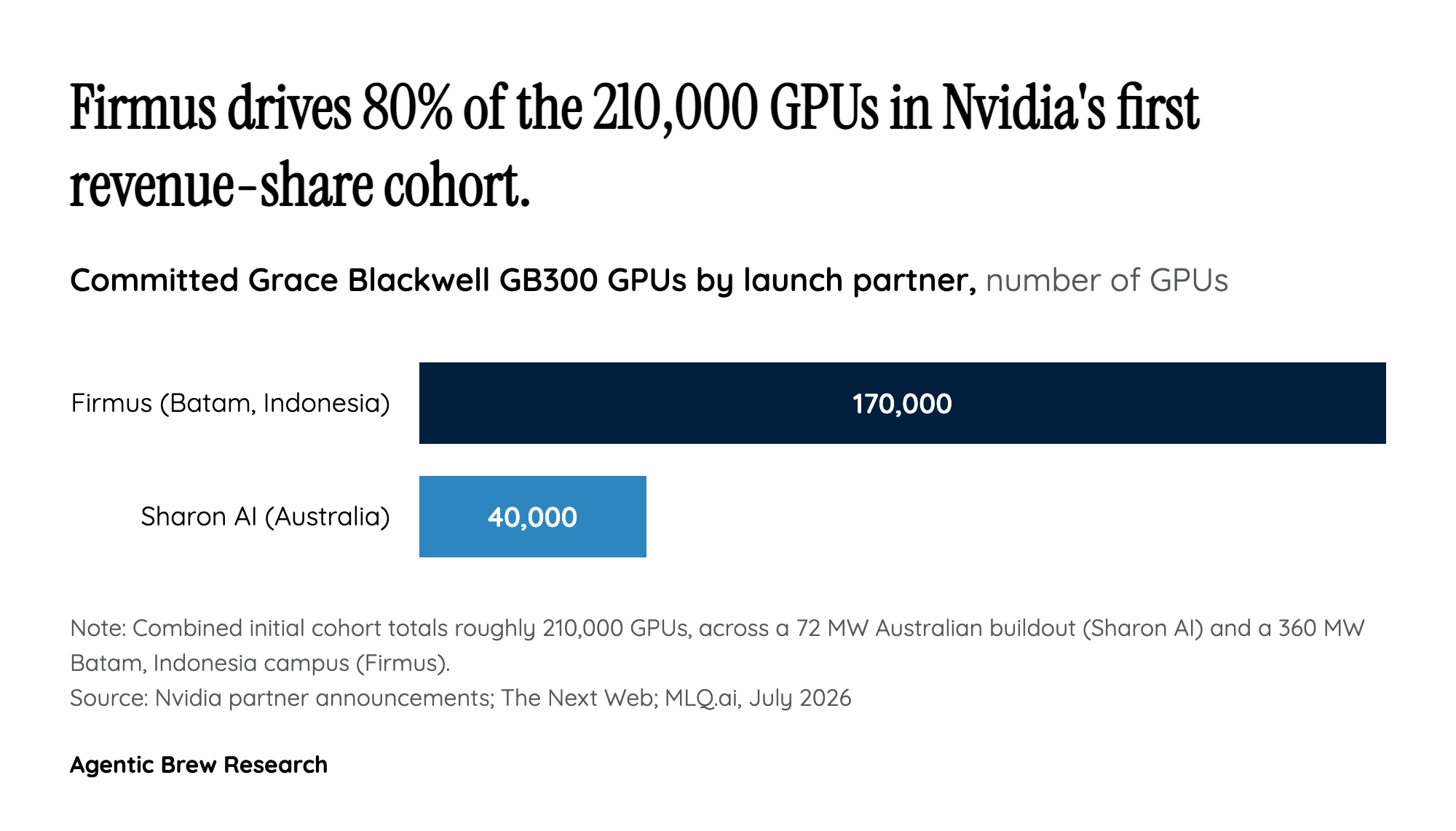
Firmus accounts for roughly 80 percent of the 210,000 GPUs across the two launch partners.

The strategic target is the tier of AI infrastructure below the hyperscalers. By absorbing utilization risk and offering non-dilutive financing, Nvidia lets neoclouds and startups build without pre-funding every GPU from their own balance sheet or trading away equity to venture investors [1]. The two launch partners show the scale involved: Sharon AI is deploying up to 40,000 GB300 GPUs across a six-year, 72-megawatt sovereign-AI buildout in Australia, while Firmus is constructing a 360-megawatt AI factory on Batam Island, Indonesia, scaling toward 170,000 GPUs against a reported $25 billion to $30 billion in committed offtake [1]. Sharon AI's chief executive James Manning called the collaboration a pivotal moment [1].

There is a second-order motive. Hyperscalers have increasingly leased compute from neoclouds to convert massive upfront capital spending into operating expense, pushing the funding burden down to smaller operators who then need exactly the kind of Nvidia-backed financing this program provides [4]. Demand-side AI-native firms such as Baseten, Fireworks AI, and Together AI - whose per-token businesses generate the recurring cash flow a revenue-share deal depends on - are the intended tenants [2]. The program, in effect, tries to manufacture a competitive compute market that keeps Nvidia silicon as the default layer no matter which model ultimately wins.

The Skeptics' Counter: Are the GPUs Even Lit Up?

The loudest pushback questions the premise that compute is scarce enough to justify the scheme. Developer commentary on YouTube framed the revenue-share model as financial engineering symptomatic of an AI bubble, pointing to the dark GPUs debate - the argument that a meaningful share of purchased chips sit idle for lack of power or tenants - and to signals that hyperscalers like Meta and xAI have begun renting out excess capacity. If compute were truly as constrained as the buildout implies, the skeptics ask, why would Nvidia need to advance credits and guarantee utilization at all?

Community sentiment across investor forums skewed cynical, with a recurring worry that revenue-sharing marks a cyclical, funding-dependent industry rather than durable demand. The counterpoint, made in trade coverage, is that unlike telecom-bubble vendor financing this program targets existing AI inference demand rather than speculative capacity, which would make the counterparty risk less alarming than the parallels suggest [5]. Whether the flywheel compounds or seizes ultimately depends on a figure Nvidia declined to disclose - the actual revenue-share percentage - and on whether the tokens these AI factories produce find enough paying customers [2].

Historical Context

2026-05-07
IREN inked an AI-infrastructure deal with Nvidia, part of a wave of GB300-based neocloud deals preceding the revenue-share program.
2026-06-12
Sharon AI announced a six-year strategic compute collaboration with Nvidia to enable 72 megawatts of new Australian data-center capacity with up to 40,000 GB300 GPUs.
2026-07-01
Nvidia formally launched the revenue-sharing and credit-support program with Sharon AI and Firmus as first partners, scaling toward roughly 210,000 GPUs combined.

Power Map

Key Players
Subject

Nvidia revenue-sharing compute program for AI startups and neoclouds

NV

Nvidia (CFO Colette Kress)

Program originator; shifts from pure equipment vendor toward financier with a stake in customer utilization, earning hardware revenue plus a recurring usage-linked cut on the same capacity. Declined to disclose the revenue-share percentage.

SH

Sharon AI (NASDAQ: SHAZ)

First named partner; deploying up to 40,000 GB300 GPUs across a six-year, 72-megawatt sovereign-AI buildout in Australia. Its stock fell 14.2% on July 3, 2026, signaling investor caution.

FI

Firmus Technologies

First named partner; building a 360-megawatt Nvidia DSX AI factory on Batam Island, Indonesia, scaling to up to 170,000 GPUs against a reported $25-30 billion in committed offtake over six years.

CO

CoreWeave and Nebius

Earlier Nvidia-backed neoclouds cited as the template for this model; Nvidia holds roughly $2 billion equity stakes in each and committed to buying CoreWeave's unsold capacity through April 2032. Their strained balance sheets frame the circular-financing debate.

BA

Baseten, Fireworks AI, Together AI

Demand-side AI-native firms whose per-token, usage-based businesses generate the recurring cash flow a revenue-share deal depends on; the intended tenants of the new capacity.

Fact Check

5 cited
  1. [1] Nvidia offers AI startups compute now, payment later
  2. [2] Nvidia Launches Revenue-Share Program Offering AI Startups GPU Access Without Upfront Payment
  3. [3] Nvidia Launches GPU Backstop Financing Model, Takes Cut of Cloud Revenue From Neocloud Partners
  4. [4] Nvidia, CoreWeave, Nebius: Circular Financing and the GPU Boom
  5. [5] Nvidia Revenue-Sharing AI Cloud Debuts With 210,000 GPUs: Flywheel or Vendor-Finance Risk

Source Articles

Top 5

THE SIGNAL.

Analysts

"Calls Nvidia's simultaneous role as investor, supplier, and demand backstop one of the most identifiable instances of circular financing, and warns that neocloud revenue lags capital spending roughly two to one, raising the question of whether operators must keep raising cash indefinitely."

Beth Kindig
Lead Tech Analyst, I/O Fund

"Characterized the arrangement as double-dipping - Nvidia profiting from the hardware sale and again from utilization of the same chips."

The Register
Technology publication

"Called the six-year strategic compute collaboration with Nvidia a pivotal moment for the company."

James Manning
CEO, Sharon AI
The Crowd

"JUST IN: Nvidia officially launches program to let AI startups swap compute for revenue share"

@@Kalshi5533

"IMPORTANT READ. Nvidia just made one of the smartest moves I have seen from them in years. The old model: pay hundreds of millions upfront for GPUs or get in line. The new model: Nvidia gives fast-growing AI startups and cloud providers access to serious compute today, and"

@@InTheAssembly394

"Nvidia just figured out how to get paid three times for the same chip. Payment one: the cloud partner buys the GPU. Standard hardware sale, same as always. Payment two: Nvidia takes a recurring cut of the cloud revenue those chips generate. Colette Kress called it a "recurring,"

@@aakashgupta276

"Nvidia starts revenue-sharing credit-support model for AI Clouds"

@u/981flacht6143
Broadcast
NVIDIA Offers GPU Compute to Startups for Revenue Share - Circular Financing Circles Drain

NVIDIA Offers GPU Compute to Startups for Revenue Share - Circular Financing Circles Drain

Nvidia Revenue Share, Neoclouds Sell Off | Market monitor

Nvidia Revenue Share, Neoclouds Sell Off | Market monitor

IREN just got NVIDIA's $3.4B deal. Why the stock still faded.

IREN just got NVIDIA's $3.4B deal. Why the stock still faded.