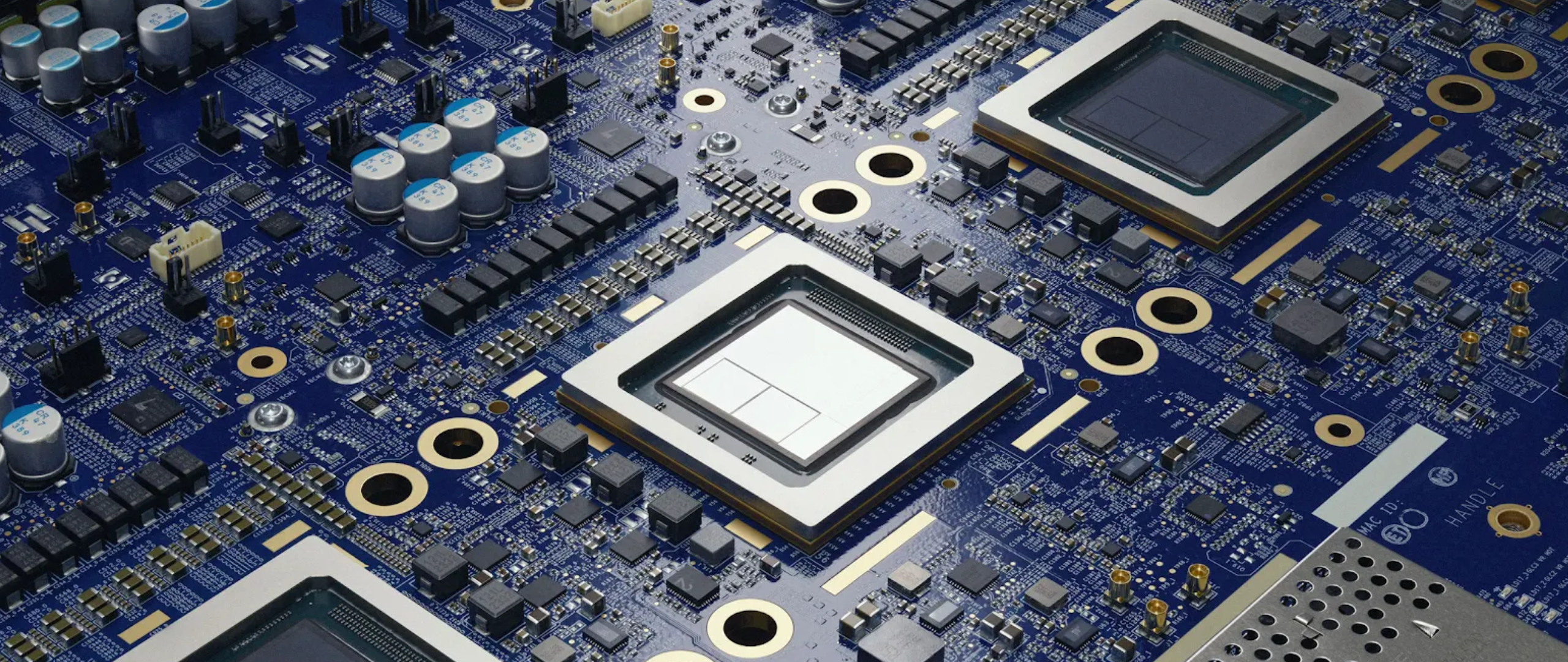
Google orders 3M+ AI chips/TPUs from Intel for 2028
TECH

Google orders 3M+ AI chips/TPUs from Intel for 2028

29+
Signals

Strategic Overview

  • 01.
    Google has placed an order with Intel to manufacture more than 3 million of its in-house tensor processing units in 2028, according to The Information, citing four people with direct knowledge of the talks; Google reportedly tapped Intel after months of testing its manufacturing technology.
  • 02.
    Nvidia is separately evaluating Intel's advanced packaging and its cutting-edge 18A process for its 2028 Feynman GPU architecture, running preliminary multiproject wafer validation, but has not placed an order.
  • 03.
    The interest in Intel comes as TSMC, which fabricates virtually every leading-edge AI chip, strains to keep up with demand, creating a backup-foundry opening; Intel shares jumped roughly 10-12% on the report, hitting a record high near $94.
  • 04.
    Google, Nvidia, and Intel all declined to comment, and the reporting could not be independently confirmed.

Deep Analysis

Why one order matters: the first hyperscaler crack in TSMC's leading-edge monopoly

Strip away the stock pop and the story underneath is structural. For years, essentially every leading-edge AI accelerator on Earth — Nvidia's GPUs, Google's TPUs, Amazon's and Meta's custom ASICs — has been etched in TSMC's fabs. That concentration is now the binding constraint: TSMC is straining to keep up with AI demand [1], and when a single supplier can't take more orders, the only lever a hyperscaler has left is a second source. Google reportedly pulling the trigger on more than 3 million TPUs from Intel for 2028 is significant less for the unit count than for who placed it [1]. A hyperscaler designing its own silicon is the most demanding, most sophisticated foundry customer there is, and Intel landing one — after Google spent months testing its manufacturing technology [2]— is the first real external validation that Intel Foundry can be trusted with bleeding-edge AI parts. Morgan Stanley's estimate that Google's total TPU output will top 6 million units across 2027 and 2028 frames how large the pie is [2]; even a minority slice routed to Intel is a meaningful diversion from TSMC's order book.


Packaging is not the same as fabbing: the distinction the market may be conflating

Here is where the bullish read needs a caveat. There is a world of difference between Intel assembling a chip and Intel manufacturing the transistors inside it. Several close observers — including a well-followed semiconductor leaker and commenters in Intel investor circles — have pushed back on the framing, arguing the 3-million-unit TPU order may be for Intel's advanced packaging (fusing and connecting silicon, e.g. EMIB-class interconnect) rather than fabbing the dies themselves on Intel's process node. That matters because packaging, while lucrative and capacity-relevant, does not prove Intel's 18A node is competitive with TSMC's most advanced lines. The genuinely node-level signal sits on the Nvidia side: Nvidia is running preliminary multiproject wafer validation on Intel's 18A process, testing whether Intel can fuse four graphics chips into one package for its 2028 Feynman architecture [1][2]. Crucially, Nvidia has not ordered anything yet. So the cleanest way to read today's news is two separate signals braided together — a Google volume commitment whose exact scope (package vs. wafer) is unconfirmed, and a Nvidia process evaluation that is real but still pre-commercial.

A report, not a contract: why the timing is almost too convenient

The contrarian case is worth stating plainly. None of this is officially confirmed — Google, Nvidia, and Intel all declined to comment, and the underlying claim rests on The Information's sourcing [2][3]. Skeptics in Intel investor forums went further, arguing parts of the narrative recycle earlier 2026 reporting on Intel-Google collaboration, and that the only genuinely new elements are the 18A node confirmation and the concrete 3-million-unit 2028 volume. Yet the timing is exactly what Intel's turnaround thesis required. Its foundry arm posted $5.4 billion in Q1 2026 revenue that is still overwhelmingly internal demand [3]; the missing ingredient has always been a marquee external customer. Analysts captured both the promise and the peril: TECHnalysis Research's Bob O'Donnell says the real turnaround signal is foundry becoming significant by 2027 [3], while Cerity Partners' Michael Schulman calls the whole effort a high-stakes gamble to become a credible rival by 2030 [3]. A roughly 10-12% one-day surge to a record high [1][3]prices in the optimistic ending of a story whose first chapter is still a set of anonymous sources.

Historical Context

2014
Google has co-designed TPUs with Broadcom for seven generations since 2014, with chips fabricated through TSMC.
2025-12
MediaTek joined Broadcom as a silicon design partner for the eighth-gen TPU program, ending Broadcom's exclusive role.
2026-01
Current TPU v7 (Ironwood) is manufactured on TSMC's N3P process, and planned eighth-gen TPUs are targeted for TSMC 2nm in late 2027 — context for Intel being added as a 2028 source.
2026-06-08
Intel stock hit a record high near $93-94 after The Information's report, putting the foundry turnaround narrative back in focus.

Power Map

Key Players
Subject

Google orders 3M+ AI chips/TPUs from Intel for 2028

GO

Google (Alphabet)

Customer placing the order; designs TPUs in-house and is seeking a second-source foundry beyond TSMC to secure 2028 capacity for more than 3 million chips.

IN

Intel

Foundry beneficiary; the deal would be a marquee external win for Intel Foundry's turnaround push to challenge TSMC, and its stock surged on the report.

NV

Nvidia

Prospective customer testing Intel's 18A process and advanced packaging for its 2028 Feynman GPUs; no order placed yet.

TS

TSMC

Incumbent leading-edge foundry whose capacity constraints are pushing customers to weigh Intel as a backup.

BR

Broadcom / MediaTek

Google's long-standing TPU co-design partners (Broadcom since 2014; MediaTek joined for the eighth generation), with chips historically fabricated at TSMC.

Fact Check

3 cited
  1. [1] Google and Nvidia eye Intel as backup chip manufacturer amid TSMC strain
  2. [2] Intel (INTC) Stock Rockets 12% on Major Google TPU Deal and Nvidia Manufacturing Tests
  3. [3] Intel Stock Hits Record High as Google AI Chip Report Puts Foundry Turnaround in Play

Source Articles

Top 5

THE SIGNAL.

Analysts

"Argues the true signal of Intel's complete turnaround is the foundry business ramping; if foundry becomes significant by 2027, that indicates the turnaround is complete."

Bob O'Donnell
President, TECHnalysis Research

"Frames Intel's long-term foundry prospects as a high-stakes gamble on establishing itself as a legitimate foundry rival by 2030."

Michael Schulman
Cerity Partners

"Projects Google's total TPU production will exceed 6 million units combined across 2027 and 2028."

Morgan Stanley
Investment bank
The Crowd

"The information: Google has placed an order with Intel to package more than 3 million TPUs. Across 2027 and 2028, Google is expected to produce more than 6 million TPUs using Intel's packaging technology."

@@jukan05328

"Alphabet Inc.'s Google recently placed an order with Intel Corp. to manufacture more than 3 million of its specialized AI chips in 2028, the Information reported, citing two unnamed sources."

@@business56

"THIS IS HUGE Google and Nvidia have picked Intel as a backup chip manufacturer For years, the world's most advanced chips came from one place - TSMC That concentration created a massive vulnerability Geopolitical tensions around Taiwan haven't cooled Every hyperscaler has a [...]"

@@leshka_eth7

"Google secured Intel to manufacture more than 3 million AI chips for 2028 production, Nvidia is testing Intel's 18A process and advanced packaging for future GPU architectures, The Information reports."

@u/itailitai69
Broadcast
Google Cloud Goes Full Stack, Amazon's $100B Anthropic Bet, Intel's Foundry Moment & More

Google Cloud Goes Full Stack, Amazon's $100B Anthropic Bet, Intel's Foundry Moment & More

Intel Foundry Services Customers in 2026? Apple, Qualcomm, Google, Nvidia, Broadcom, MediaTek...

Intel Foundry Services Customers in 2026? Apple, Qualcomm, Google, Nvidia, Broadcom, MediaTek...

TPUs Via Cloud Next, Intel Earnings, Foundry Scarcity

TPUs Via Cloud Next, Intel Earnings, Foundry Scarcity