Google launches Nano Banana 2 Lite and Gemini Omni Flash
TECH

Google launches Nano Banana 2 Lite and Gemini Omni Flash

38+
Signals

Strategic Overview

  • 01.
    On June 30, 2026, Google launched Nano Banana 2 Lite (API name gemini-3.1-flash-lite-image), its fastest and most cost-efficient Gemini image model, generating 1K images in about 4 seconds at $0.034 each.
  • 02.
    Google simultaneously launched Gemini Omni Flash (gemini-omni-flash-preview), a cost-efficient video model that accepts text, image, audio, and video inputs, outputs short cinematic video with native audio, and is priced at $0.10 per second.
  • 03.
    The two models are designed to be chained: Nano Banana 2 Lite generates an image that is passed as a reference to Gemini Omni Flash to animate it into video, via the now-generally-available Interactions API.
  • 04.
    Both models are available via Google AI Studio, the Gemini API, and the Gemini Enterprise Agent Platform, and roll out across consumer products including Search AI Mode, the Gemini app, NotebookLM, Google Photos, and Google Flow.

Google Just Optimized for the Bottom of the Market - On Purpose

The headline number is not quality, it is throughput. Nano Banana 2 Lite generates a 1K image in about four seconds for $0.034 [3], and Google's own framing calls it its fastest, most cost-efficient Gemini image model, built for high throughput, speed and scale [1]. That is a deliberate move down-market. Where the frontier race is about fidelity and control, this launch is about undercutting - the Lite variant roughly halves the price of its predecessor while collapsing latency from around twenty seconds to four [3].

The logic Google states out loud is that cost and latency, not model capability, are what actually gate deployment at scale [3]. A marketing team running thousands of ad variants, a social app serving millions of users, or an ecommerce catalog storyboarding product shots does not need studio-grade output on every call - it needs a price per image that survives being multiplied by a very large number [2]. Google is betting the low-end, high-volume segment is the segment worth owning, and that its Google Cloud footprint, already used by millions of developers, is the distribution wedge to take it [3].
The Real Product Is the Pipeline, Not Either Model

The two releases are more valuable together than apart. Nano Banana 2 Lite is meant to be a high-speed image generator whose output is passed as a reference into Gemini Omni Flash, which animates that still into short video [1]. The connective tissue is the Interactions API, now generally available, which preserves session history and context so you can generate 3-10 second videos at 720p and then conversationally edit and refine the outputs [5]. Developer YouTube converged on exactly this read: the interesting artifact is the chained image-to-video app, and Omni Flash's true unlock is that it is a multi-turn video editor you steer by referencing a prior interaction rather than re-uploading assets.

That mechanism changes the shape of the work. Instead of one-shot text-to-video, you get a stateful conversation - generate an image, animate it, then issue up to three sequential edits against the same session, each building on the last [1]. Google positions the Interactions API as its primary interface for talking to Gemini models and agents [4], which reframes these two media models less as standalone toys and more as components you compose inside a larger agent loop.

Follow the Money: A $1.034 Product Clip and a Three-Rung Price Ladder

Follow the Money: A $1.034 Product Clip and a Three-Rung Price Ladder
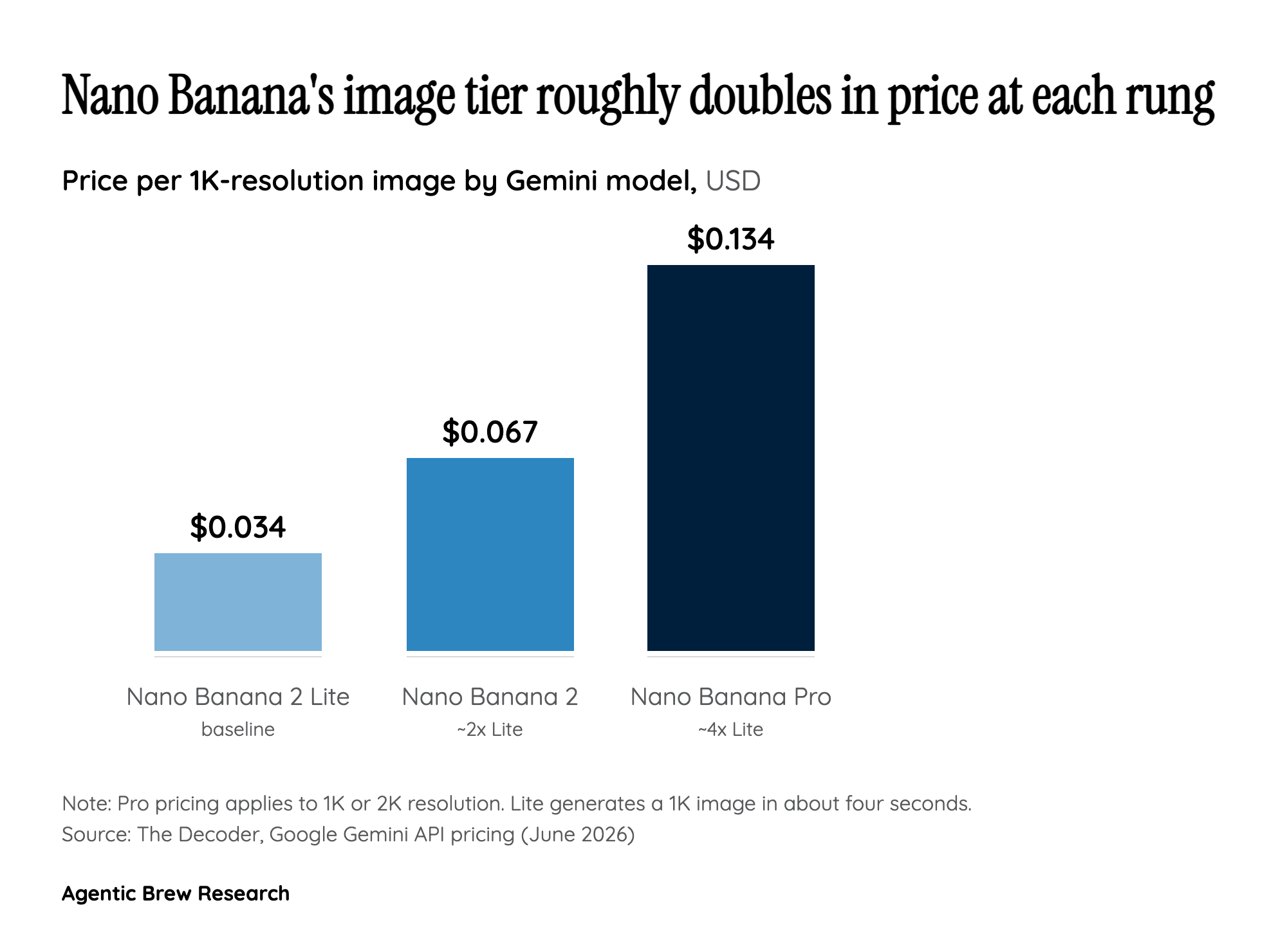
Each rung of the Nano Banana image family roughly doubles the previous tier price per 1K image.

The economics are legible enough to plan a budget around. A four-second $0.034 image feeding a $0.10-per-second video means a ten-second animated product clip costs roughly $1.034 in raw model spend before any regeneration [3]. For an operations team, a number that clean is the point - it turns generative video from an open-ended experiment into a line item.

The image side reads as a deliberate price ladder across the family: Nano Banana 2 Lite at $0.034 per 1K image, Nano Banana 2 at $0.067, and Nano Banana Pro at $0.134 [3]. Each rung roughly doubles the last, letting teams route by stakes - cheap tier for rough drafts and routing, premium tier for finals. On the video side, Omni Flash's $0.10 per second of 720p output is priced to match Veo 3.1 Fast, and it ranked #1 in the LMArena Text-to-Video Arena with a score of 1527 [6], a signal that the down-market pricing does not come with bottom-tier video quality.

The Contrarian Read: 'Cheaper and Derpier' - and a Conspicuous Missing Benchmark

Reddit was sharply divided, and the split is the most honest part of this story. The dominant r/singularity mood was that Google keeps shipping cheaper and derpier models rather than pushing the frontier, with one recurring framing that it is degrading the models instead of upgrading them. r/Bard skewed more receptive, impressed above all by raw speed. The defenders' argument is specific rather than reflexive: flash and lite tiers make agent workflows viable at scale, because if an agent runs a task 100,000 times a day and can tolerate a modest error rate, a cheap-enough model enables work that larger models price out of existence. Even critics conceded they reach for Gemini over the alternatives because unlimited free generations beat higher quality behind hard caps.

The load-bearing skeptic point is not about quality at all - it is about the benchmarks. Across all three tracked Reddit threads, the community flagged that Google's launch comparisons pointedly omit OpenAI's GPT Image 2, and read that omission as deliberately misleading. Notably, Nano Banana 2 Lite is now the free image tier in AI Studio, with the original Nano Banana pulled, and it is already live on OpenRouter [7]- a distribution move that makes the missing comparison land harder, because the model many people will now use by default is the one whose benchmarks skip the most obvious rival.

Historical Context

2025-08
Original Nano Banana (Gemini 2.5 Flash Image) launched as a viral hit, driving 23M+ new Gemini app users and 500M+ images generated in about two weeks.
2025-11
Nano Banana Pro (Gemini 3 Pro Image) released with higher visual fidelity, accurate text rendering, and studio-quality control.
2025-12
The Interactions API launched in public beta before reaching general availability at the June 2026 launch.
2026-02-26
Nano Banana 2 (Gemini 3.1 Flash Image) released, bringing Pro capabilities to the Flash architecture at Flash-tier pricing.
2026-06-30
Nano Banana 2 Lite and Gemini Omni Flash launched simultaneously for developers.

Power Map

Key Players
Subject

Google launches Nano Banana 2 Lite and Gemini Omni Flash

GO

Google / Google DeepMind

Developer and vendor of both models. Uses its Google Cloud distribution reach - millions of existing developers - to push low-cost, high-throughput generative media into enterprise and consumer products.

EN

Enterprise and developer customers

Target users - marketing teams running high-volume A/B ad tests, social apps serving millions, ecommerce storyboarding and virtual try-on, and agentic creative workflows where per-image cost and latency decide deployability at scale.

AR

Artlist

Early creative-tooling partner cited by Google, endorsing the speed benefit for creators.

IN

Invideo

Early partner highlighting Gemini Omni Flash's VFX and production capabilities.

Fact Check

7 cited
  1. [1] Start building with Gemini Omni Flash and Nano Banana 2 Lite
  2. [2] Nano Banana 2 Lite and Gemini Omni Flash now available on Vertex AI
  3. [3] Google launches Nano Banana 2 Lite for fast AI images and Gemini Omni Flash for video via API
  4. [4] Gemini Omni Flash | Gemini API
  5. [5] The Interactions API is now generally available
  6. [6] Gemini Omni | Google DeepMind
  7. [7] Gemini 3.1 Flash Lite Image | OpenRouter

Source Articles

Top 5

THE SIGNAL.

Analysts

"Frames the launch around removing tooling speed as a bottleneck for creative work: Great creative happens when your tools move at the speed of your ideas."

Michael Gerstenhaber
VP Product Management, Google

"Speed is no longer a limitation. When generation is faster than imagination, creators can stay inside the idea instead of waiting on the tool."

Idan Yonas
Artlist

"The VFX capabilities surprised me, and looking at it as a producer, that brings in some very interesting possibilities."

Nishant Tahilramani
Invideo
The Crowd

"introducing nano banana 2 lite: our fastest, most cost-effective gemini image model yet built for high-velocity developer pipelines, it delivers text-to-image outputs in 4 seconds at just $0.034 per 1K-resolution image swap it into your workflow today via ai studio and the"

@@GoogleAIStudio2423

"Today we're releasing two generative media models for developers and enterprises with strong cost-performance. Nano Banana 2 Lite: our fastest, most cost-efficient image model in the Nano Banana family. Gemini Omni Flash: our natively multimodal high quality, cost"

@@Google686

"Gemini Omni Flash and Nano Banana 2 Lite are now live in OpenArt. Create, edit, and iterate with Google's latest models - all in one place. Nano Banana 2 Lite: 4-second image generation Omni Flash: conversational video editing, no timeline required Try them now"

@@openart_ai29

"Nano Banana flash lite?"

@u/Independent-Wind4462153
Broadcast
Introducing the Gemini Omni Flash API

Introducing the Gemini Omni Flash API

Gemini Omni Flash: Anything to Anything model from Google

Gemini Omni Flash: Anything to Anything model from Google

Google's NEW AI Updates Nano Banana LITE and Omni are INSANE

Google's NEW AI Updates Nano Banana LITE and Omni are INSANE