
AI data center backlash becomes a 2026 midterm liability
TECH

AI data center backlash becomes a 2026 midterm liability

38+
Signals

Strategic Overview

  • 01.
    Public opposition to a nearby AI data center surged from 42% to 75% in under a year, according to Heatmap/Embold Research polling of registered voters.
  • 02.
    An internal National Republican Senatorial Committee memo warns AI companies that data centers are a 'sleeper issue' that could cost the GOP the Ohio Senate seat and spread nationwide.
  • 03.
    Governors in Texas, New York, and Pennsylvania - spanning both parties - have imposed new data center permitting pauses or guardrails in 2026.
  • 04.
    The AI industry has responded with a coordinated PR push, including a $6.4 million Meta advertising campaign and community outreach from Microsoft and OpenAI.

Deep Analysis

The Political Mechanics: How Ohio Became the Test Case

A National Republican Senatorial Committee memo obtained by reporters this month warns AI companies directly that data centers have become a 'sleeper issue' threatening the entire 2026 midterm cycle, not just a handful of races [1]. The memo singles out Ohio, where GOP incumbent Jon Husted is cast as the anchor dragging down the ticket, and warns that if he loses on the issue, other Republicans nationwide will not go near the next data center project [1]. Ohio's dynamic is a case study in how fast the issue can move: Democratic challenger Sherrod Brown has put more than 6,000 TV ratings points behind ads branding Husted 'the face of data centers in Ohio,' tying him to developer tax breaks while local electricity bills climb [3][4]. GOP strategists concede their own messaging apparatus cannot fix this alone - the memo argues it is on the AI industry to explain who benefits, who pays, and why a community should want a data center in the first place [2]. The NRSC memo's own risk framing was echoed by reporting that the Cook Political Report rates six Senate contests as toss-ups where data centers play a role [2]. Independent pollsters have documented parallel numbers: Gallup found 71 percent of Americans oppose a data center in their own area, including 48 percent 'strongly opposed,' with resistance concentrated in the Midwest and South [5].

The Money Math: Who Captures the Buildout, Who Absorbs the Cost

Beneath the political messaging is a real dispute over who benefits from the AI buildout versus who pays for it. Voters increasingly link nearby data centers to their own utility bills: wholesale electricity prices in regions with heavy data-center activity have risen as much as 267 percent since 2020, with year-over-year increases of roughly 21 percent in New Jersey, 13 percent in Virginia, and 5 percent in Georgia [6]. Ohio's Sherrod Brown campaign has made this the crux of its attack, accusing Husted of approving 'sweetheart tax deals' for developers even as residents' bills climbed [3]. Gallup's polling shows the resource-use complaint is not abstract - half of all opponents cite excessive water or energy consumption as their primary objection [5]. The dispute also cuts against the usual partisan script: Gallup found Democrats (56 percent strongly opposed) are more resistant than Republicans (39 percent), and opposition is highest in the Midwest and South [5].

The Physical Scale Driving the Reaction

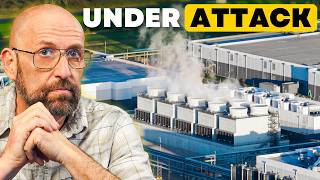
The scale behind this backlash is genuinely new. In Texas, grid operator ERCOT has been sitting on roughly 1,800 pending data-center connection requests representing more than 474 gigawatts of demand - over five times the grid's all-time peak load - which is what prompted Gov. Greg Abbott, a longtime booster of the AI buildout, to order a halt on new approvals pending an audit of power, water, and community impacts [7][8]. That reversal from a red-state governor matters because it shows the backlash is not confined to blue states: New York's Kathy Hochul signed the country's first statewide moratorium on new hyperscale data center permits of 50 megawatts or more [9][10], and Pennsylvania's Josh Shapiro followed with an executive order he called the 'strictest guardrails in the nation,' conditioning state permitting on energy-affordability, water and environmental limits, and local-community approval, while banning NDAs on data center deals [11][12]. Three governors, three different political incentives, one direction of travel: slower approvals and more local leverage over projects that used to move through statehouses with little friction.

The Industry's Charm Offensive - and Its Limits

The industry's response has been a coordinated, and so far uneven, public-relations push. Meta has committed $6.4 million to an advertising and PR campaign aimed at convincing local communities that data centers benefit them [13], while Microsoft has begun dropping requests for local tax breaks and OpenAI has held community meetings around its roughly $30 billion Georgia data center as part of a broader industry effort to get ahead of the narrative [14]. That effort is competing with a culture that has already turned data centers into a punchline: beverage brands Liquid Death and Garage Beer, backed by former NFL player Jason Kelce, built a marketing campaign around soliciting Americans' urine as 'data center coolant,' explicitly mocking the industry's water use [15][16]. When a company's local-benefits pitch is competing with a viral satire campaign for share of voice, the industry's spending gap looks more like a messaging gap than a dollar gap.

The View From the Timeline: Bipartisan Mockery and a Jobs-Math Gap

Community discussion on X, YouTube and Reddit has surfaced a jobs-math gap now feeding the backlash: a widely-viewed independent explainer highlighted that Meta's planned Louisiana site is pitched around more than 5,000 construction jobs at peak, but a Harvard researcher's estimate cited in the same video put permanent staffing once the facility opens at just 20 to 50 people - a mismatch that sharpens the 'who really benefits' question at the center of the political fight. The same video used Loudoun County, Virginia to explain why some local officials keep approving projects despite the backlash: the county draws roughly $1.3 billion a year in data-center tax revenue, money that has funded ten straight years of homeowner tax-rate cuts, and losing that revenue would push a typical homeowner's property tax bill up by an estimated $5,800 a year. Separate physical-scale reporting circulating online described a hyperscale project in Utah spanning roughly 61 square miles with an eventual 9-gigawatt draw that would exceed the rest of the state's entire electricity use combined, and noted that data centers already account for about 30 percent of Ireland's electricity use, up from just 5 percent in 2015 - offered as a preview of where the U.S. debate could be heading. Online, the backlash reads as genuinely bipartisan and often mocking in tone: progressive communities have joked about Republicans reopening coal plants just to keep data centers powered, a claim has circulated that some right-leaning media outlets were testing a 'galaxy centers' rebrand for the industry, and a vote in Carson City, Nevada, where local opposition to a data center was overridden by state officials, has become a widely discussed symbol of local control being sidelined. Not all of the online reaction favors the backlash, though - some commentators have pushed back, arguing data centers are being judged unfairly against dirtier infrastructure like coal plants and that the reaction is disproportionate, a framing echoed by a widely shared claim that stalled AI infrastructure could cost meaningful points of GDP growth.

Is This Really About Data Centers - or About AI Itself?

Some analysts argue the data-center fight functions as a proxy for a deeper unease about AI rather than a narrow objection to industrial infrastructure. CNBC framed it bluntly: data centers are 'only a small part' of what is driving up electricity prices nationally, but the claim that 'AI data centers are eating your electricity' is a simple story that fits pre-existing public skepticism of the technology [17]. That skepticism is now showing up as a disclosed business risk - reporting on Anthropic's IPO plans notes that public backlash against AI infrastructure has been cited as a risk factor in the company's own risk disclosures [18]. The NRSC's own memo makes a similar point in political terms: it describes public perception of data centers as still unsettled but currently negative, and warns that unless the industry itself changes the conversation, campaigns will keep finding data centers to be the easiest available symbol for a much bigger set of anxieties about AI's costs and who controls it [2].

Historical Context

2025-09
Baseline poll finds Americans evenly split on a nearby data center: 43% support, 42% opposed, 15% unsure.
2026-03
National telephone survey finds 71% oppose local AI data center construction.
2026-07-14
Gov. Hochul signs the nation's first statewide moratorium on new hyperscale data center permits.
2026-08-03
Gov. Abbott directs ERCOT and PUCT to pause approvals for roughly 1,800 pending data center grid-connection projects.
2026-08-13
Latest poll shows opposition at 75%, up from 42% a year earlier.
2026-08-18
Gov. Shapiro signs executive order imposing strict development guardrails on data centers.
2026-08-19
Internal memo obtained by reporters warns AI companies that data centers are politically radioactive and threaten the Ohio Senate race.

Power Map

Key Players
Subject

AI data center backlash becomes a 2026 midterm liability

NA

National Republican Senatorial Committee (NRSC)

Authored the internal memo warning AI companies that data centers are politically radioactive and threaten multiple 2026 Senate races

OH

Ohio Senate candidates Jon Husted (R) and Sherrod Brown (D)

Data centers have become the central attack line in the race, with Brown running a multimillion-dollar campaign branding Husted 'the face of data centers in Ohio'

GO

Gov. Greg Abbott (R-TX)

Ordered ERCOT and PUCT to halt new data center grid-connection approvals pending an energy, water, and community-impact audit

GO

Gov. Kathy Hochul (D-NY)

Signed the first statewide moratorium on new hyperscale data center permits

GO

Gov. Josh Shapiro (D-PA)

Signed an executive order imposing new energy, water, and local-approval requirements on data center developers

ME

Meta, Microsoft, OpenAI and other AI/cloud companies

Running PR campaigns, dropping local tax-break requests, and holding community meetings to counter public backlash

Fact Check

18 cited
  1. [1] GOP privately warns AI companies data centers threaten 2026 midterms
  2. [2] GOP memo: data center backlash will keep dominating the Ohio Senate race
  3. [3] Data centers and the NRSC memo shadow Ohio's Senate race
  4. [4] Data centers become flashpoint in Ohio Senate race between Husted and Brown
  5. [5] Americans oppose data centers in their area, Gallup poll finds
  6. [6] 'Cost me the election': data centers trigger voter backlash over electricity prices
  7. [7] Texas pauses new data center grid connections amid capacity crunch
  8. [8] Gov. Abbott pauses new data centers until ERCOT, PUCT audit energy and water usage
  9. [9] Governor Hochul launches first statewide moratorium on new hyperscale data centers
  10. [10] New York enacts one-year ban on new AI data center permits
  11. [11] Governor Shapiro signs executive order on data center development guardrails
  12. [12] Pennsylvania's Shapiro sets new limits on data center development
  13. [13] Meta drops $6.4 million on PR push as data center backlash grows
  14. [14] Tech industry deploys charm offensive to combat AI data center backlash
  15. [15] Liquid Death and Garage Beer urge Americans to send their pee to data centers
  16. [16] Liquid Death and Garage Beer turn data center water fears into a marketing campaign
  17. [17] Rising electricity prices tied to AI data centers become a midterm election issue
  18. [18] Anthropic lists AI backlash as a risk factor ahead of its IPO

Source Articles

Top 5

THE SIGNAL.

Analysts

Describes the shift in opposition as historically fast and broad-based, cutting across party, income, and geography.

Robinson Meyer (Heatmap News)
Journalist/analyst tracking public opinion data

Argue data centers are only a small part of what is driving up electricity prices, but the story that AI data centers are eating your electricity is simple and compelling given pre-existing voter skepticism of AI.

CNBC analysts
Framing the political narrative around energy prices

Argue that party committees cannot fix the industry's brand problem alone and that it is on AI companies to explain who benefits, who pays, and why a community should want a data center.

NRSC memo authors
GOP campaign strategists
The Crowd

The National Republican Senatorial Committee sent a private memo yesterday to US AI companies warning them that the GOP is on the verge of losing Ohio over data centers, and unless something is done to improve public perception, political support will collapse nationwide.

@@AndrewCurran_2865

People are about twice as likely to approve of coal plants being built nearby as opposed to data centers. Coal plants use more water and pollute more. They create comparable noise pollution. There is no way this makes sense outside a media panic.

@@JeremiahDJohns7030

JUST IN: Chamath Palihapitiya warns growing resistance to AI data centers could wipe 200-300 basis points off annual U.S. GDP.

@@Polymarket1033

Republicans Are Realizing That No One Wants Data Centers

@u/KeanuRave10010000
Broadcast
What's really behind the data center backlash?

What's really behind the data center backlash?

Data Center Backlash Has Republicans Panicking

Data Center Backlash Has Republicans Panicking

Why are AI data centres facing a backlash? | The Economist

Why are AI data centres facing a backlash? | The Economist

AI data center backlash becomes a 2026 midterm liability — AI News | Agentic Brew