SpaceX's record-breaking IPO
TECH

SpaceX's record-breaking IPO

35+
Signals

Strategic Overview

  • 01.
    SpaceX priced its IPO at $135 per share, the largest stock debut in history, selling roughly 555.6 million shares to raise about $75 billion at a $1.77 trillion valuation. It began trading on Nasdaq under the ticker SPCX on June 12, 2026, a raise nearly three times the prior record set by Saudi Aramco.
  • 02.
    The $1.77 trillion valuation would make SpaceX the seventh-biggest company in the U.S., surpassing Tesla, while Elon Musk retains over 82% voting control after the offering. Yet the company is unprofitable, posting a $4.3 billion operating loss on $18.7 billion in revenue last year.
  • 03.
    Demand overwhelmed supply: total order-book interest reportedly topped $250 billion, with retail demand alone exceeding $100 billion, prompting SpaceX to cut the retail allocation from roughly 30% toward the low-20% range and brokerages like Robinhood to ration shares by lottery.
  • 04.
    On the eve of the listing, Musk appeared virtually at ASML's Technology Conference to unveil 'Terafab,' an estimated $55 billion in-house chip-manufacturing facility built on ASML's EUV lithography machines, signaling a vertical-integration push spanning Tesla, SpaceX, and xAI.

A record three times over — set against a money-losing balance sheet
A record three times over — set against a money-losing balance sheet
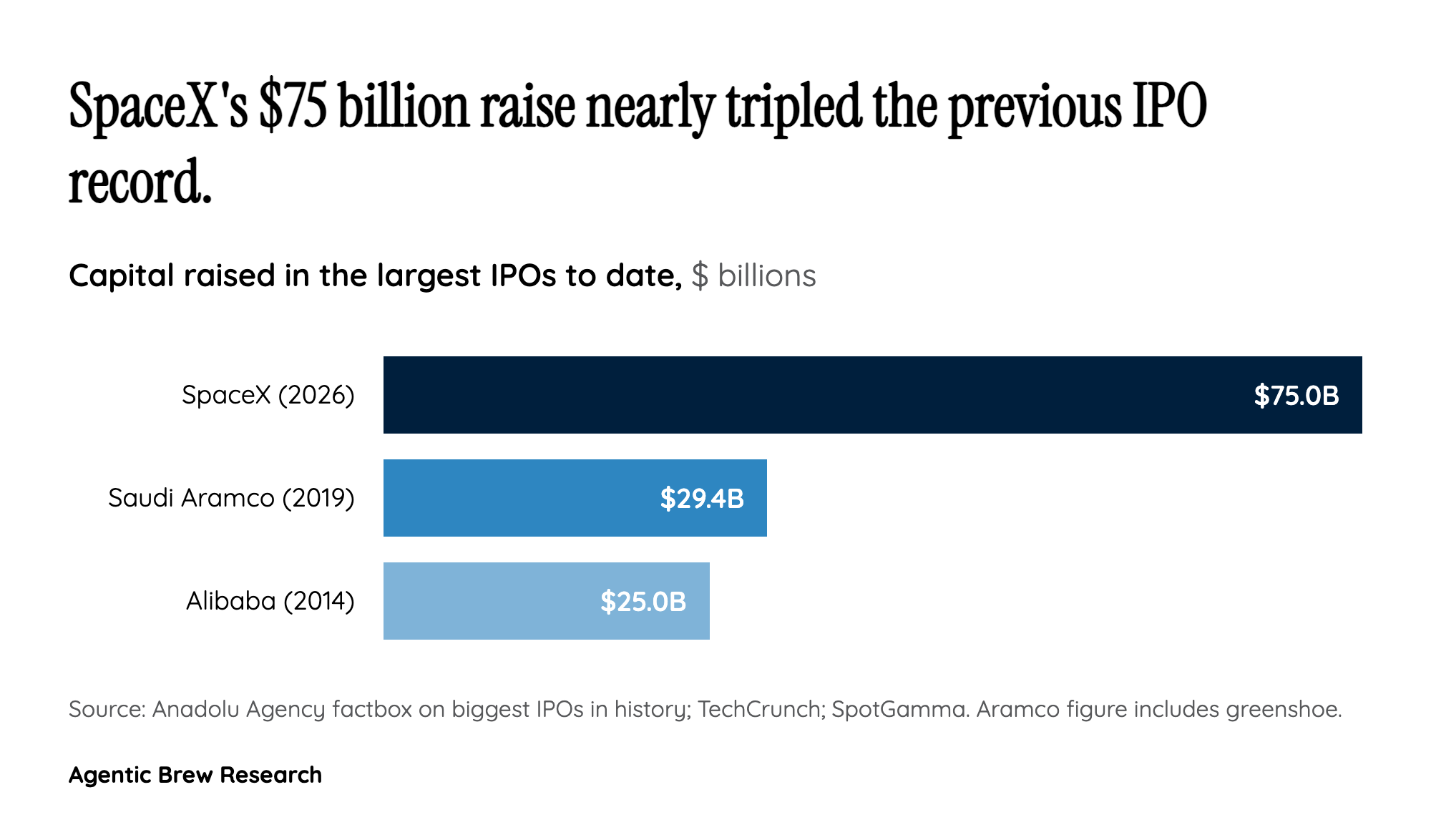
SpaceX's $75 billion raise nearly tripled the previous IPO record set by Saudi Aramco.

The headline numbers are staggering even by mega-cap standards. SpaceX priced 555.6 million shares at $135 to raise roughly $75 billion at a $1.77 trillion valuation [1][3], a raise close to three times the prior record held by Saudi Aramco's $29.4 billion 2019 listing and Alibaba's $25 billion debut in 2014 [2]. That valuation would vault SpaceX past Tesla into the seventh-biggest U.S. company, with the Guardian noting that validating that valuation would hand Musk the title of the world's first trillionaire [4]. What unsettles the skeptics is the gap between price and fundamentals: the company lost $4.3 billion at the operating line on $18.7 billion of revenue last year [4], and at the deal valuation it trades near 96 times sales [5]— far above the sub-30x multiple that even transformative-industry peers tend to command. Morningstar's Michael Field calls the valuation 'extremely speculative,' pinning it on 'unknown and untested technologies' concentrated in the AI business [5]. The bull case rests on Starlink scale — an S-1 deep dive circulating on Reddit cites roughly 10 million subscribers across 164 countries, near double year-over-year, on $3.26 billion of Q1 connectivity revenue — but the same filing shows a $2.6 billion 2025 loss and roughly $30 billion of cash burn over four quarters.
The demand wasn't organic — it was engineered

The most consequential structural story is how much of SPCX's buying pressure is mechanical rather than conviction-driven. A Nasdaq rule change effective May 1, 2026 lets a top-40 market-cap stock join the Nasdaq-100 after just 15 trading days instead of three months [6], and the offering's staggered float and lock-up structure was designed to expand the public float fast enough to maximize that index weighting [6]. SpotGamma estimates that fast-track inclusion forces roughly $22-27 billion of near-term mechanical buying from QQQ and Russell 1000 trackers, with another $8-12 billion deferred from S&P 500 funds after the S&P committee rejected fast-track entry on June 4 [6]. Because the expected public float is only 3-5%, that index demand collides with a thin tradable supply, amplifying price swings [6]. Layered on top is an unusually heavy retail allocation — cut from roughly 30% toward the low-20% range, still far above the typical 5-10% — even as retail demand topped $100 billion and total orders reportedly exceeded $250 billion [7][8]. Robinhood resorted to a random lottery to ration shares [7]. The combination of forced index buyers and an inflated retail float is exactly what critics point to when they call the debut a manufactured exit-liquidity event.

The $100 billion shadow market faces its reckoning

Years of pre-IPO hype spawned a sprawling secondary market of special purpose vehicles, and the IPO is about to test how much of it is real. SPVs that resold SpaceX exposure are stacked four to five layers deep, meaning lower-tier backers may own fewer shares than they believe — or none at all [9]. Rainmaker Securities CEO Glen Anderson notes that 'in special purpose vehicles, people are just trading units, not trading shares' [10], a distinction most retail buyers never grasped. Anduril cofounder Matt Grimm puts the fraud risk bluntly, asking how many people think they bought into SpaceX but are 'actually just funding some dude's coke habit in Miami' and concluding 'the number is not zero' [10]. Unicorns Exchange's Idan Miller expects that once the lock-up lifts, 'there will be some vehicles that will be revealed as scammers or fraud' [9], while Sabertooth Capital's Justin Ernest warns the bottom SPV layer 'may have to wait eight or nine months' to receive any shares [9]. Even where shares eventually arrive, predatory fee structures erode the holdings [9]— making the post-lock-up period a slow-motion reckoning for a roughly $100 billion shadow market [10].

Terafab: the pre-IPO chip bet that reframes the whole empire

Hours before the listing, Musk used ASML's Technology Conference to fold a second story into the IPO narrative: vertical integration of chip manufacturing. He unveiled 'Terafab,' a Texas facility he wants to supply Tesla, SpaceX, and xAI in-house [11], with an estimated build cost of about $55 billion and reporting suggesting full buildout could reach as high as $119 billion [12]. The plan hinges entirely on ASML, the sole maker of the EUV lithography machines required, at roughly $350-400 million each — and ASML shares rose after it confirmed Musk's participation [11][12]. The site has reportedly secured Grimes County tax incentives despite local opposition [12]. The timing is the point: courting a key supplier on the eve of the raise lets Musk reframe SpaceX not just as a launch-and-Starlink business but as the connective tissue of a self-supplying industrial empire — a narrative that helps justify a valuation that, on current financials, cannot stand on rockets alone.

Wall Street's calm versus the crowd's contempt

The sentiment split between institutions and the public is unusually stark. On the sell side, Goldman Sachs strategist Ben Snider argues that 'record US equity issuance will not derail the bull market in 2026' [5], and Bloomberg's coverage leaned into the market-structure question of whether the mega-offering reopens the IPO window or crowds out smaller issuers. Glenmede's Jason Pride captures the open question directly, asking whether SpaceX is 'a new growth opportunity for the market, or a signal that the market has already entered bubble territory' [5]. The social conversation is far less ambivalent. On X, voices flagged the staggered insider lock-up structure and argued retail and pension funds are being made into forced buyers — one framing the setup as 'exit liquidity for an overpriced IPO.' Reddit was overwhelmingly bearish: r/wallstreetbets met the valuation with disbelief and 'rug-pull' framing, attributing the inflated retail share to 'the aura or mystique of Elon Musk,' while r/technology dismissed the valuation lineage running from Twitter to xAI to SpaceX as making 'no sense.' Tellingly, even the most detailed bullish Reddit analysis ended on caution — recommending limit orders and waiting weeks to months given the thin float.

Historical Context

2014-09-19
Alibaba's NYSE listing raised about $25 billion, the largest IPO in the world at the time.
2019-12-11
Aramco listed on Tadawul at a roughly $1.7 trillion valuation, raising a then-record $29.4 billion including the greenshoe, the largest IPO before SpaceX.
2026-05-01
A new Nasdaq-100 rule took effect allowing a top-40 market-cap stock to join after just 15 trading days instead of three months, enabling SpaceX's fast-track inclusion.
2026-06-12
SpaceX debuted on Nasdaq as SPCX at $135 per share, the largest IPO in history at roughly three times the prior record.

Power Map

Key Players
Subject

SpaceX's record-breaking IPO

EL

Elon Musk / SpaceX

Issuer and controlling shareholder, retaining over 82% voting control post-IPO while simultaneously courting ASML for the roughly $55 billion Terafab chip venture to vertically integrate his companies.

AS

ASML

Holds a monopoly on the EUV lithography machines (around $350-400 million each) required to build Terafab, positioning it as the key supplier; its shares rose after confirming Musk's participation.

RO

Robinhood and online brokerages

Primary channel for heavy retail allocation; Robinhood distributed SPCX shares to retail users via a random lottery as demand far outstripped supply.

NA

Nasdaq

Listing exchange whose new rule, effective May 1, 2026, lets a top-40-by-market-cap stock join the Nasdaq-100 after just 15 trading days, triggering forced passive index-fund buying of SPCX.

SP

SPV sponsors and secondary-market investors

Multi-layer SPVs stacked four to five deep hold pre-IPO SpaceX exposure; backers face delayed and uncertain share delivery, predatory fees, and fraud risk once lock-ups lift.

Fact Check

12 cited
  1. [1] SpaceX sets IPO price, roadshow details as Musk eyes record debut
  2. [2] Factbox: From Aramco to Alibaba, biggest IPOs in history before SpaceX's planned market debut
  3. [3] SpaceX officially prices shares at $135 in the largest IPO ever
  4. [4] SpaceX to list on US stock market at historic $1.77tn valuation
  5. [5] SpaceX IPO won't break the bull market, but investors are worried about what comes next
  6. [6] SpaceX IPO and index changes
  7. [7] SpaceX cuts retail IPO allocation to low-20% range, source says
  8. [8] SpaceX IPO demand tops $100B from retail investors as share allocations tighten
  9. [9] SpaceX SPV investors won't know their true holdings until post-IPO lock-ups lift
  10. [10] As SpaceX goes public, a $100 billion shadow market faces a reckoning
  11. [11] Musk courts ASML for Terafab chip venture ahead of SpaceX IPO
  12. [12] Ahead of SpaceX IPO, Elon Musk addresses ASML employees as part of push into chip manufacturing

Source Articles

Top 5

THE SIGNAL.

Analysts

"Views SpaceX as overvalued, arguing the valuation rests on untested technologies, especially in its AI business."

Michael Field
Analyst, Morningstar

"Believes the market can absorb SpaceX's record raise without breaking the bull market, saying record U.S. equity issuance will not derail the 2026 rally."

Ben Snider
Strategist, Goldman Sachs

"Warns that SPV investors hold derivative units rather than actual shares: 'In special purpose vehicles, people are just trading units, not trading shares.'"

Glen Anderson
Cofounder and CEO, Rainmaker Securities

"Argues a nonzero share of retail buyers who think they own SpaceX through SPVs have actually been defrauded: 'How many people think that they have bought into SpaceX, but they're actually just funding some dude's coke habit in Miami? The number is not zero.'"

Matt Grimm
Cofounder, Anduril

"Expects that when SpaceX lock-ups lift, some SPVs will be exposed as fraudulent: 'Once the lock up of the shares is removed...there will be some vehicles that will be revealed as scammers or fraud.'"

Idan Miller
Managing partner, Unicorns Exchange
The Crowd

"SpaceX's IPO filing has reveals a staggered insider share lock-up structure instead of one giant unlock all at once. There's no typical 6-month lockup. Here's the timeline: • After Q2 2026 earnings: up to 20% of eligible insider shares unlock • If the stock trades 30%+ above"

@@SawyerMerritt2143

"SPACEX will be the biggest and most expensive IPO I have seen. Retail, Pension funds and alike will be forced to buy it via the ETF inclusion which was only possible by fully changing multiple rules to create exit liquidity for an overpriced IPO. Very sad to see this type of"

@@TheShortBear1885

"WILL SPACEX'S IPO BE THE LARGEST EXIT LIQUIDITY EVENT EVER ENGINEERED? SpaceX reserved up to 30% of its IPO for retail investors, compared to the typical 5–10% allocation seen in most offerings. Meanwhile, Fidelity just cut its minimum account requirement from $500,000 to just"

@@coinbureau147

"SpaceX locks in IPO price of $135, making it largest stock debut ever"

@u/jsg24fps5257
Broadcast
SpaceX Makes History With Biggest-Ever IPO

SpaceX Makes History With Biggest-Ever IPO

Wall Street Preps for the SpaceX IPO

Wall Street Preps for the SpaceX IPO

SpaceX IPO Debuts on Nasdaq | Elon Musk's Company Raises Record $75 Billion

SpaceX IPO Debuts on Nasdaq | Elon Musk's Company Raises Record $75 Billion