SpaceX's $40 Billion Debt Deal for Nvidia AI Chips
TECH

SpaceX's $40 Billion Debt Deal for Nvidia AI Chips

33+
Signals

Strategic Overview

  • 01.
    SpaceX is in talks to raise roughly $40 billion in debt to buy Nvidia AI chips (about $10 billion in bank loans and $30 billion in investment-grade debt), with Apollo Global Management expected to lead the financing and Pimco among the lenders in talks; the deal is expected to close in 2027 and would likely use the GPUs themselves as collateral.
  • 02.
    Elon Musk said on SpaceX's August 2026 earnings call that the company would build exclusively on Nvidia hardware because it views the Vera Rubin architecture as the best available.
  • 03.
    Investors approached earlier about the chip purchase financing said they received only a brief two-page memo, and SpaceX's existing 2056-maturity bonds are trading at around 85 cents on the dollar amid debt-load concerns.
  • 04.
    SpaceX ended Q2 2026 with 1.4 gigawatts of AI compute capacity, targeting 2+ gigawatts by year-end, after routing about $15.8 billion of $18.4 billion in quarterly capex to AI compute; the financing report drew a muted market reaction (SpaceX shares down 1-2%, Nvidia up about 0.5%), and CFO Bret Johnsen has guided to over $100 billion in annualized revenue by December.

Deep Analysis

Thirty-year paper against three-year hardware

The structural oddity here is duration mismatch, not headline size. The package is shaped as roughly $10 billion in bank loans plus $30 billion of investment-grade debt [1], with reporting pointing to maturities stretching out as far as 30 years [4], and the Nvidia GPUs themselves expected to serve as the collateral [3].

AI data center hardware typically loses about 30% of its replacement value per year, which means the chips securing those notes could be worth a fraction of the outstanding principal well before the debt matures [4]. That asymmetry is exactly what one bond strategist objected to: "The equity market owns the upside, bondholders don't. So you have to get paid for the risk." [4]The deal is not expected to close until 2027 [1], which leaves a long runway for the collateral question to get repriced before a single dollar is drawn.

Apollo is running a template Nvidia helped design

This is not an improvised financing. In August 2026 Nvidia announced AI compute infrastructure financing platforms with Apollo, BlackRock, Blackstone, Brookfield, Goldman Sachs and KKR, aiming to mobilize over $500 billion of third-party capital explicitly so buildout costs sit on outside investors' balance sheets rather than Nvidia's, with Jensen Huang holding an option to backstop up to $125 billion of potential deals [6]. Apollo is now the expected lead on SpaceX's package and is expected to place the debt broadly [2], with Pimco among the lenders in talks [3]. Layered on top is Musk's own commitment on the August earnings call that SpaceX would build "exclusively on Nvidia because we think the Vera Rubin architecture is the best architecture" [3].

Trading and technology communities seized on the loop this creates - a chip vendor helping assemble the capital that funds purchases of its own chips from a customer that has sworn off alternatives - and the critique surfaced across all three forum threads that discussed the deal, from trading-focused forums to general technology forums. The pushback was not unanimous: a meaningful contrarian strand argued the arrangement is closer to ordinary vendor financing than to anything circular, and noted SpaceX's investment-grade credit ratings as a counterpoint.

The real question is how much AI debt the market can still swallow

Morgan Stanley's framing is the most useful lens: the pricing and investor take-up of this deal is "a useful test of how much more AI borrowing investors can absorb," set against its estimate that AI infrastructure will need $1.5 trillion of external financing by 2028 [8]. The run-rate context is stark - investment-grade issuance from hyperscalers and AI-focused issuers hit $218.0 billion through July 8, 2026 versus $80.5 billion over the same stretch of 2025 [11].

The stress indicators are already visible on SpaceX's existing paper: the 2056 notes trade near 85 cents on the dollar at roughly 2.27 percentage points over Treasuries, while investors approached earlier about the chip purchase reported receiving only a two-page memo [3]. A thin diligence package on a $40 billion ask is the kind of detail that looks like froth in hindsight. An independent commentary channel picked up the same thread, framing the raise within a broader AI-debt-bubble narrative rather than as routine corporate financing.

GPU collateral went from novelty to norm in three years

GPU collateral went from novelty to norm in three years
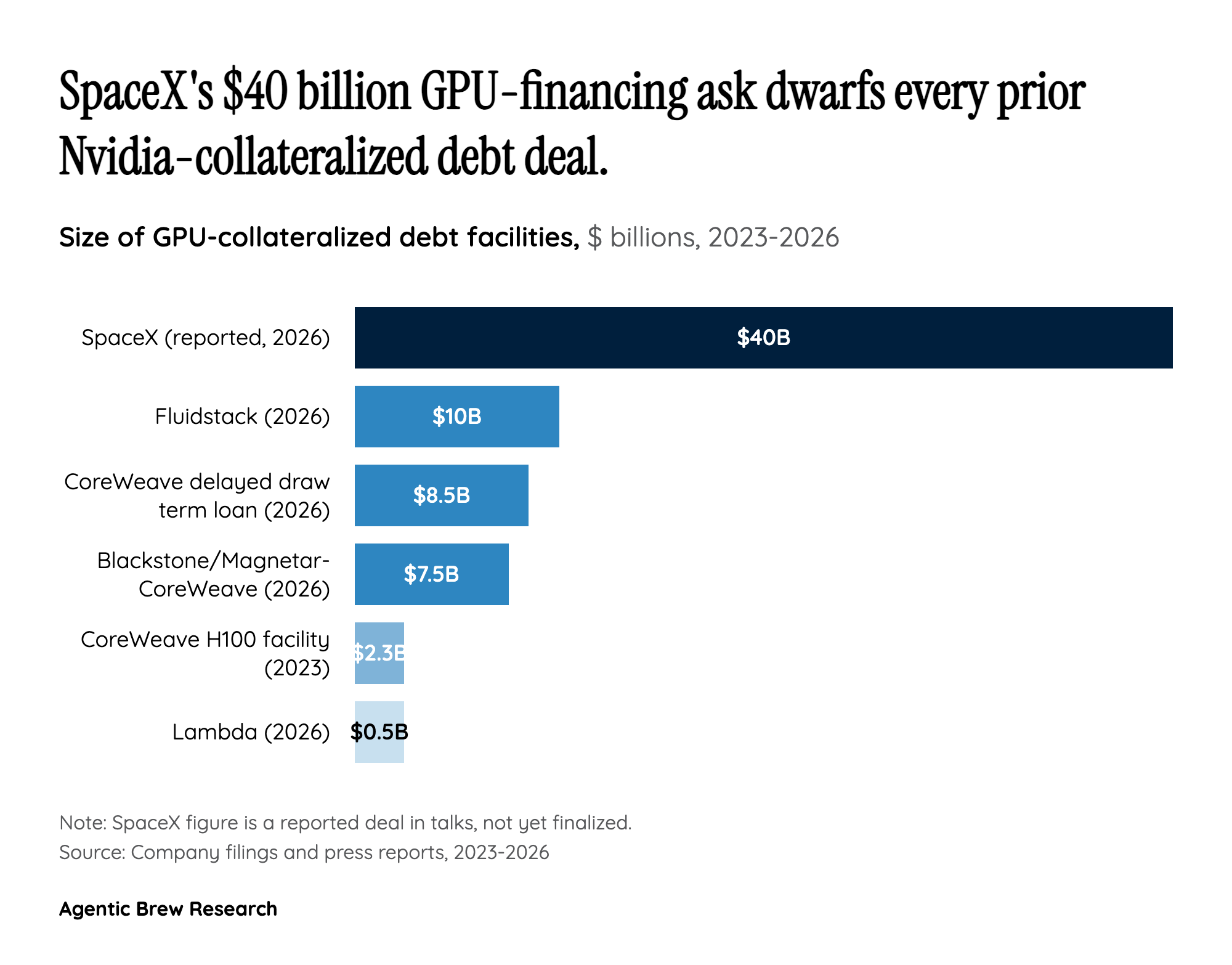
SpaceX's reported $40 billion ask dwarfs every prior Nvidia GPU-collateralized debt facility, including CoreWeave's $8.5 billion loan and Fluidstack's $10 billion deal.

The practice SpaceX is about to scale started small and recently. CoreWeave's 2023 $2.3 billion facility backed by Nvidia H100s was the first known case of that hardware being pledged as loan collateral [10]. By March 2026 the same playbook had produced an $8.5 billion delayed draw term loan for CoreWeave, alongside a $7.5 billion Blackstone and Magnetar facility, a $10 billion Fluidstack deal and a $500 million Lambda loan [9].

SpaceX's $40 billion ask is roughly four times the size of the largest of those facilities, while the underlying valuation question - what a depreciating GPU fleet is actually worth in a default - has never been tested through a down cycle. The precedent chain explains why lenders are comfortable with the structure, and also why that comfort is largely untested.

The bull case is a revenue case, not a balance sheet case

Everything supportive about this deal depends on compute demand, not on credit metrics. SpaceX put roughly $15.8 billion of about $18.4 billion of Q2 2026 capital spending into AI compute, ended the quarter at 1.4 gigawatts of capacity, targets more than 2 gigawatts by year-end, and its CFO has guided to over $100 billion in annualized revenue by December [1]. Wolfe Research thinks those compute targets could eventually mean around $350 billion of Nvidia hardware sales [4], and Motley Fool's read leans on SpaceX's 247% year-over-year AI segment revenue growth with Nvidia still trading at "a discount of just 25 times forward earnings" [5]. Dan Ives argues the backlog and Starlink cash flow carry the leverage, while conceding "the debate is whether a company this early in its public life should carry that much leverage" [7].

On the other side of the ledger, Oppenheimer models more than $400 billion of net debt by 2031 [4]. The market itself barely blinked - SpaceX down about 1-2% and Nvidia up roughly 0.5% on the report [1]- and community analysis split along the same seam, with some pointing to SpaceX's cash position against post-raise total debt to argue the headline overstates the risk, while others questioned whether renting out idle compute inflates the revenue run-rate the whole thesis rests on.

Historical Context

2023-08
CoreWeave secured a $2.3 billion debt facility using Nvidia H100 GPUs as collateral, the first known instance of H100 hardware pledged against a loan and the precedent for the GPU-backed AI infrastructure debt now reaching SpaceX scale.
2026-03-31
CoreWeave closed an $8.5 billion delayed draw term loan for AI infrastructure expansion, part of a wider pattern of large GPU-collateralized facilities that also included a $7.5 billion Blackstone and Magnetar facility, a $10 billion Fluidstack deal and a $500 million Lambda loan.
2026-06
SpaceX went public at roughly $85.7 billion to $86 billion and shortly after sold $25 billion of investment-grade bonds; those 2056-maturity notes have since weakened to about 85 cents on the dollar amid debt-load concerns.
2026-07-08
Investment-grade bond issuance from hyperscalers and AI-focused issuers reached $218.0 billion through July 8, 2026, far outpacing the $80.5 billion sold over the same period in 2025, showing the scale of the AI debt wave the SpaceX deal belongs to.
2026-08-10
Nvidia announced partnerships with six major financial firms to establish AI compute infrastructure financing platforms targeting over $500 billion of third-party capital, keeping buildout costs off Nvidia's own balance sheet, with Jensen Huang holding an option to backstop up to $125 billion of potential deals.

Power Map

Key Players
Subject

SpaceX's $40 Billion Debt Deal for Nvidia AI Chips

AP

Apollo Global Management

Lead arranger of the $40 billion debt package, expected to help distribute and place the debt with a broad range of institutional investors

PI

Pimco

Among a small group of bond lenders in talks to help fund the debt deal

NV

Nvidia

Chip supplier for the order (Vera Rubin architecture) and architect of a broader $500 billion AI compute financing partnership with Apollo, BlackRock, Blackstone, Brookfield, Goldman Sachs and KKR

EL

Elon Musk

SpaceX CEO who committed the company to building exclusively on Nvidia Vera Rubin hardware

BR

Bret Johnsen

SpaceX CFO, who projected over $100 billion in annualized revenue by December 2026

MO

Morgan Stanley

Frames the deal as a market test of AI borrowing appetite, estimates $1.5 trillion of external AI infrastructure financing needed by 2028, and reiterated a $300 price target and Buy rating on SpaceX

Fact Check

11 cited
  1. [1] SpaceX (SPCX) Stock: $40 Billion Apollo Financing for Nvidia Chips
  2. [2] SpaceX seeks $40 billion in debt led by Apollo to fund Nvidia chip order, FT says
  3. [3] SpaceX's $40 Billion Debt Push: Apollo, Pimco and Nvidia's Vera Rubin Chips
  4. [4] SpaceX Bond Deal: 30-Year Maturities, Nvidia Chip Collateral Worth a Fraction by Mid-Decade
  5. [5] Is SpaceX About to Hand Nvidia a $40 Billion Payday? Here's What It Could Mean for Investors
  6. [6] NVIDIA Partners With Apollo, BlackRock, Blackstone, Brookfield, Goldman Sachs and KKR to Establish AI Compute Infrastructure Financing Platforms to Mobilize Over $500 Billion of Third-Party Capital
  7. [7] SpaceX $40B Apollo-Led Loan to Buy Nvidia Chips; Nvidia Near $6 Trillion
  8. [8] SpaceX Seeks US$40 Billion Financing to Buy Nvidia Chips, Sources Say
  9. [9] CoreWeave Secures $8.5 Billion Loan to Aggressively Expand AI Infrastructure
  10. [10] CoreWeave Stock: The $2.6 Billion Debt Signal the AI Bubble Is Ignoring
  11. [11] Bond Issuance Backing AI Investment Tops $250B, Testing Limits of Voracious Investor Demand

Source Articles

Top 5

THE SIGNAL.

Analysts

“Argues SpaceX's growing AI backlog and Starlink cash generation can support the additional debt, while acknowledging a live debate about carrying this much leverage so early in the company's public life. "The debate is whether a company this early in its public life should carry that much leverage."”

Dan Ives
Bullish on SpaceX despite rising leverage

“Flags that equity holders capture the upside from AI infrastructure bets while bondholders absorb the downside risk of rapidly depreciating chip collateral. "The equity market owns the upside, bondholders don't. So you have to get paid for the risk."”

Unnamed bond market strategist cited by Tech Times
Skeptical of bondholder risk and reward in GPU-collateralized AI debt

“Says the pricing and investor take-up of the SpaceX deal will be a useful gauge of how much additional AI-related borrowing the market can digest, against estimates that AI infrastructure needs $1.5 trillion in external financing by 2028.”

Morgan Stanley research desk
Cautious on the market's capacity to absorb more AI debt

“Frames the $40 billion GPU order as meaningful revenue visibility for Nvidia, pointing to SpaceX's 247% year-over-year AI segment revenue growth alongside Nvidia trading at "a discount of just 25 times forward earnings."”

The Motley Fool analysis
Reads the deal as a positive demand signal for Nvidia shareholders
The Crowd

“SpaceX $SPCX is reportedly looking to raise $40 Billion by selling debt to buy Nvidia $NVDA chips - Financial Times”

@@StockMKTNewz1518

“SpaceX is reportedly exploring $40,000,000,000 in debt to secure Nvidia chips. A rocket company is now borrowing at sovereign scale to get its hands on compute. AI infrastructure demand keeps climbing, and the biggest players are financing it with leverage.”

@@moonbag221

“$SPCX wants to borrow $40 billion to buy a ton of Nvidia chips. Is the company betting too big? @dandefrancesco, @juleshyman, @ChrisJVersace, @joebrusuelas, and @vtg2 break it down. Join the Market Hang every day at 12:30 p.m. ET on Yahoo Finance.”

@@YahooFinance43

“SpaceX looks to raise $40bn to buy Nvidia chips in financing led by Apollo”

@u/Poka-yoke11200
Broadcast
SpaceX seeks $40B for Nvidia chips

SpaceX seeks $40B for Nvidia chips

SpaceX Eyes $40 Billion Deal to Buy Nvidia Chips

SpaceX Eyes $40 Billion Deal to Buy Nvidia Chips

SpaceX Adds Another $40 Billion to AI Debt Bender

SpaceX Adds Another $40 Billion to AI Debt Bender