Meta's Muse Spark Open Model and Apple Mac Studio Local Deployment
TECH

Meta's Muse Spark Open Model and Apple Mac Studio Local Deployment

31+
Signals

Strategic Overview

  • 01.
    Meta released Muse Spark Open on October 15, 2026: an 816-billion-parameter mixture-of-experts model with 42 billion active parameters, native multimodal input, and a 1-million-token context window, positioned as the most capable US open-weight model and built for coding and long-horizon agentic work.
  • 02.
    Apple and Meta jointly optimized the model to run locally on two M5 Ultra Mac Studios using Apple's MLX framework and RDMA over Thunderbolt 5, though even a compressed 4-bit version of the model occupies roughly 493GB, more than a single 512GB Mac Studio can hold.
  • 03.
    The model is distributed under a custom Muse Model License, not an OSI-approved open-source license: it requires 'Built with Muse Spark Open' attribution, bans use in critical infrastructure, transportation, heavy machinery, and military or nuclear applications, and requires companies over $20 million in aggregate gross revenue to sign a separate agreement to offer it as a hosted API.
  • 04.
    Together AI, Fireworks AI, and Baseten offer hosted API access at launch for $1.25 per million input tokens and $4.25 per million output tokens ($0.15 for cached input), while weights are also downloadable via Amazon SageMaker AI, Google Cloud Model Garden, Hugging Face, and Microsoft Foundry.

The 'accessible' pitch meets enterprise-grade cost math

Meta and Apple framed Muse Spark Open's Mac Studio deployment as proof that frontier-scale AI no longer requires the cloud, but the hardware math tells a different story. Even a compressed, 4-bit version of the model occupies roughly 493GB, which already exceeds a single 512GB Mac Studio's usable memory and forces a minimum two-machine cluster linked over Thunderbolt 5[1]. A realistic buy-today four-Mac-Studio setup costs in the $44,000-$50,000 range, while a two-Mac-Studio cluster is estimated at $22,000-$25,000[2]. Independent cost modeling found that such a cluster, run continuously at maximum utilization, would need roughly 21.8 months to break even against hosted API pricing[3]. That math reframes 'local deployment' as a decision for enterprises and labs amortizing fixed infrastructure, not a weekend project for an individual developer.
Agentic leader, coding laggard

Agentic leader, coding laggard
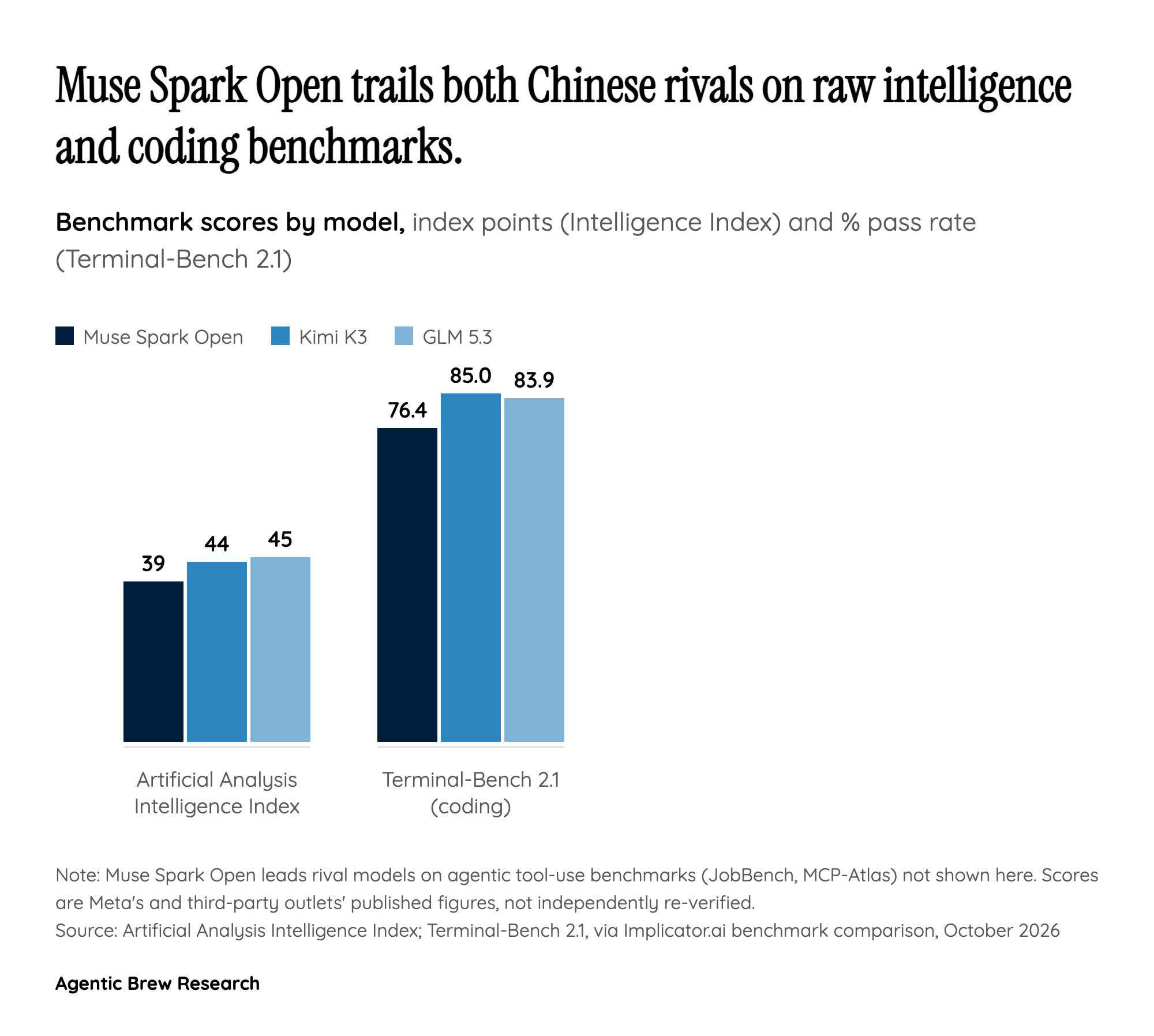
Muse Spark Open trails both Chinese rivals on raw intelligence and coding benchmarks, but leads on agentic tool-use tests.

Meta's own research team calls Muse Spark Open 'the most capable US open-weight model to date'[4], a claim that only holds within a US-only comparison set. On the Artificial Analysis Intelligence Index, Muse Spark Open scores 39, trailing Kimi K3 (44) and GLM 5.3 (45), and on Terminal-Bench 2.1 coding tasks it scores 76.4 against 85.0 for Kimi K3 and 83.9 for GLM 5.3[5]. The model does lead on benchmarks built around tool use and long-horizon planning, edging out rivals on JobBench and MCP-Atlas[5], which lines up with Meta's framing of the release around agentic work rather than raw coding ability. Even Meta's own chief AI officer underscored the gap, acknowledging plainly that these models are not the company's most capable releases[5].

An open license with closed-door clauses

The Muse Model License governing Muse Spark Open is not OSI-approved open source. It mandates 'Built with Muse Spark Open' attribution and requires any company with more than $20 million in aggregate gross revenue to sign a separate agreement before offering the model as a hosted API service[6]. It also bans use in critical infrastructure, transportation, heavy machinery, and military or nuclear applications - restrictions that repeat, almost word for word, category bans Meta first wrote into the Llama 3 community license[6]. Nathan Lambert of Interconnects called the terms 'an unnecessary strategic risk for labs trying to compete'[7], arguing that the commercial strings attached could blunt adoption even as the model narrows Meta's capability gap with Chinese open-weight rivals.

A US flag planted in an open-weight race China was winning

The release lands against a backdrop where Chinese labs had come to dominate open-weight usage: Chinese-origin models accounted for 41% of Hugging Face downloads in the year before launch, and open-weight models overall made up 60% of OpenRouter's US-originating token volume[2]. Nathan Lambert framed Muse Spark Open as cutting the American-Chinese open-weight gap roughly in half[7], while investor Haseeb Qureshi read the release as reviving competitive urgency for Meta, writing that reports of the company's death had been exaggerated and that it is 'a race again'[8]. Read this way, Muse Spark Open is less a decisive technical leap than a strategic bid to keep a US lab at the top of the open-weight leaderboard at a moment when the most capable open models were increasingly coming from elsewhere.

Historical Context

2024
Meta's Llama 3 community license already included carve-outs barring certain government and military uses; the Muse Model License repeats those category bans (critical infrastructure, nuclear, military) almost word for word.
2026-03
Chinese open-weight models (Qwen, DeepSeek, Kimi) accounted for 41% of Hugging Face downloads in the year preceding Muse Spark Open's release, surpassing US models and setting the competitive backdrop for Meta's launch.
2026-10-15
Muse Spark Open released alongside a simultaneous Apple partnership announcement for M5 Ultra Mac Studio local deployment via MLX.

Power Map

Key Players
Subject

Meta's Muse Spark Open Model and Apple Mac Studio Local Deployment

ME

Meta (Meta AI Research)

Developer and publisher of Muse Spark Open; set the license terms and published the benchmark claims the model is being judged against

AP

Apple

Partnered with Meta to optimize local deployment on M5 Ultra Mac Studio hardware via the MLX framework, positioning Mac Studio as viable large-model inference hardware

TO

Together AI, Fireworks AI, Baseten, Groq, Modal, Nebius, OpenRouter

Hosted API providers offering Muse Spark Open inference at launch pricing

MO

Moonshot AI (Kimi K3) / Z.ai (GLM 5.3)

Rival open-weight labs whose models beat Muse Spark Open on several benchmarks and whose license terms are directly compared against Meta's

NA

Nathan Lambert (Interconnects)

Independent AI analyst whose commentary on the release's competitive positioning and licensing risk has shaped how the launch is being read

Fact Check

9 cited
  1. [1] Meta Releases Muse Spark Open, an Over 800 Billion Parameter Model That Can Run Locally on Multiple M5 Ultra Mac Studios
  2. [2] Meta Unveils Muse Spark Open, the New Top U.S. Open-Weights Model, and It Runs on Two Paired Mac Desktops
  3. [3] Muse Spark Open: Two Mac Studios, Cost vs. Cloud
  4. [4] Muse Spark Open
  5. [5] Meta Releases Muse Spark Open, an 816B Model That Trails Chinese Rivals at Coding
  6. [6] Meta Muse Spark Open 816B Open-Weights License: Critical-Infrastructure Ban, $20M Hosting Clause vs. Kimi K3, GLM 5.3
  7. [7] Meta Shakes Up the Frontiers of Open
  8. [8] Muse Spark Open discussion thread
  9. [9] Muse Spark Open model page

Source Articles

Top 5

THE SIGNAL.

Analysts

“Argues Muse Spark Open narrows the gap between top American and Chinese open models at a good moment given real LLM agent adoption, but flags the custom license (mandatory branding, $20M revenue gate) as a genuine adoption barrier and strategic risk for labs building on it. Quote: "the gap between the best American and Chinese models has been reduced roughly by half... This is why we think it's an unnecessary strategic risk for labs trying to compete."”

Nathan Lambert
Author, Interconnects.ai (independent AI analyst)

“Downplayed the release relative to Meta's frontier work, acknowledging it is not the company's most capable model. Quote: "These aren't the most capable models that we've developed or released."”

Meta chief AI officer (unnamed, as quoted by implicator.ai)
Meta chief AI officer

“Characterized the release as reviving competitive urgency for Meta in the broader AI race. Quote: "reports of Meta's death had been exaggerated... a race again."”

Haseeb Qureshi
Investor
The Crowd

“1/ muse spark open is the most capable US open-weight model to date. 816B total params, 42B active. 1M-token context. natively multimodal. built for coding and agentic work like long-horizon tasks, hard software engineering, multi-step reasoning. america! 🇺🇲”

@@alexandr_wang5595

“Today we’re releasing Muse Spark Open, the most capable US open-weight model to date. Built for coding and agentic work, it excels at long-horizon tasks, complex software engineering, and multi-step reasoning. Key Model Specs: → 816B total / 42B active parameters → 1M token [...]”

@@AIatMeta11462

“llama serve -hf ggml-org/Muse-Spark-Open-816B-A42B-GGUF:Q2_K (on two mac studios). Well done @finkd & @johnternus!”

@@ClementDelangue313

“Introducing Muse Spark Open: the most capable US open-weight model to date”

@u/AIatMeta1300
Broadcast
【速報】Muse Spark Open登場。米国オープンウェイトモデル最強。KImi K3に複数ベンチで勝利

【速報】Muse Spark Open登場。米国オープンウェイトモデル最強。KImi K3に複数ベンチで勝利

Muse Spark Open is HERE: What REALLY Takes to Run It?

Muse Spark Open is HERE: What REALLY Takes to Run It?

Muse Spark Open: Meta's 816B-Parameter Open-Weight Model

Muse Spark Open: Meta's 816B-Parameter Open-Weight Model

Meta's Muse Spark Open Model and Apple Mac Studio Local Deployment — AI News | Agentic Brew