Wall Street AI agent orchestration hiring surge
TECH

Wall Street AI agent orchestration hiring surge

28+
Signals

Strategic Overview

  • 01.
    Job postings referencing 'agent orchestration' at major banks jumped 1,721% in 2026, from 108 references in 2025 to 1,967 this year, according to hiring-data firm Draup cited by CNBC.
  • 02.
    AI-related job postings at JPMorgan Chase, Citigroup and Capital One rose 49% in 2026 versus 2025, to 139,819 listings.
  • 03.
    Hiring is expanding beyond model-builders to 'forward-deployed engineers' embedded directly in trading desks, compliance units, HR and back-office operations, who decide which agents are needed, what each can access, and who signs off.
  • 04.
    Median base salaries for these roles range from $134,986 for data scientists up to $235,158 for chief data scientists, with agentic AI engineers at $176,999, and some banks offering signing bonuses exceeding $200,000.

Deep Analysis

Banks Are Hiring Translators Between Trading Desks and AI Agents, Not Just Model-Builders
Banks Are Hiring Translators Between Trading Desks and AI Agents, Not Just Model-Builders
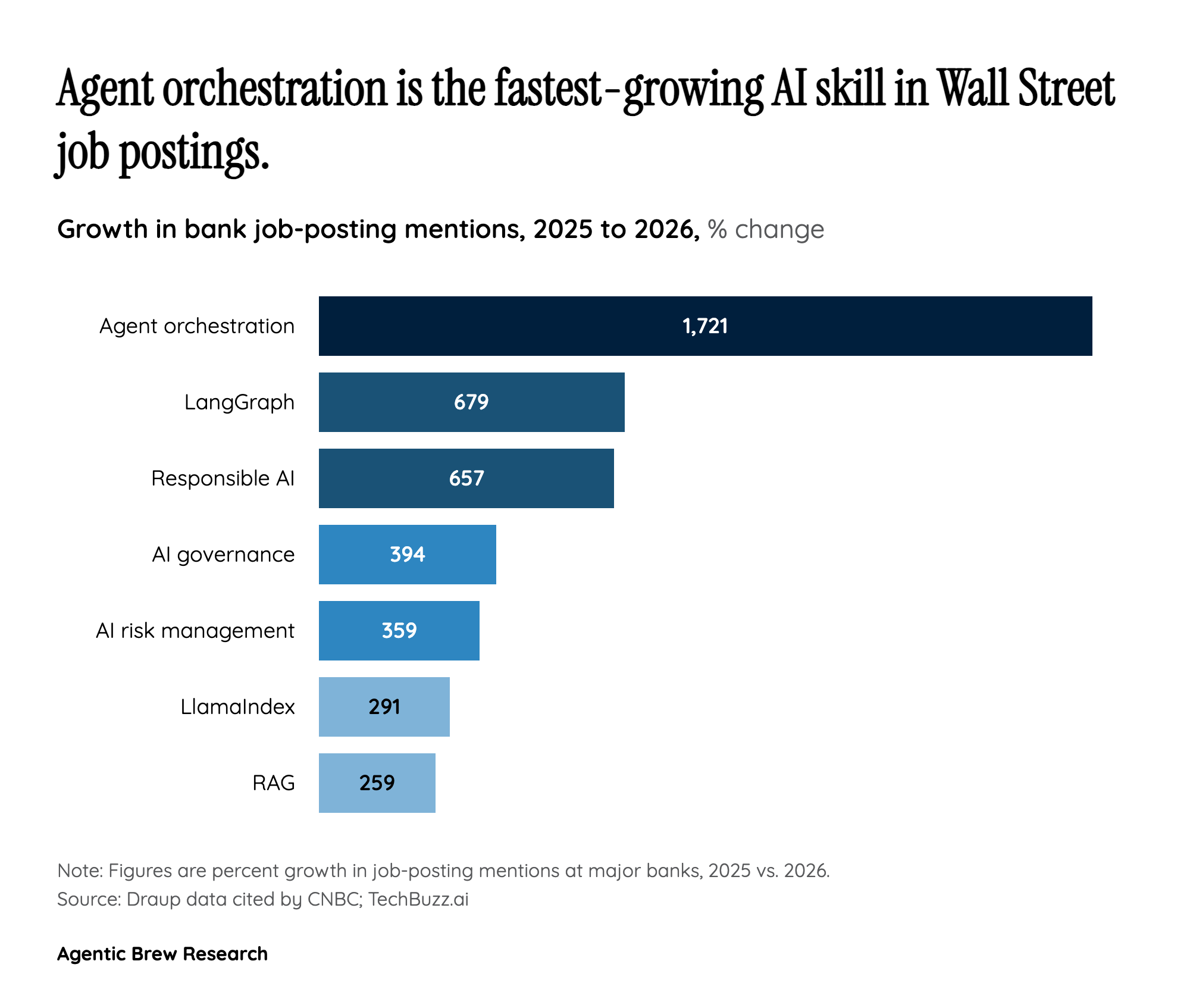
Agent orchestration mentions grew 1,721% in 2026, more than double the growth rate of any other related skill.

The headline number, a 1,721% jump in job postings mentioning 'agent orchestration,' from just 108 references in 2025 to 1,967 this year, is less about more AI than about a different kind of AI job [1]. The people being hired aren't primarily the researchers who build large language models. They're 'forward-deployed engineers' who sit inside trading desks, compliance units, HR and back-office operations, deciding which specialized agents a given workflow needs, what data and systems each agent can touch, and who in the organization signs off when the agent chain produces an output [1]. That description also circulated on X, including from industry-commentary account @awi_digest, but it traces back to the same CNBC reporting rather than offering independent confirmation from inside a trading floor. That's a fundamentally different job description than the machine-learning-engineer roles banks were posting two years ago.

The practitioner case for why this role exists at all echoed outside the hiring data too. Rogo's CEO, a former Lazard M&A banker now building AI agents for finance, has described how a $50 billion M&A deal can still be bottlenecked by a 22-year-old analyst and decades-old Excel tools working through the night, even though retail trading has long been automated; purpose-built agents, not generic chat tools, are what close that gap. That lines up with what candidates report from the inside: on a banking-focused Reddit forum, a candidate interviewing for a newly created 'AI Engineer VP' team at Goldman Sachs described an opaque, still-forming process, confirming that banks are standing up entirely new internal AI-engineering functions rather than just relabeling existing roles.

The tooling demand confirms the shift. Postings mentioning LangGraph, the framework for coordinating multi-step automated workflows, grew 679% in 2026, while references to retrieval-augmented generation rose 259% [2]. At the same time, mentions of 'responsible AI' climbed 657%, 'AI governance' 394%, and 'AI risk management' 359% [2]. Banks aren't just teaching engineers to wire agents together, they're teaching them to wire agents together safely, which is a much narrower and more expensive skill set than generic AI engineering.

The Salary Data Shows Banks Will Pay Almost as Much to Govern Agents as to Build Them

On compensation, the clearest signal is how close governance-adjacent roles sit to the model-building roles on the pay scale. Median base salaries (excluding bonus and equity) run from $134,986 for data scientists up to $235,158 for chief data scientists, with generative AI managers at $190,836 and agentic AI engineers at $176,999, a roughly 31% premium over a traditional data scientist [3]. Layered on top, some banks are offering signing bonuses exceeding $200,000 specifically to land experienced agent-orchestration specialists [4], a level of urgency usually reserved for scarce, business-critical hires rather than general-purpose technologists.

The clearest tell that this is a governance story as much as a capability story: postings for governance-related skills now outnumber postings for model-building skills by roughly 1.9 to 1 (more than 16,000 references versus about 8,400) [5]. That imbalance exists because regulators haven't caught up. SR 26-2, issued by the Federal Reserve, OCC and FDIC in April 2026, rescinded the prior model-risk framework and explicitly stated that generative and agentic AI models are 'novel and rapidly evolving' and fall outside its scope [5]. Banks are building their own internal accountability structures, deciding who signs off and who answers for an agent's mistake, entirely on their own initiative, well ahead of any regulatory mandate.

Scale AI's CEO Is Warning the Industry It's Hiring For: Ten Agents at 85% Accuracy Isn't 85% Accuracy

The uncomfortable fact sitting underneath the hiring boom is that chaining agents together doesn't just add capability, it compounds risk. Scale AI CEO Jason Droege put the math bluntly: 'If you have a 10-agent system and each is 85% accurate, that's 0.85 to the 10th power accuracy by the end' [6]. That's a dramatic falloff in reliability for workflows touching trading, compliance or risk management, which is precisely why the hiring surge is concentrated in orchestration and governance roles rather than in raw model-building. A separate developer-education explainer makes the same point from the architecture side: an orchestrator agent is supposed to only delegate work to specialized sub-agents, never do the work itself, and the moment it starts micromanaging those sub-agents the system breaks down, because the underlying models tend to over-trust their own judgment. That's effectively a software-design description of the exact governance problem banks are now hiring for. JPMorganChase's own head of AI research, Manuela Veloso, frames the practical response as going slow on purpose: 'Build an AI system that does the minimum, but build it such that it improves over time,' rather than over-scoping an agent network from day one [6].

That caution isn't limited to bank executives, and it isn't universally shared either. Among practitioners discussing the trend outside official channels, the skepticism runs deeper and more specific: one quant working in fixed income argued that large language models remain unreliable for real architectural decisions in trading systems and predicted an eventual blowup from AI-generated trading-code bugs. On the other side of the same debate, a separate, heavily discussed Reddit thread described a manager multiplying team output 10 to 50 times using coding agents and compared the moment to the start of a major disruption, a claim commenters immediately pushed back on as an unmeasurable 'vibes' metric rather than real data. That split, cautious bank experts and a contested productivity debate on one side, a confident hiring market on the other, sits in direct tension with the celebratory framing of the hiring data. Banks are racing to hire people who can make multi-agent systems safe precisely because, by their own experts' admission, nobody has fully solved the compounding-error problem yet, and the regulatory vacuum left by SR 26-2 means there's no external backstop forcing the issue.

AI Headcount Is the One Line Growing While the Rest of the Bank Shrinks

Zoom out to headcount trends and the orchestration hiring surge looks less like a side project and more like where banks are placing their bets. Evident Insights, tracking 50 major banks, found AI-related roles grew from roughly 60,000 to nearly 80,000 in about 18 months, a nearly 13% increase in just six months, even as total bank headcount fell 3% over the same period; the banks leading on AI adoption grew headcount 25% above the industry average since 2024 [7]. In an industry otherwise cutting jobs, AI and orchestration roles are counter-cyclical, which is part of why signing bonuses and six-figure base salaries are showing up for a skill set that barely existed as a distinct job category two years ago.

That growth isn't happening without internal friction. Inside the same banks hiring aggressively for orchestration talent, employees below VP-level rated agentic AI as 'not very valuable' at roughly twice the rate of executive leadership [6], a generational trust gap that mirrors the efficiency-versus-risk tension playing out at the top. The efficiency case is real: Capital One's agent-orchestration systems cut processing times by up to 80%, and Bank of Singapore's orchestrator agent took customer onboarding from 10 days to one hour, adopted by over 500 relationship managers [4][6]. But the same organizations banking those efficiency wins are the ones whose own AI research leaders are urging incremental builds and whose rank-and-file remain unconvinced, suggesting the hiring surge is as much about managing a nervous rollout as it is about chasing productivity gains.

Historical Context

2026-04-17
Regulators issued guidance SR 26-2, rescinding the prior SR 11-7 model-risk framework, and explicitly excluded generative AI and agentic AI models from its scope, leaving banks to self-govern agent risk ahead of formal rules.
2025-09
AI roles across 50 tracked major banks grew from roughly 60,000 to nearly 80,000 within about 18 months, a six-month increase of nearly 13%, even as overall bank headcount fell 3% in the same period.

Power Map

Key Players
Subject

Wall Street AI agent orchestration hiring surge

DR

Draup

Enterprise hiring-data firm whose exclusive analysis of job listings (provided to CNBC) is the sole source of the 1,721% agent-orchestration statistic and the related skill-growth figures driving the entire narrative.

JP

JPMorgan Chase

One of the three banks driving the 139,819 AI job listings in 2026; its Chief Analytics Officer and AI Research head have pushed agent-driven process redesign across the firm.

CA

Capital One

Built agent-orchestration systems that cut processing times by up to 80%, making it a proof point for the hiring case.

GO

Goldman Sachs

Its CIO has described the bank as 'rethinking every step' of its operations around agents, signaling orchestration hiring is tied to firm-wide process redesign, not a niche tooling choice.

EV

Evident Insights

Independent banking-AI research firm tracking 50 major banks' AI headcount, providing corroborating data that AI roles are growing even as overall bank headcount shrinks.

Fact Check

7 cited
  1. [1] AI Skills Most in Demand at JPMorgan Chase, Citigroup, Capital One
  2. [2] How AI Is Redefining Wall Street Jobs
  3. [3] Wall Street's Hottest AI Skill Surges 1,721% as Banks Race to Deploy AI Agents
  4. [4] Banks Rush to Hire Agent Orchestration AI Engineers as Demand Soars 1,721%
  5. [5] Bank AI Agents, Governance, and Hiring Model Risk
  6. [6] Agentic AI's Generation Gap
  7. [7] Banks Ramp Up AI Hiring as ROI, Efficiency Gains Mount

Source Articles

Top 5

THE SIGNAL.

Analysts

“Calls agent orchestration the hottest skill on Wall Street and frames the talent gap as a massive opportunity for people who understand both data and where to apply AI.”

Vijay Swaminathan
CEO, Draup

“Argues AI-related banking roles are uniquely insulated from the headcount contraction happening elsewhere in banks.”

Alexandra Mousavizadeh
Co-founder and co-CEO, Evident Insights

“Warns that multi-agent systems compound error rates, a core reason banks need skilled orchestration and governance engineers rather than simply more agents.”

Jason Droege
CEO, Scale AI

“Advocates an incremental build approach to agentic systems rather than over-scoping from the start.”

Manuela Veloso
Head of AI Research, JPMorganChase
The Crowd

“'The hottest skill on Wall Street': Demand for this AI ability jumped 1,721% as banks embrace agents”

@@CNBC26

“Wall Street AI job postings surged 49% this year as demand for agent skills soars: References to agent orchestration in bank job postings jumped 1,721% this year, according to hiring data firm Draup dlvr.it/TVlJQ3”

@@qz0

“CNBC/Draup: Wall Street job posts mentioning "agent orchestration" jumped 1,721% this year. Banks arent just hiring model builders anymore. They are putting forward-deployed engineers on trading desks, compliance, and back office people who wire agents into real workflows.”

@@awi_digest0

“White Collar Workers are in Big Trouble”

@u/simmol820
Broadcast
Building the Intelligence Layer for Wall Street (Rogo CEO)

Building the Intelligence Layer for Wall Street (Rogo CEO)

After This Video, You'll Actually Understand Agent Orchestration

After This Video, You'll Actually Understand Agent Orchestration

I Built a Trading Team of AI Agents Smarter Than Wall Street

I Built a Trading Team of AI Agents Smarter Than Wall Street

Wall Street AI agent orchestration hiring surge — AI News | Agentic Brew