Sovereign AI and national model stacks
TECH

Sovereign AI and national model stacks

21+
Signals

Strategic Overview

  • 01.
    Nations including the US, China, India, the UAE, Saudi Arabia, Japan and the EU are pouring billions into sovereign AI, aiming to control the full stack from chips to foundation models, though the consensus is quietly shifting from total sovereignty toward 'strategic autonomy.'
  • 02.
    Japan finalized a $6.3 billion (¥1 trillion) program for domestic foundation models and infrastructure as the cornerstone of a $65 billion semiconductor revitalization push, including a 1-trillion-parameter LLM led by SoftBank and Preferred Networks.
  • 03.
    The UK committed £1.1 billion at London Tech Week, including £750 million for a national AI supercomputer operational by 2030 and £400 million for advanced chips, with a goal to expand domestic AI compute twentyfold by 2030.
  • 04.
    China is assembling its own 'AI sovereignty stack' of domestic chips and clouds for inference and government systems, but output is expected to fall short of demand because US export controls limit access to advanced chipmaking tools.

The Sovereignty Paradox: You Can Move Your Dependence, Not Escape It

The central, counterintuitive finding of 2026 is that sovereign AI mostly doesn't make you sovereign. The CNAS Sovereign AI Index frames it bluntly: 'No country—not even the United States—can achieve full control over the complex and varied inputs that power frontier AI systems' [1]. The mechanism is layered dependence. A nation can build a national data center to escape reliance on US cloud platforms, but as CNAS puts it, that move 'does not eliminate dependence on American technology. It only shifts exposure from one layer of the U.S. tech stack to another' [1]. Buy your own GPUs and you depend on NVIDIA's silicon and CUDA; run open weights and you are likely running Meta's Llama, which appears in 36% of sovereign model projects [1]. The hard numbers behind the paradox are stark: the US and China together control roughly 90% of the compute needed to build frontier AI and own all 50 of the top-ranked foundation models, and around 70% of tracked sovereign projects involve a foreign partner — four-fifths of those involving a US company [1]. Germany's experience is the clearest tell: Cohere's acquisition of Aleph Alpha is read as the country retaining the operating layer while ceding the frontier model layer to a Canadian buyer [1]. This is why the vocabulary is quietly migrating from 'sovereignty' to 'strategic autonomy' — a tacit admission that the goal is to reduce, not erase, exposure.
By the Numbers: A $177 Billion Market, Geographically Lopsided

By the Numbers: A $177 Billion Market, Geographically Lopsided
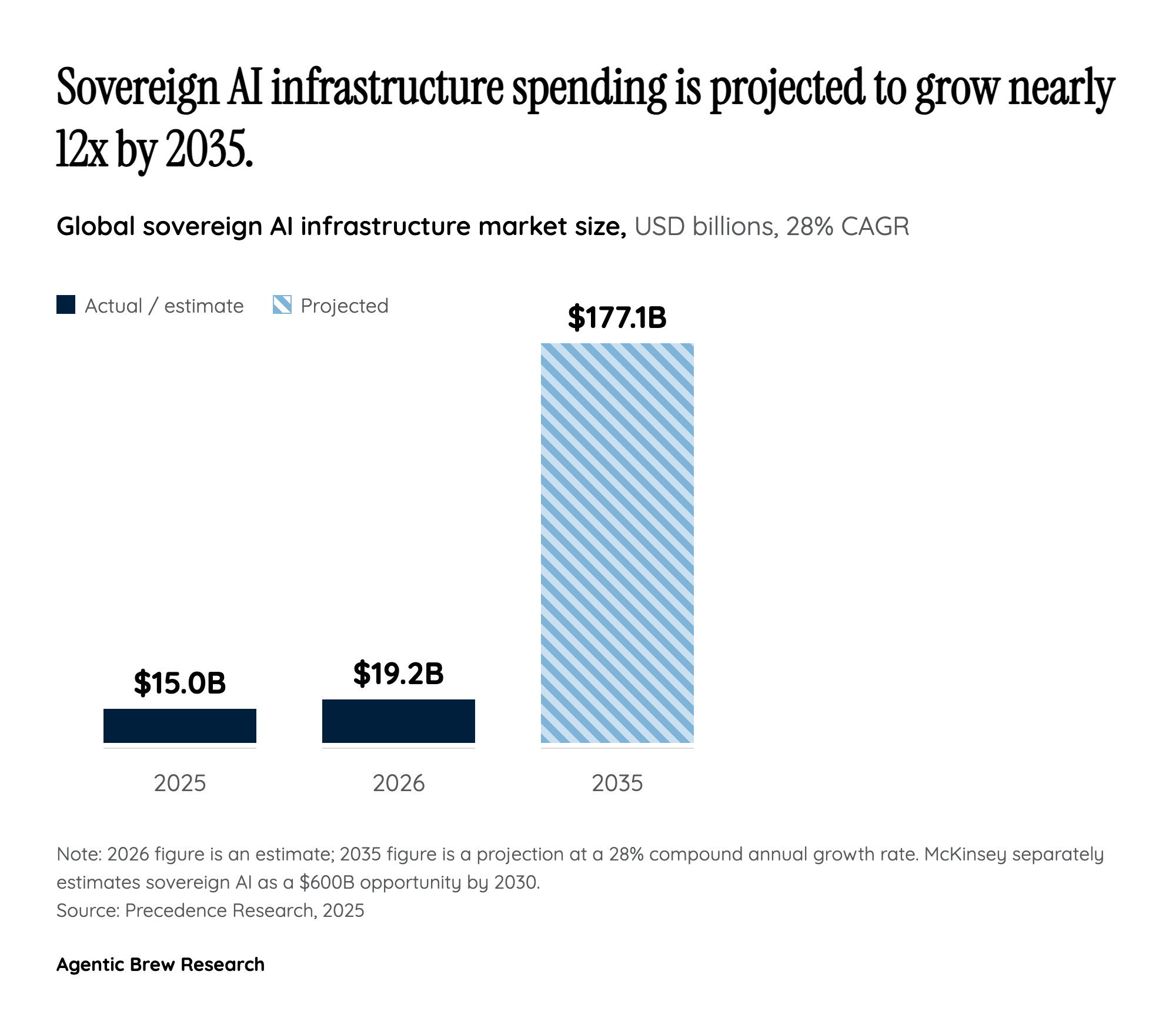
Sovereign AI infrastructure market growth (2025 baseline to 2035 projection) alongside the geographic concentration of disclosed investment, where the Middle East and East Asia exceed 80% of tracked global spending.

The capital behind sovereign AI is real and accelerating. The sovereign AI infrastructure market sat at $15.00 billion in 2025, reaches an estimated $19.20 billion in 2026, and is projected to hit $177.09 billion by 2035 at a 28% CAGR [4], while McKinsey has floated sovereign AI as a $600 billion opportunity by 2030 [4]. But the money is not evenly distributed. According to CNAS, the Middle East and East Asia together account for more than 80% of all tracked publicly disclosed sovereign AI investment, with the UAE and Japan alone making up over two-thirds [1]. National headline numbers underline the scale of the arms race: Japan's $6.3 billion model-and-infrastructure program sits inside a $65 billion semiconductor strategy, with a further ¥2 trillion (~$13 billion) for regional data centers [5], while the UK's £1.1 billion commitment funds a £750 million supercomputer and £400 million in chips toward a twentyfold compute expansion by 2030 [6]. Jensen Huang's framing — that this is 'the largest infrastructure build-out in human history' and still early [3]— is bullish, but it doubles as a sales pitch, which is the tension the next section unpacks.

Enabler or Grift? NVIDIA Sits at the Center of Every Deal

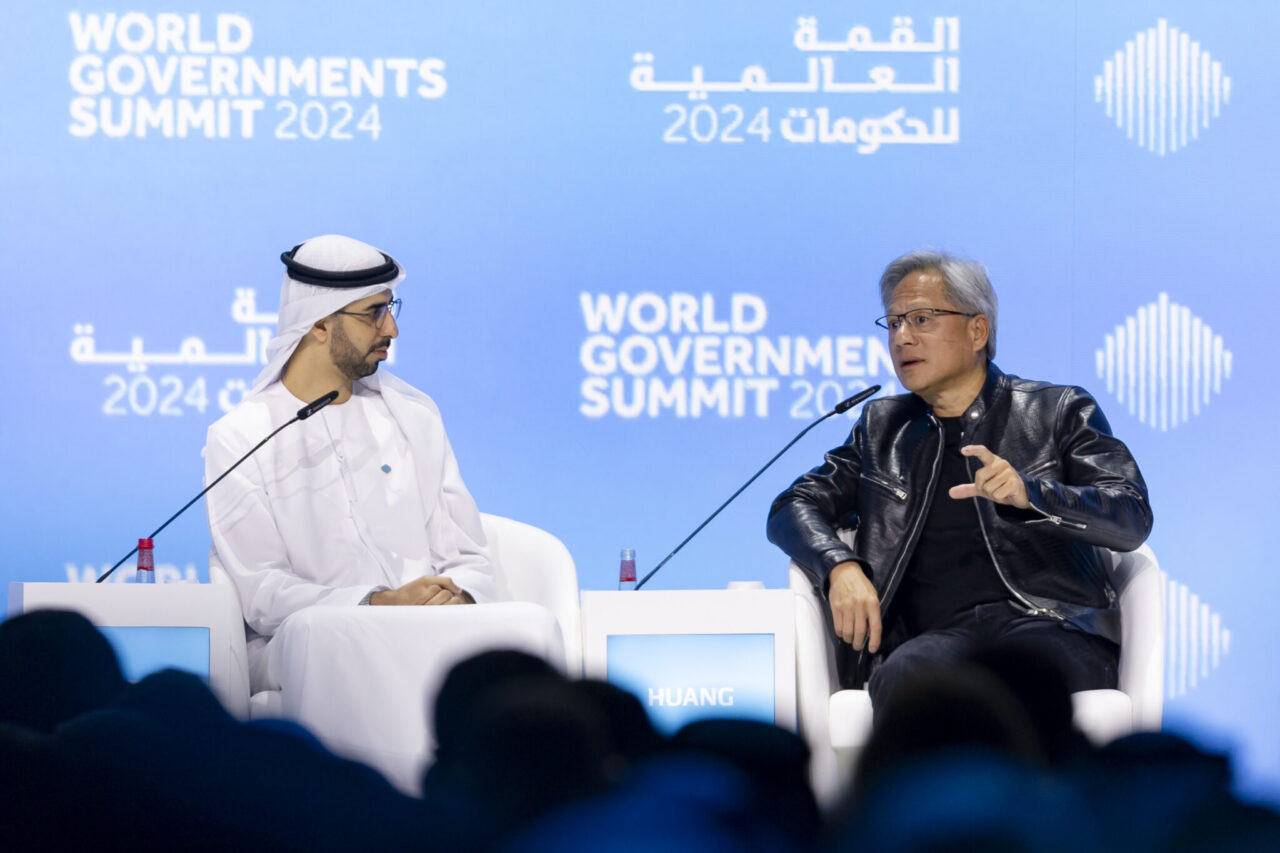
If one company embodies the paradox, it is NVIDIA. Its GPUs power 52% of all tracked sovereign AI infrastructure projects, and it is involved in essentially every sovereign deal [1], while marketing the concept directly to governments under the banner 'National Transformation With Sovereign AI.' Jensen Huang's pitch is emotional as well as technical: a national model, he argues, 'codifies your culture, your society's intelligence, your common sense, your history' [2]. That framing has been enormously effective — telcos across five continents, from Canada's TELUS to Indonesia's Indosat, are now building NVIDIA-powered national 'AI factories' [9]. But it has also drawn a sharp contrarian read. In developer and policy communities online, sentiment is genuinely split: many accept the geopolitical logic of wanting jurisdictional control over data, yet a vocal cohort dismisses the wave as 'an NVIDIA grift' — sovereignty marketing that mostly converts public budgets into GPU sales without delivering real independence. The skepticism is sharpest around mid-sized countries presumed to lack the engineering talent to do more than buy hardware. Both readings can be true at once: NVIDIA is simultaneously the indispensable enabler of national ambition and its largest financial beneficiary, which is precisely why the 'autonomy' it sells keeps routing back through its own stack.

The AI Fracture: When Where You Live Decides Which AI You Get

The second-order consequence of all this spending is a splintering of the AI map along jurisdictional lines. Analysts now describe an 'AI fracture' in which where users live increasingly determines what AI they can access, as national-security imperatives and economic competition split the landscape across jurisdictions [10]. The driver, surfaced repeatedly in online policy discussion, is trust and legal reach rather than cost alone — US legal warrants can reach US-owned cloud operators regardless of where the servers physically sit, which is why governments want operators under their own jurisdiction. Export controls are accelerating the split: US license applications for controlled chips to China face a presumption of denial, pushing Beijing to build a domestic sovereignty stack [7]and prompting allies such as Taiwan to weigh matching curbs on chip exports to China [8]. The result is a feedback loop. Controls harden borders, borders justify sovereign build-outs, build-outs deepen the fracture — and because nearly every build-out still rests on the US stack, the map fragments politically while remaining technologically concentrated in the very hands nations are trying to route around.

Historical Context

2025-12-01
The sovereign AI infrastructure market is measured at $15.00 billion in 2025, establishing the baseline before the 2026 surge.
2026-01-13
Japan finalizes its $6.3 billion sovereign AI initiative inside a $65 billion semiconductor revitalization push.
2026-02-19
India celebrates the roll-out of the Sarvam and BharatGen models at the India AI Impact Summit as a step toward full-stack AI self-reliance.
2026-04-01
Cohere's acquisition of Aleph Alpha is read as Germany keeping the operating layer while ceding the frontier model layer to a Canadian partner.
2026-06-09
Taiwan weighs tighter AI chip export controls targeting China to align with US restrictions and curb smuggling.

Power Map

Key Players
Subject

Sovereign AI and national model stacks

NV

NVIDIA

Dominant infrastructure supplier and the connective tissue of the trend: its GPUs power 52% of tracked sovereign AI projects, it is involved in essentially every sovereign deal, and it actively markets 'National Transformation With Sovereign AI.'

JA

Japan (GENIAC / SoftBank / Preferred Networks / Rapidus)

National sponsor building domestic foundation models, a 1-trillion-parameter LLM, and 2nm foundry capacity via Rapidus to decouple from foreign tech reliance.

UK

UK Government (DSIT, Technology Secretary Liz Kendall)

Funder committing £1.1 billion for compute, chips and skills to expand sovereign AI capacity twentyfold by 2030.

SA

SAP

European enterprise vendor building a sovereign AI stack and planning to invest more than $20 billion in EU sovereign cloud and AI solutions.

UA

UAE and East Asia

The largest sovereign AI investors: the UAE and Japan alone account for over two-thirds of disclosed investment, and the Middle East plus East Asia together exceed 80% of all tracked global spending.

TE

Telcos (TELUS, Indosat Ooredoo Hutchison)

Carriers building NVIDIA-powered national AI factories; TELUS is the first North American provider in NVIDIA's Cloud Partner program, and Indosat built Indonesia's first sovereign AI factory with a Bahasa LLM.

Fact Check

10 cited
  1. [1] The Sovereign AI Index
  2. [2] Every Country Needs Sovereign AI, NVIDIA CEO Says
  3. [3] Jensen Huang on the AI bubble and the largest infrastructure buildout in history
  4. [4] Sovereign AI Infrastructure Market Size and Forecast
  5. [5] Japan's $6 Billion Sovereign AI Gambit: A High-Stakes Race for Technological Autonomy
  6. [6] Government commits more than one billion to sovereign AI
  7. [7] China Builds AI Sovereignty Stack Amid US Export Controls
  8. [8] Taiwan Mulls Curbs on AI Chip Exports to China to Align With US
  9. [9] Telcos Across Five Continents Are Building NVIDIA-Powered Sovereign AI Infrastructure
  10. [10] The AI Fracture: Four Jurisdictions Splitting the Map of AI Geography

Source Articles

Top 1

THE SIGNAL.

Analysts

"Every country needs to own the production of its own intelligence, because a national model encodes a nation's culture, history and data."

Jensen Huang
CEO, NVIDIA

"Control of AI hardware equals control of future economic and hard power; whoever owns the hardware holds the keys to the future."

Liz Kendall
UK Technology Secretary

"Full sovereignty is unattainable outside China in the near term; national projects only shift dependence between layers of the US technology stack rather than escaping it."

Pablo Chavez, Vivek Chilukuri, Ruby Scanlon
Authors, CNAS Sovereign AI Index (April 2026)

"Today's AI spending is the largest infrastructure build-out in human history and remains only in its early stages."

Jensen Huang
CEO, NVIDIA
The Crowd

"U.K. PM Starmer and NVIDIA CEO Jensen Huang opened London Tech Week to announce new efforts to scale sovereign AI — including a national AI skills initiative, a new research center, and the U.K.'s fastest AI supercomputer. The U.K. will invest £1B in AI research compute by 2030."

@@nvidianewsroom218

"Roll-out sovereign AI models by Sarvam and BharatGen at the #IndiaAIImpactSummit2026 is a defining moment in India's journey towards achieving self-reliance in full-stack AI infrastructure. Kudos to @SarvamAI and @BharatGen_Com for the trailblazing innovations. India's AI is"

@@dpradhanbjp191

"NEW: "Sovereign AI" is ubiquitous in today's policy debate, but what does it actually look like in practice? To answer that, we've just launched the CNAS Sovereign AI Index, which tracks 130+ sovereign AI projects across 50 countries."

@@vivekchil70

"Bernie finally figured it out! Proposing an AI sovereign wealth fund"

@u/GuidedVessel271
Broadcast
Sovereign AI Stacks: The New Strategic National Resource

Sovereign AI Stacks: The New Strategic National Resource

Sovereign Cloud-Sovereign AI Conundrum

Sovereign Cloud-Sovereign AI Conundrum

Building the Future of Voice-First Sovereign AI: Sarvam & NVIDIA

Building the Future of Voice-First Sovereign AI: Sarvam & NVIDIA