Kunlunxin's $50B Hong Kong IPO and its pay-to-play chip mandate
TECH

Kunlunxin's $50B Hong Kong IPO and its pay-to-play chip mandate

23+
Signals

Strategic Overview

  • 01.
    Baidu's AI chip unit Kunlunxin Technology is planning a Hong Kong IPO at a target valuation of $50 billion, per a June 28, 2026 report by The Information.
  • 02.
    Kunlunxin asked prospective IPO investors to also commit to buying its semiconductors, at a value three to seven times the worth of their planned IPO subscription.
  • 03.
    Baidu confidentially filed Kunlunxin's listing application with the Hong Kong Stock Exchange in January 2026, and the unit is also pursuing a dual listing on Shanghai's STAR Market.
  • 04.
    Kunlunxin already supplies Tencent and is reportedly in talks with ByteDance, demand the company cites as validation for its silicon ahead of the listing.

Deep Analysis

The pay-to-play chip mandate

The defining feature of the Kunlunxin IPO is not the headline valuation but the condition attached to it. Prospective investors were asked to commit to buying Kunlunxin semiconductors worth three to seven times the value of their planned IPO subscription [1]. In practice this collapses two separate questions into one: "will you fund us?" and "is there a market for our chips?" are now answered by the same people. Analyst Gennaro Cuofano of FourWeekMBA frames the move bluntly, arguing that when the people asked for capital are the same people asked to buy the product, the company has stopped raising money and started manufacturing demand [3]. The structure builds an order book that supports the elevated valuation, but it does so by converting institutional shareholders into captive customers rather than by winning competitive sales.

By The Numbers

By The Numbers
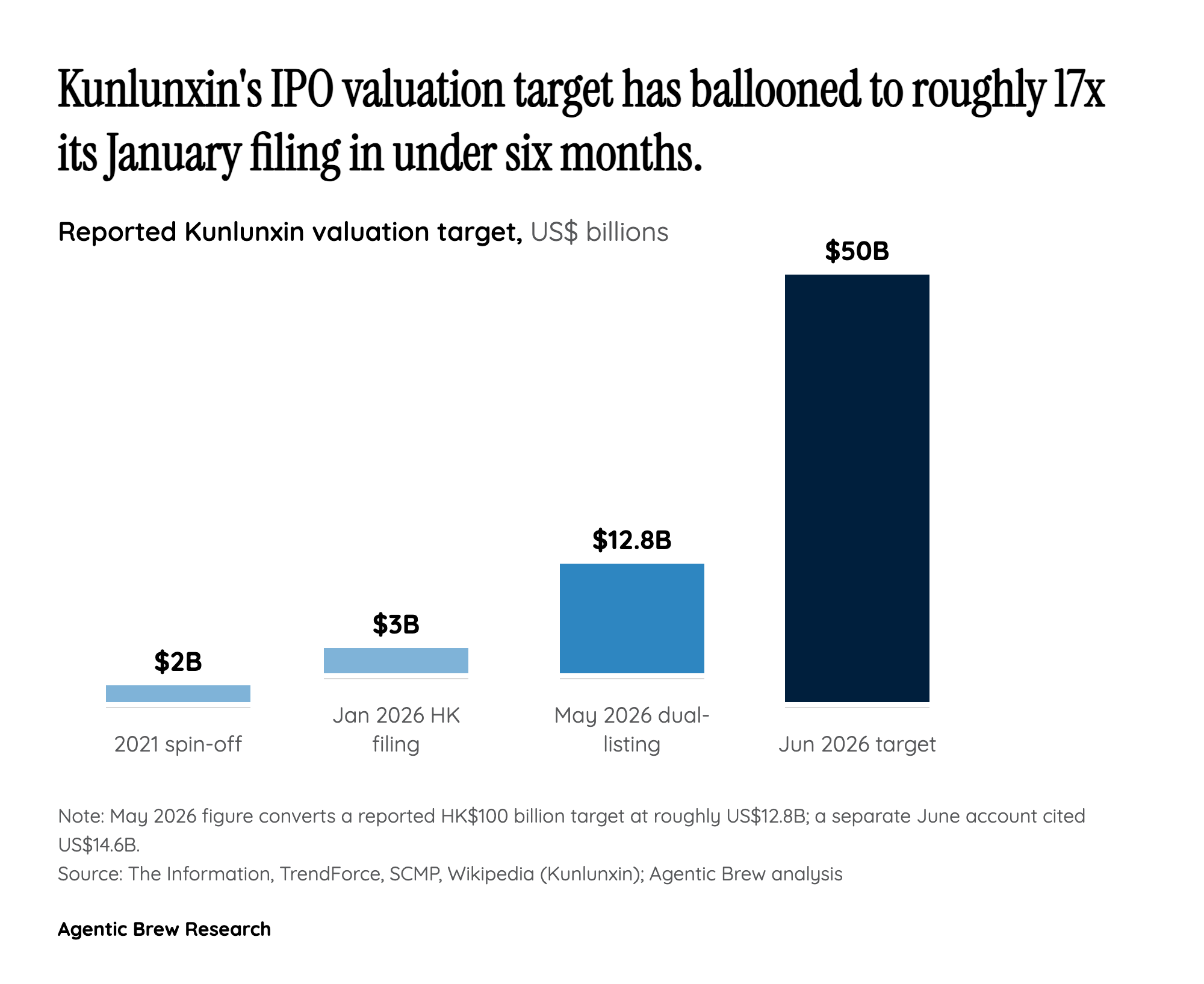
Kunlunxin valuation target by milestone, US$ billions: $2B (2021) to $50B (June 2026).

The valuation trajectory is the clearest signal of how aggressive this listing is. Kunlunxin was spun out of Baidu in 2021 at roughly US$2 billion [5]. By the January 2026 confidential Hong Kong filing it was reported near US$3 billion [5]. In May 2026 reports pointed to an HK$100 billion target, roughly US$12.8 billion [6], while a separate account put the figure near US$14.6 billion [7]. The June 2026 target of $50 billion [2]represents an escalation of roughly 17x over the January filing in under six months. The chip-purchase mandate of three to seven times each investor's subscription [1]sits underneath that number, meaning a meaningful share of the demand backing the valuation is contractually manufactured rather than organically won.

Circular financing and regulatory exposure

The tie between equity allocation and chip orders has drawn comparisons to circular-financing arrangements that the Bank for International Settlements warned about during the AI investment boom [3]. Coverage of the structure notes that it has triggered debate among financial analysts and regulatory specialists, raising related-party-transaction and disclosure concerns [4]. The same reporting situates the technique within capital-compression pressures facing Chinese chip startups, where U.S. export controls on advanced foreign processors push domestic buyers toward home-grown silicon and give chipmakers leverage to demand purchase commitments [4]. The open question is whether Hong Kong and Shanghai listing rules treat the bundled chip orders as ordinary commercial demand or as a related-party financing arrangement that requires fuller disclosure.

The software-stack skeptic view

Beneath the financing debate sits a harder engineering question that the valuation narrative tends to skip. Across community discussion, the recurring contrarian point is that the real barrier for Chinese AI accelerators is not raw silicon specifications but software-stack fragmentation: the absence of mature drivers, quantization backends, and CUDA-like tooling outside China. On paper Kunlunxin is competitive, with its third-generation P800 rated at 345 FP16 TFLOPS against the Kunlun II's 128 FP16 TFLOPS, and Baidu has run a 30,000-chip P800 cluster [5]. But strong throughput numbers do not by themselves close the ecosystem gap, which is why investor demand engineered through purchase mandates is a weaker proof point than demand won from buyers free to choose any vendor.

Historical Context

2011
Baidu began developing its own AI chips via an FPGA-based AI accelerator project.
2018-07
Baidu unveiled the Kunlun AI chip publicly, described as 30 times faster than its original FPGA-based processor.
2021-04
The chip project was spun out as a separate entity called Kunlunxin, valued around US$2 billion at spin-off.
2021-08
Kunlunxin unveiled the Kunlun II AI chip, described as comparable to the Nvidia A100.
2025-04
Baidu powered on a 30,000-chip cluster running its third-generation P800 Kunlun chips.
2026-01-02
Kunlunxin confidentially filed for a Hong Kong IPO, reported at a valuation near US$3 billion at that time.
2026-05-08
Reports emerged of a dual Shanghai STAR Market and Hong Kong listing with an HK$100 billion (roughly US$12.8B) valuation target.

Power Map

Key Players
Subject

Kunlunxin's $50B Hong Kong IPO and its pay-to-play chip mandate

KU

Kunlunxin Technology

Baidu's AI chip unit and IPO issuer; pursuing the $50B Hong Kong listing while tying chip-purchase commitments to share allocation, effectively converting investors into customers.

BA

Baidu (BIDU)

Majority owner spinning off Kunlunxin; benefits from unlocking the valuation of its chip arm and demonstrating third-party demand for its silicon.

TE

Tencent

Existing Kunlunxin chip customer, cited as validation of external demand for Kunlun chips.

BY

ByteDance

TikTok parent reportedly in talks and considering using Kunlunxin chips ahead of the IPO.

PR

Prospective IPO investors and fund managers

Asked to double as customers by committing to chip orders three to seven times their subscription, blurring the shareholder and customer line.

Fact Check

7 cited
  1. [1] Baidu's AI Chip Unit Kunlunxin Targets $50 Billion Hong Kong IPO
  2. [2] Baidu's chip unit wants IPO investors to buy its chips too
  3. [3] Baidu's Kunlunxin IPO: When Investors Become Customers
  4. [4] Baidu Kunlunxin $50 Billion IPO Strategy Ties Share Allocation to Semiconductor Orders
  5. [5] Kunlunxin
  6. [6] Baidu Chip Unit Kunlunxin Reportedly Launches STAR Market IPO Process
  7. [7] Baidu chip unit Kunlunxin eyes US$14.6b valuation in Hong Kong IPO

Source Articles

Top 3

THE SIGNAL.

Analysts

"Argues that requiring investors to also be customers manufactures demand rather than proving it, blurring the customer and shareholder line."

Gennaro Cuofano
Author and analyst, FourWeekMBA

"Frames the IPO as the public test of where the captive-market line is drawn."

Gennaro Cuofano
Author and analyst, FourWeekMBA
The Crowd

"KUNLUNXIN, BAIDU'S AI CHIP UNIT, TARGETS $50 BILLION HONG KONG IPO - THE INFORMATION KUNLUNXIN IPO SUBSCRIBERS OBLIGATED TO PLEDGE CHIP ACQUISITIONS WORTH 3-7X THEIR INVESTMENT - THE INFORMATION"

@@FirstSquawk37

"Kunlunxin's target valuation of $50 billion is almost 40% higher than the $36 billion market value commanded by Baidu, which currently owns 58% of Kunlunxin and is traded both on the Nasdaq Stock Exchange and in Hong Kong."

@@pstAsiatech16

"$BIDU semiconductor unit Kunlunxin is reportedly targeting a $50 billion IPO valuation while testing a highly unconventional fundraising tactic. The company has asked prospective investors to commit to purchasing its AI chips as a condition of their investment."

@@oesnadaki0

"7 Chinese companies are already shipping H100/H200-class AI chips, most IPO'd in the last 6 months. I mapped all of them."

@u/awfulalexey966
Broadcast
Baidu's AI Chip IPO: $13.5B Valuation? | BIDU Stock Deep Dive & Price Prediction

Baidu's AI Chip IPO: $13.5B Valuation? | BIDU Stock Deep Dive & Price Prediction

Baidu Inc (BIDU) Stock Analysis: Major Price Surge and AI Chip Spinoff News

Baidu Inc (BIDU) Stock Analysis: Major Price Surge and AI Chip Spinoff News

Baidu's(BIDU) AI Chip Bombshell: Kunlunxin IPO Could Change EVERYTHING

Baidu's(BIDU) AI Chip Bombshell: Kunlunxin IPO Could Change EVERYTHING