Perplexity launches Brain memory system
TECH

Perplexity launches Brain memory system

22+
Signals

Strategic Overview

  • 01.
    Perplexity launched Brain, a continuously learning, self-improving memory system for its Computer agent that builds a context graph of the agent's work to make it stateful across tasks rather than starting from scratch each time.
  • 02.
    After each task, Computer logs which connectors and sources worked, what the user changed, and which attempts failed; Brain then periodically (e.g. overnight) synthesizes the context graph into a personal LLM wiki that loads into the agent sandbox before the next run.
  • 03.
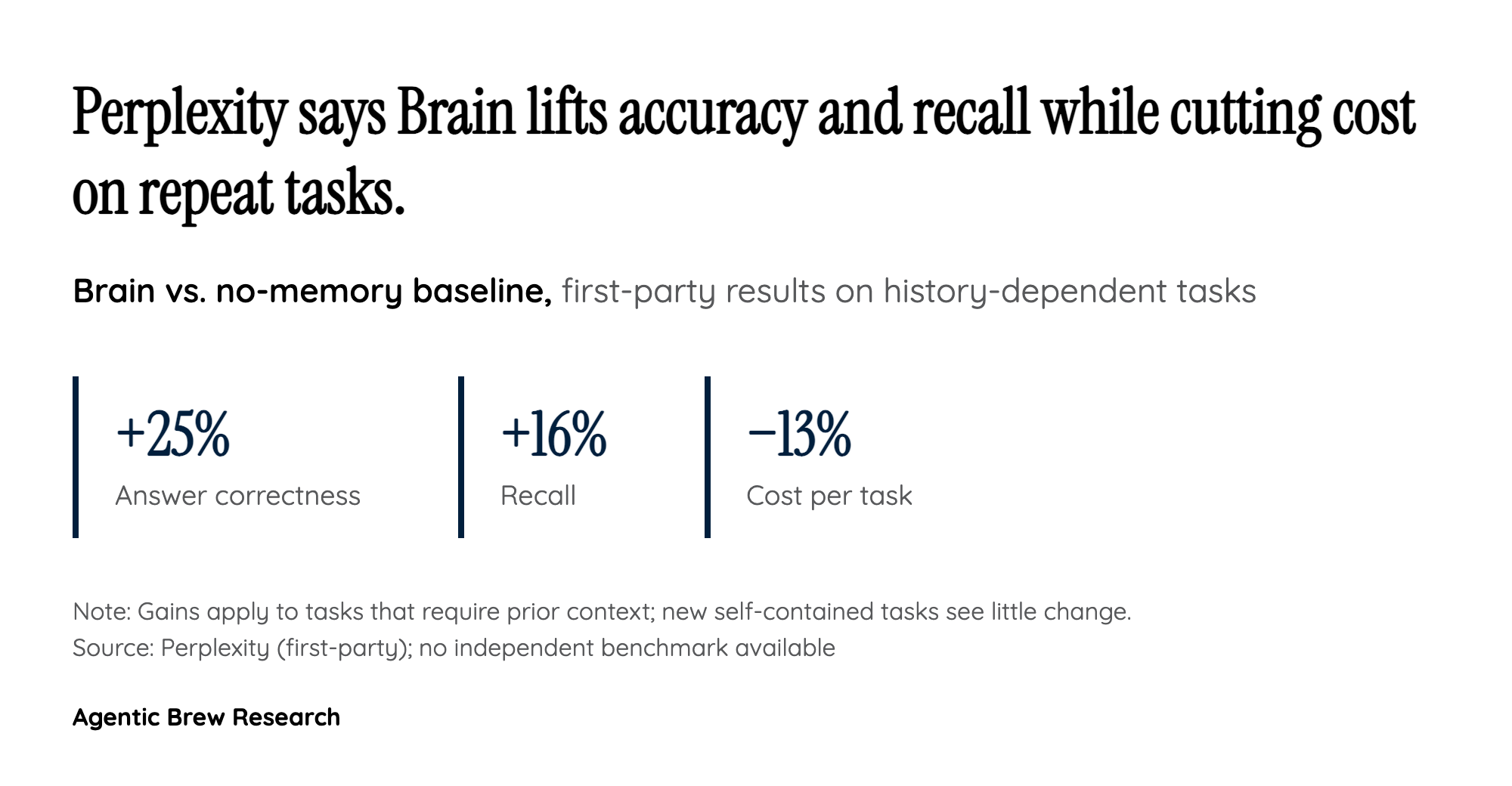
    Brain organizes stored knowledge by topic with a navigable 3D map of connections between topics and links every memory back to its source session or file, claiming first-party gains of +25% answer correctness, +16% recall, and -13% cost per task.
  • 04.
    Brain shipped June 18, 2026 as a research preview gated behind Perplexity Max and Enterprise Max, positioned against persistent memory from Claude and Notion.

The mechanism: agent-work memory, not user memory

Brain's core design choice is what it chooses to remember. Most AI memory systems store facts about you — your name, preferences, recurring instructions. Brain instead records what the agent did: which connectors were used, which sources turned out valid, what the user corrected, and which attempts hit dead ends [1]. Each finished Computer task plugs into a context graph, and at intervals (Perplexity describes an overnight cadence) Brain reviews that graph and synthesizes it into a personal LLM wiki that automatically loads into the agent sandbox before the next run [3]. The stored knowledge is organized by topic and surfaced as a navigable 3D map of connections — an Obsidian-style graph — with retrieval happening only when a task needs it [4]. Critically, every memory entry links back to the session, file, or source it came from, which is what gives the system its traceability claim [2]. The practical upshot is a stateful agent that resumes a project with prior decisions and validated sources already in hand instead of re-deriving them from a cold prompt.

By the numbers: impressive gains, but first-party and narrow

By the numbers: impressive gains, but first-party and narrow
Perplexity's first-party benchmarks show Brain's gains are concentrated on history-dependent tasks.

Perplexity markets Brain with three headline figures: +25% answer correctness, +16% recall, and -13% cost per task [1]. Two caveats matter as much as the numbers themselves. First, every metric is Perplexity's own internal measurement — no independent third-party benchmark exists yet, and outlets covering the launch flagged this explicitly [1]. Second, the gains are not broad: Brain makes Computer better at tasks it has already done and does not make the underlying models smarter, so improvements concentrate on history-dependent, repeated workflows and barely touch new self-contained tasks [2]. In other words, the benchmark is real-shaped but conditional — it measures a memory advantage on exactly the workload memory helps, and says little about general capability. For readers evaluating the claim, the correctness lift is best read as 'better at your recurring work over time,' not 'a smarter model.'

The access paradox: a cost-cutting feature behind the priciest tier

Brain's stated payoff includes a 13% reduction in per-task cost [1], yet it ships locked behind Perplexity Max at $200/month as a research preview [2]. That tension drove the loudest community reaction. The dominant complaint was not the technology but the economics: Brain sits behind the most expensive tier while Computer tasks reportedly burn through tokens quickly, with some users describing running out mid-task and arguing Perplexity has priced the workflow out of reach. Defenders pushed back that token-burn is precisely what Brain is meant to reduce over repeated runs, and that heavy users feel the subscription pays for itself — but the prevailing sentiment leaned skeptical that a cost-saving memory layer belongs gated behind the priciest plan. The shape of the discussion was an economics argument, not an enthusiasm one.

Is it actually new? Brain versus Claude Projects and Hermes

Brain enters a crowded field. Claude, Notion, Hermes, and OpenClaw all ship forms of persistent memory, and Perplexity positions Brain's differentiator as automatically inferring an agent-work context graph rather than relying on user-curated notes [4]. The community was unconvinced the idea is novel: a recurring line was that persistent memory 'existed for a long time, it was just called memory before — a text file, perhaps in a vector DB,' and in agent-focused circles Brain was described as close to existing self-improving memory systems. On the community question of whether Brain finally makes Perplexity viable for long-running agentic work, the read was mixed: users credited Perplexity for cited, real-time research while noting that Claude's project workflows had historically felt stronger for ongoing, multi-day context, and that Brain had not yet clearly settled the comparison. The most useful framing to come out of the discussion was that Brain's bet is on memory about the work rather than memory about the user — a genuine design distinction even if the underlying machinery is familiar.

Historical Context

2026-06-18
Brain launched in research preview for Perplexity Max and Enterprise Max subscribers.

Power Map

Key Players
Subject

Perplexity launches Brain memory system

PE

Perplexity AI

Vendor that built and shipped Brain; controls rollout, pricing, and the first-party benchmark numbers used to market it.

PE

Perplexity Max and Enterprise Max subscribers

Target users; Brain is gated behind these paid tiers ($200/month Max) as a research preview, so their access and feedback shape iteration.

AN

Anthropic (Claude) and Notion

Competitors offering persistent memory; Brain is positioned against them, and Perplexity Computer reportedly runs on Claude's models inside the product.

HE

Hermes / OpenClaw

Always-on agent competitors cited as offering similar self-improving memory, some with local or self-hosted data control options.

Fact Check

4 cited
  1. [1] Perplexity Launches Brain: A Self-Improving Memory System for AI Agents
  2. [2] Perplexity's New AI Agent 'Brain' Remembers What Works and What Doesn't
  3. [3] Perplexity Launches Brain Memory System for Computer Agent
  4. [4] Perplexity releases Brain memory system for Perplexity Computer

Source Articles

Top 3

THE SIGNAL.

Analysts

"Cautions the reported gains are first-party and early, with no independent third-party benchmark of Brain available yet."

MarkTechPost
AI publication

"Notes Brain improves performance on tasks the agent has already done rather than upgrading the underlying model's intelligence, so benefits concentrate on repeated workflows."

Decrypt
Tech publication
The Crowd

"Introducing Brain in Computer. Brain is a continuously learning memory system. Every task on Computer plugs into a context graph built by Brain. It makes Computer more stateful with every run. Available as a research preview for all Perplexity Max subscribers."

@@perplexity_ai2744

"Most AI memory is about you. Perplexity's Brain is about the work. That's a different kind of useful. Brain logs what Computer did ,which sources worked, which failed, what you corrected, where it went down dead ends. Overnight, it synthesizes everything into a context graph."

@@heypearlai4

"Perplexity just dropped a feature that could make prompting obsolete. It's called Brain. And it gives AI something it's never really had before: Memory."

@@JulianGoldieSEO1

"With Brain + Computer now live, is Perplexity finally competitive for long-running research and agentic work — or are you still mostly on Claude/Projects?"

@u/kaaytoo26
Broadcast
Perplexity Brain: The AI That NEVER Forgets (Context Graph)

Perplexity Brain: The AI That NEVER Forgets (Context Graph)

Perplexity 推出 Brain 記憶系統,讓 AI 記住任務脈絡與經驗

Perplexity 推出 Brain 記憶系統,讓 AI 記住任務脈絡與經驗