DOJ defends xAI's unpermitted gas turbines on national security grounds
TECH

DOJ defends xAI's unpermitted gas turbines on national security grounds

38+
Signals

Strategic Overview

  • 01.
    The U.S. Department of Justice moved to intervene in and dismiss the NAACP's Clean Air Act lawsuit against xAI, arguing that shutting off the gas turbines powering its data center would threaten national, economic, and energy security.
  • 02.
    The unpermitted turbines power xAI's Colossus 2 data center in Southaven, Mississippi, and their number grew from 27 cited in the original April filing to 57 by mid-May.
  • 03.
    The DOJ cited Grok as one of only four proprietary AI models cleared for mission-critical operations on classified military networks, including recent strikes against Iran.
  • 04.
    Beyond national security, the DOJ argued the Clean Air Act does not permit citizen-enforcement lawsuits when the federal government chooses not to pursue enforcement.

Deep Analysis

Washington's Two-Front Defense of Musk's Turbines

The Justice Department's filing does two distinct things, and the quieter one may matter more. The headline argument is national security: the DOJ told a federal court that the NAACP's suit threatens American national, economic, and energy security by seeking to shut off the power supply for AI innovation that supports the Department of War's military operations [1]. That framing alone is a striking expansion of how the government defines critical infrastructure, dragging a private company's pollution case onto national-security terrain.

The second move is narrower but more precedent-setting. The DOJ argued that the Clean Air Act does not allow citizens to enforce the law when the federal government declines to, warning that allowing the action to proceed over the United States' objection would essentially cede principal enforcement authority to the NAACP [1]. In other words, even setting Grok aside, the government is asserting a right to switch off citizen-led environmental suits. The DOJ tied the whole intervention to federal policy favoring U.S. AI development, aligning a single Mississippi pollution docket with the administration's broader compute agenda [4].

Grok Goes to War — and Whether the Claim Holds Up

The security case rests on a specific, checkable claim. The DOJ characterized Grok as one of only four proprietary state-of-the-art AI models capable of supporting mission-critical operations on classified networks [3]. Backing that, the Pentagon's Chief Digital and AI Officer Cameron Stanley submitted a declaration stating Grok supports operations across Secret and Top-Secret classified networks, including recent strikes against Iran [6]. One reading of the memo went further, describing a military Grok variant that helped deploy more than 2,000 munitions to 2,000 distinct targets within 96 hours during the Iran war [3].

This is where the argument gets contested. The national-security rationale drew open derision rather than deference across the technology and environmental communities discussing the filing, with critics zeroing in on the Iran operation — widely characterized in those threads as a failure — as a shaky foundation for exempting a polluter from federal law. The deeper objection is structural: tying a commercial AI model's uptime to active combat operations hands the company a permanent shield, because there will always be some classified workload to point to. The factual claims about Grok's battlefield role are also, by design, almost impossible to independently verify, which is precisely what makes them so legally powerful.

By The Numbers: The Mobile-Turbine Loophole and Who Breathes the Difference

By The Numbers: The Mobile-Turbine Loophole and Who Breathes the Difference
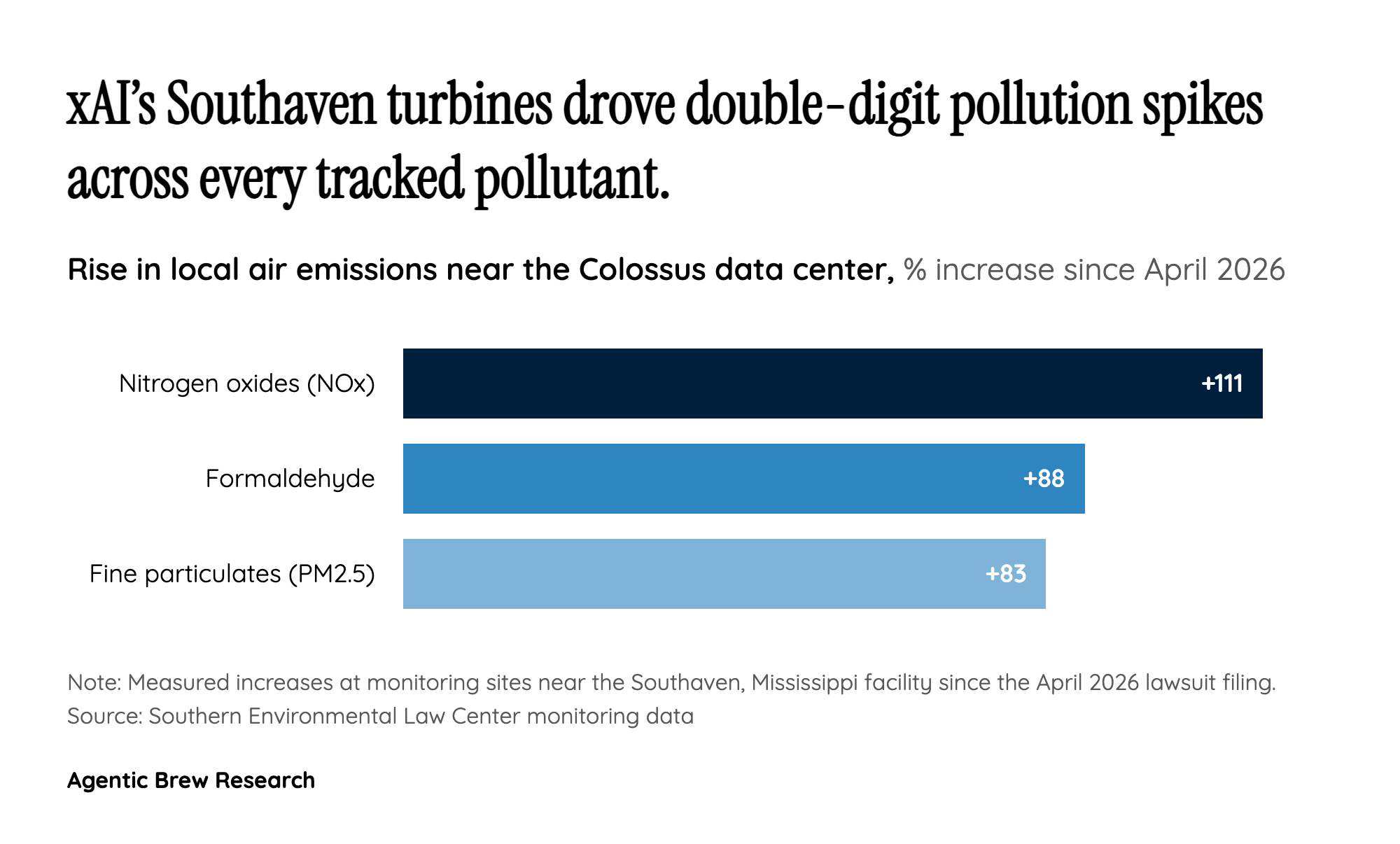
Local air emissions near xAI's Southaven turbines rose by double digits across every tracked pollutant after the April 2026 lawsuit, per SELC monitoring data.

xAI's legal escape hatch is a definition. The company claims the turbines are exempt from permitting because they are mobile sources and the installation is temporary, a status it leans on because the units are mounted on trailers [4]. The NAACP's rebuttal is physical: each turbine is roughly 14 feet tall, nearly 100 feet long, and weighs more than 200,000 pounds — hardly the portable equipment the exemption was written for [4]. Meanwhile the fleet kept growing, from the 27 turbines cited when the suit was filed to 57 by mid-May, all operating without air permits [1].

The cost lands locally. Since the April filing, monitoring tied to the site recorded sharp jumps across every tracked pollutant — nitrogen oxides, formaldehyde, and fine particulates all rising by double digits [6]— in a Memphis-area region that already carries some of the nation's worst asthma rates and where the affected neighborhoods are predominantly Black [7]. By one estimate the plant could emit more than 1,700 tons of smog-forming NOx per year, potentially the largest single industrial NOx source in greater Memphis [2].

The Template Risk Everyone in AI Is Watching

Strip away the Memphis specifics and what is left is a reusable playbook. Observers warned that framing a private AI company's data center as a national security asset could create a legal template that lets AI firms bypass environmental permitting requirements [5]. Pair that with the DOJ's separate claim that it can extinguish citizen Clean Air Act suits [4], and the combination would narrow one of the main tools communities use to police polluters when regulators decline to act.

The strategy is also clearly built to scale. SpaceX's IPO filing disclosed plans to purchase $2.8 billion in additional gas turbines over three years, with at least $2 billion earmarked for mobile units — the very category xAI says is exempt [2]. That is not a temporary bridge while grid power catches up; it is a long-term bet on the mobile-source loophole holding. Environmental groups including Earthjustice and SELC have framed the federal intervention as a power grab on behalf of a politically connected company [8], and the case now functions as an early test of whether AI infrastructure can be insulated from the environmental laws that bind every other heavy industry.

Historical Context

2024-06
xAI began operating its Colossus 1 supercomputer in Memphis, drawing power from as many as 35 unpermitted gas turbines.
2025-06
SELC, on behalf of the NAACP, sent xAI a notice of intent to sue over unpermitted gas turbines powering its Colossus 1 supercomputer in Memphis.
2026-03
The Mississippi Department of Environmental Quality approved construction of 41 gas turbines at the Southaven plant, a permit SELC promptly appealed.
2026-04-14
The NAACP and SELC sued xAI and its subsidiary MZX Tech over 27 unpermitted gas turbines powering Colossus 2 in Southaven.
2026-05-15
SELC reported the Southaven facility had grown to 57 operating turbines, up from the 27 cited in the original complaint.
2026-06-15
The DOJ filed its motion to intervene in and dismiss the NAACP lawsuit, invoking national security and Grok's military role.

Power Map

Key Players
Subject

DOJ defends xAI's unpermitted gas turbines on national security grounds

U.

U.S. Department of Justice

Filed the motion to intervene and dismiss on xAI's behalf, invoking national, economic, and energy security and contesting the NAACP's standing to bring a citizen suit. Its position determines whether the case is heard at all.

XA

xAI / MZX Tech (Elon Musk)

Defendant operating the unpermitted gas turbines at Colossus 2; argues the trailer-mounted units are exempt mobile, temporary sources. It is the direct beneficiary of the federal intervention.

NA

NAACP

Plaintiff arguing the unpermitted turbines violate the Clean Air Act and disproportionately harm Black and frontline communities near Southaven and South Memphis.

SO

Southern Environmental Law Center & Earthjustice

Co-counsel for the NAACP; documented the turbine count rising to 57 and the corresponding pollution increases, and characterized the DOJ move as a power grab.

U.

U.S. Department of Defense / Cameron Stanley

The Pentagon's Chief Digital and AI Officer submitted the declaration asserting Grok's role on classified networks and in Iran operations, supplying the factual core of the DOJ's national-security argument.

ST

State of Mississippi / MDEQ

The Mississippi Department of Environmental Quality approved construction of dozens of turbines at Southaven, a permitting decision since appealed that sits at the heart of the dispute over whether the units may lawfully operate.

Fact Check

8 cited
  1. [1] Trump DOJ Argues xAI Gas Turbines Are Key for National Security
  2. [2] DOJ claims xAI's unpermitted gas turbines are a matter of 'national, economic, and energy security'
  3. [3] Under Trump, DOJ Moves to Intervene in NAACP Lawsuit in Support of Musk's xAI
  4. [4] DOJ may intervene in NAACP lawsuit over xAI's data center gas turbines
  5. [5] The Federal Government Is Treating xAI's Data Center as a National Security Asset, and That Should Concern Everyone
  6. [6] DOJ invokes national security to defend xAI's unpermitted gas turbines in NAACP lawsuit
  7. [7] Civil Rights Group Sues xAI for Illegal Pollution from Data Center Power Plant
  8. [8] DOJ assists Musk's xAI in NAACP air pollution suit, asks court to toss case

Source Articles

Top 5

THE SIGNAL.

Analysts

"Says the companies are evading clean air laws to run dirty turbines, calling it a familiar pattern of asking Black and frontline communities to bear the toxic brunt of innovation."

Abre' Conner
Director of Environmental and Climate Justice, NAACP

"Declared that Grok is one of only four AI models supporting mission-critical operations across Secret and Top-Secret classified networks, including recent U.S. military operations against Iran."

Cameron Stanley
Chief Digital and AI Officer, U.S. Department of Defense

"Argues the trailer-mounted turbines are stationary sources operating without the permits federal law requires, and criticized the DOJ's intervention as a power grab that strips communities of legal recourse."

Southern Environmental Law Center
Co-counsel for the NAACP
The Crowd

"NEWS: The DOJ is preparing to intervene in support of xAI in a lawsuit over unpermitted gas turbines powering its Colossus 2 data center in Mississippi. The federal government argues a ruling against xAI would be inconsistent with Trump's executive order on accelerating U.S. AI"

@@muskonomy953

"As tech companies scramble to build massive new data centers to power artificial intelligence, marginalized communities are bearing the brunt of the environmental harms. In Memphis, Tennessee, Elon Musk's xAI operates over two dozen methane gas-burning turbines without legal"

@@democracynow421

"The largest U.S. civil rights group on Tuesday sued xAI and a subsidiary, claiming they illegally operated more than two dozen gas turbines in Mississippi to power its Colossus 2 data center, posing a health risk to local residents."

@@ReutersLegal25

"DOJ claims xAI's unpermitted gas turbines are a matter of 'national, economic, and energy security'"

@u/esporx785
Broadcast
xAI files motion to dismiss NAACP lawsuit

xAI files motion to dismiss NAACP lawsuit

We Caught Elon Musk's AI Data Center Defying Federal Law

We Caught Elon Musk's AI Data Center Defying Federal Law

Musk's Memphis Pollution. Justin Pearson Names the Crime. EPA Confirms Illegal xAI Turbines.

Musk's Memphis Pollution. Justin Pearson Names the Crime. EPA Confirms Illegal xAI Turbines.