Zhipu AI GLM-5.2 matches Claude in cybersecurity bug detection
TECH

Zhipu AI GLM-5.2 matches Claude in cybersecurity bug detection

35+
Signals

Strategic Overview

  • 01.
    Zhipu AI (Z.ai) released the open-weight GLM-5.2 model on June 13, 2026, with open weights following around June 16. It uses a 744-billion-parameter Mixture-of-Experts design (~40B active per token), a 1-million-token context window, and ships under an MIT license with no regional restrictions.
  • 02.
    On Semgrep's IDOR (Insecure Direct Object Reference) detection benchmark, GLM-5.2 scored 39% F1, beating Claude Code at 32%, at roughly $0.17 per vulnerability found and with no scaffolding - a bare prompt in a simple harness.
  • 03.
    The release landed one day after the US Commerce Department ordered Anthropic to block foreign access to its Fable 5 and Mythos 5 models on cybersecurity national-security grounds, with Zhipu framing GLM-5.2 as a direct rebuttal: 'frontier intelligence belongs to everyone.'
  • 04.
    Two separate independent security evaluations - from Graphistry (CyBT-CTF) and Semgrep - found GLM-5.2 performing on par with leading US models on cybersecurity investigation and vulnerability-discovery benchmarks, with Graphistry's evaluation reportedly showing it matching Opus 4.8.

Export controls met their first real test - and lost

The timing is the story. On June 12, 2026 the US Commerce Department ordered Anthropic to wall off foreign access to its Fable 5 and Mythos 5 models, citing a jailbreak technique that could expose Mythos's cybersecurity capabilities to misuse [3]. One day later, Zhipu AI shipped GLM-5.2 to its coding-plan members, and within roughly two weeks an independent security firm reported it beating the very class of capability the ban was meant to contain [1]. Zhipu wrapped the release in a single line that read like a rebuttal to Washington: 'frontier intelligence belongs to everyone' [3]. The mechanism that makes the controls toothless is the license. Because GLM-5.2 ships under an MIT license with no regional locks, anyone anywhere can download the weights, strip safety guardrails, fine-tune the model for a specific target, and run it locally with zero provider visibility [8]. A restriction on an API-gated US model simply does not bind a freely downloadable foreign one - which is why commentators framed this as export controls failing their first real-world test rather than merely being challenged.

What the benchmark actually shows - and what it does not

What the benchmark actually shows - and what it does not
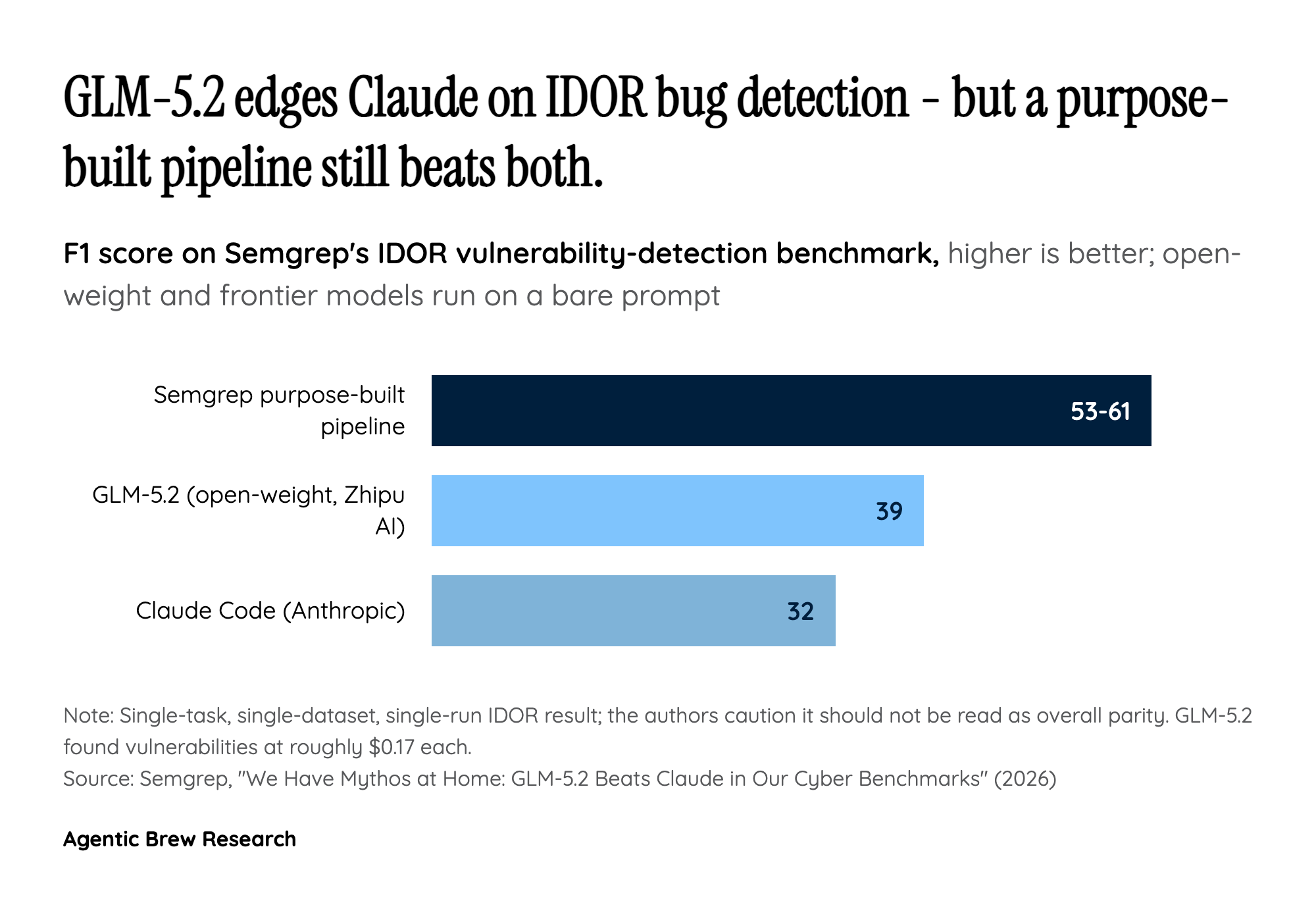
GLM-5.2 scored 39 F1 on Semgrep IDOR detection vs Claude Code 32, though Semgrep purpose-built pipeline reached 53-61.

The headline number is narrow on purpose. On Semgrep's IDOR (Insecure Direct Object Reference) detection benchmark, GLM-5.2 scored 39% F1 against Claude Code's 32%, at about $0.17 per vulnerability found and with no scaffolding - just a bare prompt in a simple harness [1]. But the same benchmark put both models well behind Semgrep's own purpose-built multimodal pipeline, which scored 53-61% F1 with full endpoint enumeration, a reminder that the engineering scaffolding around a model can matter as much as the model itself [1]. The benchmark authors are blunt about the limits: this is one task, one dataset, one run, and they warn it should not be generalized into overall parity - GLM-5.2 might lead on IDOR while the tables turn on a task like SSRF detection [1]. A second independent evaluation from Graphistry, using a CyBT-CTF cyber-investigation benchmark, reportedly reached the stronger conclusion that GLM-5.2 matches Opus 4.8 [4]. Community reception tracked this split. Across developer forums the mood was strongly positive but with a vocal skeptical minority, and the most striking single data point was an unverified, community-reported account of GLM-5.2 surfacing a months-old concurrency bug in under twenty minutes that Opus 4.8, GPT-5.5 and a competing model had all missed - prompting that developer to start auditing other projects for security holes with it. Treated as anecdote rather than proof, it is the clearest signal yet that the bug-finding capability shows up in real codebases, not just leaderboards.

The real threat is to price, not just to parity

Strip away the geopolitics and the durable risk is economic. GLM-5.2 reportedly matches or beats GPT-5.5 on several long-horizon coding benchmarks at roughly one-sixth the cost, and Zhipu's GLM Coding Plan is priced at around a tenth of Anthropic's Claude Code and Max tiers [7]. That kind of cost compression incentivizes enterprises to shift budgets toward cheaper open alternatives, and the market noticed: Zhipu's stock surged as much as 48% intraday before closing up 32.8%, leaving it up nearly 820% year-to-date since its early-January IPO [5]. Analysts cast this as a swing at the 'valuation scaffolding' beneath the entire US AI trade - the assumption that frontier capability stays scarce and richly monetizable - with the central question being whether intelligence is becoming cheaper, more portable, and less geographically captive [4]. UBS reportedly estimates Chinese frontier models climbed from about 60% of leading US-model intelligence in 2023 to roughly 90% today [4]. There is a counterweight from the other side: Elon Musk argues benchmark parity is not real-world usefulness, where Anthropic still leads and 'definitely shows up in revenue' [2]. Notably, Zhipu says GLM-5.2 was trained on domestic Huawei Ascend accelerators rather than Nvidia hardware, suggesting the cost story is built on a deliberately non-Nvidia domestic stack [4].

Dual-use capability and the data-sovereignty trap

An equally good bug finder is, by definition, an equally good bug exploiter. Vercel's Guillermo Rauch cut against the parity hype - noting the circulating numbers come from a narrow Semgrep test rather than a head-to-head with Mythos - but flagged the deeper problem: these cybersecurity capabilities are 'equally useful in an offensive as well a defensive capacity,' and he points teams to the open-source Deepsec harness for defensive scans [2][6]. The offensive edge is that equivalent bug-finding capability in adversary hands threatens US companies unaware of latent vulnerabilities in their own code [6]. A second, quieter risk lives in the convenience path: developers who reach for Z.ai's hosted API rather than running the open weights themselves send their data through a company subject to China's National Intelligence Law, and DHS has warned this could compel disclosure of US persons' or businesses' data [3]. The open weights neutralize export controls; the hosted API reintroduces a sovereignty exposure that the open weights were supposed to let you avoid. Running locally is therefore both the safest privacy posture and, increasingly, a practical one.

Historical Context

2026-04
An earlier DeepSeek shock established the precedent that the cost of 'good enough' intelligence can fall far faster than incumbent US AI valuations assume - the template now applied to GLM-5.2.
2026-06-12
The US government ordered Anthropic to block foreign access to Fable 5 and Mythos 5, citing a jailbreak technique that could expose Mythos cybersecurity capabilities to misuse.
2026-06-13
GLM-5.2 rolled out to GLM Coding Plan members, one day after the Anthropic export ban.
2026-06-16
Open weights released under the MIT license with no regional locks, alongside release notes.
2026-06-22
Semgrep published its 'We have Mythos at Home' cyber benchmark blog showing GLM-5.2 beating Claude Code on IDOR detection.

Power Map

Key Players
Subject

Zhipu AI GLM-5.2 matches Claude in cybersecurity bug detection

ZH

Zhipu AI (Z.ai)

Beijing-based developer of GLM-5.2; released it open-weight under an MIT license as a counterweight to US export controls, with its GLM Coding Plan priced at roughly a tenth of Anthropic's Claude Code/Max tiers.

AN

Anthropic

Maker of Claude Mythos 5 and Fable 5; ordered by the US government to block foreign access on national-security grounds, making it the benchmark GLM-5.2 is measured against.

SE

Semgrep

Security tooling firm that ran the IDOR benchmark showing GLM-5.2 (39%) beating Claude Code (32%) but both trailing Semgrep's own pipeline (53-61%); its authors stress the single-task caveat.

GR

Graphistry

Ran an independent CyBT-CTF cybersecurity evaluation reportedly confirming GLM-5.2 matches Opus 4.8 on cyber investigation tasks.

US

US Commerce Department

Issued the June 12, 2026 export-control directive restricting Anthropic's Mythos/Fable 5 abroad; GLM-5.2's open release exposes the policy's limits.

VE

Vercel / Guillermo Rauch

Next.js and Vercel creator who pushed back on parity hype but flagged dual-use risk, pointing teams to the open-source Deepsec harness for defensive scans.

Fact Check

9 cited
  1. [1] We Have Mythos at Home: GLM-5.2 Beats Claude in Our Cyber Benchmarks
  2. [2] Chinese AI Lab Says It Can Match Anthropic's All-Powerful Claude Mythos at Sniffing Out Security Bugs
  3. [3] AI Export Controls Fail Their First Real Test as GLM-5.2 Cybersecurity Benchmarks Expose the Gap
  4. [4] GLM-5.2 Could Be China's New AI Wrecking Ball
  5. [5] Zhipu AI's Stock Rockets After Chinese Firm Makes GLM-5.2 Open Source
  6. [6] Guillermo Rauch on GLM-5.2 Cybersecurity Parity and Dual-Use Risk
  7. [7] Z.ai's Open-Weights GLM-5.2 Beats GPT-5.5 on Multiple Long-Horizon Coding Benchmarks for 1/6th the Cost
  8. [8] China AI Security: Anthropic Mythos Power and Trump AI Policy Backlash
  9. [9] GLM-5.2: Everything You Need to Know

Source Articles

Top 5

THE SIGNAL.

Analysts

"GLM-5.2 beat Claude Code on IDOR with no scaffolding, but this is a single-task, single-dataset, single-run result that should not be over-generalized to overall parity."

Katie Paxton-Fear, Seth Jaksik, Brenden Noblitt, Erik Buchanan
Semgrep security researchers (benchmark authors)

"Cautions that the circulating parity numbers come from a narrow Semgrep test, not a head-to-head with Mythos, and emphasizes the offensive/defensive dual-use risk while recommending open defensive harnesses like Deepsec."

Guillermo Rauch
CEO of Vercel, creator of Next.js

"Argues benchmark parity does not equal real-world usefulness, where Anthropic still leads and which shows up in revenue rather than benchmarks."

Elon Musk
CEO, xAI/Tesla

"Treats GLM-5.2 as another swing at the assumption that frontier AI capability stays scarce and richly monetizable, with the key risk to US AI valuations being rapid cost compression and intelligence becoming cheaper and less geographically captive."

Stephen Innes
Markets analyst, Investing.com

"Called GLM-5.2 the first open model good enough to use as a primary daily-driver model."

Matt Velloso
Former VP at Meta Platforms and Google DeepMind
The Crowd

"This is the moment Chinese AI beat American AI. One of the largest public crypto companies in the world just DUMPED OpenAI and Anthropic. Coinbase switched to open-weight Chinese models from Zhipu and DeepSeek, and shaved nearly 50% off the company's internal AI spending. The https://t.co/EStCy2285Y"

@@Ric_RTP1128

"GLM-5.2 can now be run locally!🔥 The 2-bit model retains ~82% accuracy after we shrunk it from 1.51TB to 238GB (-84% size). Run on a 256GB Mac or RAM/VRAM setups. GLM-5.2 is the strongest open model to date. Guide: https://t.co/bI7FeeKHDd GGUF: https://t.co/BMkxswdj5N https://t.co/qIPuU63W9D"

@@UnslothAI7359

"1-bit GLM-5.2 GGUF vs. Claude 4.8 Opus vs. GPT-5.5 We gave 3 models the same prompt and compared one-shot outputs. The 1-bit GLM-5.2 GGUF ran locally on a Mac Studio M3 Ultra with 256GB RAM at ~21.6 tok/s. Which output do you like best? GGUF: https://t.co/BMkxswdj5N https://t.co/UoXsCSh4Gn"

@@UnslothAI3557

"GLM 5.2 via Claude Code is the first non-Claude model that feels close to Opus"

@u/nseavia71501285
Broadcast
GLM 5.2 in Claude Code is Blowing My Mind

GLM 5.2 in Claude Code is Blowing My Mind

GLM-5.2 is Basically Opus (For 1/5 the Price)

GLM-5.2 is Basically Opus (For 1/5 the Price)

GLM 5.2 is my new favorite model...

GLM 5.2 is my new favorite model...